Балкански 2006, Теория — Задача 2. Blood circulation
Concours Général de Physiques “Minko Balkanski” 20 mai 2006 · 20 май 2006 г.
Указания
The two problems are completely independent and can be treated in any order.
The clearness, the quality and the precision of the work, which must be written in English, will form a very significant share of the final note.
The duration of the composition is 4 hours.
Условие
In this part of the problem, one is interested in blood circulation in the arteries. An artery is modelled by a pipe of radius r and length, with a flow Q of blood. When the blood passes through pipe, the fluid is exposed to a force of viscous friction on against the wall. This force is responsible for a fall of pressure ΔP between the two ends of the artery. We can thus define a viscous resistivity .
It can be shown that there is an equivalence between this hydrodynamic circuit and an electric circuit with the proviso of associating a current I to the flow Q, a tension U to the fall of pressure ΔP and a resistance R to the hydrodynamic resistance .
1. Write down Ohm's law for one artery.
2. Determine the power provided by the heart. Take Q = 5 l/min and ΔP = 100 mmHg.
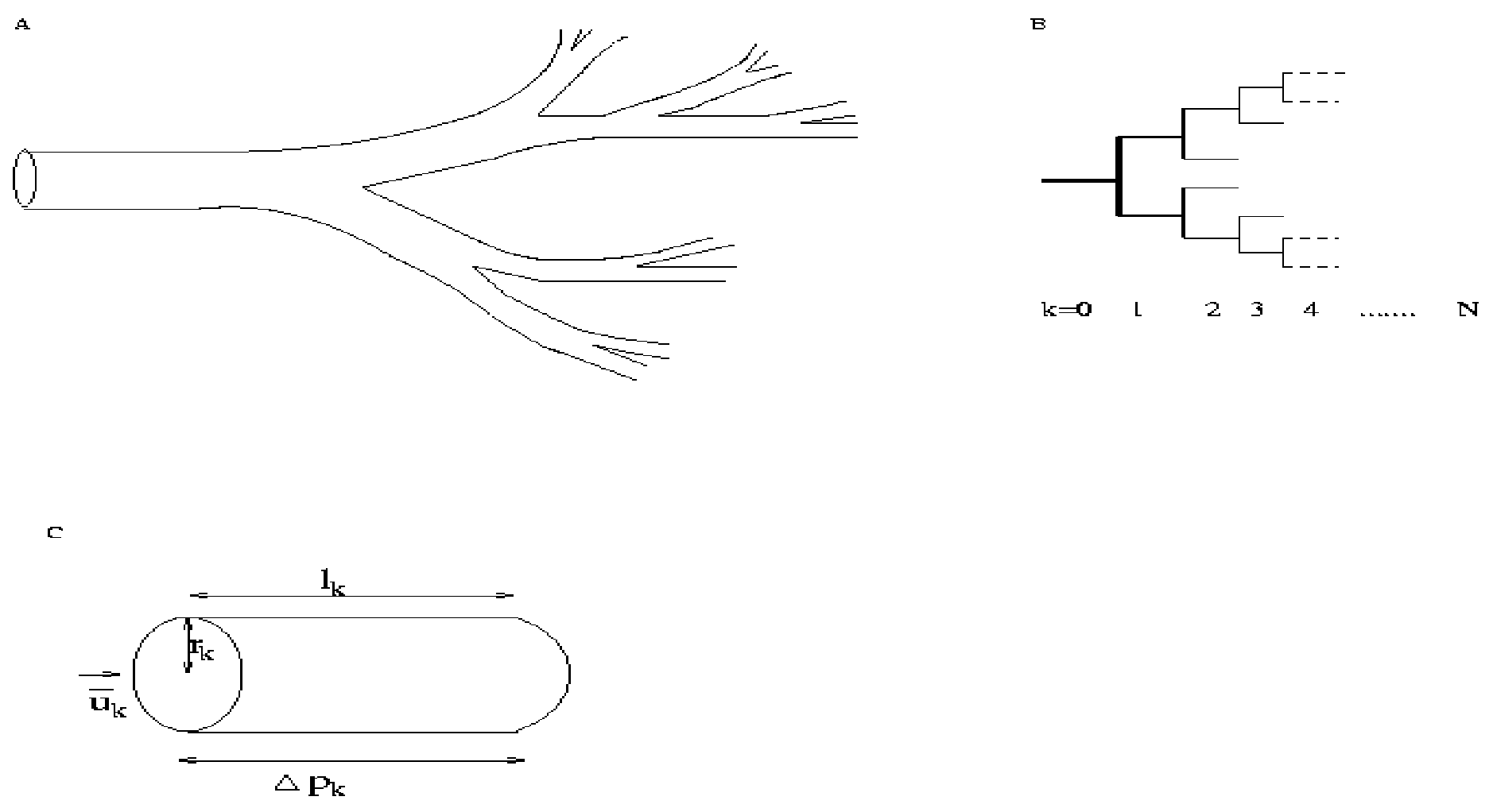
A network of arteries is considered: each artery of the order k is divided into arteries of order k+1 and of diameter smaller than that of the artery from which they result. The aorta will indicate the artery of order 0; the smallest ramifications i.e. the last generation of arteries will be indicated as capillaries. A typical artery of a level of division k has a length , a radius and a fall of pressure (figure 4). The flow in an artery is defined as the product of the surface of a section of the artery and the mean velocity of the fluid in that section, i.e. .
3. Determine the total number of arteries in the generation k?
4. Schematically, write down the law of conservation of flow?
We shall consider the scale factors and . We shall suppose that these scale factors do not depend on k, that is to say: , et .
5. How does vary with respect to n?
By considerations which won’t be detailed here, one can determine the variation of γ in function of n, .
We will try in the following questions to determine by another method the way in which and vary with n.
6. Write down the total volume of the network (the volume of the blood) as a function of n, β, γ, N et . N is the total number of generations and is the volume of the aorta. Simplify this relation when and . It is the simplified relation which will be used from now on.
The flow in the system is supposed laminar, and in this case the hydrodynamic resistance of an artery is given by Poiseuille's law , where is the dynamic viscosity of the fluid.
7. Determine the resistance of the whole network according to n, β, γ, N and the total resistance of the aorta . Simplify this relation when , et .
8. By making an analogy with Ohm's law determine cardiac expenditure Wc, which is, the power provided by the heart to overcome the viscous forces.
If the circulatory system is examined, keeping in mind the idea of economy, one is convinced easily that there are two antagonistic principal factors: if the artery is too small, the work necessary to make the blood circulate will be too significant (as described by Poiseuille's law), on the other hand if the volume of the vessel is too large, the volume of the blood which is stored in it will be a burden to the entire body. Determine thus the most advantageous situation in order to minimize the function , where b is a dimensional constant.
9. Determine the variation of and according to n. Compare those to the resulting ones previously obtained.
Now we shall consider now the distribution of the pressure along the arterial tree.
It was seen previously that when considering all the arteries of a given generation, one can replace them by an equivalent artery. As a consequence, the whole arterial network will be equivalent to a circuit of arteries in series. In what follows all the arteries shall be taken with the same thickness D and the same Young modulus E.
Recall: The Young modulus is defined as a pressure and it reflects the elastic properties of material.
10. Find a relation between the average pressure in an artery – P, E, d and the radius r of the artery. The pressure outside the vessel is considered equal to zero.
11. By using Poiseuille's law, determine the variation (decrease) of the average pressure in the arterial tree with respect to the length.
12. This law gives a rather good approximation for the pressure with respect to the length, but it does not give a correct relation between the pressure and flow at all. Do you have an idea why?
Решение
Внимание: Непълно решение
В архива няма официално решение на тази задача.
Оригинал в Архива: CGP_2006_en.pdf