Балкански 2008, Теория — Задача 1. Flat water!
Concours Général de Physiques « Minko Balkanski » — 17 May 2008 · 17 май 2008 г.
Указания
The main problem and the three exercises are completely independent and can be solved in any order.
All the answers must be given in English or French. The clarity and precision will be taken into account for the final note.
The exam is 4 hours long! The calculators are authorized.
Условие
The main goal of this problem is to obtain numerical values. An analytical expression of the result as a function of the given parameters should be given, but it’s just a bypass to the final solution.
The surface tension, or interface energy, or surface energy is defined as energy per unit area:
This effect allows for example insects to walk on water and explains the capillary. The surface tension also explains the formation of soap bubbles.
Here we do not take into account the interaction between the liquid and the surface on which it is fixed. It is assumed that the liquid does not wet the surface and the bottom-side of the drop is a liquid-air interface. This situation is observed in the case of a drop of water on a hot plate or on a hydrophobic surface (duck feathers, lotus leaf, etc.).
1. Capillary length.
1. a) What is the dimension of (called surface tension)?
1. b) Using , (mass per unit volume) and g (acceleration of gravity) construct a quantity having a dimension of a length. We will call this length «capillary length».
1. c) What is the capillary length of the water?
2. The small droplets.
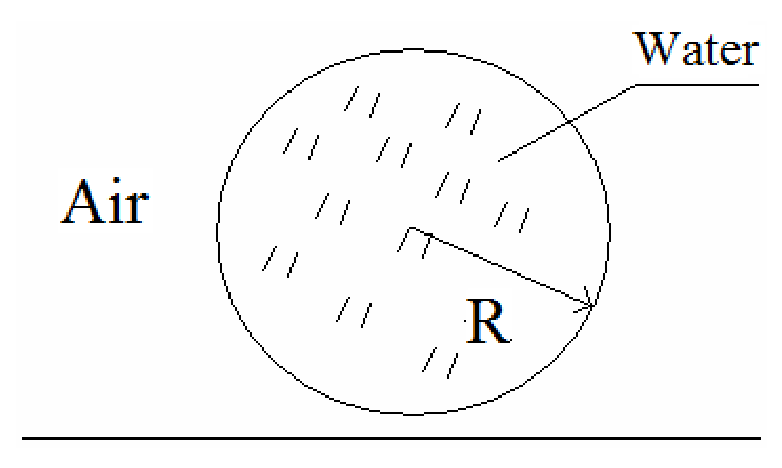
2. a) Considering one small droplet give the expression of the surface energy and the energy of gravitation as a function of the radius of the droplet (R), the acceleration of gravity (g) and the mass per unit volume of the water ().
2. b) What is the condition, on the radius of the droplet, to have its size essentially dictated by the capillary forces?
3. The big drops.
Here the drop is sufficiently large to be considered as « puddle » flattened by gravity (thickness e and radius r, with ).
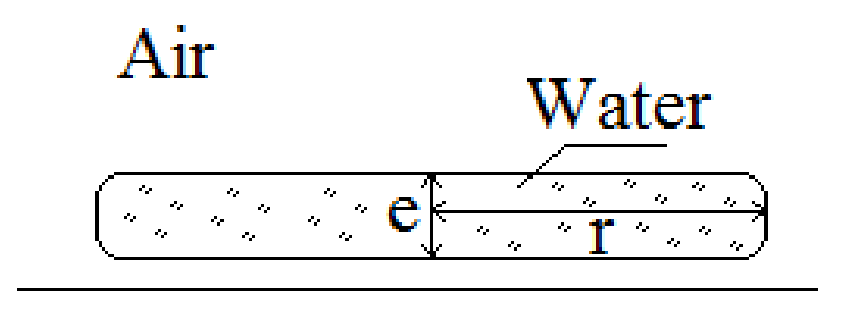
3. a) Estimate the total surface of the drop, the surface energy and the gravitational energy, as a function of r, e, , g and .
3. b) Minimizing the total energy, determine the thickness of the puddle.
4. Give the relationship between the volume V of the drop and its apparent diameter d, viewed from above, in the case of small drops and big drops. Sketch the function .
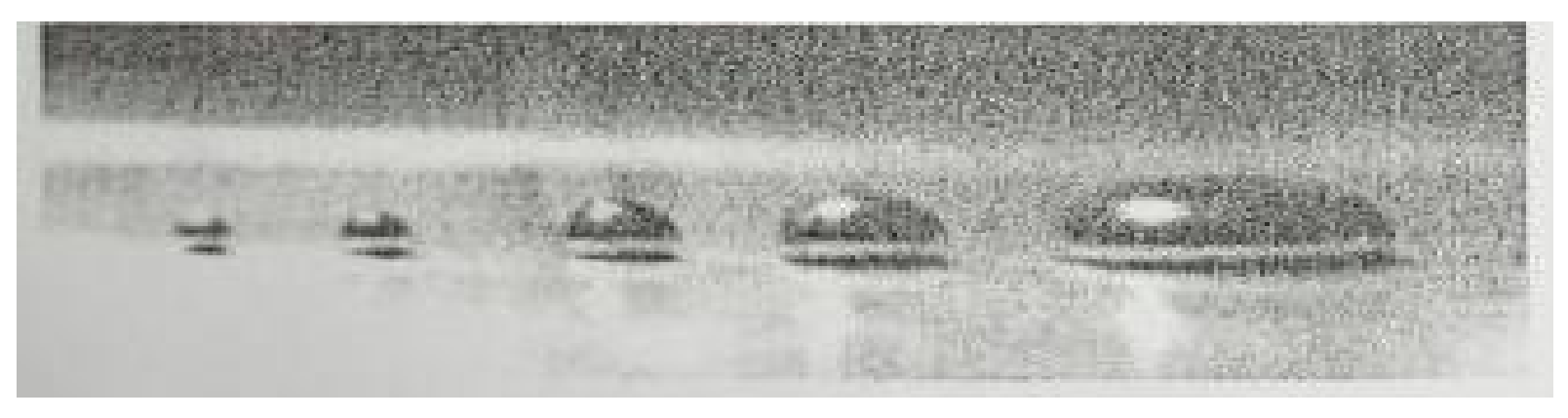
5. Using figure 1, estimate the «capillary length» and the surface tension of the mercury.
Решение
Внимание: Непълно решение
В архива няма официално решение на тази задача.
Оригинал в Архива: CGP_2008_en.pdf