Балкански 2009, Теория — Задача 1. Some aspects of the astronautics
Concours Général de Physiques « Minko Balkanski » · 16 май 2009 г. · 12 т.
Указания
The main problem and the two exercises are completely independent and can be solved in any order.
All the answers must be given in English or French. The clarity and precision will be taken into account for the final note.
The exam is 4 hours long! The calculators are authorized.
Условие
The main goal of this problem is to obtain numerical values. An analytical expression of the result as a function of the given parameters should be given, but it’s just a bypass to the final solution.
I – Propulsion by reaction.
In this part we will study the principle of propulsion. To this end, we will consider a board with wheels or a trolley on which we have a machinist and n sacks filled with sand and of individual masse m everyone. We neglect all dissipative effects. In order to simplify the expressions, we will also neglect the masse of the trolley and the machinist itself compared to the masse of every sand-bag. The referential system R, attached to the Ox axis is galilean.
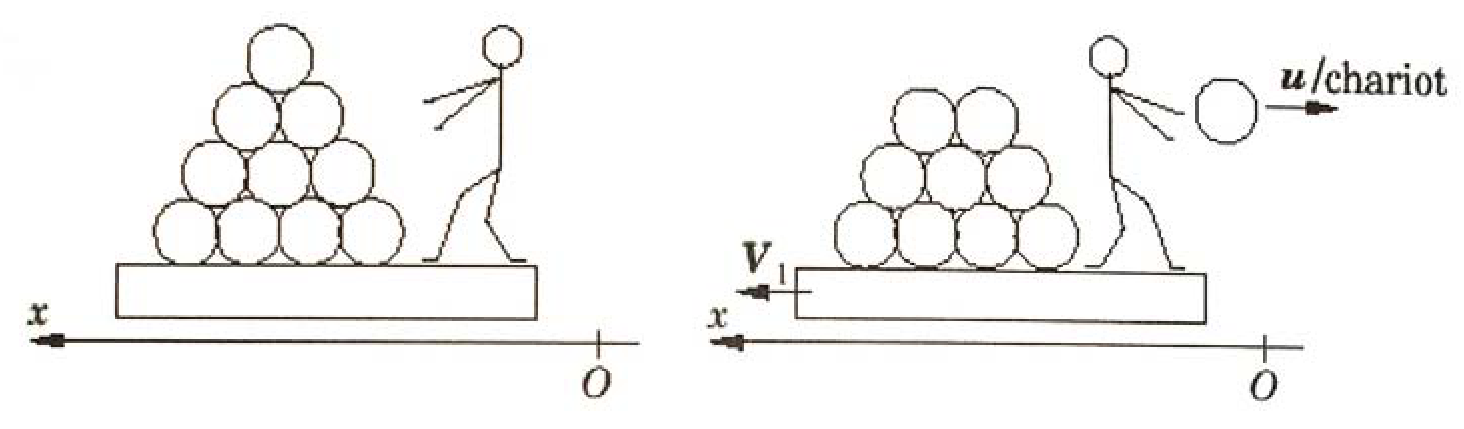
I.A At time , the operator throw out the first sack of masse , with speed compared to the speed of the board! Show that, in the referential attached to the ground (to the axis), the impulsion of one system (which you should define precisely) is conserved. Using this general property, find the speed (evaluated in ) of the trolley and all that is on it, after this first throw.
Every symbol in bold should be considered as a vector variable.
I.B At time , the machinist throw out a second sack, with speed compared to the speed of the board! Evaluate the speed (in ) of the trolley and all that is on it, after this second throw. Show that it could be rewritten as . Define the studied system.
I.C Establish the expression of the speed of the trolley, always evaluated in the referential , after the -th throw effectuated at time , as a function of and . Define the studied system.
I.D Establish the expression of the average acceleration of the trolley during a period of time including the -th throw (for instance, between and ) as a function of and (in ).
I.E We call the “outflow of masse” or “masse debit”, which is the masse thrown out of the trolley per time unit. Express as a function of and .
I.F Show that the system trolley and all that it contains after the -th throw seems to be exposed, during a period of time including the throw, to a pushing force average that you should express as a function of and .
II – Propulsion by a rocket engine.
Now, we will study of a total masse (at the moment ) and speed in a galilean referential ; we suppose that the “outflow of masse” of the effected gas is constant and that the speed of ejection is in the referential attached to the rocket. All the external forces are represented by one force noted .
II.A By making a detailed balance of the impulsion of one closed system between the time and , show that , where is a “pushing force”, which expression you should precise by means of and .
II.B We suppose that the rocket is moving in the empty space, we neglect all gravitational forces; the initial and final masse of the rocket is respectively and ; and have the same fixed direction. Give the increase of the speed as a function of and where is the norm of supposed constant.
II.C We define the propulsion efficiency as the ratio of the kinetic energy, communicated to the “useful masse” of a rocket accelerated from a stand still position, to the total energy that is used, defined as , where is the ejected mass between the initial and the final moment. Give the expression of as a function of . Draw as a function of . How can you explain qualitatively the existence of a maximum?
II.D The total initial masse of the rocket Saturn V was , the speed of ejection of the gases was and the take-off acceleration about (). Evaluate the “masse outflow” and discuss.
In all the preceding questions the referential () is attached to the earth.
II.E At , a rocket without initial speed, situated at is ignited. We suppose that the rocket is ascending vertically in a gravitational field (supposed constant), with a “masse outflow” , also supposed constant. The planet is without atmosphere. Find the expression giving the evolution of the speed and the altitude as a function of and . We remind you that .
II.F The radius of the Earth is . The intensity of the Earth’s gravity on the surface is (). Evaluate the potential energy of a masse of 1kg. at rest on the Earth surface, supposing its potential energy at infinity as zero.
II.G The energy produced by the combustion of one kilogram of dioxygen and dihydrogen mixture is less than . In these conditions, is it possible to overcome the gravitation field of the Earth? We ask for a qualitative analysis.
III. – The ionic engine.
The ejection of matter could be done not only by a chemical, but also by an electrical way.
III.A Inside a spacecraft, charged particles of masse and positive charge are accelerated by a potential and after that ejected outside the spacecraft. Suppose that is the ejected “masse outflow”. Express the “pushing force” as a function of and .
III.B In the case, where we neglect the gravitational force and the air resistance, evaluate the minimal electric power that the engine should supply, so that the acceleration of the spacecraft is . should be expressed as a function of and the total instant masse of the spacecraft at the.
III.C Numerical applications: The engine NSTAR in the probe Deep Space One, launched on 24 October 1998, had the following characteristics:
- Accelerating tension:
- Consumed electrical power by the engine:
- Ejected particles: ions Xenon, charge (, the molar masse of Xenon is , the elementary electrical charge is )
- Pushing force:
Calculate the ratio in two different ways. Is the provided data consistent? (an answer limited to “Yes” or “No” will be considered insufficient)
Решение
Внимание: Непълно решение
В архива няма официално решение на тази задача.
Оригинал в Архива: CGP_2009_en.pdf