Балкански 2012, Теория — Задача 1. Charged droplets; Rotation of a copper ring; Bicycle pump
Concours Général de Physique “Minko Balkanski” · 6 май 2012 г.
Указания
The main problem and the two exercises are completely independent and can be solved in any order.
All the answers must be given in English or French. The clarity and the precision of expression will be taken into account in the attribution of the final note.
The exam is 4 hours long. The calculators are authorized.
Условие
Physical constants:
- Surface tension of the oil:
- Vacuum permittivity:
- Elementary charge:
- Atmospheric pressure:
- Perfect gas constant:
- Avogadro’s number:
- Speed of light:
- Earth’s magnetic field:
- Density of cooper:
- Resistivity of cooper:
- Angle between and the horizon:
Part I
Charged droplets (10pts)
The charge of the electron was measured for the very first time in 1909, by Robert Millican. In his experimental set up, he was observing the speed of propagation of charged oil droplets. Measuring the forces applied to the droplets, he proved that the charge in each of them was a multiple of , which he later associated with the elementary charge of the electron.
In this problem, we will try to estimate under which conditions a fog (cloud) of charged oil droplets is stable. We will take into consideration two types of potential energies, one due to the charge of the droplet (electrostatic energy) and another one related to the cohesion of the droplet (surface tension energy). The second one is written as , where is the surface of the droplet and the surface tension of the oil.
1 Stability condition
We will focus on one charged oil droplet suspended in the air.
I.1.1 What is the distribution of the charges? What happens if the droplet is sufficiently charged? (1pts)
I.1.2 Calculate the total energy of the droplet. (2pts)
I.1.3 What is the pressure inside the droplet? (1pts)
I.1.4 Show that if the droplet is small and its charge higher than a certain threshold it will burst. Propose a stability criterion. (1pts)
2 Fragmentation of a droplet
In the previous part of the problem, we assumed that the droplets were spherical. Nevertheless, when their radius becomes smaller and smaller, the forces deform the droplets. In this part, we will try to characterize their instability by employing an energy model. When a droplet becomes unstable it fragments itself into small droplets; we would like to find the number, the size and the charge of theses droplets. To simplify, we will use the same spherical geometry of the droplets, but all reasoning will be based only on the energy approach.
I.2.1 Which are the conserved quantities? Write down the conservation equations. (0,5pts)
I.2.2 Calculate the total energy of the system . (0,5pts)
I.2.3 Show that the configuration, which minimizes the energy, is the one where the charge of each droplet is proportional to its radius and all the droplets have the same size and charge. You could investigate the variations of the sizes and the charges of the droplets separately. (2pts)
I.2.4 Calculate the size of the droplets and their charge. What is the total energy of the system as a function of the number of droplets? (0,5pts)
I.2.5 Find out the number of droplets. (1pts)
I.2.6 Finally, we would like to use the assumption that the total charge could be only a multiple of . Numerical application: What is the smallest size of a droplet with charge ? (0,5pts)
Part II
Exercices (10pts)
Rotation of a copper ring Rotation of a copper ring (5pts)
A circular ring of thin copper wire is set rotating about a vertical diameter at a point within the Earth’s magnetic field. The magnetic flux density of the Earth’s magnetic field at this point is directed at an angle of below the horizontal. Given that the density of copper is and its resistivity is , calculate how long it will take for the angular velocity of the ring to halve. This time is much longer than the time for one revolution.
You may assume that the frictional effects of the supports and air are negligible, you should ignore self-inductance effects, although these would not be negligible. [5 т.]
Bicycle pump (5pts)
A reservoir, with a total volume , contains air (considered an ideal gas) at an atmospheric pressure . We could increase this pressure by pumping air using a motor driven piston, which glides without any friction into a cylinder. The maximum free volume in the cylinder is (the piston is at the beginning of a stroke, on the left), whereas the minimum volume of the cylinder is (the piston is at the end of a stroke, on the right).
During the backward movement (from right to left), both valves and are closed, then opens when the pressure of the air inside the cylinder becomes greater than the atmospheric pressure ; the air from outside is sucked up. (see upper part of the figure)
During the forward movement (from left to right), closes; the air inside the pump is compressed, then opens whenever the pressure of the air inside the cylinder becomes bigger than the pressure inside the reservoir; the air from the cylinder is displaced into the reservoir. (see lower part of the figure)
We will admit that during all the previous transformations the air passes through a continuum of equilibrium states at constant temperature.
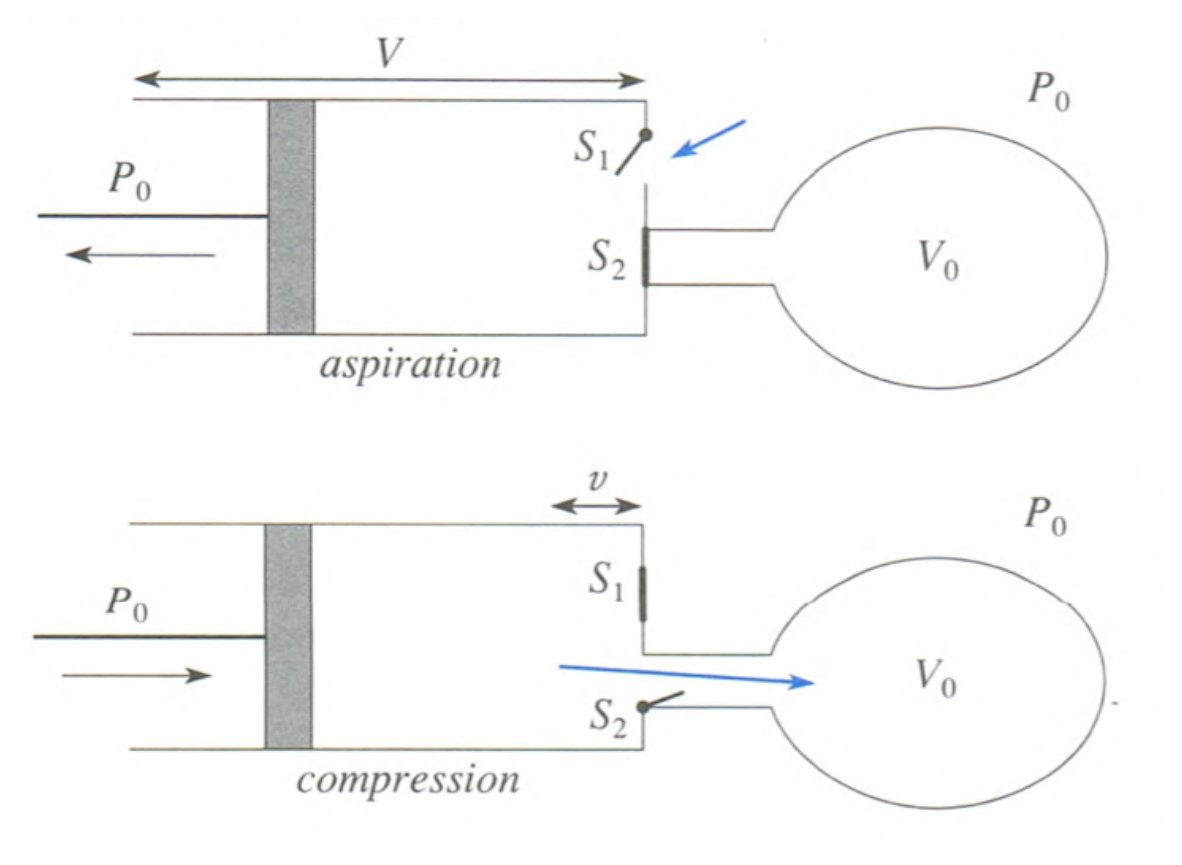
Bicycle pump 1.(a) Calculate the pressure of the air inside the reservoir after strokes of the piston.(1pts)
Bicycle pump 1.(b) What is the limit value of for large ? Find the pressure , by using your physical intuition and without passing through the intermediary phases.(1,5pts)
- Let us suppose that .
Bicycle pump 2.(a) Write down the expression of the pressure as a function of , , and k.(1pts)
Bicycle pump 2.(b) Calculate the mechanical work of the motor that operates the piston after strokes.(1,5pts)
Решение
Внимание: Непълно решение
В архива няма официално решение на тази задача.
Оригинал в Архива: CGP_2012_en.pdf