Балкански 2026, Теория — Задача 2. How an Asteroid Forms Its Core
Concours Général de Physique «Minko Balkanski» · 31 юли 2026 г. · 10 т.
Прочетете внимателно!
Част първа и част втора съдържат условията на задачите съответно на френски и английски език. Единствените външни документи, на които имате право, са френски и английски речници. Употребата на калкулатори е позволена.
При оценяването на задачите голяма тежест ще имат яснотата и стилът на изложените решения и аргументация. Не използвайте излишна проза в аргументите си, бъдете кратки, точни и ясни. Използването на схеми за онагледяване на разсъжденията Ви е желателно. Пишете само на езика, който сте избрали (френски или английски).
Задачите носят еднакъв брой точки. Разпределяйте времето си разумно: ако се затрудните на даден въпрос или задача, можете спокойно да продължите нататък и да се върнете към него по-късно.
Разполагате с 4 часа. Успех!
Условие
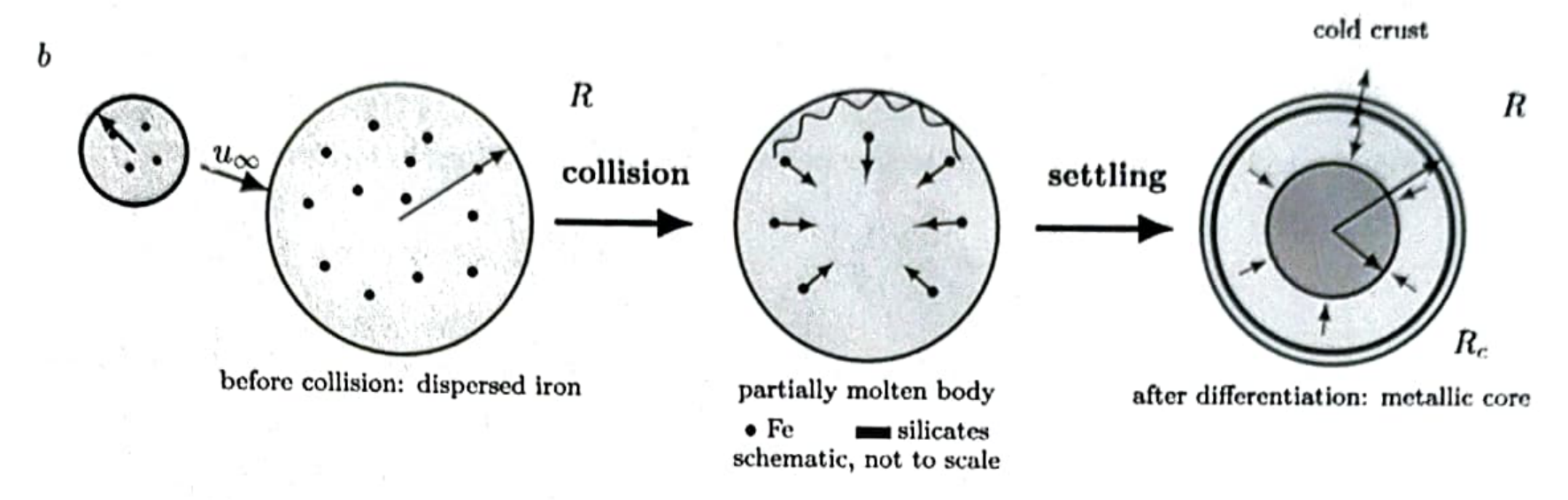
We study a fictitious spherical asteroid called Balkania. It is initially homogeneous: iron is uniformly dispersed in silicate material. A collision heats it and produces partial melting. Iron droplets may then sink and form a metallic core. The model is deliberately simplified; any additional assumption must be stated clearly.
Subparts marked are more difficult. They may be left for a second pass; no later question depends on them unless the required result is supplied again.
Data for Balkania.
| Initial radius | |
| Initial iron volume fraction | |
| Silicate density | |
| Iron density | |
| Mean specific heat capacity | |
| Initial temperature | |
| Onset-of-melting temperature | |
| Effective latent heat of melting | |
| Thermal diffusivity | |
| Surface emissivity |
Collision. The impactor is spherical, has radius , and has the same composition and mean density as Balkania. Its speed at infinity is . Balkania is treated as fixed during the approach. The collision is perfectly inelastic: the bodies remain joined. A fraction of the kinetic-energy loss during the collision is converted into uniform internal energy of the merged body; mass loss is neglected.
Iron droplets. Their radius is . The dynamic viscosity of the molten silicate is .
I. Impact heating and partial melting
1. Determine Balkania's mean density . Then calculate the iron mass fraction.
2. Let be the mass of Balkania and the mass of the impactor.
2. a) Calculate , , and the ratio .
2. b) Using conservation of the impactor's mechanical energy during the approach, show that
where is its speed just before contact. Calculate and comment on the importance of gravitational acceleration.
3. Let be the common speed of the two bodies immediately after the collision.
3. a) Using conservation of momentum, express . Show that the kinetic-energy loss during the collision is
3. b) Show that the deposited energy per unit mass of the merged body is
and calculate it.
3. c) The energy first heats the body to . The remaining energy causes melting at approximately constant temperature. Determine the molten fraction . Iron droplets can move when . Does the collision trigger differentiation?
3. d) Neglecting gravitational acceleration during the approach, determine the minimum impactor radius required to reach exactly .
II. Sinking of iron droplets
In Parts II–IV, to keep the model analytically simple, use Balkania's initial values and and neglect the mass increase caused by the impactor. The gravitational field is approximated by that of the initial homogeneous sphere of density . You may use the result that a homogeneous spherical shell produces no gravitational field at an interior point.
4. At a distance from the centre, show that the gravitational field strength is
Calculate the surface acceleration .
5. After differentiation, all the iron forms a pure spherical core of radius . By conserving the total iron volume, determine .
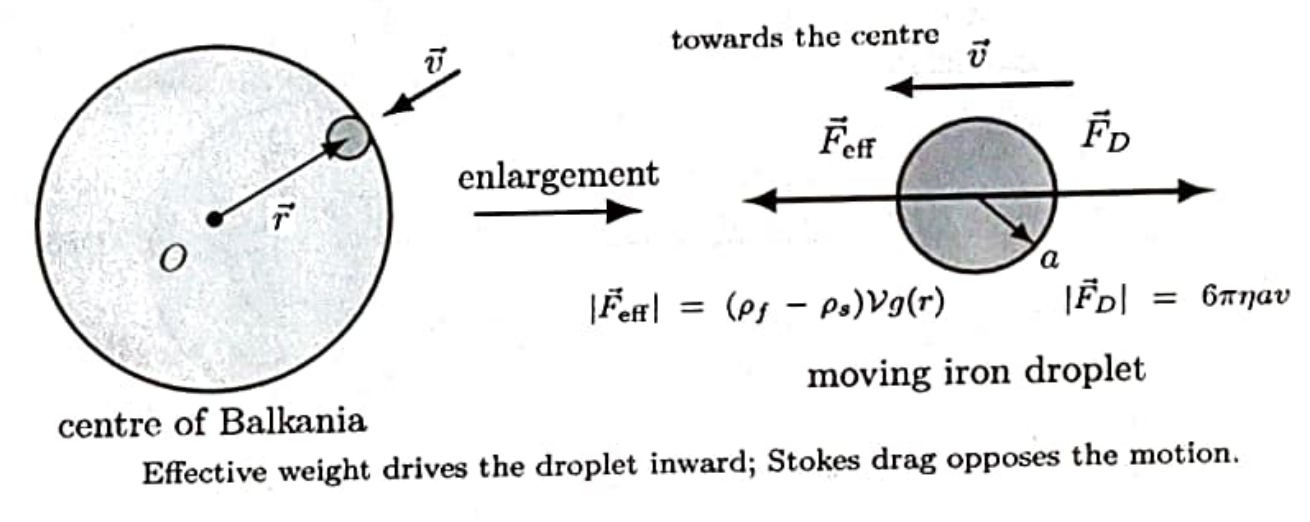
6. An iron droplet of volume is at distance from the centre.
6. a) Taking account of weight and buoyancy, show that the inward resultant force has magnitude
6. b) At low Reynolds number, the Stokes drag force has magnitude . Assuming terminal speed, show that
6. c) Calculate . Check the consistency of the Stokes regime using
7. Over a very short time interval, take the position and hence as constant. Establish the equation of motion of a droplet released from rest in the form
Express and calculate . Estimate the distance and justify the terminal-speed assumption used in Question 6.
8. Consider a droplet initially at the surface. Since , write .
8. a) Obtain an expression for , then calculate the settling time from to .
8. b) Deduce the dependence of on and . Determine the minimum droplet radius that reaches the core in less than 100 yr, with all other data unchanged.
9. At the end of differentiation, calculate the field just outside the core, neglecting the field of the outer mantle. Compare it with the initial homogeneous field . Does the calculation of tend to overestimate or underestimate the actual final settling time?
III. Energy released by differentiation
Assume radial ordering is preserved: the iron initially contained inside a sphere of radius is found, after differentiation, inside a pure iron sphere of radius .
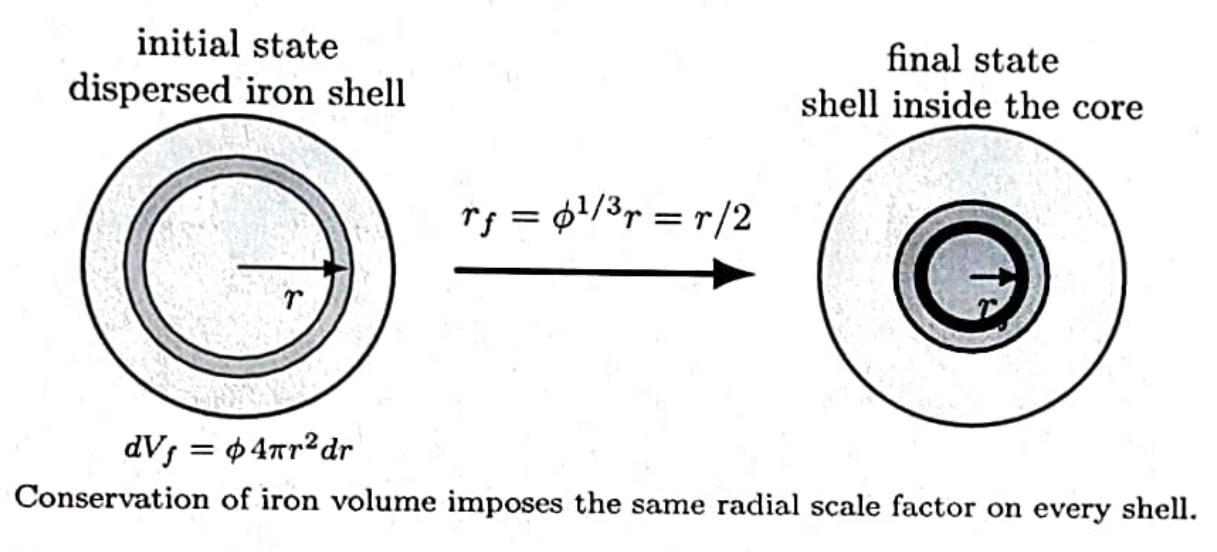
10. Show that .
11. For a small iron volume initially at distance , approximate its displacement as a motion from to in the initial field.
11. a) Show that the gravitational work released per unit iron volume is
11. b) The iron volume initially contained in the shell is . Hence obtain the total released energy,
12. Assume that this energy is fully converted into heat within the asteroid.
12. a) Calculate the mean temperature rise . Compare it with the impact heating.
12. b) Determine the radius for which differentiation alone would produce a mean temperature rise of 100 K, with all other data unchanged. Interpret the result.
IV. Does the asteroid cool too quickly?
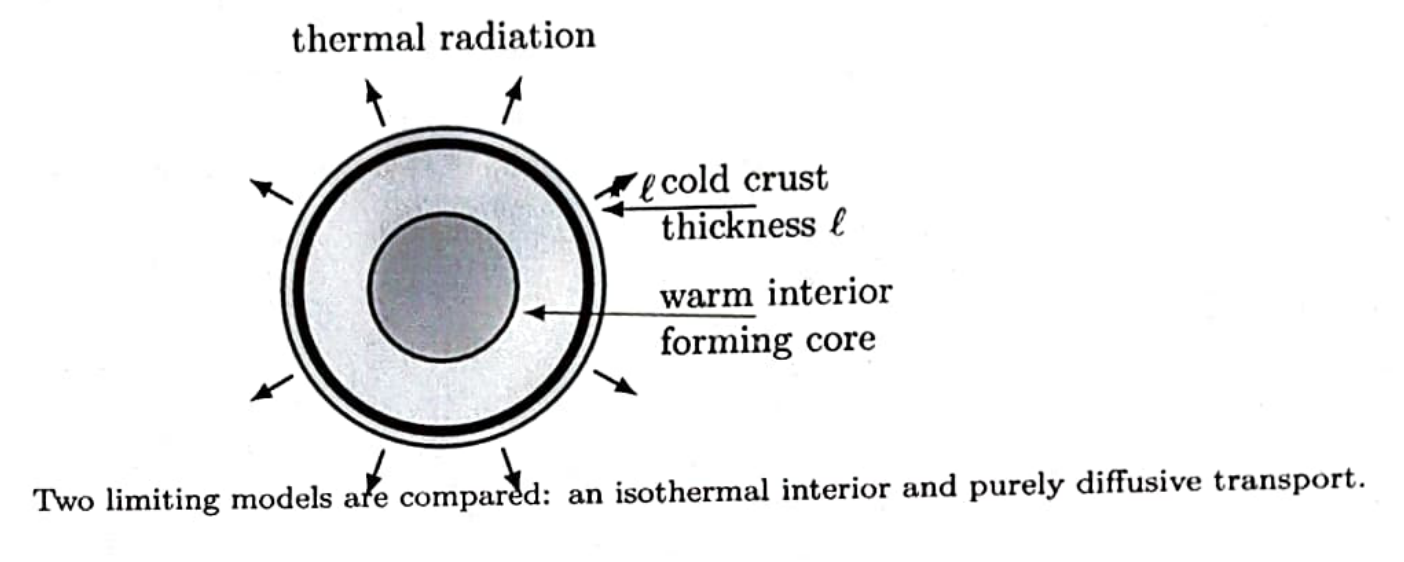
13. At temperature , radiation received from space is neglected.
13. a) Calculate the initial radiated power
13. b) In an isothermal model, the molten fraction first solidifies at . Taking the radiated power as constant and equal to its value in part a), estimate the time required to remove the latent heat .
13. c) After solidification, write the differential energy balance governing when the radiated power varies as . Using the mathematical hints, calculate the time required to cool from 1400 K to 1300 K. Estimate and compare it with .
14. In a solid or a liquid without efficient mixing, heat diffuses over a distance of order
14. a) Calculate during and compare it with . Also estimate the diffusion time across the entire asteroid.
14. b) The exact volume fraction in the surface layer of thickness is
Estimate it, then explain how a cold crust can coexist with an interior that remains partially molten. Conclude whether the core can form within the diffusive model.
14. c) How would very efficient internal convection modify this conclusion? A qualitative discussion is sufficient.
Решение
Внимание: Непълно решение
В архива няма официално решение на тази задача.
Annexe : constantes et relations utiles — Reference sheet : constants and useful relations
Constantes communes / Common constants
Français
Les relations ci-dessous peuvent être utilisées directement. Elles ne remplacent pas le choix et la justification du modèle physique.
Problème I – petites variations et optique
Pour :
Au premier ordre :
Problème II – seuil, équations et intégrales
Pour la question 3d) :
La racine physique vérifie .
Si et :
Si :
Intégrales utiles :
Pour : .
English
The relations below may be used directly. They do not replace the choice and justification of a physical model.
Problem I – small changes and optics
For :
To first order:
Problem II – threshold, equations, and integrals
For Question 3d):
The physical root satisfies .
If and :
If :
Useful integrals:
For : .
Оригинал в Архива: CGP_2026.pdf