EuPhO 2018, Теория — Задача 3. Staircase
EuPhO 2018, Moscow — Theory
Условие
The equilibrium shape of bodies in zero-gravity is determined by the minimum of their surface energy. Thus, for example, the equilibrium shape of a water droplet turns out to be spherical: the sphere has the smallest surface area among bodies of the same volume.
At low temperature, the equilibrium shape of crystals may have flat facets. The parts of the crystal surface that have a small angle with the facet are in fact staircases of rare steps on this facet. The height of such steps is equal to the period of the crystal lattice .
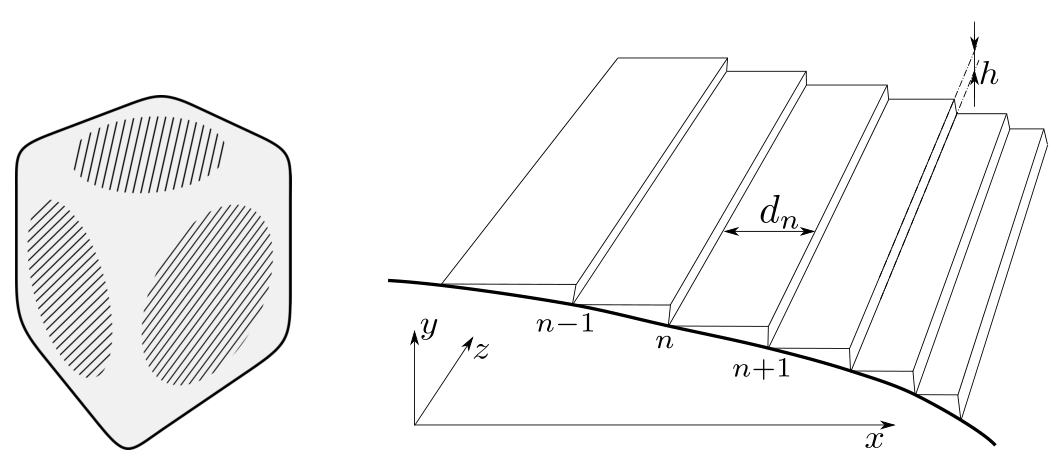
Equilibrium surface profile of a certain crystal and the corresponding microscopic staircase are shown schematically in the figure, where denotes the step number, counting from . The profile shape at can be approximated as , where and .
A. Express the distance between two adjacent steps as a function of for .
B. The interaction energy of two steps depends on the distance between them as
where is a constant. Assume that only adjacent steps interact. Find the numerical value for the exponent .
Отговори
- A.
- B. -2
Решение
A Since , . The distance between the steps is
B Equilibrium energy value, being minimum, must be stable against small perturbations of the crystal shape. Allowed are perturbations which conserve the total volume of the crystal. In other words a small horizontal displacement of one step must be accompanied by an equal and opposite displacement of another step.
The energy change associated with a small horizontal displacement of the -th step is
In order for to be zero for arbitrary and it is necessary to require that the factor in the parentheses does not depend on :
Substituting , we get¹:
The interaction energy corresponds to that of two dipoles in 2D:
¹ Trivial solutions and imply that the total energy within given constraints does not depend on the shape of the crystal.
Оригинал в Архива: th_pr.pdf · официални решения: th_sol.pdf