EuPhO 2019, Теория — Задача 1. Ice pellets
EuPhO Riga | LATVIA 2019 — Theoretical Problems Text for Student: COM-A1
Условие
An interesting weather phenomenon can occur when the temperature profile in the atmosphere shows an inversion. The solid blue line in figure 1 shows such a temperature profile. The inversion occurs at heights between and .
Under these conditions snow falling through the atmosphere (partially) melts in the warmer layer and (partially) freezes again before reaching the ground in the form of “ice pellets”.
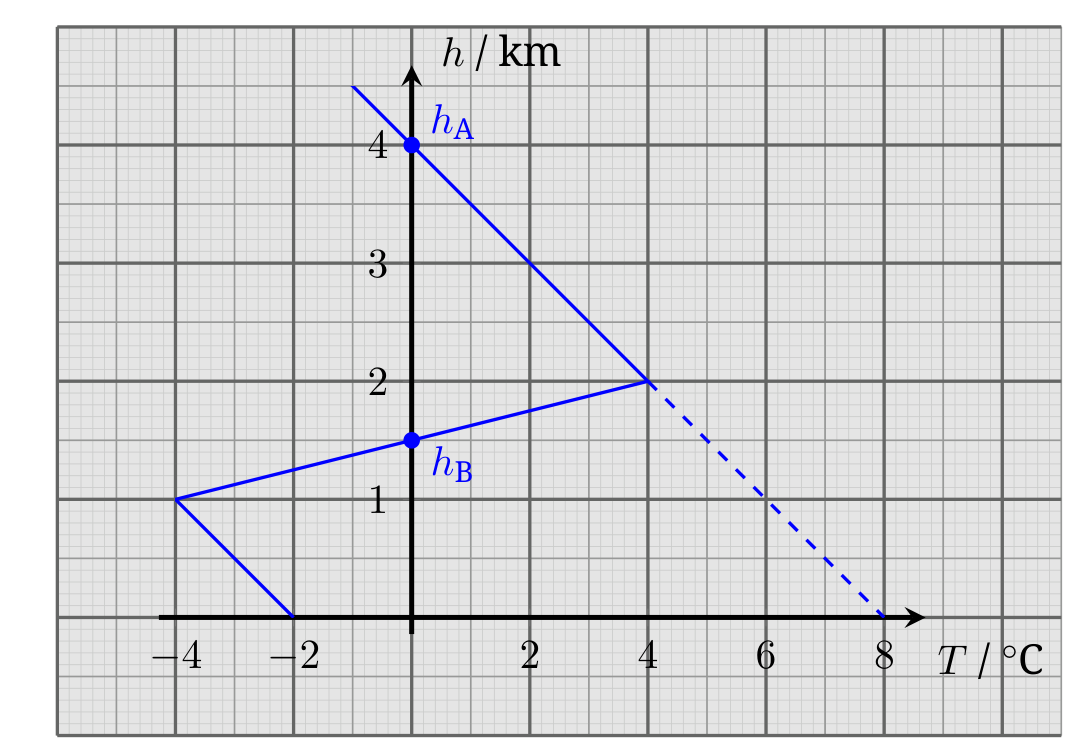
Assume that a small, spherical ice droplet almost completely melts while falling through the atmospheric layer between and where the temperature is above freezing point.
a. Determine the mass fraction of the droplet that freezes before reaching the ground.
b. Find, as precisely as possible, the temperature of the droplet at ground level if there were no inversion and the temperature profile followed the dashed line below a height of .
Neglect evaporation, condensation and size changes of the droplet. Assume that water and ice have very high thermal conductivity and that the density of the atmosphere is constant with height.
Use for the the specific heat of water and for that of ice. The specific latent heat for the melting of ice is .
Отговори
a. 0.8
b. 7.9 °C
The official solution gives ; including viscous dissipation it gives .
Решение
a. With the given assumptions of constant droplet size and constant atmospheric density the drag force leads to a constant velocity for the fall of the droplet through the atmosphere.
We can assume that the droplet temperature above follows the atmosphere temperature profile (also see below) and remains constant and equal to during the melting below that height.
For small temperature differences the heat exchange rate is proportional to this difference . The factor depends on the droplet geometry and its velocity, as well as on the air density. Since these are constant .
In the region between and the droplet is therefore heated at a rate
The total heat transfer between and is
where is the area between the temperature curve and the height-axis in the region between heights and . The right hand side equates the heat with the latent heat necessary to completely melt the ice droplet of mass .
In the region below the liquid droplet partially freezes again. During this process the temperature is again constant. The mass fraction of liquid freezing before reaching the ground can again be derived from the area between the curve and the height-axis.
Dividing (3) by (2) gives the mass fraction
b. If the temperature profile follows the dashed line the droplet will completely melt and the heat transferred from the atmosphere will heat it up. Since the latent heat of melting is much bigger than the specific heat of water times some degrees of temperature variation the temperature of the liquid droplet will closely follow the temperature of the atmosphere eventually. Its temperature at ground level should therefore be close to .
For a better estimate let us introduce a new coordinate whose origin is at the height, where the droplet is completely molten (somewhat higher than ), and which is oriented downwards. For the change in temperature of the droplet we then have
where the temperature of the atmosphere is given by .
For the difference between the atmospheric temperature and the droplet temperature we have:
This differential equation is solved by
where . From equation (2) we find that such that . Therefore the exponential factor in the above equation is negligible at ground level (the constant is close to ) and we arrive at a temperature difference between the droplet temperature and the atmospheric temperature at ground level of
Another phenomenon, which effectively shifts atmosphere temperature as it is “felt” by the droplet is due to viscous dissipation. It can be estimated by equating the droplet potential energy loss rate to thermal power carried away by the circumfluent air . This gives . If both corrections were taken into account, then the droplet temperature before hitting the ground would again be .
Оригинал в Архива: th_pr.pdf · официални решения: th_sol.pdf