EuPhO 2020, Експеримент — Задача 2. Black box
EuPhO-2020 Online. Experimental Problems. Language: English
Условие
2.1 Introduction
You have a rigid mechanical black box consisting of a container of mass . Inside the container there is a load of mass that hangs on an effectively massless spring of stiffness from the ceiling of the box. Another mass is hanged to the mass via another massless spring of stiffness . There is a small viscous drag which depends on the velocity of the objects. The gravity of Earth is and is parallel to the sides of the box.
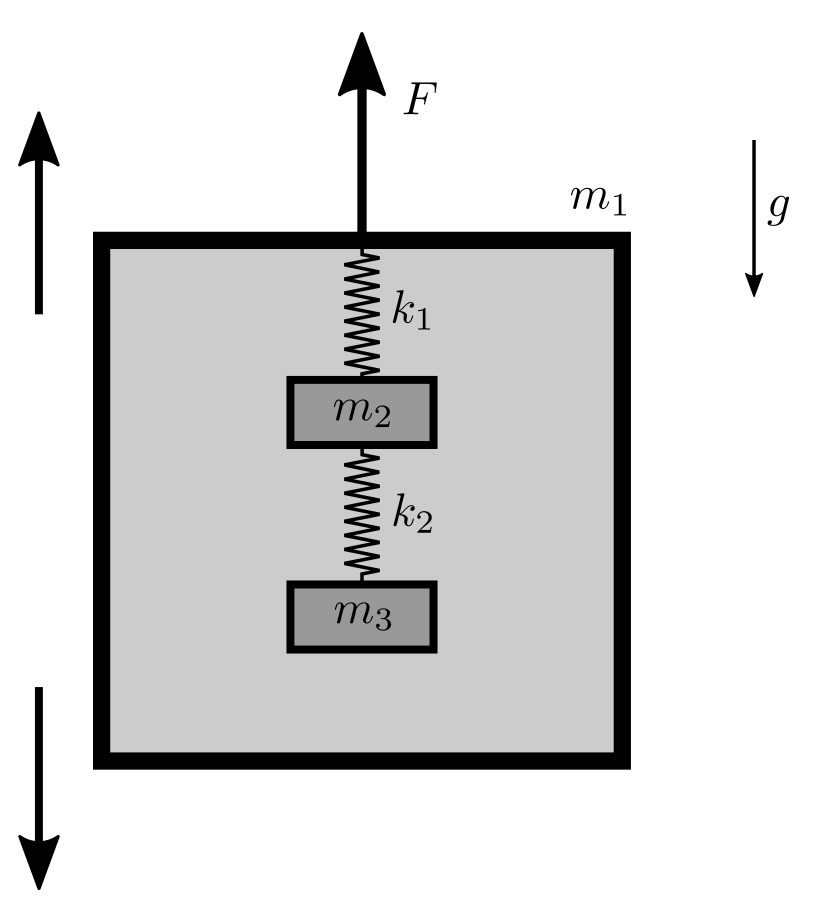
The box can be moved up or down with a piece-wise constant acceleration. The acceleration pattern can be programmed through input by giving the duration (in seconds) and acceleration (in ) for each step. The simulation shows in ”real time” the force exerted to the box that is needed to maintain the given acceleration at the current moment of time, together with the reading of time. The simulation will also output the readings to a text file in the same folder as the program. All simulations will always start with the same initial configuration for the masses.
Note: Every measurement of force has a small random error. The springs are linear for reasonably small deformations, but nonlinear for larger deformations. The values and are defined to be the stiffness of each spring for small deformations near equilibrium when the box is at rest. Force and acceleration are considered to be positive if they are directed upwards. The side length of the box is m and the box is initially in the middle of a room with height m. An experiment ends automatically if the box hits the ceiling or the floor, or if any of the masses collide with the box or with the other mass. The figure is not drawn to scale.
2.2 Task
The task is to determine all the parameters: , , , , . You do not need to provide an error analysis for these results.
As with all experiments, you must provide clearly labelled tables of data, clearly labelled graphs, and sufficient formulae derivations to make it clear what you have measured, and how you are deriving your results.
2.3 Program Interface
Initially, the program asks for a sequence of input actions. You have the following possibilities.
- Enter two numbers and press return to add a step to the acceleration pattern, for example:
1.5 -0.4The first number should be the duration of the step in seconds (must be a multiple of s) and the second number should be the acceleration in (must be between and ). - Enter
repeatand an integer and press return to repeat actions, for example:repeat 10The integer should be the number of times you want to repeat actions. Every repeat action should end with anendrepeataction (see below). - Enter
endrepeatto end repeating actions. If you start the experiment, all actions betweenrepeatandendrepeatwill be repeated a given number of times. You cannot repeat actions inside another repeat. - Enter
sampleand a number and press return to change the sampling time, for example:sample 0.4The number should be the new sampling time which is the time after which every new reading is output to the text file. The sampling time must be a multiple of s, which is also the default sampling time. - Enter
beginto finish the sequence and start the experiment.
You can also write multiple actions on the same line and then press return. For example, you can enter
sample 0.4 repeat 10 1.5 0.4 1.5 -0.4 endrepeat begin
to start an experiment where you change the sampling time to s and accelerate the box respectively with and ten times.
If you enter an invalid input, you will get one of the following error messages and you can try to enter an action again.
- If acceleration is out of range:
Acceleration is out of range. - If duration of acceleration is out of range:
Duration is out of range. - If sampling time is out of range:
Sampling time is out of range. - If the number of repeat times is out of range:
Number of repeat times is out of range. - If you try to repeat actions inside another repeat action:
Cannot repeat actions inside another repeat. - If you try to end repeat without a repeat action to end:
Cannot end repeat outside repeat. - In all other cases:
Invalid entry.
After you enter begin, the program will ask you for a name for the output file with the prompt
Enter name for output file (e.g. "results"). You should use Latin letters and numbers because some special characters are not allowed.
Enter a name and press return. You are advised to use only Latin letters and numbers for the name. Other characters may or may not be allowed in the filename and in case of an invalid filename the readings will not be saved. The readings will be saved in a .txt file with the given name in the same folder as the program.
After this, the program will display
Begin experiment.
and start the experiment. The program will then display the current time since the beginning of the experiment (Time (s)), measured value of force (Force (N)) and acceleration of the box (Accel (m/s^2)). The readings will be similarly displayed in the text file.
The program will then display one of the following messages.
- If the experiment ended successfully:
Experiment ended successfully. - If the box hit the ceiling:
The box hit the ceiling. Experiment ended. - If the box hit the floor:
The box hit the floor. Experiment ended. - If the masses inside the box collided or one of the masses inside the box collided with the box:
Masses and/or the box collided. Experiment ended.
After the experiment ends, you can start another experiment.
Отговори
m1 = 0.857 kg, m2 = 0.236 kg, m3 = 0.413 kg, k1 = 39.2 N/m, k2 = 22.6 N/m
Exact answers as printed in the official solutions (m1 + m2 + m3 = 1.506 kg).
Решение
Let the tension forces in the two springs be and , respectively. Let the height of the ceiling of the box be and let the heights of the masses be and (we will assume for simplicity that the masses have zero height). Let , , be the respective accelerations. We get the following equations of motion (ignoring all drag forces):
Since the springs are nonlinear, and in general, but we know that for small displacements near equilibrium and .
2.1 Finding
When the system is at rest and at equilibrium, then the force needed to hold the box is the total gravitational force (we can get the same result if we plug in to the equations of motion).
To measure , we find the value of when the box is at rest (). We notice that the force is constant which means that the system is initially already in equilibrium.
After averaging 10 first values we get and
Exact answer: kg.
| Finding | ||
|---|---|---|
| 1a | Notice that when | 0.5 |
| 1b | Measurement for ( N) 0 points for only having a measurement without an idea how to use it | 0.3 |
| 1c | in range kg | 0.2 |
| Total: | 1.0 |
Note: Measurement for is needed for full points, even if is correct. Solutions with raw data missing get 0.7 points. Solutions using implicitly as the sum of masses get 0.2 points from 1c.
2.2 Finding
We get from the first equation of motion that . The spring force depends only on the positions (and is the same at the beginning of every experiment), so the force at the beginning of the experiment depends only on the acceleration.
Therefore, we can measure how much the initial force changes with acceleration to get . We will use maximum acceleration () for highest accuracy. The average of three values is , so
We also conclude that .
(To even increase accuracy, one could compare and and find their difference.)
Exact answer: kg.
| Finding | ||
|---|---|---|
| 2a | or any equivalent equation of motion (max points even if has been incorrectly substituted with ) | 0.5 |
| 2b | Idea that | 0.5 |
| 2c | Using | 0.2 |
| 2d | in range kg | 0.8 |
| in range kg | 0.6 | |
| in range kg | 0.3 | |
| Total: | 2.0 |
Note: Using free-fall () without repeated measurements gets 0 points from 2c. Full points are given if but several measurements are used that give at least as good accuracy overall.
2.3 Finding
2.3.1 Method 1: Change of force after a fast movement of the box
We will quickly accelerate and then decelerate the box (to avoid drag forces). When we change the height of the box quickly and the time is short enough, we can assume that the second mass stays approximately at rest.
(Formally, if , then , therefore . The assumption holds if .)
Therefore, if we accelerate the box with acceleration for time and then with for time , then .
To have the best accuracy we will do two experiments with and , respectively. We will use (smallest time possible). We will also repeat each experiment 5 times. After averaging the results, we get the forces at to be and . Therefore
Exact answer: N/m.
| Finding , Method 1 | ||
|---|---|---|
| 3.1a | Idea to use method | 0.5 |
| 3.1b | Notice that if is small, then | 0.5 |
| 3.1c | Correct formula for | 0.5 |
| 3.1d | At least 3 measurements | 0.1 |
| 3.1e | 0.2 | |
| 3.1f | 0.2 | |
| 3.1g | in range N/m | 1.0 |
| in range N/m | 0.7 | |
| in range N/m | 0.4 | |
| in range N/m | 0.2 | |
| Total: | 3.0 |
2.3.2 Method 2: Change of force while accelerating the box
We will accelerate the box with constant acceleration and similarly as in the previous method conclude that when is small. This method is, however, less accurate than the previous method because drag force is nonnegligible for large values of but the resolution of is small for small values of .
Choosing, for example, , and averaging 5 values gives and and
The answer is larger than the correct answer because the drag force of the box at is approximately .
A better choice would be and . Averaging 5 values gives and and
The drag force has a much smaller effect (approximately ).
| Finding , Method 2 | ||
|---|---|---|
| 3.2a | Idea to use method | 0.5 |
| 3.2b | Notice that if is small, then | 0.5 |
| 3.2c | Correct formula for | 0.5 |
| 3.2d | At least 3 measurements | 0.1 |
| 3.2e | 0.2 | |
| 3.2f | 0.2 | |
| 3.1g | in range N/m | 1.0 |
| in range N/m | 0.7 | |
| in range N/m | 0.4 | |
| in range N/m | 0.2 | |
| Total: | 3.0 |
Note: A correct answer without any justification or obtained with a physically nonsensible method gives 0 points.
2.3.3 Method 3: Estimating at equilibrium and using
Although the springs are nonlinear, we can estimate by which would be true if the springs were perfectly linear.
At equilibrium
If we accelerate the box quickly downwards, then by measuring the time for the box to collide with mass 2, we can estimate the initial value of by .
Using binary search we can find that if and if .
Therefore
and
This method underestimates the value both due to nonlinearity of springs and because it overestimates (the actual value is ).
| Finding , Method 3 | ||
|---|---|---|
| 3.3a | Idea to use method | 0.5 |
| 3.3b | Correctly estimate | 0.5 |
| 3.3c | Correct formula for | 0.5 |
| Total: | 1.5 |
Note: This method is worth 1.5 points since it is very inaccurate. Estimating the distance without an idea how to use it gives 0 points.
Method for eye-balling from slow normal mode frequency assuming a rigid connection between and was rewarded with 0.5+0.5 points for idea and formula if significant progress was made (a reasonable value for the normal mode period and or was found). Simply stating gave 0 points.
2.4 Finding , and
2.4.1 Method 1: Finding natural frequencies
This method is very accurate, but needs a lot algebraic manipulation to solve for two parameters. This method could also be used to find one parameter if the other has been already found using alternative methods.
At first we will find the natural frequencies of the system when the box is at rest. Let and be small displacements near equilibrium. Then
The equations can be solved by taking and , where and are constants.
(Alternatively, one can use complex numbers: and .)
We see that and , hence
We see that the time dependence cancels out
We get from the second equation that , so after substituting to the first equation we get
As expected, cancels out (because natural frequency does not depend on the amplitude of the oscillations) and we get
The solutions to this biquadratic equation are the natural angular frequencies. If we know the solutions and , we know from the Vieta’s formulas that
where and .
We find that
This equation allows us to find . After this, it is easy to also find and .
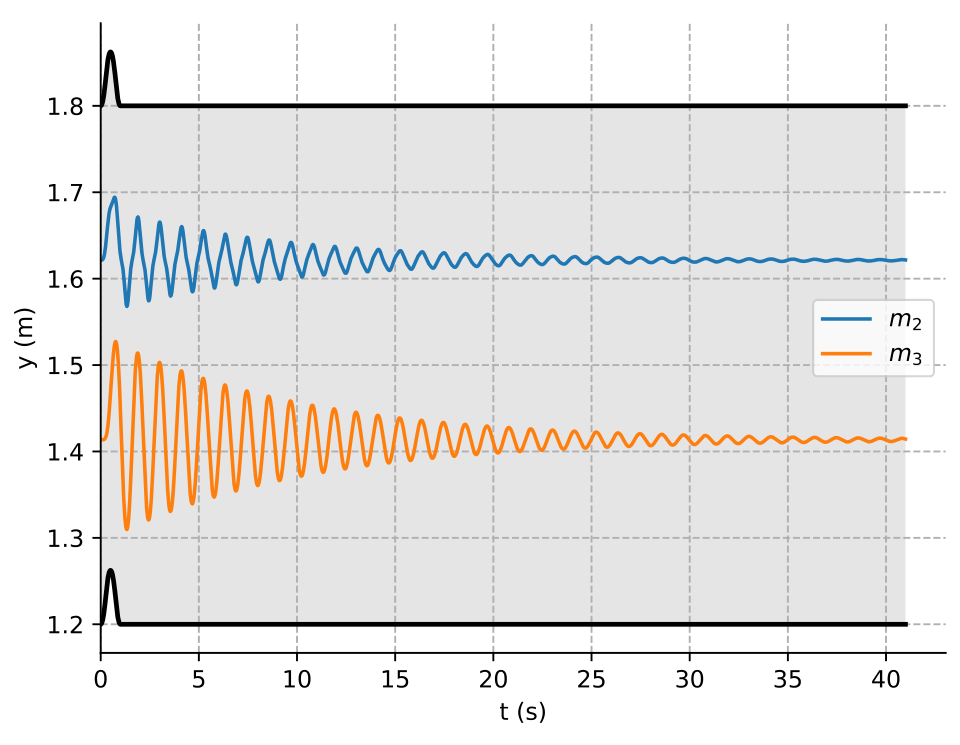
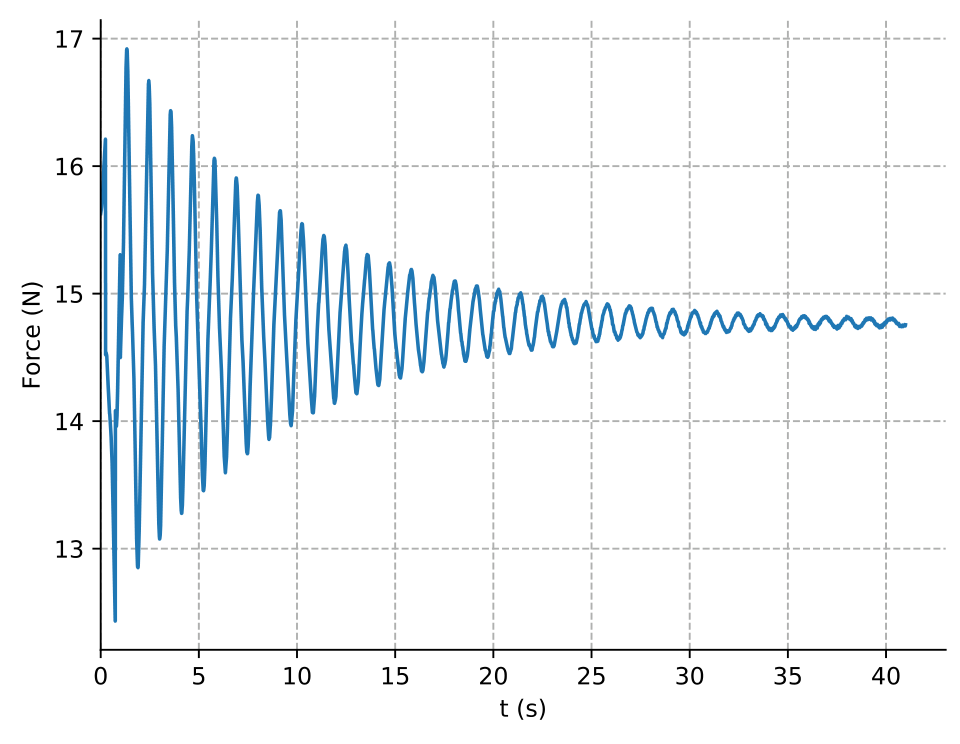
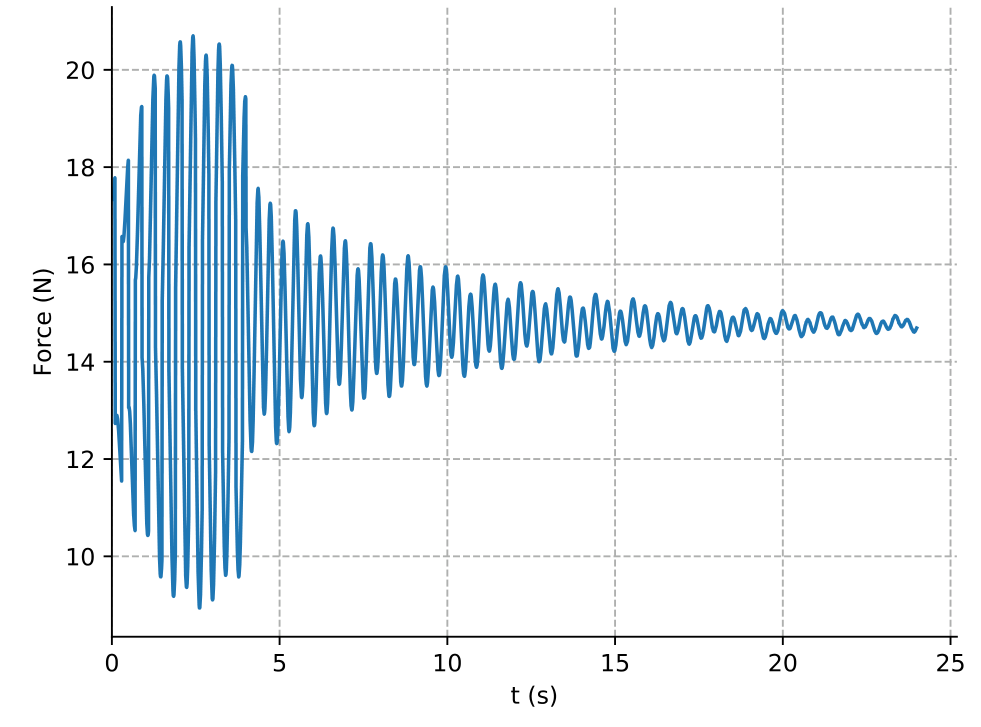
To find the natural frequencies, one can oscillate the box with different frequencies, stop oscillating and look at how force changes in time. Using trial and error we can get two estimates and .
To find the smaller frequency, we can, for example, give the box a pulse with 1 s duration.
We want to be sure that the amplitude of the oscillations is small enough when we measure the period (to avoid nonlinearity of springs). We find
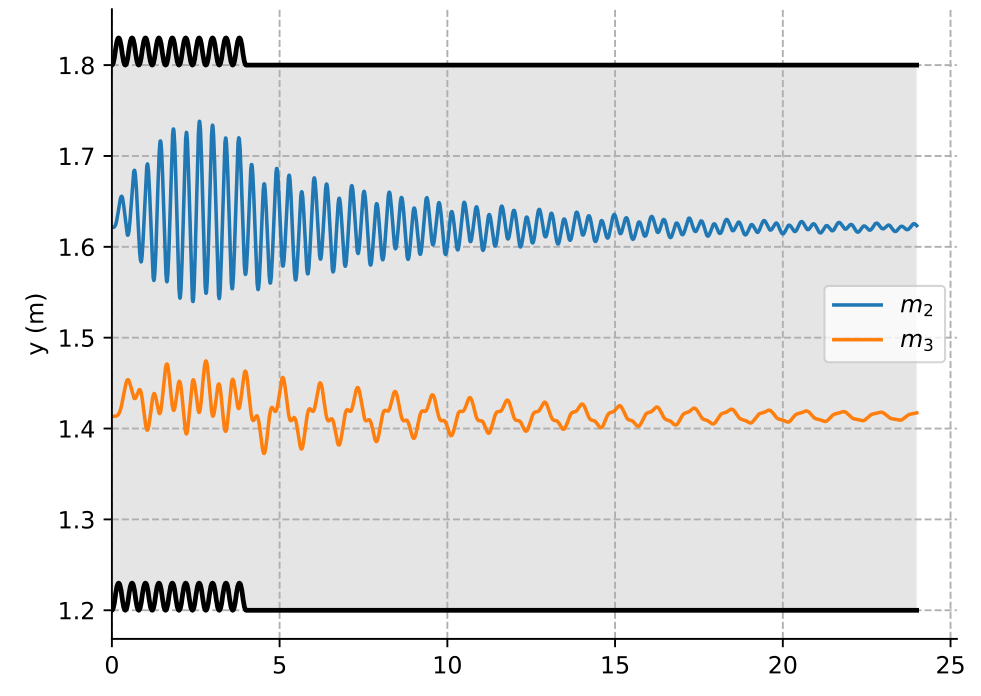
Similarly, we can amplify the larger natural frequency by oscillating the box or giving a shorter pulse.
We find
Therefore
We can then find by calculating and :
Exact answers: kg, kg, N/m.
2.4.2 Method 2: Fast pulse
Similarly as in method 1 for finding , we quickly accelerate the box with acceleration for time and then decelerate with acceleration for time . If is small, then does not change much while moving the box, so .
We also know that after the pulse when mass 2 starts to move, for a short time does not change much.
Therefore, before mass 2 starts to significantly move, and before mass 3 starts to significantly move.
Therefore, if is small, then right after time :
This method is less accurate than the previous method, it does many approximations, ignores drag forces and resolution of is small. It might be possible to make this method more accurate by taking the initial estimate for and then estimating while the box is accelerated to get a better estimate.
Theoretically it is also possible to find , although it is even less accurate. When , then , which means that .
We will use for highest accuracy. A good trade-off between resolution of and small seems to be . Since we need to find the second derivative and need a lot of accuracy, we will average the values of 10 measurements. The results are shown in the table.
| Time | (N/s) | |
|---|---|---|
| 0.10 | 12.572 | |
| 0.11 | 12.781 | 20.9 |
| 0.12 | 13.013 | 23.2 |
| 0.13 | 13.268 | 25.5 |
| 0.14 | 13.533 | 26.5 |
| 0.15 | 13.811 | 27.8 |
| 0.16 | 14.078 | 26.7 |
| 0.17 | 14.351 | 27.3 |
| 0.18 | 14.599 | 24.8 |
We estimate that at . Therefore
We also estimate that at when . We know that .
At ,
where we get .
Since ,
| Finding , , , Any method | ||
|---|---|---|
| 4a | Correct method | 0.5 |
| 4b | Correct equations allowing to solve for the values , , | 0.5 |
| Correct equations allowing to solve only for and | 0.3 | |
| 4c | Necessary measurements | 1.0 |
| If only natural frequencies (periods) are found without a plan on how to use them: | ||
| in range s | 0.3 | |
| in range s | 0.1 | |
| in range s | 0.3 | |
| in range s | 0.1 | |
| 4d | in range N/m | 1.0 |
| in range N/m | 0.8 | |
| in range N/m | 0.6 | |
| in range N/m | 0.4 | |
| 4e | in range kg or in range kg | 0.9 |
| in range kg or in range kg | 0.6 | |
| in range kg or in range kg | 0.3 | |
| 4f | Correctly calculate using or vice versa given any points received in 4e | 0.1 |
| Total: | 4.0 |
Note: Equations of motion for mass 2 and 3 give 0 points. Getting a correct biquadratic equation for gives 0.5 points from 4a, points are given for 4b only if , , or is correctly expressed from the biquadratic equation taking , , and as the only known parameters. Partial points can be given for getting an equation for (0.4 p for slightly wrong result, 0.2 p for setting up the determinant). Finding and give 0.3/0.1 points even with a plan to use them to solve a system of equations but without an idea how. Having a biquadratic equation for counts as “a plan” and in this case, finding and will each give 0.5/0.2 points with the same error tolerances. A correct answer without any justification or obtained with a physically nonsensible method gives 0 points.
2.4.3 Method 3: Estimating by estimating at equilibrium and using
After finding using method to find , we can similarly estimate , where , by quickly accelerating the box upwards. This method assumes that the masses have negligible height (which is true).
Again, using binary search, we find that the time for collision is at . Thus
The actual values are and .
| Estimating | ||
|---|---|---|
| 4.1a | Idea to use method | 0.5 |
| 4.1b | Correctly estimate | 0.5 |
| 4.1c | Correct formula for | 0.2 |
| 4.1d | in range | 0.3 |
| Total: | 1.5 |
Note: Estimating the distance without an idea how to use it gives 0 points.
Оригинал в Архива: EuPhO20_experiment-1.pdf · официални решения: EuPhO20_experiment_Solutions.pdf