EuPhO 2022, Теория — Задача 3. Dipole in a magnetic field
EuPhO-2022 Theoretical Problems. Language: English · 10 т.
General guidelines for marking
- Granularity for marks is 0.1 p.
- A simple numerical error resulting from a typo is punished by 0.2 p unless the grading scheme explicitly says otherwise.
- Errors which cause dimensionally wrong results are punished by at least 50 % of the marks unless the grading scheme explicitly says otherwise.
- Propagating errors are not punished repeatedly unless they either lead to considerable simplifications or wrong results whose validity can easily be checked later.
Условие
Two small balls of mass each with charges and respectively, connected by a rigid massless rod of length , form a dipole. The dipole is parallel to plane and is placed in a uniform magnetic field perpendicular to .
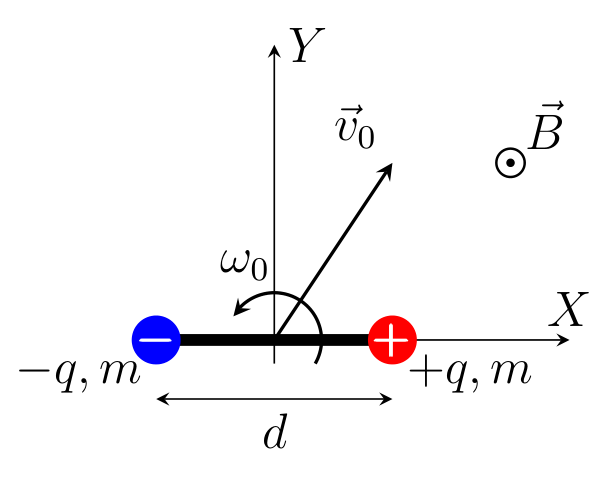
Initially, the dipole is aligned with the direction and has initial angular velocity in plane , as shown. Its center of mass is initially located at origin and given initial velocity parallel to , as well.
Consider three distinct scenarios (a, b, c-d):
(a) Find and the direction of , so that the center of mass will move with the constant velocity ? [2 т.]
(b) Given , find such (direction and magnitude), so that the center of mass will travel in a circle. Find the circle radius and the coordinates , of its center. You don’t need to prove the uniqueness of the solution. [3 т.]
(c) Given , find the minimal necessary for the dipole to reverse its orientation during the motion. [4 т.]
(d) If the dipole starts with and found in part (c), the trajectory of its center of mass has an asymptote. Find the distance from the origin to the asymptote. [1 т.]
Useful vector identity:
where “” and “” denote vector product and scalar product respectively.
Отговори
(a) ω₀ = 0 and v⃗₀ ∥ Y (perpendicular to the dipole).
(b)
The “+” sign corresponds to ω₀ > 0 (counter-clockwise rotation), the “−” sign to clockwise rotation.
(c)
(d)
Решение
Part (a): Uniform linear motion
Lorentz forces acting on the charges:
where is a vector from the center of mass to the position of the positive charge.
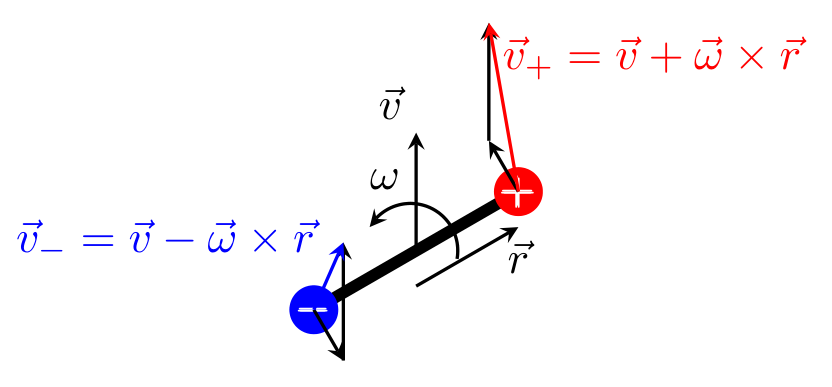
According to Newton’s first law, the center-of-mass of the dipole will move with constant velocity provided that the net force:
acting on the dipole, is zero. Since , and are perpendicular, we require . It means that dipole does not rotate: .
The pure translation, however, is possible if the pair of forces , has zero torque about :
We conclude that scalar product is zero only when , i.e. the initial velocity should be parallel to direction.
In summary, the dipole will move uniformly along if, and only if, and .
Part (b): Circular motion
The net force can be calculated as:
where is a dipole moment ( and the direction aligns with ).
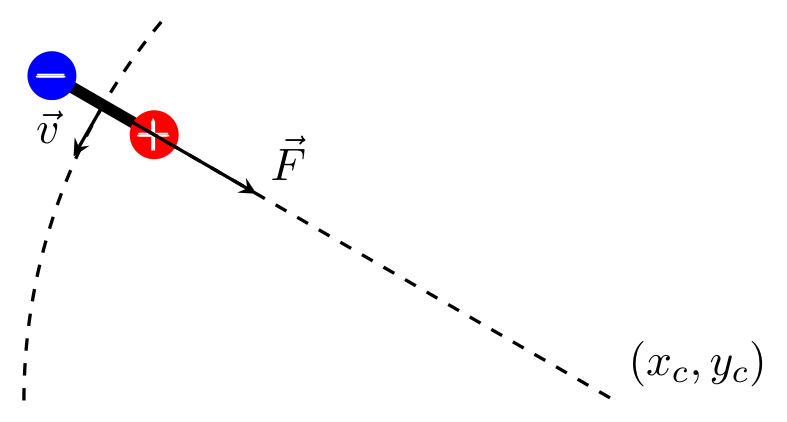
When orbits a circle, acts as a centripetal force, i.e. it points to the center of the circle. Since , the dipole is always in line with the center of the orbit. Therefore, the orbital angular velocity of is equal to the angular velocity of rotation of the dipole about .
The magnitude of the orbital velocity is:
From Newton’s second law, and accounting that the total mass of the dipole is :
i.e. the magnitude of velocity is:
and the radius of the orbit is:
The coordinates of the center of the circle are:
where the “” sign corresponds to , i.e. counter-clockwise rotation, and the “” sign —to clockwise rotation. In either case, the initial velocity should point to the negative direction:
Part (c): Reversal of the dipole
In (10) we have shown that the net force:
Since the dipole moment rotates with angular velocity , its time derivative:
From Newton’s second law:
By integrating the equation, we arrive at an additional conservation law in the system (conservation of the so called “generalized momentum”):
Thus, if has reversed its direction from to , then the velocity:
Since the magnetic field does not perform work on moving electric charges, the kinetic energy of the dipole is conserved:
Here, is the moment of inertia of the dipole with respect to its center-of-mass. Since doesn’t depend on angular velocities, is minimal when . Finally,
Alternatively, we can introduce to be the angle between the dipole moment and the axis () and rewrite the equations of translational motion in coordinates using :
By integrating these equations, given zero initial velocity, we find how velocity depends on :
Using the expression (9) for the torque, we can write the equation of rotational motion as:
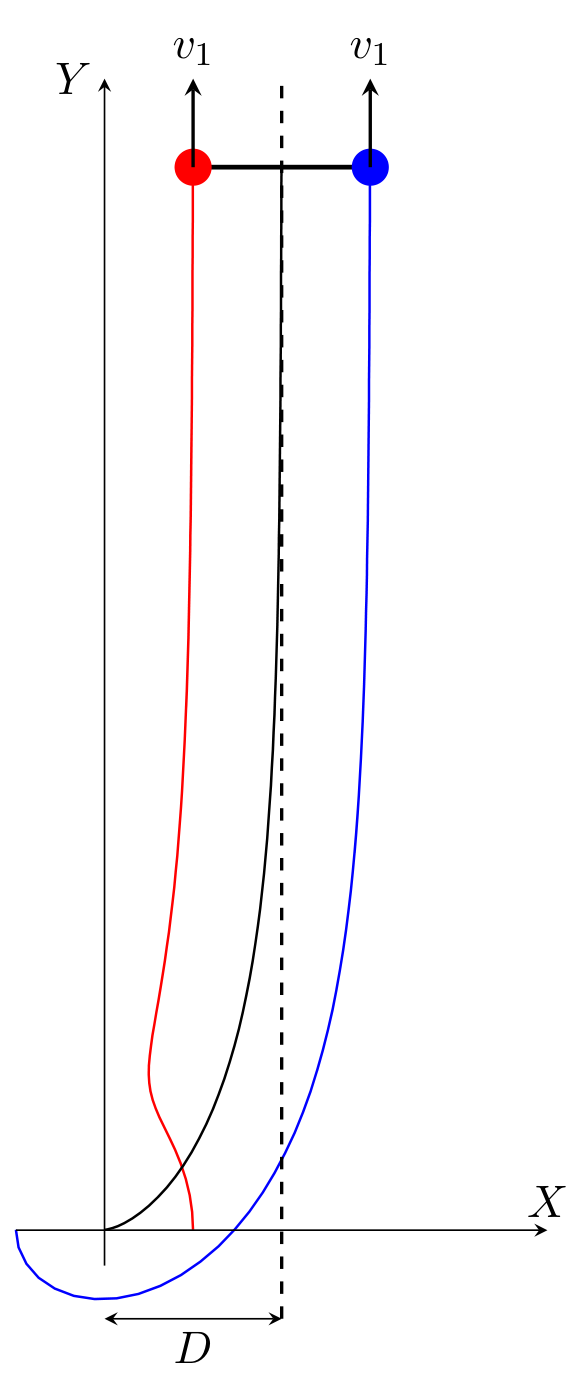
This is the equation of a mathematical pendulum of length in gravitational field . And the equivalent question becomes what is the minimal push required in the bottom position for the pendulum to reach the top position. Kinetic energy of the pendulum will be transferred to the potential energy , from which we find:
Note. Due to symmetry, both clockwise and counter-clockwise initial rotation with absolute value of will work.
Part (d): Trajectory asymptote
If dipole’s trajectory has an asymptote, then its movement along the asymptote is uniform. Indeed, if there is a linear motion with acceleration, the dipole should be always aligned with the direction of motion, thus, not rotating. and as we found in part (a), the absence of rotation can only be maintained if and .
The uniform linear motion requires , and this happens in the limit when the orientation is reversed . According to (11), in the limit, the dipole is travelling with the speed . Thus the asymptote is parallel to Y axis: (for counter-clockwise initial rotation).
If and are absolute positions of the charges, we can write equation for the angular momentum around the origin :
After integration, we find one more conservation law (conservation of the “generalized angular momentum”):
where is the position of center of mass. We also used the fact that .
Initially, centre of mass coincides with origin ():
At asymptote, the dipole has reversed direction and charges are travelling along parallel lines with the velocity :
Since (13) equals (14), we conclude that .
We can arrive to the same conclusion differently. Notice that we are interested in the coordinate of at infinity:
From (12), we can express :
Finally,
Note. If initial rotation is clockwise (), the asymptote has an equation , but the distance to the origin remains the same.
Marking scheme
| Part (a): Uniform linear motion | pts | |
|---|---|---|
| a1 | Rationalizes that the net force on the dipole is zero if the two poles move with equal velocities; Just argument is 0 pts. | 0.7 |
| a2 | Concludes that . | 0.3 |
| a3 | Using the argument of zero torque, concludes that the velocity should be perpendicular to the dipole; Just argument : 0.4 pts | 0.7 |
| a4 | States explicitly that (or ). | 0.3 |
| Total number of points for part (a) | 2.0 |
| Part (b): Circular motion | pts | |
|---|---|---|
| b1 | Derives expression for the magnitude of the net force on the dipole in terms of AND states explicitly that it is parallel to the dipole axis OR derives one single vector expression. | 0.9 |
| b2 | Realizes (drawing or explicit statement) that and the dipole axis point to the center of the orbit, and concludes that is equal to the orbital angular velocity. | 0.5 |
| b3 | Writes down Newton’s second law for the circular motion. | 0.5 |
| b4 | Makes use of the relation . | 0.2 |
| b5 | Derives expression for and specifies its direction (drawing or statement) OR derives one single vector expression for ; if direction is wrong or missing pts | 0.3 |
| b6 | Derives explicitly . If is omitted, still full points. | 0.3 |
| b7 | Writes down the coordinates of the center of the orbit; 0.2 for correct (including sign), 0.1 for correct ; is a correct answer | 0.3 |
| Total number of points for part (b) | 3.0 |
Only one of the grading tables should be used for part (c), the one which results in a higher score.
| Part (c): Reversal of the dipole | pts | |
|---|---|---|
| c1 | By integrating the equation(s) of motion derives a “generalized momentum” conservation law – a relationship between the linear momentum and the dipole moment – in vector form OR for the Cartesian components. | 1.5 |
| c2 | States explicitly that the kinetic energy of the dipole conserves. | 0.3 |
| c3 | Writes down explicit expression for the kinetic energy in terms of angular velocity and linear velocity of the center of mass. | 0.5 |
| c4 | Realizes that is minimal when in the reversed position. | 0.2 |
| c5 | By using the “generalized momentum” conservation, derives explicit expression for the linear velocity . | 0.5 |
| c6 | Applies the conservation of energy to find relationship between and | 0.8 |
| c7 | Derives the final expression for | 0.2 |
| Total number of points for part (c) | 4.0 |
Alternative approach: pendulum analogy
| Part (c): Reversal of the dipole | pts | |
|---|---|---|
| c1 | Derives the expression for the torque. Even if the derivation has been made in parts (a) or (b), the points should be assigned to Task (c); If term is not cancelled, still full points | 0.5 |
| c2 | By integrating the equations of motion, expresses and in terms of . | 1.5 |
| c3 | Writes down the equation of rotational motion in terms of . | 0.5 |
| c4 | States that the angular dynamics of the dipole is equivalent to a large-amplitude oscillation of a mathematical pendulum. | 0.3 |
| c5 | Realizes that is minimal when in the reversed position. | 0.2 |
| c6 | Applies the conservation of energy to the ”equivalent pendulum”. | 0.8 |
| c7 | Derives the final expression for | 0.2 |
| Total number of points for part (c) | 4.0 |
| Part (d): Trajectory asymptote | pts | |
|---|---|---|
| d1 | Rationalizes that the asymptote is parallel to , i.e. . | 0.1 |
| d2 | Rationalizes that asymptotically the motion is linear uniform | 0.2 |
| d3 | Either finds conservation law OR writes as integral of (with explicit expression for ) as a method to find . | 0.3 |
| d4 | Correctly computes generalized angular momentum at 0 and OR uses in integral. | 0.2 |
| d5 | Concludes that . | 0.2 |
| Total number of points for part (d) | 1.0 |
Оригинал в Архива: Theory.pdf · официални решения: Theory Solutions.pdf