EuPhO 2023 — Задача 1. E1 - Magnetic Pendulum (10 pts)
Автор: Olympiads XYZ · транскрипция на официалните материали
Проверена срещу оригинала на 13.9.2026 от същия модел, който я е транскрибирал (без независима проверка)
7. EuPhO 23 — Experimental Problems - Language: English · 10 т.
Внимание: Бележка към темата
Problem statements are outside this window; assembly must replace '[извън прозореца]' placeholders. Task 4 solution continues beyond page 6 (grading table E1.4 and figure captions printed on page 6; remaining solution pages 7-11 in another window).
Условие
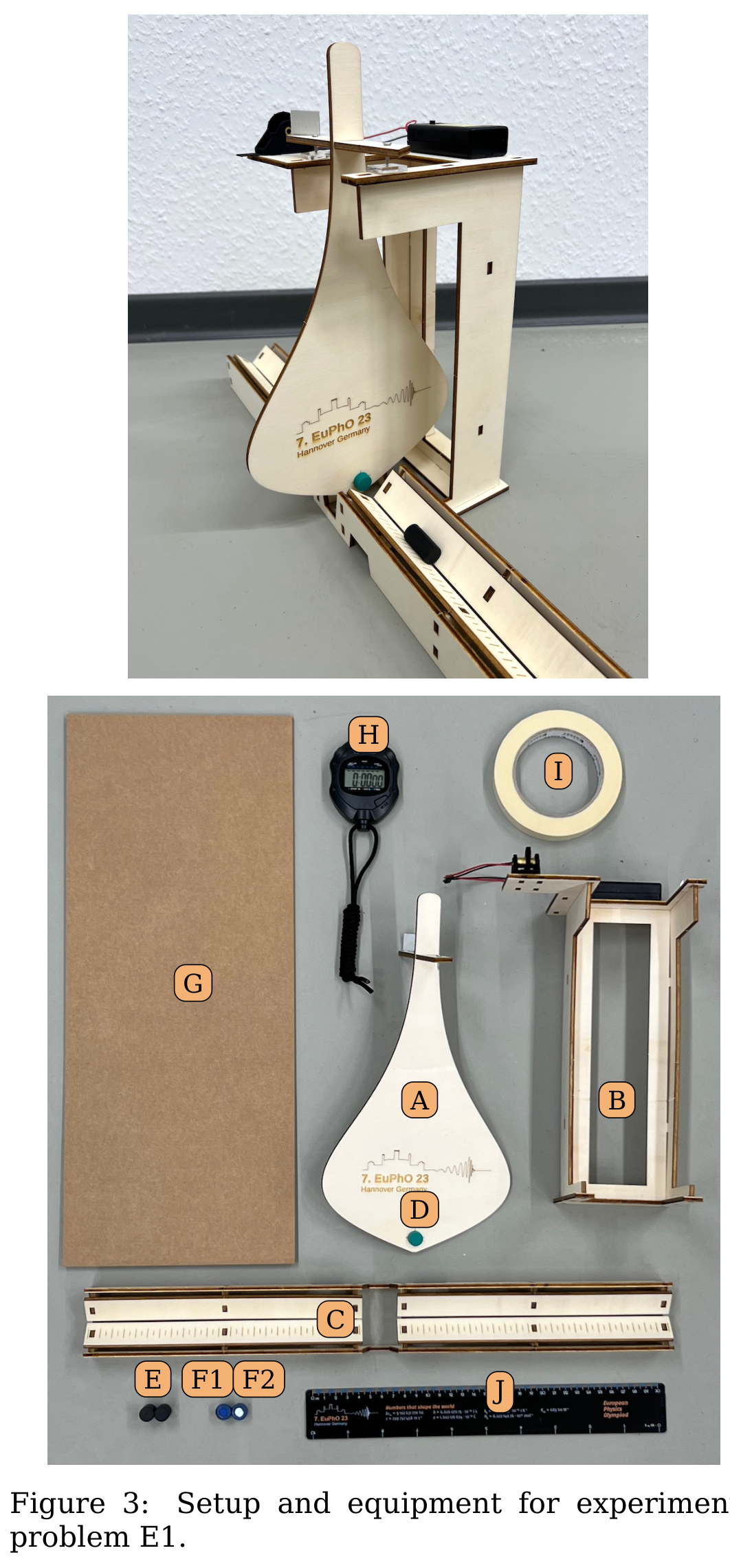
The oscillation frequency of a pendulum can be modified by magnetic forces between the pendulum and its support. In this experiment you will study pendulum motion in a combined potential from gravitational and magnetic interaction terms, using the setup shown in Fig. 3.
Equipment (see also Fig. 3)
A Pendulum body with point-like supports and mirror for angle measurement
B Pendulum tower with hard points to support the pendulum, and laser module for angle measurement
C Rails to support external magnets
D 2 small dipole magnets to be attached to pendulum body (may be green, red, white or yellow)
E 2 identical external dipole magnets (black)
F 2 unknown external magnets F1, F2 (blue, F2 is marked with white dots at its ends)
G Screen for laser spot for angle measurement
H Stopwatch
I Masking tape, e.g. to fasten pendulum tower to table
J Pencil and ruler
The magnets are quite strong. Be careful not to hurt yourself or damage the magnets. Do not look directly into the laser beam, and turn the laser off when not needed. When experimenting with the pendulum, make sure the supporting screws are resting in the grooves on the pendulum tower. Feel free to mark the pendulum with your pencil if needed.
With external magnets nearby, the magnetic pendulum moves in a combined potential formed by gravity and magnetic interaction. The resulting pendulum frequency can be written as a function of natural frequency and "magnetic frequency shift" :
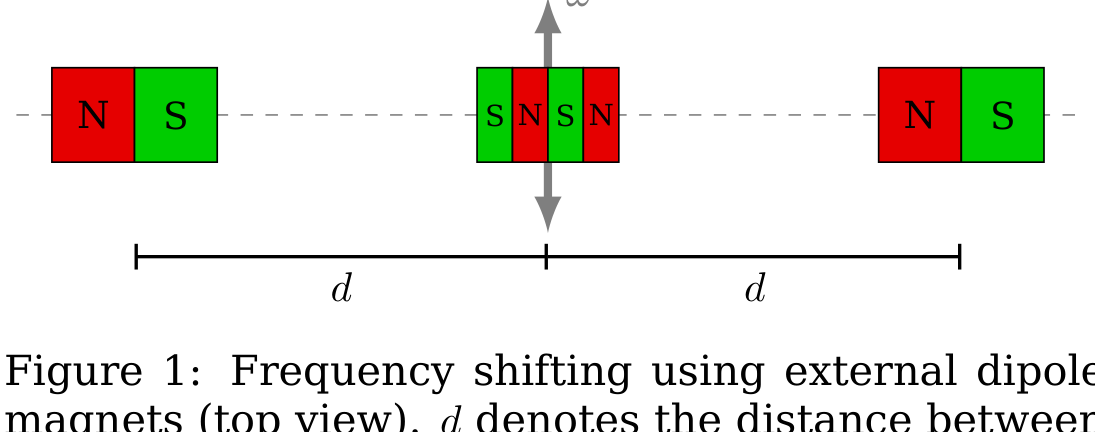
For the case of two black external dipole magnets, symmetrically placed at a distance around the pendulum equilibrium position (see Fig. 1), and small amplitude oscillations the magnetic frequency shift is:
where is the permeability of vacuum, is the moment of inertia of the magnetic pendulum around the axis of rotation, is the combined magnetic moment of the pendulum magnets, is the magnetic moment of each external dipole, and is the distance of the pendulum magnet to the rotation axis. For the relative strength of the dipole moments you may assume . Local gravity is .
Precise alignment of the rails is important. Make sure that, with the pendulum in its equilibrium position, the centers of all magnets are on a single line.
Make sure to use symmetric configurations to cancel the force on the pendulum magnets along the direction of the rails.
Task E1.1 - Masses (1.0 pts) The total mass of the pendulum body with attached small dipole magnets is .
Determine both and as accurately as possible. [1 т.]
Task E1.2 - Magnetic dipole moments (4.0 pts) a) Measure the pendulum frequencies for different magnet distances , using very small amplitudes. Make sure to cover the whole accessible frequency range.
b) Determine the "average magnetization" (magnetic moment per unit mass) of the material of pendulum magnets and external dipole magnets. Create a relevant graph for your analysis. Auxiliary measurements may be necessary to determine all unknowns. You may neglect the mass and thickness of the non-magnetic coating of the magnets. [4 т.]
Task E1.3 - Unknown external magnets (3.0 pts) The two blue unknown external magnets (F1, F2) each contain several magnetic dipoles. The dipoles inside F1 are reversed with respect to those inside F2. The magnetic frequency shift in a setup analogous to Fig. 1 also follows a power law:
a) Measure the pendulum frequencies for different distances , using very small amplitudes. Choose settings that allow finding the magnetic frequency shift as accurately as possible.
b) Determine the power law exponent .
c) Sketch a possible configuration of magnetic dipoles inside F1 and F2 and justify your choice. [3 т.]
Task E1.4 - Nonlinear pendulum (2.0 pts) Return the setup to the configuration used in Task E1.2, with black external dipole magnets arranged as in Fig. 1. Following Eqn. 1, the small-amplitude pendulum frequency can be fully cancelled, .
a) Determine as accurately as possible the magnet separation required for this full cancellation.
b) Investigate the dependence of pendulum period on its amplitude when tuned to the best cancellation you were able to obtain. Suggest a functional dependence and validate it with your data. Discuss the origin of any possible mismatch. [2 т.]
Решение
Покажи официалното решение
Оригинал в Архива: eupho2023_experiment_problems.pdf · официални решения: eupho2023_experiment_solutions.pdf