EuPhO 2023, Теория — Задача 1. T1: Thermal lens
7. EuPhO 23 Hannover Germany. Theoretical Problems. Language: English · 10 т.
Условие
When an intense laser beam falls onto a semitransparent plate, the transmitted light can self-focus to a point behind the plate due to the inhomogeneous heating of the material. This effect, known as thermal lensing, is observed in materials whose index of refraction increases with temperature, characterized by a positive thermo-optic coefficient .
A semitransparent disk with radius , thickness and optical absorption coefficient is composed of a material having thermal conductivity and thermo-optic coefficient . The outer rim of the disk is thermally connected to a circular metallic holder (not shown in the figure) maintained at a constant temperature . A parallel laser beam of radius and power is incident normally onto the center of the disk. The intensity distribution is homogeneous across the cross-section of the beam.
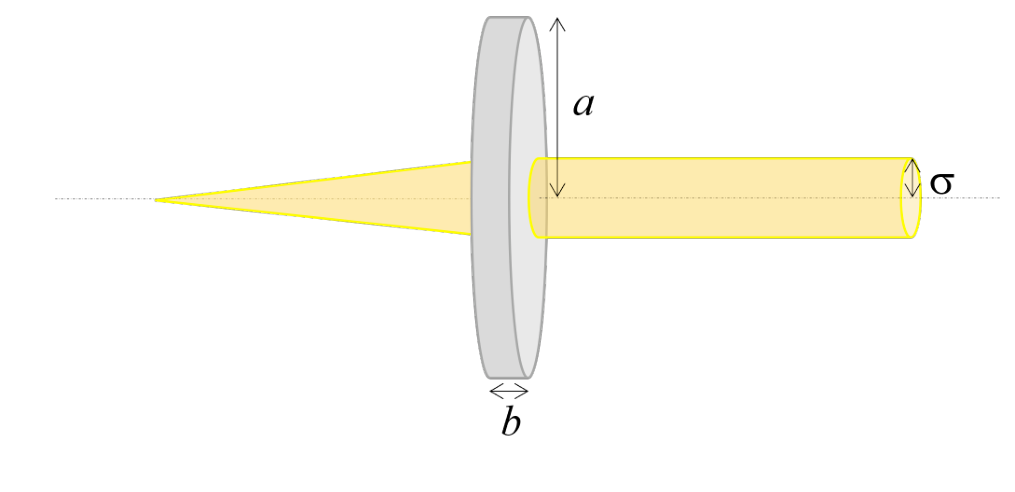
a) Sketch a qualitative graph of the temperature profile , where denotes the distance from the axis of the beam. Indicate clearly on the graph the illuminated region and the outer region . [2 т.]
b) In the vicinity of the center of the disk, the temperature profile can be represented by a quadratic function . Calculate the parameters and . [4 т.]
c) Show that the beam is focused in one point and find the distance from this point to the disk. If you failed to obtain and in part b), you may use them as parameters in your final answer. [4 т.]
Do not consider the thermal expansion of the disk. Neglect the thermal radiation and the heat exchange between the disk and the surrounding air. Assume that the index of refraction of air is .
Отговори
- b)
- c)
Решение
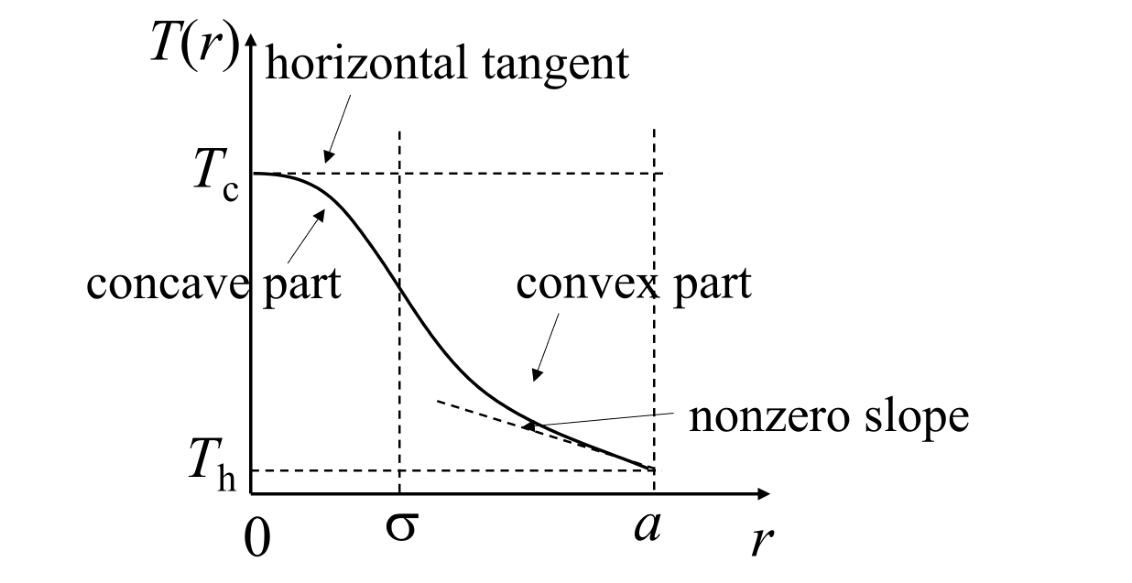
(a) Drawing a graph
The graph should present or clearly infer for the four elements shown in the figure.
| Element of the graph | Pts. |
|---|---|
| Horizontal tangent at | 0.5 |
| Graph is concave and decreasing in | 0.5 |
| Graph is convex and decreasing in | 0.5 |
| Nonzero negative slope at | 0.5 |
| Totally on (a) | 2.0 |
(b) Finding
Approach with a direct solution of the heat-transport equation.
Consider a cylindrical cut of the disk with radius . Let be the portion of laser power absorbed within the cylinder. The absorbed power is being transferred as heat towards the outer holder through the circumvent surface of the cylinder. The heat-transport equation reads:
Depending on , the absorbed power is given by two different expressions. Within the illuminated area , the incident light intensity is constant, so the absorbed power is:
and the solution for is quadratic in :
where is the temperature at the center. It is clear from that expression that the parameter is:
Outside the illuminated area, i.e. for , , which does not depend on . The solution for is logarithmic in :
where is the temperature of the holder, which is equal to the temperature along the outer rim of the disk. After matching the two solutions at we obtain:
| Task | Pts. |
|---|---|
| Writes down the heat-transport equation in radial coordinates | 0.7 |
| Derives an expression for at | 0.5 |
| Finds a quadratic solution for in the region (Subtract 0.2 pts. if he boundary condition has not been accounted for) | 0.5 |
| Identifies the expression for (Subtract 0.1 pts. if the minus sign is missing) | 0.2 |
| Calculates numerically (Subtract 0.1 pts. if the minus sign is missing) | 0.2 |
| Derives an expression for at | 0.3 |
| Finds a logarithmic solution for in the region (Subtract 0.2 pts. if he boundary condition has not been accounted for) | 0.5 |
| Sets up an equation by matching the two solutions at | 0.6 |
| Writes down the final expression for | 0.2 |
| Calculates numerically | 0.3 |
| Totally on (b) | 4.0 |
Alternative approach – direct piece-wise integration of the heat-transport equation.
After realizing that is given by a piece-wise function:
the student may substitute the given solution into heat-transport equation (1) for . This gives directly the expression (4) for the parameter . The parameter could be easily identified with the temperature at the center of the disk. On the other hand, due to the thermal contact between the rim of the disk and the holder. It follows from the heat-transport equation that:
The piece-wise integration of the two sides of the equation in the interval gives:
which is equivalent to the expression (6) for .
| Task | Pts. |
|---|---|
| Writes down the heat-transport equation in radial coordinates | 0.7 |
| Derives an expression for at | 0.5 |
| Derives an expression for at | 0.3 |
| Substitutes the given form of into heat-transport equation for the region | 0.3 |
| Obtains the expression for (Subtract 0.1 pts. if the minus sign is missing) | 0.2 |
| Calculates numerically (Subtract 0.1 pts. if the minus sign is missing) | 0.2 |
| States that | 0.2 |
| States that | 0.2 |
| Expresses through integral of in the interval | 0.3 |
| Calculates the integral in the interval | 0.3 |
| Calculates the integral in the interval | 0.3 |
| Writes down the final expression for | 0.2 |
| Calculates numerically | 0.3 |
| Totally on (b) | 4.0 |
(c) Finding the focal length
Approach based on the Fermat’s principle
We consider only the illuminated area of the disk (). Due to the nonuniform temperature distribution, the index of refraction is also -dependent, which leads to a bending of the light rays incident at nonzero radii , as shown schematically in the figure. As a result, the light rays exiting the disk, converge toward the optical axis, and, eventually, cross it in a certain point at a distance from the disk.
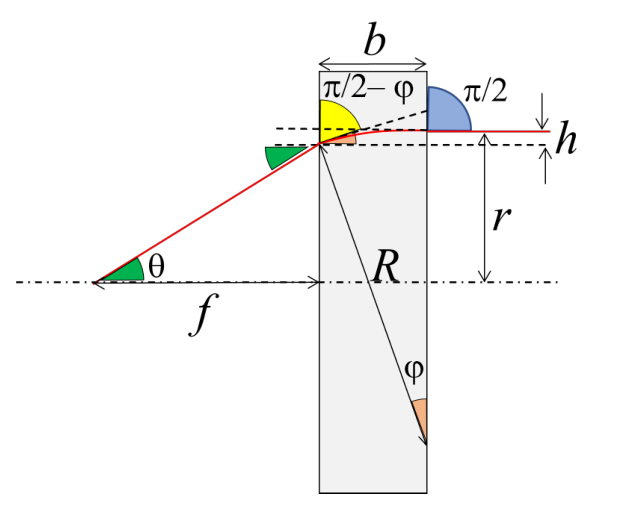
Since the ray bending is relatively small, one may assume that: (i) all the rays travel approximately the same distance inside the disk; (ii) any given ray enters and exits the disk at approximately the same height ; (iii) . Thus, the optical pathway of a ray, incident at a height above the optical axis, is:
According to Fermat’s principle, in order that all the rays focus at the same point, it is necessary that is constant within . In particular, for any , which leads to the condition:
Since:
condition (11) is satisfied if
The beam hence focuses at
Taking into account the expression for derived in part (b), we represent the answer in terms of the known parameters and calculate its numerical value:
Alternatively, the student may state that the optical pathway does not depend on and use the condition , which gives:
Since:
we obtain:
The beam thus focuses at:
| Task | Pts. |
|---|---|
| Formulates assumptions (i) and (ii) or equivalent statements | 0.2 |
| Derives a general expression for the optical pathway as a function of | 0.8 |
| Uses that and derives approximate quadratic expression for | 0.5 |
| States that focusing takes place when is the same for all rays converging in the focus | 0.5 |
| Writes explicitly equation in the form OR | 0.5 |
| Uses the dependence to derive the dependence OR to find | 0.5 |
| Derives an expression for the focal length in terms of or of the parameters given in the problem statement | 0.8 |
| Calculates numerically | 0.2 |
| Totally on (c) | 4.0 |
Approach based on a direct ray/wavefront tracing
As a next approximation, the light ray inside the disk can be modeled as a circular arc of a radius (, see the figure). As a result, the ray exits the disk at a smaller height above the optical axis (). The angle of bending of the ray inside the material is related to by:
From the Snell’s law it follows that:
Up to terms, linear in , one may write that:
Thus, the radius of the ray inside the material, is:
and the bending angle is approximately:
Alternatively, the students may trace a small part of the wavefront, associated with two rays, incident at close distances and from the optical axis. By noticing that the wavefront is perpendicular to the rays, the angle of deviation of the rays is equal to the angle of rotation of the wavefront. Let be the speed of light in the material at a distance from the axis. The time-rate , i.e. the angular speed of the wavefront is:
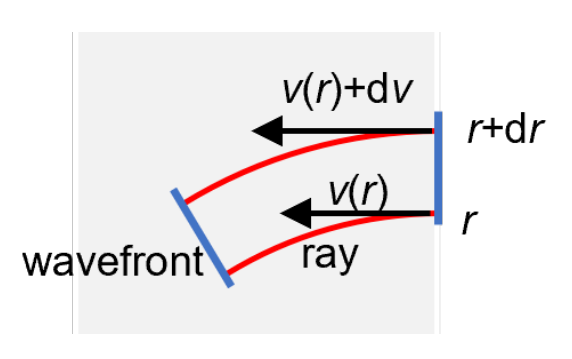
The rays reach the opposite surface of the disk in approximately the same time , so the total deflection angle of the wavefront, and of the rays, thereof, is
Upon exiting the disk, the ray undergoes additional refraction, and inclines at a new angle relative to the optical axis. The Snell’s law in the small-angle approximation (, ) states that:
Since , one obtains the following expression for the angle of inclination:
It is clear from the figure that:
which reproduces the result obtained by the Fermat’s principle.
| Task | Pts. |
|---|---|
| States or shows on a graph that the light ray inside the material can be approximated by an arc OR illustrates on a graph that the wavefront is perpendicular to the light rays | 0.2 |
| Derives the relation or equivalent OR expresses the time of travel of the ray across the disk | 0.5 |
| Applies the Snell’s law to the ray path inside the material OR derives a formula for the time-rate by considering the wavefront passing through two closely separated rays | 0.8 |
| Finds expression for the bending angle inside the material | 0.5 |
| Applies the Snell’s law for the refraction of rays exiting the disk | 0.5 |
| Uses the dependence to find | 0.5 |
| Derives an expression for the focal length in terms of or of the parameters given in the problem statement | 0.8 |
| Calculates numerically | 0.2 |
| Totally on (c) | 4.0 |
Alternatively:
Consider a ray incident at a specific height . Let be the horizontal coordinate of the ray inside the material. Our goal is to find approximately the profile of the light ray inside the material. From Snell’s law:
Since:
we obtain:
Since , the differential equation approximates to:
which is solvable by separation of variables and gives an approximate parabolic path:
Finally, for the angle, just before exiting the disk, we obtain:
| Task | Pts. |
|---|---|
| Applies the Snell’s law to express the angle dependence on for one ray | 0.8 |
| Expresses | 0.2 |
| Applies approximation to derive a separable differential equation for | 0.8 |
| Integrates to obtain parabolic path | 0.5 |
| Finds expression for the angle , before exiting the disk | 0.2 |
| Applies the Snell’s law for the refraction of rays exiting the disk | 0.5 |
| Derives an expression for the focal length in terms of or of the parameters given in the problem statement | 0.8 |
| Calculates numerically | 0.2 |
| Totally on (c) | 4.0 |
Оригинал в Архива: eupho2023_theory_problems.pdf · официални решения: eupho2023_theory_solutions.pdf