EuPhO 2025 — Задача 1. Sunny
Автор: Olympiads XYZ · транскрипция на официалните материали
Проверена срещу оригинала на 13.9.2026 от същия модел, който я е транскрибирал (без независима проверка)
Theoretical Problems. Language: English · 10 т.
Внимание: Бележка към темата
Only solutions pages 1–6 were available in this window; statements must be filled from the problems document.
Условие
You are asked to study the features of the brightly lit circle and dark rings in the figures below. Make your calculations for an idealized situation: the chair leg is strictly cylindrical of radius , strictly vertical, with a perfectly smooth, cylindrical, and perfectly reflecting surface. You may make any additional model assumptions and approximations you deem reasonable that will simplify your calculations.
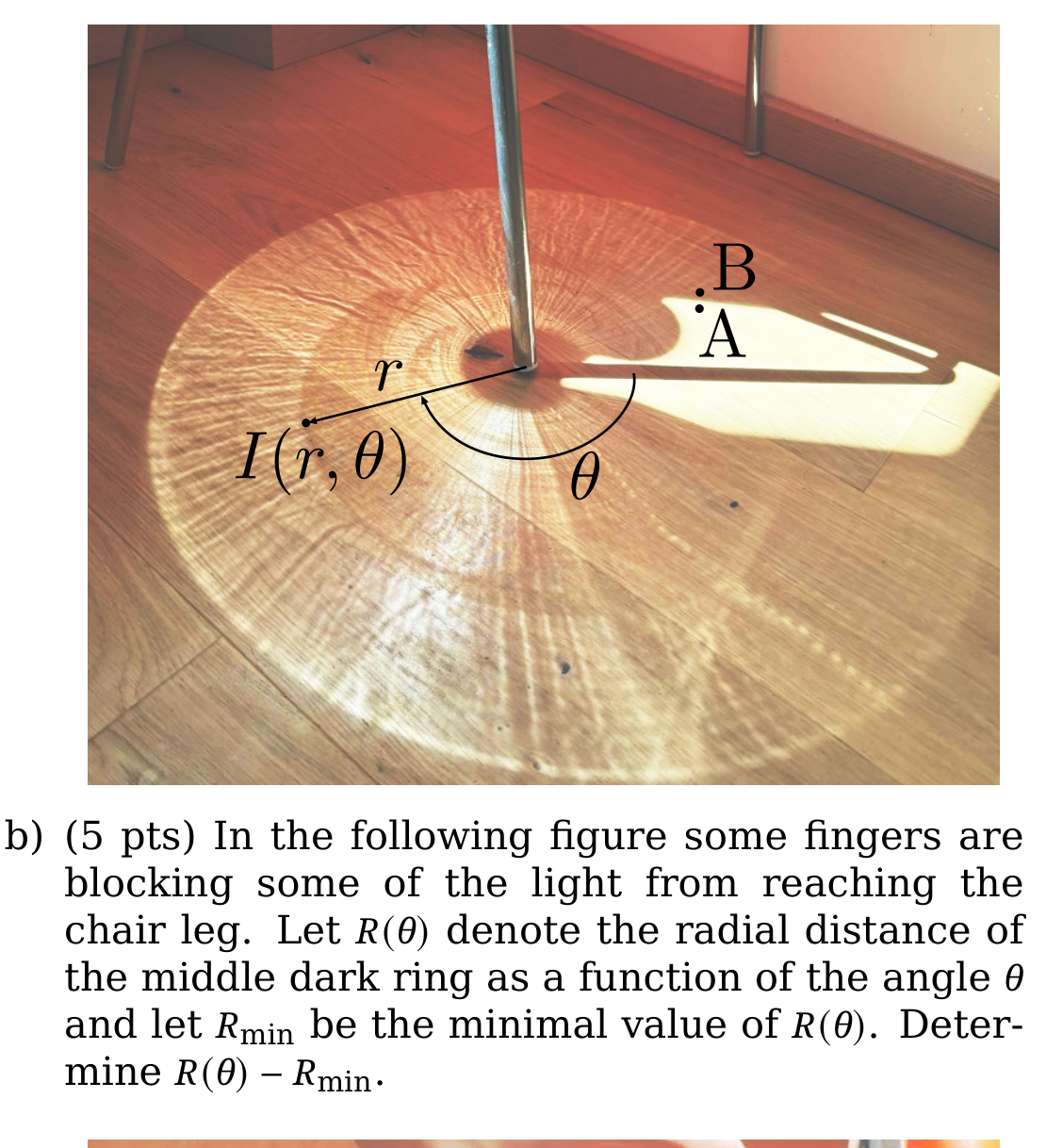
a) Determine how the illuminance surplus inside the brightly lit circle on the floor depends on the polar coordinates and . The illuminance quantifies the amount of incoming light per area. By “surplus” we mean the additional illuminance introduced due to the presence of the cylinder. Express the answer in terms of defined as the illuminance difference between points A and B in the figure. [5 т.]
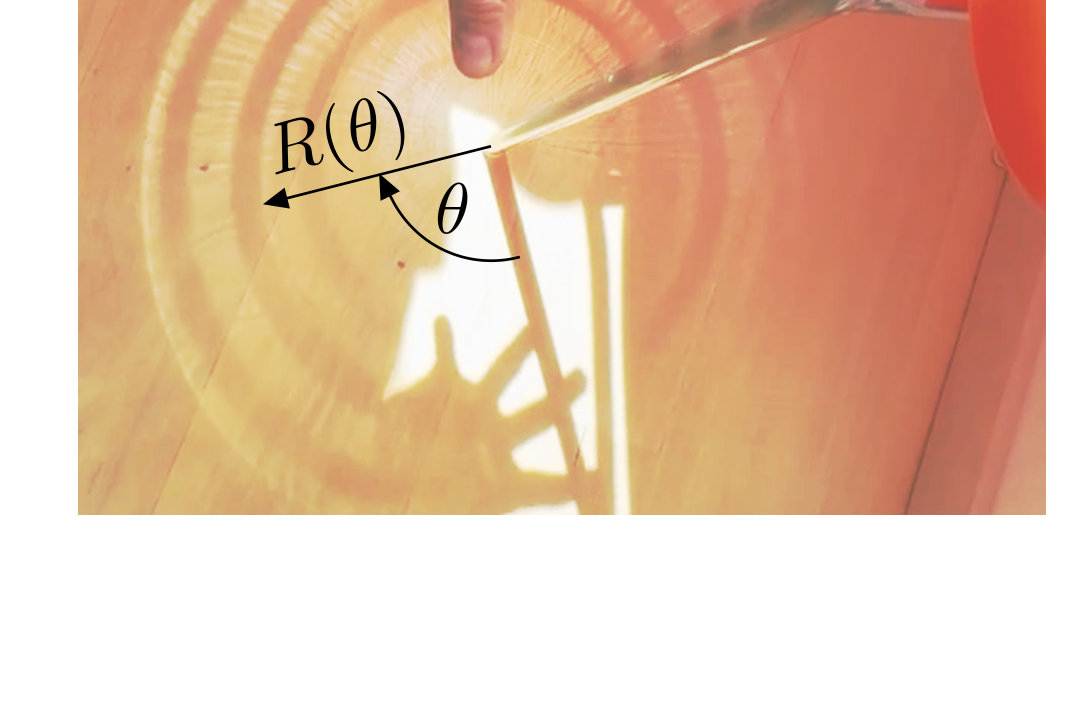
b) In the following figure some fingers are blocking some of the light from reaching the chair leg. Let denote the radial distance of the middle dark ring as a function of the angle and let be the minimal value of . Determine . [5 т.]
Решение
Покажи официалното решение
Оригинал в Архива: eupho2025_theory_problems.pdf · официални решения: eupho2025_theory_solutions.pdf