EuPhO 2026, Теория — Задача 2. Hysteresis
Theoretical Problems · 10 т.
Условие
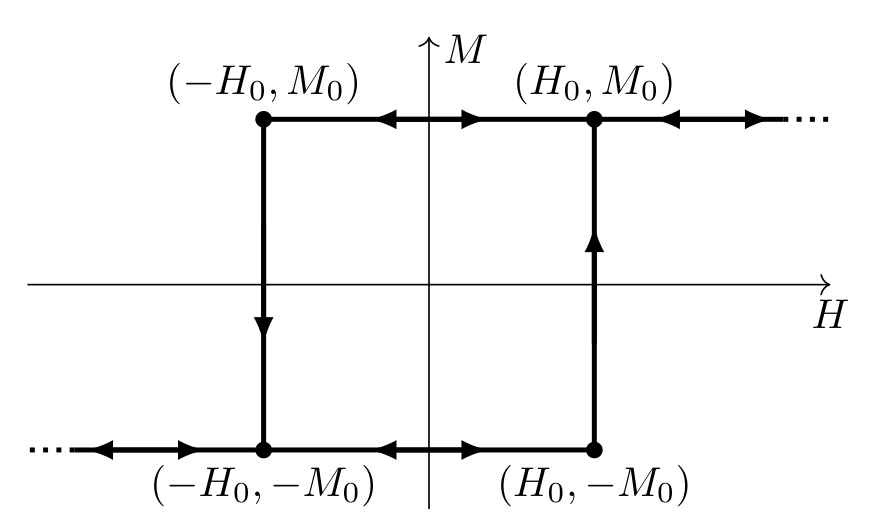
Consider a solenoid with turns, radius and length . The solenoid has a ferromagnetic core with hysteresis curve as shown in the picture. denotes the magnetization of the core and would be zero without core material. It is related to , the magnetic field strength generated by the current in the solenoid coil, and by . and are of the same order of magnitude. Assume that can only change if .
An ideal capacitor with capacitance is now connected to the solenoid forming a closed circuit. Assume that all wires have negligible resistance.
a) Initially there is a current flowing through the circuit and the capacitor is uncharged. is large enough that . After one oscillation the current again reaches a maximum value. Determine the difference between and this value. [3 т.]
b) Find the maximum current that can be attained after many oscillations. [2,3 т.]
c) The current exhibits two qualitatively distinct phases of behaviour, A and B. The system can remain in phase A indefinitely, whereas any single interval spent in phase B has bounded duration. Find the maximal possible duration of a phase-B interval, if is chosen optimally. [4,7 т.]
Решение
a) Solution considering remagnetization time
The current in the circuit and the voltages across the solenoid and the capacitor are connected through equations
where . The magnetic field strength in the solenoid is
At the start there is a large current in the circuit such that . Initially, the current charges the capacitor, while the current and the field decrease. The point, representing the momentary combination of and moves along the top horizontal line in the hysteresis curve (to the left). The magnetization does not change during this phase even when crosses 0 and becomes negative. In this phase . As in an ideal -circuit, energy is conserved.
When the current reaches the critical magnitude in the opposite direction, i.e.
the magnetization starts to reverse. The vertical hysteresis curve at means that during the magnetization reversal (which takes some time) stays constant and equal to . Therefore, also the current stays constant and equal to , while changes. For the critical current we obtain
Solving these equations with corresponding to the moment reaches (when the orientation of magnetization in the core starts to change) and using gives
After the time interval the core is completely remagnetized with . We get
The corresponding voltage is
The energy needed to change the orientation of magnetization of the core thus is
After complete remagnetization the circuit behaves again like an -circuit, but with lower energy. From on the current changes harmonically until it reaches the critical value , and the story repeats. Since the energy needed for the magnetization reversal process is independent of the starting voltage (as long as it is fully completed), during one full cycle the energy loss is twice the value computed above, i.e. . The maximum current after one cycle is reduced from due to the lower energy with , where is the inductance of the solenoid. It follows
Note that . Since we can approximate the change in the maximum current to
Solution using energy considerations
Originally the energy used to remagnetize the core is stored in the inductor, so . After a single cycle, the energy is , where the same notation as in the other approach is used. The inductance of the solenoid is given by . The loss of stored energy during one cycle is proportional to the area of the square in the hysteresis curve (an explanation is provided below) with .
We thus get
from which the result (14) follows as above.
To understand the relation between the energy loss during magnetization and the area of the square in the hysteresis curve, we consider the instantaneous electrical power in the solenoid and integrate it over over one cycle. Using equations (3) and (4) we have
Since the circuit is isolated and the capacitor uncharged at the beginning of an oscillation cycle the total electrical work over one cycle, starting at and ending at should equal zero. Integrating the power over the cycle gives
The first integral gives . The second integral gives , from which we get
Note: The quantity is the change per unit volume of the magnetic energy of the solenoid.
b) As long as the current amplitude exceeds the critical current required to change the magnetization orientation, the circuit will continue loosing energy in the remagnetization process. After many cycles the voltage at the start of the remagnetization process is too small for the remagnetization to be fully completed. The remagnetization process during the phase of the constant current stops when the voltage (and charge in capacitor) becomes zero. In this case no more energy is stored in the capacitor that can be used for remagnetization. The core then remains partially magnetized and there is no more energy dissipation connected with the core.
From now on, the circuit behaves like an LC circuit with current amplitude of . In the graph this corresponds to moving back and forth on a horizontal line within the square. Therefore, the maximum current after many oscillations is the amplitude of the current oscillations in the -circuit
c) The two distinct phases are the -circuit harmonic behaviour (phase A) and the remagnetization process (phase B). To find the maximum duration for the latter let us first consider the duration of the magnetization processes for the case where full magnetization occurs. The duration was computed in (10) and equals
Since is the same and constant for each magnetization process, we have to find the minimal value of over all possible . We can compute a derivative of with respect to ,
The derivative is negative for all values of , which means that is monotoneously decreasing with increasing . Thus the voltage has to be as small as possible. On the other hand, when the voltage at the start of the cycle is too small, it drops to zero before the core is fully remagnetized. It follows from equation (6) that this happens after time
Hence for maximal duration the voltage should be as large as possible. Together, the optimal initial voltage is the one where the voltage drops to zero precisely in the moment when the core is fully magnetized. The corresponding can be found for instance using (10) as the smallest for which a real-valued exists, which is
This gives the maximum duration as
Marking scheme T2
| Problem T2 a) | Pts. |
|---|---|
| A Relate energy loss to capacitor voltage drop (12) or area under --curve. Stating only gives 0.3 pts | 0.4 |
| B Determine energy loss over full cycle from capacitor voltage drop or area under --curve (-0.4 pts if only half cycle is considered or numerical factor is erroneous) | 1.0 |
| C Relate current to energy stored in inductor | 0.3 |
| D State/Derive/Use for inductance of solenoid | 0.3 |
| E Determine change in current (14) with or without approximation | 1.0 |
| Partial sum T2 a) | 3.0 |
| Problem T2 b) | Pts. |
|---|---|
| A State/Derive/Use | 0.3 |
| B Realize -circuit behaviour, when no remagnetization occurs | 0.5 |
| C Realize that energy is lost only in remagnetization | 0.5 |
| D Determine critical current (19) | 0.5 |
| E Realize that current amplitude after many oscillations equals critical current | 0.5 |
| Partial sum T2 b) | 2.3 |
| Problem T2 c) | Pts. |
|---|---|
| A Identify phase B as remagnetization process | 0.3 |
| B State current and voltage equations (3) (0.3 pts. each, only 0.1 pts. each for and ) | 0.6 |
| C Realize that current stays at critical current during remagnetization | 0.5 |
| D Determine as function of time (9) | 0.5 |
| E Determine time interval for remagnetization (10) | 0.5 |
| F For complete remagnetization - Derive that duration is maximised for minimal possible voltage | 0.5 |
| G For incomplete remagnetization - Determine time for complete discharge of capacitor | 0.5 |
| H For incomplete remagnetization - Derive that duration is maximised for maximal possible voltage | 0.3 |
| I Compute optimal value for voltage (23) | 0.5 |
| J Determine maximum duration (24) | 0.5 |
| Partial sum T2 c) | 4.7 |
General rules for marking in T2:
- Depending on the approach taken, points may be awarded also for subquestions not directly. So make sure to check all aspects of the marking scheme even if students only worked e.g. on part a).
- The grain size for marking is 0.1 Pts.
- Partial marks can be awarded for most aspects.
- For each mistake in calculation (algebraic or numeric) 0.2 Pts. are deducted.
- If a mistake leads to a dimensionally incorrect expression no marks are given for the result.
- Propagating errors are not punished again unless they are dimensionally wrong or entail oversimplified/wrong physics (e.g. using an approximation in a regime it does not apply).
Оригинал в Архива: eupho2026_theory_problems.pdf · официални решения: eupho2026_theory_solutions.pdf