EuPhO 2026, Теория — Задача 3. Dry ice hockey
Theoretical Problems · 10 т.
Условие
At pressure , solid (dry ice) sublimates (goes from solid to gaseous state) at . Its saturated vapour pressure follows the Clausius–Clapeyron relation:
where the latent heat of sublimation is , the molar mass is , and the gas constant is . The thermal conductivity of the gas is and its dynamic viscosity is . The density of dry ice is and the gravitational acceleration is .
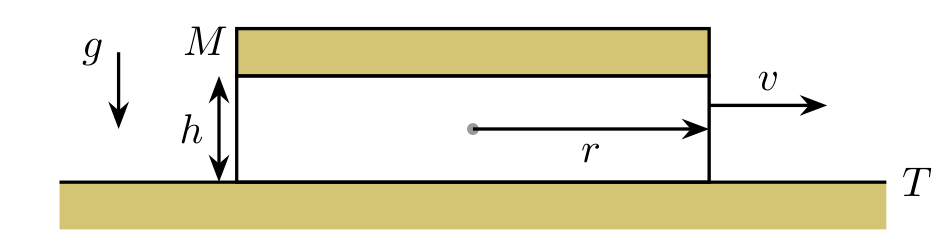
A puck of radius consists of a disc of dry ice of thickness , and a metal disc of mass on top of it. The initial temperature of the puck is and the ambient pressure is .
The puck is placed on a horizontal metal plate which is held at a constant temperature , and given an initial horizontal velocity . After a very long time, the horizontal displacement of the metal disc is measured.
Treat the gas as ideal. Assume no tilting of the puck at any moment, all surfaces are perfectly smooth, and the thermal conductivities of the metal, dry ice, and gas satisfy .
a) When is sufficiently small, is negligible and independent of . However, when reaches a critical value , the function starts to grow. Estimate . [2 т.]
b) Estimate the maximal value of the function . [8 т.]
Решение
T3: Skating (10 pts)
Part a
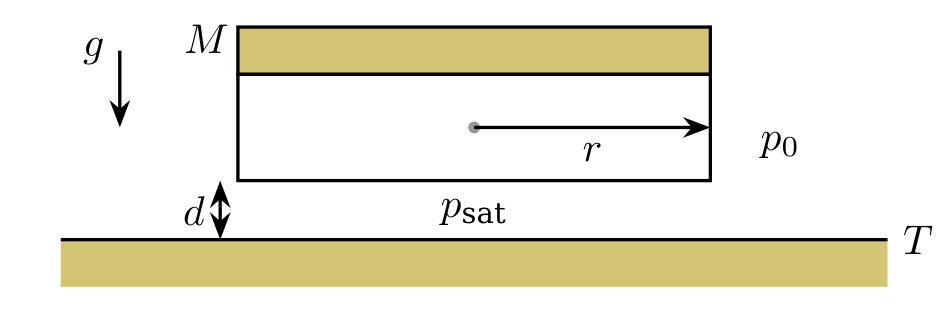
Summary: The friction force on the sliding puck behaves differently depending on whether is larger or smaller than a threshold . When is sufficiently large (i.e. the plate is hot enough), sublimation occurs on the lower surface of the puck. The gaseous formed by sublimation pushes the puck upwards, creating a gap between the puck and the plate. The friction in this regime is relatively low. If is too small, sublimation does not occur on the lower surface. In this regime, the puck remains in contact with the plate and the dry friction between the puck and the plate is large and independent of . Thus, is the temperature above which sublimation can occur and create a gap.
![p3-sol-fig1]
Calculation: Suppose is slightly larger than , so that sublimation occurs but the resulting gap is extremely narrow. Such a narrow layer of gas provides negligible thermal insulation between the puck and the disc. Therefore, the temperature of the gas and the lower surface of the puck must be close to , the temperature of the plate.
For sublimation to occur on the lower surface at this temperature, the pressure of the gas in contact with this surface must be the saturated vapour pressure for . This saturated vapour pressure, which we denote by , can be found from the Clausius-Clapeyron relation given in the question:
On the other hand, must also be such that the upwards force on the puck due to the excess pressure of the gas in the gap (above ) balances the weight of the puck. The dry ice mass is much smaller than the mass of the metal disc, . Therefore, . This implies , so (25) gives (since is not large). Therefore, (25) reduces to
so we find
Alternatively, if we ignore the order-unity coefficient ( in this case), . Throughout the rest of this solution, we will ignore order-unity coefficients (like ) in our estimates.
Extra detail
In this problem, we must assume there is no sublimation on the upper surface of the dry ice i.e. between the dry-ice disc and the metal disc. This is realistic because the temperature gradient across the gap () is much greater than the temperature gradient between the upper and lower surfaces of the dry-ice disc, , that would exist if sublimation were occurring at both surfaces. As a result, the heat flux upwards through the dry ice is negligible compared to the heat flux through the gap, so insufficient thermal energy will flow to the top surface to cause another gaseous layer to form.
We can estimate using the fact that, if sublimation is occurring at the upper surface, then the gas layer there must be at a pressure below the pressure in the bottom layer by , the pressure required to support the dry-ice disc. The temperature difference would then be using (25). But this is only .
Part b
Summary: As increases above , the rate of sublimation increases. More gas is created and the gap between the puck and the plate widens. The gas needs to flow out of the gap, and calculating the resulting flow (treating the gas as a fluid) will allow us to determine the gap width as a function of . When the puck slides, the flow beneath it has a non-zero shear. The viscous force due to this shear is what slows the puck down. If is not too large, the viscous friction is large and the puck will come to a stop well before the dry ice has fully sublimated. We will refer to this regime as the 'low-temperature regime', .
When increases, increases and the viscous friction decreases, which means is an increasing function of . However, as increases, the dry ice also sublimates faster. Once is sufficiently large, the final displacement of the metal disc is determined by the distance the puck travels before the dry ice evaporates completely. When there is no dry ice remaining, the metal disc drops down onto the plate and moves no further (as we assume a relatively large dry friction between the disc and the plate). We will refer to this range of as the 'high-temperature regime', .
We will find that the distance is maximised approximately at the value where the two regimes meet: .
![p3-sol-fig2]
Calculation: First we estimate in the high-temperature regime. For this, we need to know the rate of dry-ice sublimation for a given . Sublimation requires energy; this energy is supplied by a flow of heat from the hotter plate to the cooler dry ice. The heat is conducted through the gas in the gap.
The temperature of the gas in the gap will, to a good approximation, vary linearly with height between at the plate and at the lower surface of the puck. In reality, the temperature at the lower surface of the puck will deviate slightly from because the pressure of the gas in the gap is slightly higher than , as in part a), and varies with position, as explained after (35). However, by similar reasoning to that of part a), the size of this deviation is . We will find that , so this deviation can be neglected. Then, the small width of the gap ensures that the temperature profile is similar to what we would find in the gap between two infinite planes held at different temperatures, which is a linear profile. The vertical temperature gradient in the gap is therefore , which means there is an upwards heat flux in the gap of size . Note that the fact that the temperature profile is linear is not essential here; what matters for these estimates is that the gradient is set by and the gap width. The energy flowing into the dry ice per unit time is , by integrating the heat flux over the area of the lower surface. Therefore, gas in the gap is produced by sublimation at a rate (mass per unit time) of
since sublimation at the sides of the dry-ice disc can be neglected. The time taken for all the mass of the dry ice to sublimate is
using (28). Thus, the distance that the puck slides is
Note that this estimate assumes the puck speed does not fall significantly below on the sublimation timescale. This assumption is valid when , which defines the high-temperature regime (we show this more explicitly in (42)).
Next we consider the low-temperature regime . This regime is easiest to understand if we first discuss what happens when the disc is not given any horizontal velocity.
Without any horizontal velocity, the system is symmetric under rotations about the axis of the puck (axisymmetric). The flow of the out from underneath the puck is then radial and axisymmetric. If the dry ice sublimates slowly (), the flow will be close to a steady flow at all times (the process is quasi-stationary). It will be useful to estimate the typical speed of the flow. At steady state, all the gas sourced beneath the puck must flow out at the rate that it is created. The rate at which mass flows out through the outer radial edge of the gap (which is a cylindrical surface of surface area ) is , where is the mass density of the gas. This must equal , so using (28). The density is given by the ideal-gas law , which means
We took the temperature to be in the ideal-gas law because the temperature of the gas and puck will be close to when . This also means we can approximate the density of the gas in the gap as a constant (in reality, the linear temperature profile in the gap will cause some variation of density with height, but this is negligible when ). For estimate (31) to be useful, we need to find another relation involving . Such a relation will be provided by the balance between pressure and viscosity in the gas.
Since the gap width is small, , the Reynolds number of the flow is very low and the flow is similar to the Poiseuille flow of a viscous fluid between two infinite planes. The very low Reynolds number means the injection of gas due to sublimation at the dry-ice surface will have a small effect on the velocity profile, provided the gas is not injected with an unrealistically large normal velocity. Then, the characteristic size of the flow is
as in a Poiseuille flow between two infinite planes. This can also be obtained from dimensional analysis, or via the following more advanced derivation.
Treating the shear viscosity as a constant (in reality, the viscosity of a gas depends on temperature, but the temperature variation is small, ), the radial flow speed satisfies
in cylindrical coordinates (this is known as the 'lubrication', or 'thin film', approximation). Equation (33) says that a steady flow results from a balance between radial pressure gradients and viscous forces in the fluid. We have used the fact that the pressure is approximately independent of , as it would be in a Poiseuille flow between two infinite planes. The solution to (33) is
where we use no-slip boundary conditions at the surfaces at or . Note that, as required by axisymmetry, vanishes at , where has a local maximum so .
For the estimates in this problem, equation (33) and its solution are not necessary. All that is required is the fact that the characteristic size of the flow satisfies (32).
Extra detail
In order for the gas in the gap to be accurately modelled by fluid equations like (33), the gap cannot be too small. The first reason is that molecules of the gas must experience many collisions with each other in the time it would take for them to traverse the gap. Molecular collisions are the microscopic cause of viscosity and the reason heat is transported by conduction (instead of being transported by hot molecules travelling, uninterrupted, from the hotter plate to the puck). The mean free path is , where is the number density and is an approximate radius of a molecule. The gap must be large enough that . Second, the gap must be large enough that the surfaces can be treated as smooth rather than rough: must be larger than the characteristic height of any 'bumps' in the surfaces. We are instructed to assume this in the problem.
How large is ? As in part a, the excess pressure must support the weight of the puck, so
Note that, in part a, was uniform over the lower surface of the puck. In this part, decreases with , because the radial pressure gradient must drive the outflow of gas. As a result, the pressure at the dry-ice surface is larger at smaller , and (according to Clausius-Clapeyron) the temperature at the dry-ice surface is also larger at smaller .
Combining (32) and (35), we find
Then, substituting (31) into (36) gives
This is the relation that determines the gap width as a function of .
Let us now return to the situation where the puck is given an initial horizontal speed . The flow velocity of the gas beneath the puck must change, because the radial flow (34) no longer satisfies the no-slip boundary condition at . Fortunately, we can correct this by simply adding the linear shear flow (in the direction of ) to the axisymmetric flow discussed above (i.e. to the flow described by (34)). The resulting combination satisfies the no-slip boundary conditions at each surface. This simple superposition is possible because fluid flow in a low-Reynolds number regime is a linear phenomenon (the governing differential equation (33) is linear).
The new flow exerts a viscous force on the lower surface of the puck, of size . Therefore, the equation of motion for the puck takes the form
Integrating over time, we find
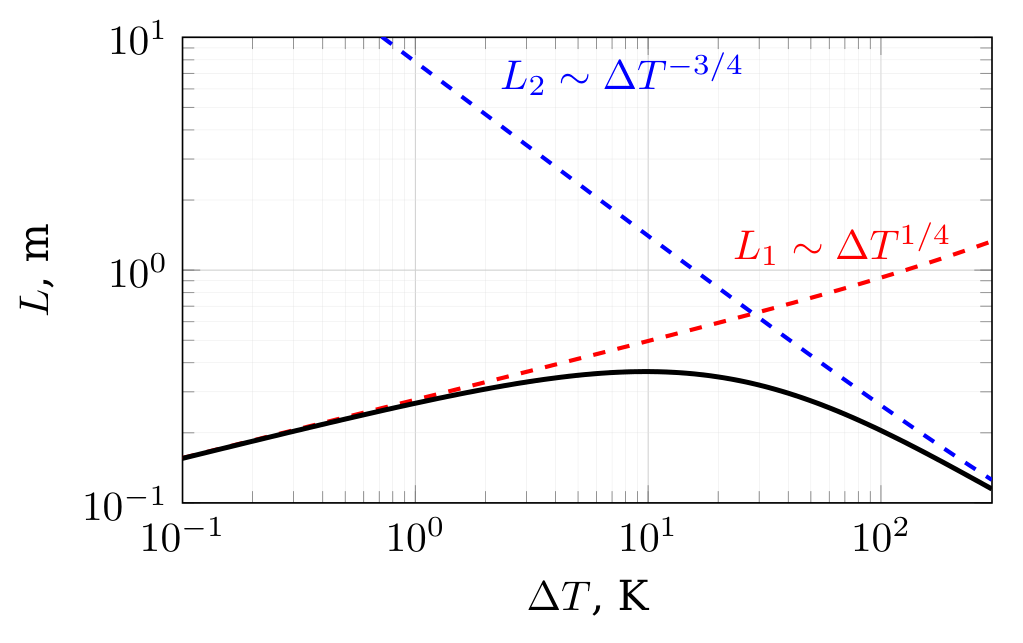
Note that in the high-temperature regime increases as the temperature decreases, while in the low-temperature regime increases as the temperature increases. The temperature at which is maximised is therefore the temperature at which the two regimes meet, so that neither (30) nor (39) is valid. Equating (30) and (39), we find
Interestingly, is independent of . Therefore, result (40) could be derived without solving for the radial flow and obtaining (37). To calculate , we can substitute (40) into either (30) or (39); we constructed so that the result would be the same either way. Using, in addition, equation (37) for , we find
One could equally use an 'average' temperature such as to estimate , which would give a slightly higher value of .
Alternatively, instead of using , we can say that around the maximum , the puck still slows according to due to viscous friction, but it must stop moving when the dry ice has fully sublimated. This occurs at time , according to (29). Thus
Since , there is no elementary analytical formula for the maximum value of . But we can still estimate that the maximum happens around and , which is consistent with the previous estimate.
General rules for marking T3:
- Marks for one part of the problem should be awarded even if it is contained in a student's working for another part. For example, make sure to check whether students can obtain marks for part b) even if they only worked on part a) (the only exception is item T3 b) L).
- Similarly, students do not need to obtain points in the same order as listed in the mark scheme or solution. They can, for example, calculate before they calculate , or the other way around.
- Estimates do not require correct order-unity coefficients (such as or 2); what is required is the correct scaling with physical quantities. When numbers are computed, the mark scheme provides the acceptable range in the format .
- If students obtain an estimate in the mark scheme in a rearranged form (e.g. they write down in terms of instead of in terms of ), they obtain full credit.
- For part a) item F and part b) item Q, students who obtain a correct formula but make a mistake when substituting numbers into it receive 0.4 points.
Marking scheme T3
| Problem T3 a) 2pts | Pts: | |
|---|---|---|
| A | State/use that is negligible and independent of when the puck and plate are in direct physical contact | 0.2 |
| B | Use for the puck temperature | 0.3 |
| C | Realise that Clausius-Clapeyron must be satisfied at the lower surface (argument about extremely small gap does not need to be explicit) | 0.3 |
| D | Use Clausius-Clapeyron to connect and (or in integrated form) | 0.2 |
| E | Estimate the excess pressure in the gas using | 0.3 |
| F | Numerical value | 0.7 |
| Problem T3 b) 8pts | Pts: | |
|---|---|---|
| High temperature regime, 2pts | ||
| A | State/use that can be limited by complete sublimation of the dry ice | 0.5 |
| B | Temperature gradient in gap is , or heat flux in gap is | 0.3 |
| C | Obtain | 0.4 |
| D | Obtain | 0.7 |
| E | State/use that the temperature on the lower puck surface is | 0.1 |
| Low temperature regime, 2pts | ||
| F | State/use that can be limited by friction from viscosity | 0.5 |
| G | Estimate | 0.3 |
| H | Estimate (or any reasonable pressure/temperature on RHS) | 0.2 |
| I | State/use that friction force is | 0.3 |
| J | Obtain . | 0.7 |
| Intersection of regimes, 4pts | ||
| K | Estimate | 0.7 |
| L | State/use still holds in part b) | 0.3 |
| M | State/use no-slip boundary conditions apply, or state parabolic solution for | 0.3 |
| N | Obtain | 0.7 |
| O | Idea to estimate from the point where the regimes meet or overlap or integrated with both effects taken into account | 0.6 |
| P | Obtain or a numerical value for | 0.7 |
| Q | Numerical value for | 0.7 |
Оригинал в Архива: eupho2026_theory_problems.pdf · официални решения: eupho2026_theory_solutions.pdf