GeCAA 2020, Теория — Задача 4. Light Curves
GeCAA-2020 — Theory · 20 т.
Внимание: Бележка към темата
Eight complete native whole tasks and 27 requests, with all 25 official key pages, alternatives, marking criteria, and the complete two-page GeCAA-2020 constants companion. This bilingual Russian/English question edition is transcribed from its printed English column; task titles use the matching English key. Russian-only figure captions remain native. Printed scientific and source-edition discrepancies remain with attributed local notes. Task points total 150 by addition; no aggregate paper total or overall time limit is printed, so those fields remain unspecified. Referenced answer sheets/boxes are not in the obtained packet or complete 2020 archive-folder inventory.
Native source editions and gaps
Question masthead: GeCAA-2020 [Russian], Теоретический тур / Theory, with Russian and English columns. Official English key masthead: GeCAA - Theory Solutions, October 3, 2020. That is the printed key edition date; no competition held date/place is inferred. The designated answer sheets/boxes mentioned for Light Curves and Meteor Radiant were not obtained. The primary question/official key wording variants are recorded inside their original tasks.
Table of constants
The dated GeCAA-2020 constants companion prints Russian and English labels alongside the following native values.
Fundamental constants
| Quantity | Symbol | Value |
|---|---|---|
| Speed of light in vacuum | ||
| Planck constant | ||
| Boltzmann constant | ||
| Stefan-Boltzmann constant | ||
| Elementary charge | ||
| Universal gravitational constant | ||
| Universal gas constant | ||
| Avogadro constant | ||
| Wien’s displacement law | ||
| Mass of electron | ||
| Mass of proton | ||
| Mass of neutron | ||
| Atomic mass unit (a. m. u.) |
Astronomical data
| Quantity | Symbol | Value |
|---|---|---|
| 1 parsec | 1 pc | |
| 1 astronomical unit (au) | 1 au | |
| 1 jansky | 1 Jy | |
| Hubble constant | ||
| Solar luminosity | ||
| Apparent angular diameter of Sun | ||
| Effective temperature of Sun | ||
| Obliquity of the ecliptic (Earth) | ||
| Inclination of the lunar orbit w. r. t. ecliptic | ||
| Apparent visual magnitude of full moon | ||
| North Ecliptic Pole (J2000.0) | ||
| North Galactic Pole (J2000.0) | ||
| 1 sidereal day | ||
| 1 tropical year | 365.2422 solar days | |
| 1 sidereal year | 365.2564 solar days |
Solar magnitudes
| Quantity | Value |
|---|---|
| Apparent visual magnitude | |
| Absolute visual magnitude | |
| Apparent bolometric magnitude | |
| Absolute bolometric magnitude |
Solar system
| Object | Mean radius (km) | Mass (kg) | Semi-major axis (au) | Eccentricity |
|---|---|---|---|---|
| Sun | 695500 | — | — | |
| Mercury | 2440 | 0.387 | 0.206 | |
| Venus | 6052 | 0.723 | 0.007 | |
| Earth | 6378 | 1.000000 | 0.016710 | |
| Moon | 1737 | 0.002572 | 0.054900 | |
| Mars | 3390 | 1.524 | 0.093 | |
| Jupiter | 69911 | 5.203 | 0.048 | |
| Saturn | 58232 | 9.537 | 0.054 | |
| Uranus | 25362 | 19.189 | 0.047 | |
| Neptune | 24622 | 30.070 | 0.009 |
Gauss’s formulae
Cosine theorem:
Sine theorem:
Source note: The English native heading is “Gauss’s formulae”; its Russian counterpart is “Сферическая тригонометрия”. Blank source symbol cells remain blank. This is the dated same-competition constants PDF obtained from the GeCAA 2020 archive Constants folder.
Условие
The light curve A shown below, shows a fictional edge-on eclipsing binary system containing stars X (radius , luminosity ) and Y (radius , luminosity ). Assume that star X is brighter, but star Y is hotter.
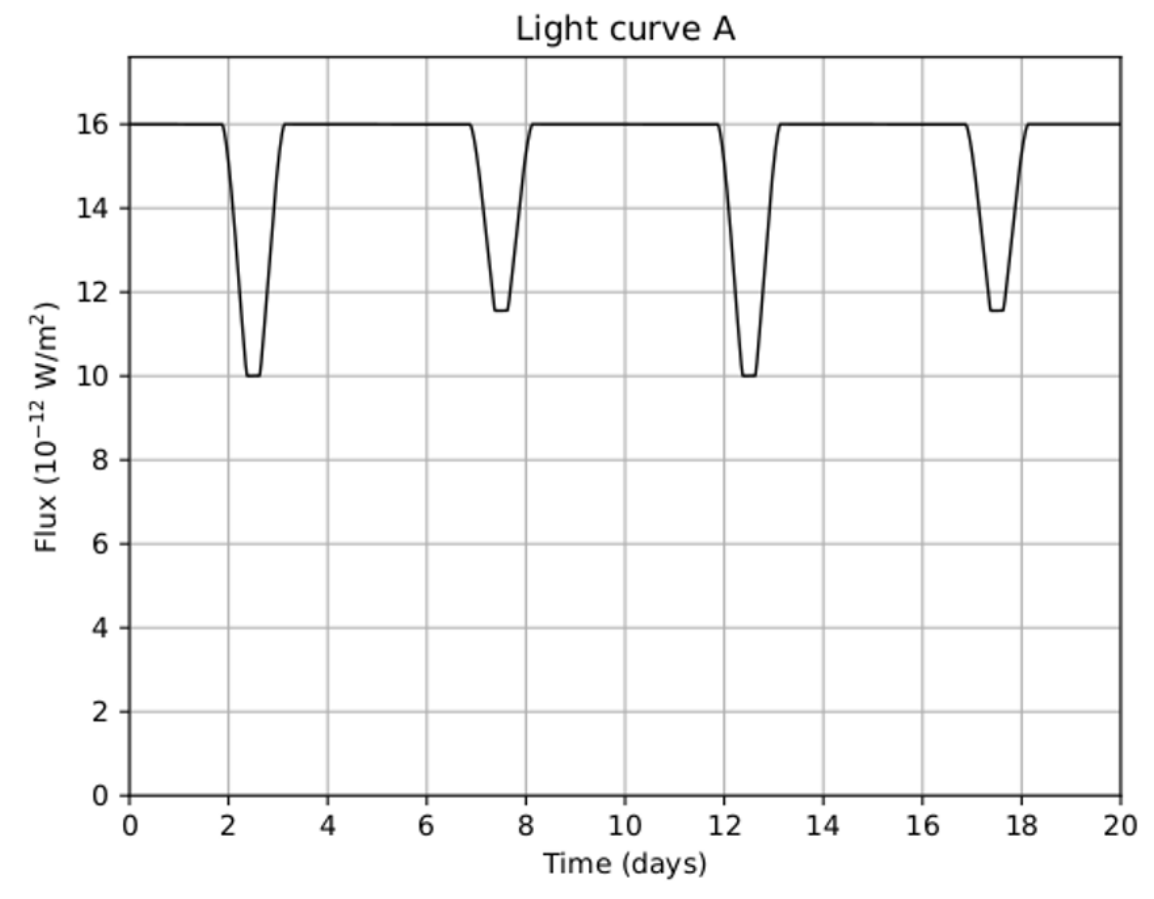
a) Which of the two stars is more likely to be on the main sequence? (Choose “X” or “Y”) [1 т.]
b.i) Based on light curve A, estimate , the ratio of the radii of the two stars; [2 т.]
b.ii) Based on light curve A, estimate , the ratio of the luminosities of the two stars. [2 т.]
c) For light curves B to F, in each case only one parameter of the binary system has been changed from the case in light curve A. For each case, choose the description from the following list that best corresponds to the change (write the appropriate number in the answer sheet).
- Star X increased in size.
- Star X increased in luminosity.
- Star X decreased in size.
- Star X decreased in luminosity.
- Star Y increased in size.
- Star Y increased in luminosity.
- Star Y decreased in size.
- Star Y decreased in luminosity.
- Star X is a variable star.
- Star Y is a variable star.
- The inclination of the system relative to the Earth has changed.
- The distance of the system from the Earth has decreased.
- The distance of the system from the Earth has increased.
- The orbital period of the system increased.
- The orbital period of the system decreased.
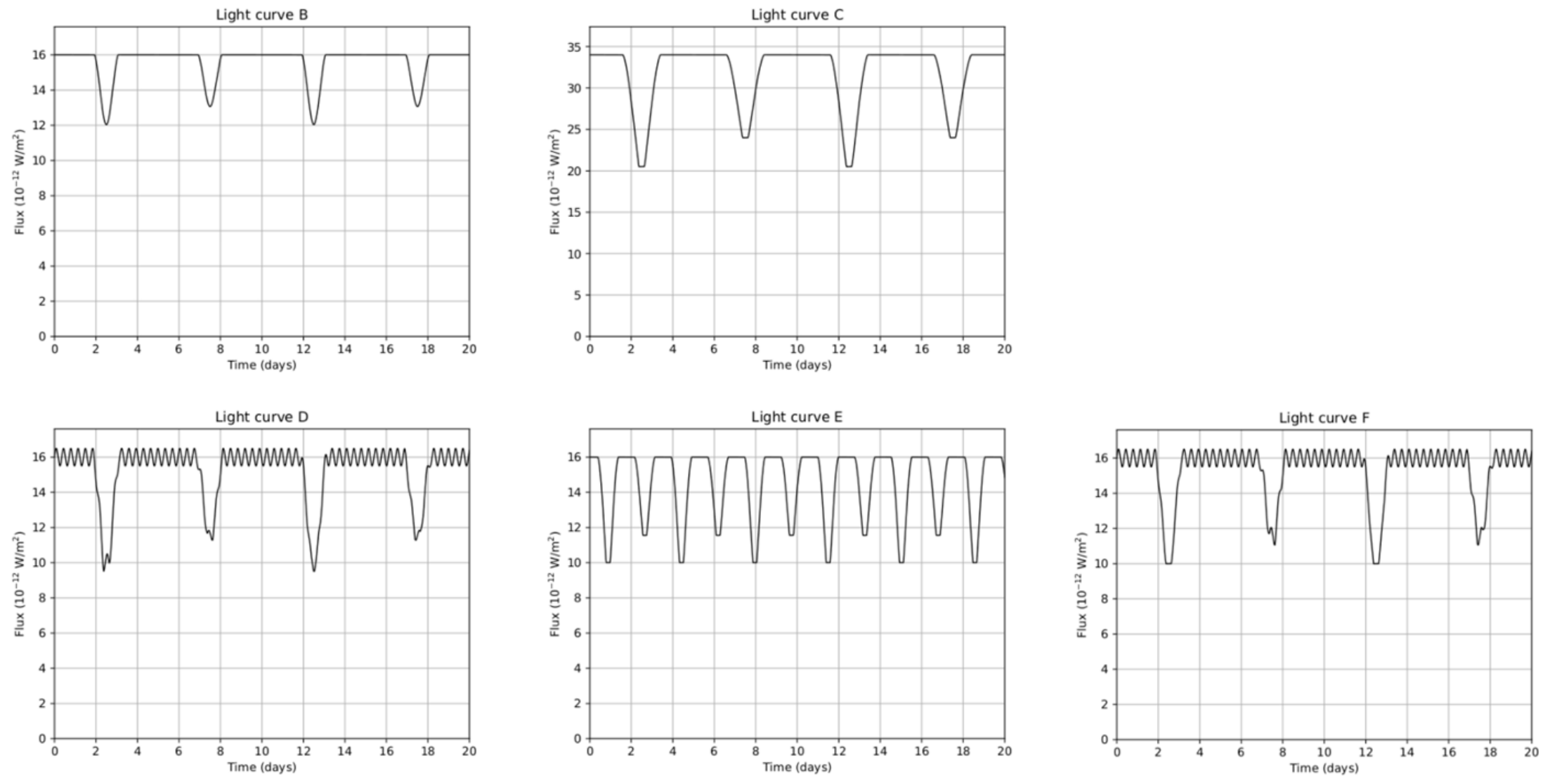
[15 т.]
Отговори
- a) Y.
- b.i) .
- b.ii) .
- c) B: (cxi); C: (cxii); D: (cix); E: (cxv); F: (cx), as printed in the official key.
Решение
(a) As “Y” is smaller, yet hotter, it must be on the main sequence. [1.0]
(b) (I) For this we have to measure the total duration of eclipse and compare it with bottom flat part (total eclipse phase) in the lightcurve. Total eclipse time should be days, flat period of eclipse days. [1.0]
(II) Because star Y is hotter, star Y will be brighter than a part of star X with the same area. Thus, the deeper dip in the light curve is due to star Y passing behind star X. Thus, the flux from star X must be . As the combined flux is , the flux of star Y is . Thus
(c)
- Light Curve B: We see that the dips in brightness both become shallower and have become rounded at the bottom, while the maximum brightness is still . If radius of one of the stars had changed (rounded bottom), then we would expect that total eclipse period to also change. But that has not happened. Brightening of star X can explain shallower dip but not rounded trough. This means that the stars no longer fully eclipse each other. Hence, (cxi): The inclination of the system relative to the Earth has changed. [4.0]
- Light Curve C: The y-axis shows that the overall flux has increased. Since flux of both the stars has gone up by the same factor and there is no substantial change in the profile of eclipse, (cxii): The distance of the system from the Earth has decreased. [4.0]
- Light Curve D: The regular fluctuations in brightness indicate the one components of the system is a variable star. Since the fluctuations persist through all the dips in flux, this indicates that the variable star is never completely eclipsed. Therefore, (cix): Star X is a variable star. [3.0]
- Light Curve E: The overall flux and dips in the flux are the same size, but occur much more frequently. This means that (cxv): The orbital period of the system decreased. [2.0]
- Light Curve F: The regular fluctuations again indicate that one of the components of the system is a variable star. During the primary eclipse, light curve is perfectly flat. This can only occur if, (cx): star Y is a variable star. [2.0]
Source note: The primary bilingual question uses options 1–15 and subparts b.i/b.ii; the English key’s reprint uses Roman (i)–(xv) and b(I)/(II), and asks for the appropriate Roman numeral. Its solution prints the c-prefixed references above. Their description correspondence to the primary question is B: 11, C: 12, D: 9, E: 15, F: 10. All repeated A–F graphs on key pages 8–9 were inspected and correspond to the native question graphs retained here. The answer sheet mentioned in the question/key was not obtained.
Теми и трудност
Оценена трудност: 3/5.
Звезди · Двойни звезди · Променливи звезди · Диаграма на Херцшпрунг–Ръсел
Предпоставки: Гимназиална подготовка, Разширена олимпиадна подготовка
Оригинал в Архива: GeCAA-2020_Theory.pdf · официални решения: Theory Solutions.pdf · допълнителни данни: GeCAA-2020_Constants.pdf