GPhO 2019, Теория — Задача 2. Controlled fusion
The 3nd Gulf Physics Olympiad — Theoretical Competition · 7 октомври 2019 г. · 11 т.
Указания
- The examination lasts for 5 hours. There are 3 problems worth in total 30 points. Please note that the point values of the three theoretical problems are not equal.
- You must not open the envelope with the problems before the signal of the beginning of competition.
- You are not allowed to leave your working place without permission. If you need any assistance (broken calculator, need to visit a restroom, etc), please raise your hand until an organizer arrives.
- Use only the front side of the sheets of paper.
- For each problem, there are dedicated Solution Sheets (see header for the number and pictogram). Write your solutions onto the appropriate Solution Sheets. For each Problem, the Solution Sheets are numbered; use the sheets according to the enumeration. Always mark which Problem Part and Question you are dealing with. Copy the final answers into the appropriate boxes of the Answer Sheets. There are also Draft papers; use these for writing things which you don’t want to be graded. If you have written something that you don’t want to be graded onto the Solution Sheets (such as initial and incorrect solutions), cross these out.
- If you need more paper for a certain problem, please raise your hand and tell an organizer the problem number; you are given two Solution sheets (you can do this more than once).
- You should use as little text as possible: try to explain your solution mainly with equations, numbers, symbols and diagrams. Though in some places textual explanation may be unavoidable.
- After the signal signifying the end of examination you must stop writing immediately. Put all the papers into the envelope at your desk. You are not allowed to take any sheet of paper out of the room. If you have finished solving before the final sound signal, please raise your hand.
Условие
In all your subsequent calculations, you may use the following physical constants and their numerical values.
Boltzmann constant
Elementary charge
Electron’s mass
Planck’s constant
Permittivity of free space
Nuclear fusion is a reaction where light atomic nuclei merge to form a larger nucleus. The difference in the rest energies of the fusing nuclei and the fusion product is released as heat. For instance, if deuterium (consisting of one neutron and one proton, denoted as D) and tritium (consisting of two neutrons and one proton, denoted as T) merge, they will form an -particle, a neutron, and of energy. While humans have learned how to ignite fusion reaction explosively in hydrogen bombs, they are still struggling to succeed in controlled fusion, i.e. to control fusion reaction so that the released heat could be used for operating power plants. The most feasible reaction for a controlled fusion is the above mentioned D-T reaction which will be addressed by this Problem.
Part A. General considerations (0.5 points)
In what follows, we shall express the temperature in electron volts; this is a common practice for so high temperatures. corresponds to such a temperature by which the characteristic thermal energy equals to the potential energy of an electron in electrostatic potential of .
For a power plant, the released fusion energy must be larger than the total energy loss. It can be shown that for an optimally designed D-T reactor (device in which the controlled fusion takes place), the temperature of the deuterium and tritium nuclei should be while the product of the number density of particles (the number of particles per volume) and the confinement time (the time during which density remains roughly constant) should not be less than ; this requirement is know as the Lawson criterion. The main technological challenge is to achieve a long enough confinement of the hot plasma.
A.i. Express the fusion temperature in Kelvins. [0,5 т.]
Part B. Tokamak (2.5 points)
The most popular design of fusion reactors is tokamak. In a tokamak, charged particles move along magnetic field lines and are confined because the field lines are confined into a finite volume of space. Qualitatively, the magnetic field lines have the same shape as in the case of an infinitely long straight current passing coaxially through a circular current loop. In the following subtasks, you’re expected to provide the sketches in a 3d projection as shown in the figure.
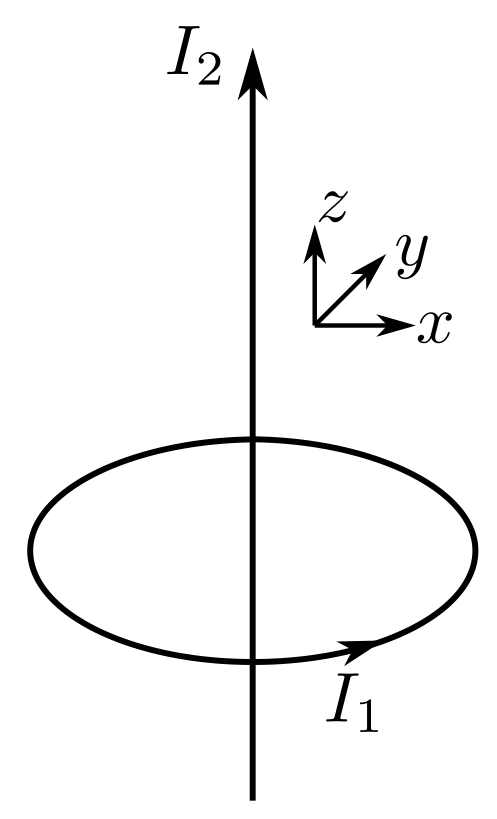
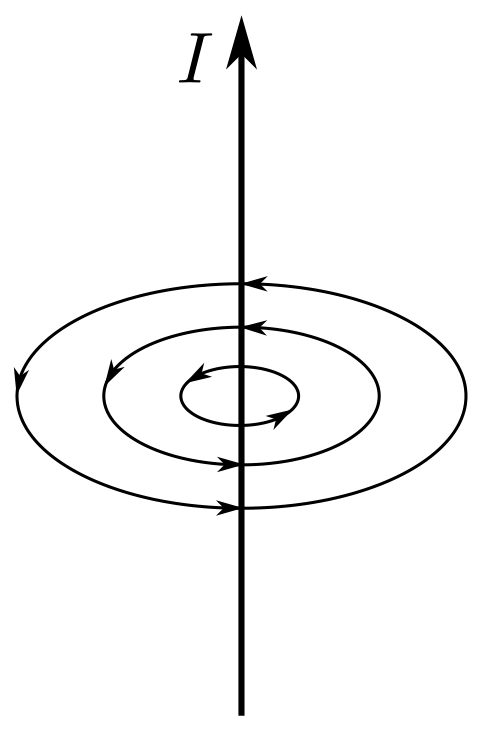
B.i. Sketch magnetic field lines of a infinitely long straight current. [0,5 т.]
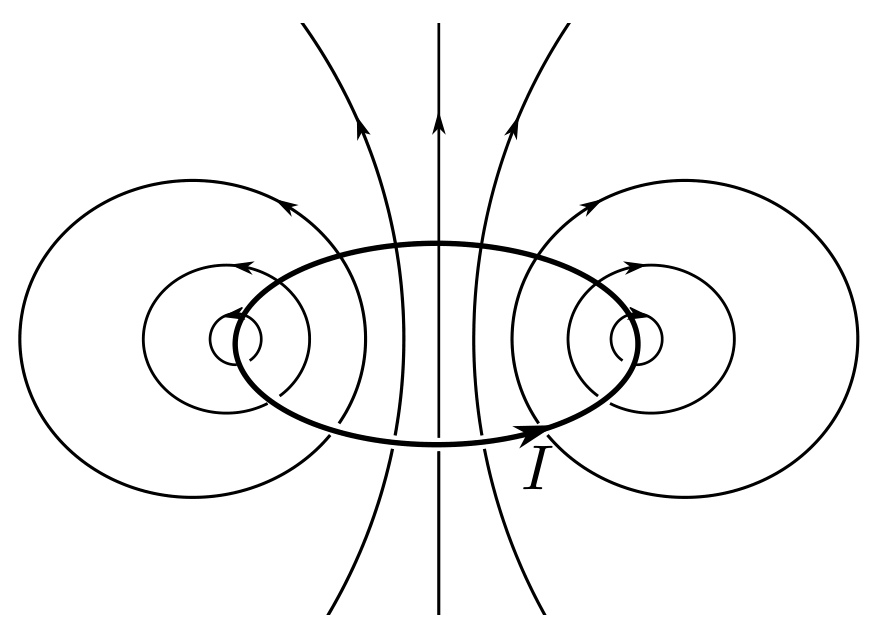
B.ii. Sketch magnetic field lines of a circular current loop. [0,5 т.]
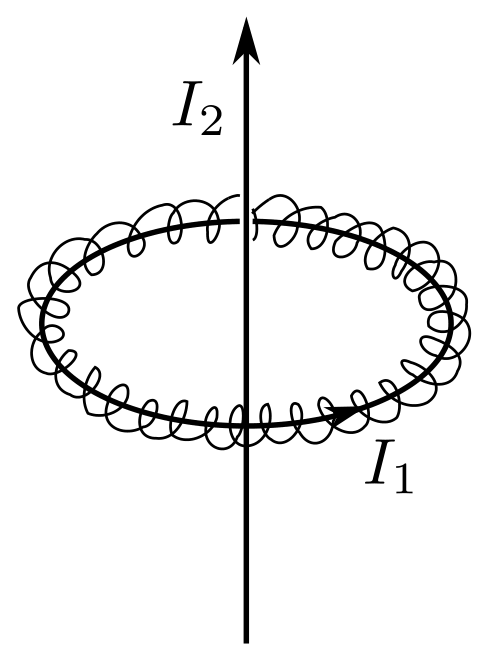
B.iii. Sketch a magnetic field line of an infinitely long straight current passing coaxially through a circular current loop which starts from a small distance from the circular current. [0,75 т.]
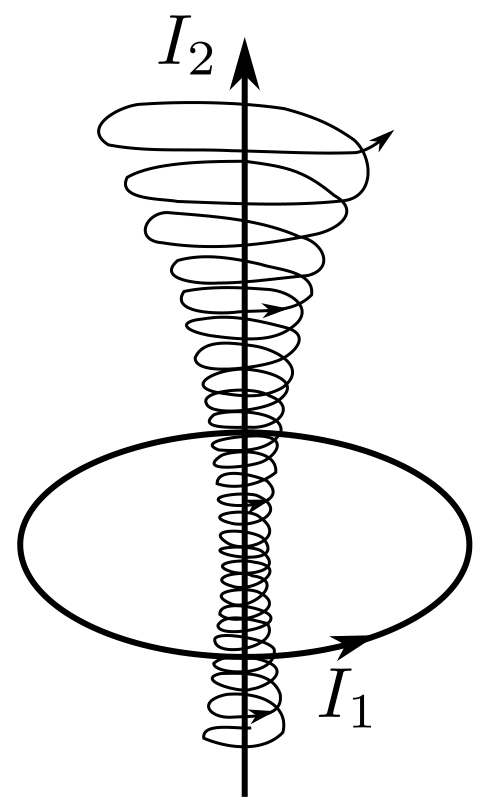
B.iv. For the same current configuration as before, sketch a magnetic field line starting from a small distance from the straight current. [0,75 т.]
Part C. Cold fusion (3.5 points)
“Cold fusion” refers to a muon-catalytic fusion process by which an electron in a hydrogen molecule (which can include one deuterium and one tritium nucleus) is substituted by a muon. Muon, having a 207 times larger mass than an electron, brings the nuclei in the molecule closer to each other, thereby increasing the probability of their fusion. The idea of such a catalytic fusion was suggested in 1947-48 by A. Sakharov and F.C. Frank, and lead to a short-lived research boom in 1989 after an erroneous report of a successful fusion at room temperatures by M. Fleischmann and S. Pons. The problem with muon-catalytic fusion is that the energetic cost of producing one muon is larger than the total energy released by fusion reaction mediated by one muon; the possible solutions are either decreasing the energetic cost of a muon, or increasing the number of fusions mediated by a single muon. In what follows, we consider a simple approach to understand why substituting electrons with muons will decrease the size of an atom.
C.i. Using classical mechanics and considering an electron on a circular orbit of radius around a point-like nucleus of charge , relate the momentum of the electron to the orbit’s radius . [1 т.]
C.ii. At the ground state, the total energy is as small as possible; meanwhile, the state of the electron (muon) cannot violate the uncertainty principle. From these considerations, find an estimate for the radius at the ground state. [1 т.]
C.iii. By the subtask i, we neglected the distance between the two nuclei in the molecule which was permissible for estimating the orbital radius . Now, however, we want also to get an estimate for the distance between the nuclei. To that end, consider another simple model. The two electrons (muons) on their orbit form a ball-like cloud: let us assume that there is a spherical ball of radius carrying a total charge , homogeneously distributed over the entire volume of the ball. Inside the charged ball, there are two nuclei which can be considered as point masses and point charges (of charge each), able to move frictionlessly inside the ball. Find the equilibrium distance between the nuclei. [1 т.]
C.iv. Based on the model suggested above, by how many times is the distance between the deuterium and tritium atoms reduced when orbital electrons are substituted by muons? [0,5 т.]
Part D. Inertial confinement fusion (4.5 points)
Third approach to controlled fusion is based on the idea that due to mass and inertia, it takes some time, although short, for any hot blob of matter to explode and scatter. In order to satisfy the Lawson criterion one can increase the confinement time, but one can also increase the number density . In the inertial confinement fusion devices, powerful beams are used to create highly compressed balls of gas of densities exceeding the density of lead by hundreds of times. In what follows, we consider this approach by adopting a simple model: a liquid spherical shell of total mass and radius is surrounding a ball of gas of number density , temperature , and pressure (in reality, the shell is solid, but at really high pressures, solids essentially liquify); see the figure. Each gas molecule consists of a deuterium nucleus, tritium nucleus, and two electrons. The thickness of the walls of the spherical liquid shell is much smaller than ().
D.i. Consider a small piece of shell of surface area . Express its mass in terms of the quantities introduced above. [0,5 т.]
D.ii. External pressure () is applied to the shell. Express the initial acceleration of a small piece of the shell in terms of the quantities introduced until now. [1 т.]
D.iii. While the shell contracts due to external pressure, the pressure inside grows, and at a certain moment, it becomes larger than the external pressure. Express the minimal radius of the shell and the maximal temperature inside the shell (which are achieved when the surrounding shell stops for a moment before reversing its direction of motion) in terms of the quantities introduced above. Keep in mind that the inside temperature becomes so high that the gas is converted into a completely ionized plasma made of nuclei and electrons. You may assume that remains constant during the entire process (this might not be entirely true, but under this assumption, we shall still be able to get a correct order of magnitude for the answer), the shell contracts while retaining its spherical shape, and the thermal energy transferred to the shell can be neglected. [1,5 т.]
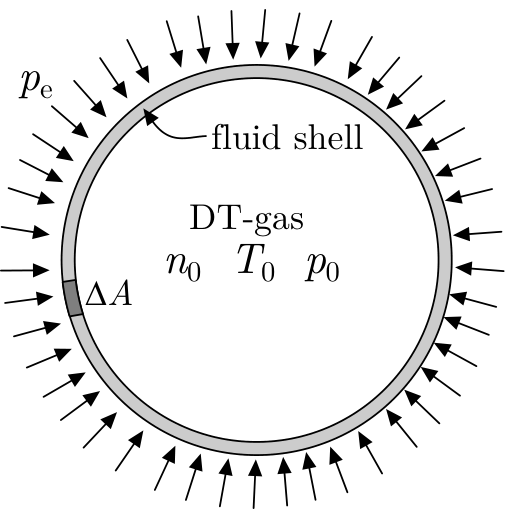
D.iv. The huge external pressure is created by irradiating the shell from outside, isotropically from all sides, with a laser of total output power . As a result, the outer layers of the shell are evaporated, and the evaporated atomic nuclei flow away at the average speed of . Estimate the pressure in terms of , , and ; you may assume that is much smaller than the speed of light. [1,5 т.]
Отговори
A.i. ≈ K
C.i.
C.ii.
Official values: R(m = me) = 1.7×10⁻¹⁰ m, R(m = mμ) = 8.1×10⁻¹³ m.
C.iii.
C.iv. ≈
D.i.
D.ii.
D.iii.
D.iv.
Решение
Part A. General considerations (0.5 points)
i. (0.5 pts) We need to equate thermal and electrostatic energies, (0.2 pts)
with . (0.1 pts)
Hence, the fusion temperature can be expressed in Kelvins as (0.1 pts)
which yields numerically
(0.1 pts)
Part B. Tokamak (2.5 points)
i. (0.5 pts) The magnetic field lines curl around the straight current with the direction determined by the right hand rule or something equivalent. (0.2 pts)
(0.3 pts)
Only one fieldline shown: -0.1 pts. No direction of the fieldlines shown: -0.2 pts; wrong direction: -0.1 pts.
ii. (0.5 pts) Very close to the circular loop, the magnetic field is similar to that of a straight wire. Far away, the magnetic field lines correspond to that of a magnetic dipole. (0.2 pts)
The in-between area can be approximate drawn as shown in the figure
(0.3 pts)
Only one fieldline shown: -0.1 pts. No direction of the fieldlines shown: -0.2 pts; wrong direction: -0.1 pts.
iii. (0.75 pts) Without the infinite wire, the field line would make a short circular loop around the circular current and terminate. In the presence of the long wire, a tangential component of the magnetic field is added, so the previously circular magnetic field line starts to drift in the tangential direction around the infinite wire while still winding rapidly around the circular loop. This forms a helical pattern along the surface of a toroid as shown in the figure. (0.25 pts)
(0.5 pts)
iv. (0.75 pts) Using similar arguments, without the presence of the circular loop, the magnetic field lines would make a short circular loop around the infinite wire and then terminate. If we add the circular loop, the field lines start drifting along the field lines of the circular loop that are very close to the center (the field lines lie on the - and -axis in cylindrical coordinates) while winding rapidly around the symmetry axis (after all, the magnetic field strength from the infinite wire is much bigger). This means that the field line forms a dense helix that’s slowly getting wider and wider the farther away you go from the plane of the circular loop until it eventually completes the loop by coming back very far away from the circular loop. (0.25 pts)
(0.5 pts)
If the helix doesn’t get wider, subtract 0.15 pts from the full score.
Part C. Cold fusion (3.5 points)
i. (1 pt) The electron (muon) experiences an electrostatic force of
(0.4 pts)
where the factor of two comes from the fact that the nucleus has charge . This is an attractive force and it acts as a centripetal force
(0.4 pts)
(formula for centripetal acceleration only yields 0.3 pts). Combining the two, one gets
(0.2 pts)
ii. (1 pt) According to the uncertainty principle, the standard deviation of the momentum and the position of the particle obey the following inequality
(0.3 pts)
where is the reduced Planck’s constant. Since we are after an estimate, the numerical factors do not really matter so we will omit those from now on. The momentum of the electron (muon) is always so , whereas the standard deviation of the position is in the order of the radius of the circle, so . (0.3 pts)
This yields
(0.1 pts)
Solving for gives
(0.2 pts)
For an electron, , for a muon, . (0.1 pts)
No marks for energy expressions, and no marks for .
iii. (1 pt) Due to symmetry, we need only consider the force balance on one of the nuclei because the other one experiences exactly the same forces. (0.1 pts)
The force balance is between the electromagnetic force from the other nucleus and from the electron (muon cloud). The first corresponds to a repulsive force of
(0.2 pts)
With the electron (muon) cloud, only the charge that is inside a sphere of radius contributes to the electromagnetic force. This can be verified using Gauss’ theorem on the said sphere. (0.1 pts)
The charge inside the smaller sphere is given by , because the charge of the sphere scales as the radius cubed.
(0.2 pts)
The force from the cloud is then
(0.2 pts)
Now, because of force balance, , so
(0.1 pts)
Solving for , one gets
(0.1 pts)
iv. (0.5 pts) Since scales linearly with and is inversely proportional to the mass, the distance between the nuclei is reduced by a factor of . (0.5 pts)
No marks for the answer without any motivation. The points can be obtained only by summarizing the results of Ciii and Civ. Using the result of Civ without the result of Ciii gives 0.1 pt.
Part D. Inertial confinement fusion (4.5 points)
i. (0.5 pts) The fluid shell has uniform mass density along its surface which can be expressed as , where is the total area of the shell. (0.2 pts)
The mass of the small piece is therefore
(0.3 pts)
ii. (1 pt) Since the external pressure is much bigger than the internal, the shell will start contracting. (0.2 pts)
The total force acting on the small piece is , where a positive force would be pointing radially outwards. (0.5 pts)
The acceleration can therefore be expressed as
(0.3 pts)
iii. (1.5 pts) Since , the final pressure is also much smaller than . Indeed, the shell accelerates until the pressure inside becomes equal to the external pressure and continues motion due to inertia, until huge inside pressure stops the motion. So, final volume is correspondingly much smaller than the initial — this can be inferred from the adiabatic law . (0.2 pts)
So, the work of the external force can be calculated as
(0.2 pts)
This work goes to the internal energy,
(0.2 pts)
where is the heat capacitance by constant volume per one particle, and is the total number of particles. (0.2 pts)
Since the gas becomes totally ionized, each DT molecule will produce 4 particles. (0.2 pts)
So, , where
(0.2 pts)
Bringing all expressions together, we obtain
(0.2 pts)
To find , we combine adiabatic law and ideal gas law to obtain . This gives and since , we get
(0.1 pts)
iv. (1.5 pts) To get an estimate of the induced pressure, we can say that all of the power from the laser goes to increasing the kinetic energy of the evaporated outgoing flow of mass. (0.3 pts)
If the absolute sign of the rate of change of the mass of the outer shell is , then, by considering a small interval of time , conservation of energy reads as
(0.3 pts)
Therefore,
(0.3 pts)
From the conservation of momentum, one can write
(0.3 pts)
so
(0.3 pts)
Оригинал в Архива: th.pdf · официални решения: th_sol.pdf