GPhO 2022, Теория — Задача 1. Dark matter
The 4th Gulf Physics Olympiad — Theoretical Competition · 14 март 2022 г. · 10 т.
Указания
- The examination lasts for 5 hours. There are 3 problems worth in total 30 points.
- You must not open the envelope with the problems before the signal of the beginning of competition.
- You are not allowed to leave your working place without permission. If you need any assistance (broken calculator, need to visit a restroom, etc), please raise your hand until an organizer arrives.
- Use only the front side of the sheets of paper.
- For each problem, there are dedicated Solution Sheets (see header for the number and pictogram). Write your solutions onto the appropriate Solution Sheets. For each Problem, the Solution Sheets are numbered; use the sheets according to the enumeration. Always mark which Problem Part and Question you are dealing with. Copy the final answers into the appropriate boxes of the Answer Sheets. There are also Draft papers; use these for writing things which you don’t want to be graded. If you have written something that you don’t want to be graded onto the Solution Sheets (such as initial and incorrect solutions), cross these out.
- If you need more paper for a certain problem, please raise your hand and tell an organizer the problem number; you are given two Solution sheets (you can do this more than once).
- You should use as little text as possible: try to explain your solution mainly with equations, numbers, symbols and diagrams. Though in some places textual explanation may be unavoidable.
- After the signal signifying the end of examination you must stop writing immediately. Put all the papers into the envelope at your desk. You are not allowed to take any sheet of paper out of the room. If you have finished solving before the final sound signal, please raise your hand.
Условие
One of the main unsolved problems in modern physics is concerning dark matter. It’s a hypothetical form of matter which gets its name from its peculiar property not to interact with electromagnetic fields (i.e. light), making it very difficult to detect. It’s thought to account for around of matter in the universe, including most of the mass in galaxies.
The existence of dark matter is motivated by various astrophysical observations which cannot be explained unless there’s more matter that cannot be seen. The primary candidate for dark matter is a new elementary particle that’s yet to be discovered. Experiments to directly detect and study dark matter particles are ongoing but have yet to succeed.
This task focuses on one indirect observation of dark matter and tests its agreement with a potential model for dark matter.
Part A. Rotation curves (5.5 points)
For this part, you may use the following physical constants and their numerical values:
Gravitational constant .
.
Duration of one year is days.
Rotation curves are a commonly used method to deduce the matter densities of galaxies. A rotation curve shows the orbital speeds of stars in a particular galaxy as a function of the radial distance from the galaxy’s centre. The following figure shows the simplified rotation curve of the Milky Way. We approximate it into two regions A and B, one with a linearly increasing profile from 0 to for , and the other with a constant velocity profile for .
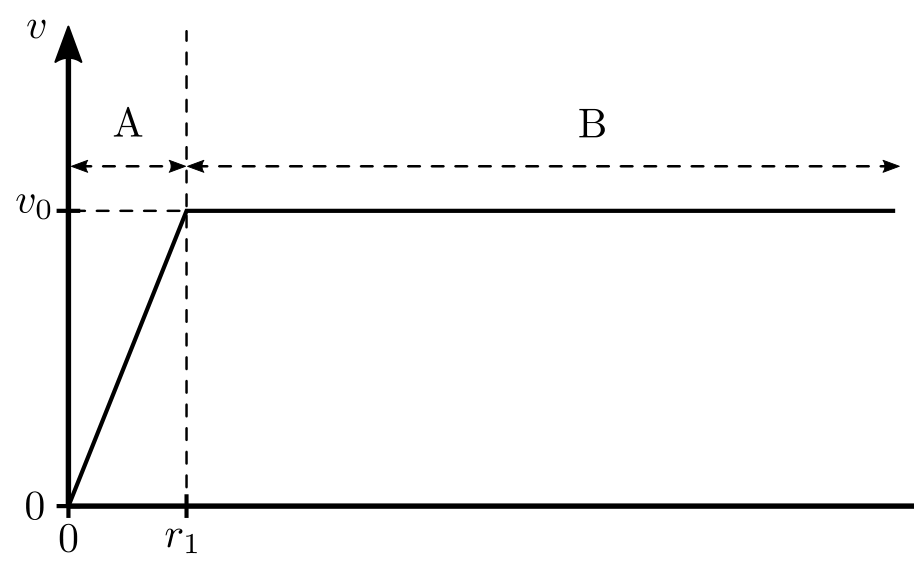
A.1 How far is the Sun from the centre of the galaxy if its orbital period is ? [1 т.]
A.2 Consider a test particle of negligible mass in a circular orbit of radius around a point mass . Find the orbital speed of the test particle. [1 т.]
A.3 Consider a cloud of gas of uniform density and radius . Express the orbital speed of the aforementioned test particle for both when and in terms of , , and the physical constants. Also find an expression for the potential energy per unit mass in the cloud. [1,5 т.]
A.4 We now focus on the Milky Way galaxy. Deduce the matter density as a function of in both of the regions A and B shown on figure 1. You may assume spherical symmetry. [1,5 т.]
A.5 In the neighbourhood of the Sun, stars are typically separated by a distance of from each other. Estimate the density of visible mass (in the form of stars) in the solar neighbourhood. Compare this with the results from part 4. and comment on potential discrepancies. Take the mass of a typical star to be . [0,5 т.]
Part B. Self-interacting dark matter (4.5 points)
Self-interacting dark matter, or SIDM for short, is one of the many proposed classes of dark matter particles. Like most DM models, it interacts weakly with ordinary matter via gravity. Its main characteristic is that the particles interact strongly with each-other, leading to energy and momentum exchange between dark matter particles. Specifically, the interactions happen with a rate large enough that the dark matter in a galaxy thermalizes and assumes a uniform temperature . We additionally consider the dark matter gas to be sparse enough (i.e. classical) so that Boltzmann statistics can be used for describing how the particle densities and velocities are distributed.
B.1 According to Boltzmann statistics, the density of dark matter is proportional to
where is the potential energy per unit mass at the respective position in space and is the mass of a dark matter particle.
Assuming that most of matter in the Milky Way is made up of dark matter, which region(s) can agree with the implications of the SIDM model? [1,5 т.]
B.2 Find the thermal speed of the dark matter particles in the aforementioned region(s) that agree with the SIDM model. [1 т.]
B.3 One of the key assumption for the isothermal model to work is that the dark matter particles undergo enough collisions to thermalize, i.e. the mean free path length of dark matter particles is significantly smaller than the characteristic size of the Milky Way. Based on this, give an estimate for the lower bound of the ratio of the self-interaction cross section to the mass of a dark matter particle. [1 т.]
B.4 Another of our assumptions has been that the SIDM gas is classical in nature, i.e. the density of the gas is well below the limit where quantum effects become evident. This condition can generally be written as
where is the number density of dark matter, the Boltzmann constant, and the reduced Planck’s constant. Based on this, give a lower bound for the mass of a dark matter particle for the classical considerations to apply in the Milky Way. [1 т.]
Отговори
A.1 8.1 kpc
A.2
A.3
A.4
A.5 ; visible mass is concentrated in the non-spherical galactic disc.
B.1 Only region B ().
B.2 400 km/s
B.3 0.7 m²/kg
B.4 kg
Решение
Part A. Rotation curves (5.5 points)
1. (1 pt) If Sun’s orbital speed is , then it must cover a distance of in one full period. Here, is Sun’s distance from the galactic centre. Hence,
The Sun can be in one of the regions, either or . If , then and so we get which, after plugging in the values, gives a contradiction. (0.3 pts)
Hence, and . Therefore,
Indeed, .
2. (1 pt) The orbiting test particle of mass experiences gravitational acceleration
which acts as the centripetal force
due to it orbiting on a circular trajectory. Equating the two, we find
If the student writes the final answer directly, they receive full marks.
3. (1.5 pts) Solving this part requires the use of Gauss’ law for gravity. Applying it gives that the gravitational acceleration at a given point is only dictated by the mass that’s within an imaginary sphere of radius . (0.3 pts)
Outside of the cloud, when , via Gauss’ law, the gas acts as a point mass of mass and the speed is therefore given by . (0.2 pts)
Inside the cloud, when , the mass within is given by and so the speed is . (0.3 pts)
The gravitational acceleration inside and outside the cloud are given by
The potential energy in the cloud can be found from its integral definition
4. (1.5 pts) The speed profile in the region is linearly increasing, which is also the case for the uniform density cloud in part 3. Hence, in region A, when , is constant (0.2 pts) and can be found from
to be
In region B, when , we have . This doesn’t directly agree with any of the previously investigated scenarios. We can still express the total enclosed mass as
The differential of the mass can be related to the density at via . Thus,
If the student calculates the average density , then they lose up to (0.5 pts) in the last point.
5. (0.5 pts) From the previous part, We calculate the matter density at to be
The visible density around the Sun can be estimated as the product of the number density of stars and the mass of a typical star. This gives
We see that . The reason for this is that when calculating total matter density, we assumed spherical symmetry, while visible mass is concentrated on the galactic disc, which is highly non-spherical. As a result, underestimates the density around the solar neighbourhood. (0.2 pts)
Part B. Self-interacting dark matter (4.5 points)
1. (1.5 pts)
In region A, when , we have and . However, Boltzmann statistics would predict the density to be
where is a constant. This can’t agree with the actual constant density, no matter the value of . Hence, doesn’t agree with the SIDM model. This is not surprising, as visible matter dominates in the centre of the galaxy. (0.5 pts)
In region B, when , we have . The potential can be found by integrating. First,
and so
doesn’t converge at infinity, instead we substituted the infinite limit by a constant, as in reality the constant speed profile can’t be sustained indefinitely (that would lead to infinite mass galaxy) and must decay at some point. Boltzmann statistics would then predict the density to be
stands as a proxy for a constant. This must agree with and indeed, it’s satisfied when we set and . Hence region B is the only region that agrees with the SIDM model. (0.3 pts)
2. (1 pt) In region B, when , we found that . In an isothermal gas, the thermal speed satisfies
so . (0.3 pts)
3. (1 pt) When travelling a radial distance of , a dark matter particle encounters around other particles. (0.4 pts) Here is the cross-sectional area of a dark matter particle, and is the number density of dark matter. The thermalization condition in region is then
Hence,
4. (1 pt) We use and to get
Hence,
This is significantly smaller than any other elementary particle. For example electron’s mass is .
Оригинал в Архива: th.pdf · официални решения: th_sol.pdf