GPhO 2022, Теория — Задача 3. Physics of sports
The 4th Gulf Physics Olympiad — Theoretical Competition · 14 март 2022 г. · 10 т.
Указания
- The examination lasts for 5 hours. There are 3 problems worth in total 30 points.
- You must not open the envelope with the problems before the signal of the beginning of competition.
- You are not allowed to leave your working place without permission. If you need any assistance (broken calculator, need to visit a restroom, etc), please raise your hand until an organizer arrives.
- Use only the front side of the sheets of paper.
- For each problem, there are dedicated Solution Sheets (see header for the number and pictogram). Write your solutions onto the appropriate Solution Sheets. For each Problem, the Solution Sheets are numbered; use the sheets according to the enumeration. Always mark which Problem Part and Question you are dealing with. Copy the final answers into the appropriate boxes of the Answer Sheets. There are also Draft papers; use these for writing things which you don’t want to be graded. If you have written something that you don’t want to be graded onto the Solution Sheets (such as initial and incorrect solutions), cross these out.
- If you need more paper for a certain problem, please raise your hand and tell an organizer the problem number; you are given two Solution sheets (you can do this more than once).
- You should use as little text as possible: try to explain your solution mainly with equations, numbers, symbols and diagrams. Though in some places textual explanation may be unavoidable.
- After the signal signifying the end of examination you must stop writing immediately. Put all the papers into the envelope at your desk. You are not allowed to take any sheet of paper out of the room. If you have finished solving before the final sound signal, please raise your hand.
Условие
Part A. Hammer throw (4 points)
A hammer is an iron ball of mass density and , fixed to steel wire with a grip on the other end. The length of the steel wire (grip included) is ; the mass and air drag of the wire and the grip can be neglected. During the flight, a drag force acts on the hammer, where is the speed of the hammer with respect to the air, — the cross-sectional area of the iron ball, and — the density of air. Free fall acceleration is .
An athlete throws a hammer to a distance of . Assume that (a) the launching velocity of the hammer forms an angle of with respect to the horizon; (b) immediately before the hammer is released, the hammer moves along a circle of radius , where denotes the length of the arms; (c) the height of the hammer above the ground immediately before it is released can be neglected (i.e. taken to be equal to zero).
A.1 What is the speed of the hammer just before being released if we neglect the effect of air drag on the hammer? [0,5 т.]
A.2 What is the force with which the athlete pulls from the grip at the final stage of his throw? [1 т.]
A.3 From this part onwards, we consider the effects of air drag. Find the air drag acting on the hammer at the beginning of its flight. [0,5 т.]
A.4 Estimate as precisely as you can by how much is the final speed of the hammer (just before hitting the ground) smaller than its initial speed. [1 т.]
A.5 Estimate as precisely as you can by how much would the distance of the throw be longer if there were no air drag. [1 т.]
B Part B. Discus throw (1 points)
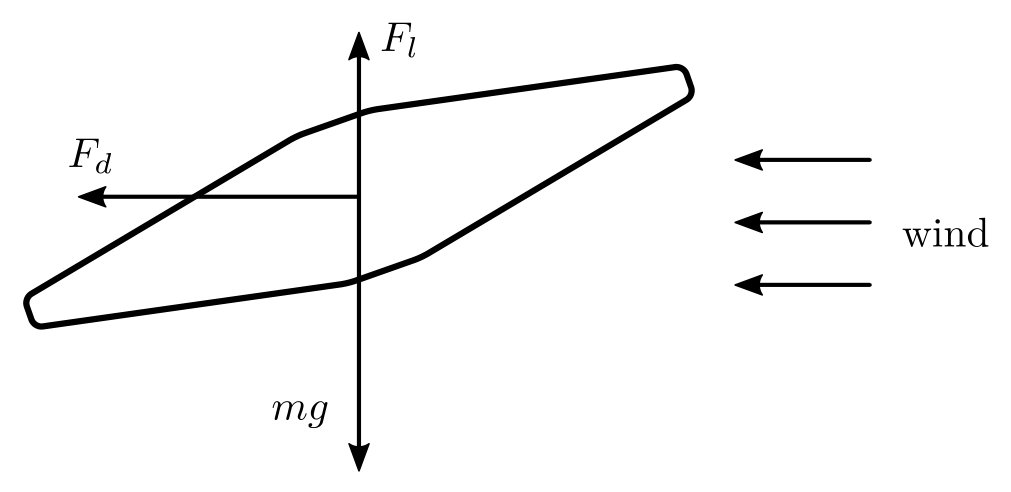
Usually tailwind helps in sports, but not in discus throw. Explain qualitatively, why headwind can increase the distance reached in discus throw. Use a force diagram to show which forces are acting on a discus during its flight and in which way they are influenced by headwind. [1 т.]
Part C. Pole vault (5 points)
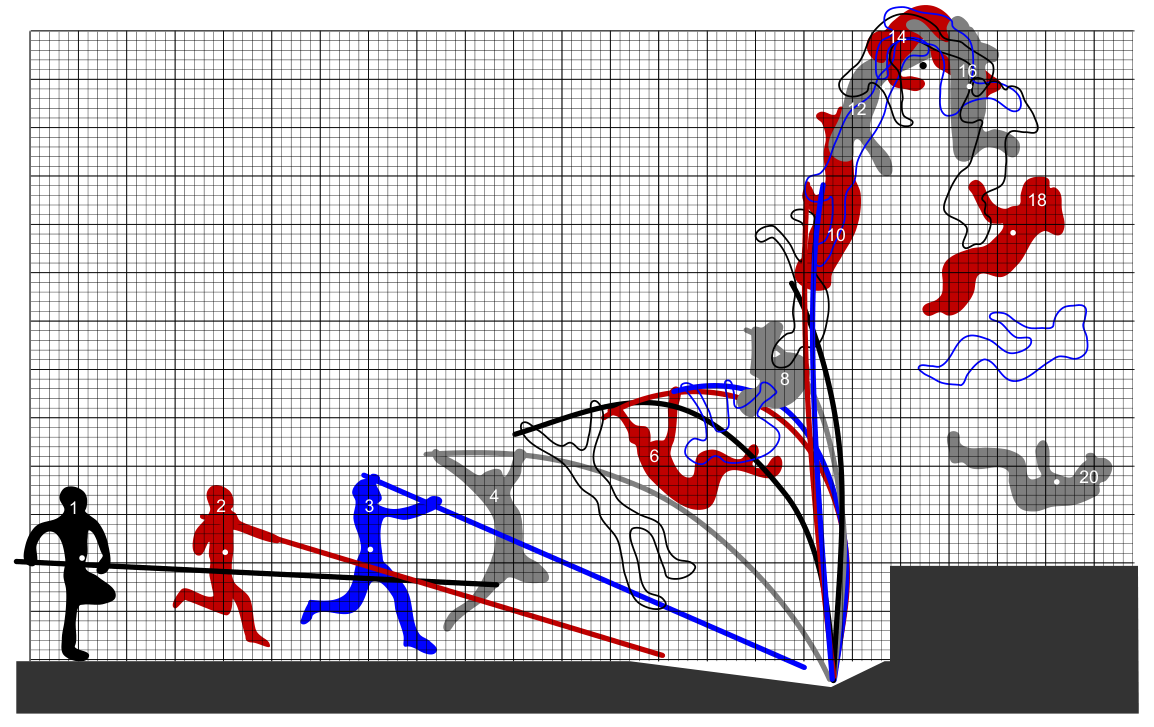
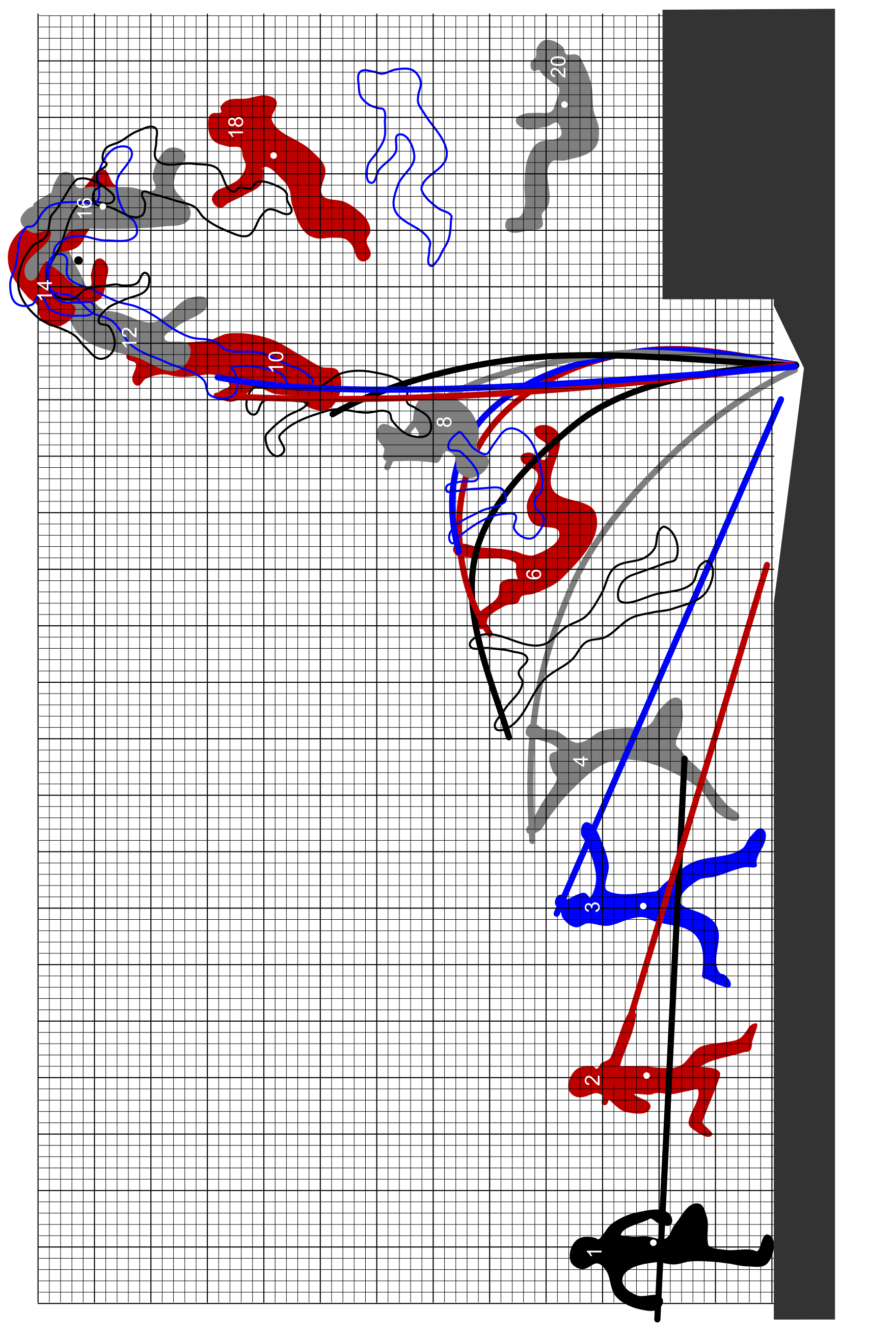
The figure shows an athlete (Armand Duplantis) setting the new world record of in pole vault (a bigger figure can be found in the next sheet). The figure is to scale and the inter-line distance of the grid is . What you can see is an overlay of a series of 20 snapshots, the time interval between two subsequent snapshots is not known. For positions 1, 2, 3, 16, 18, and 20, the white dots show the position of the centre of mass of the athlete. The black dot shows the location of the bar. To avoid clutter, some position numbers are not shown.
C.1 For which position is the elastic energy of the pole the largest? [0,5 т.]
C.2 Determine the value of the time interval by taking appropriate readings from the figure. Free fall acceleration is .
Remark: if you are unable to do it, in what follows you may use a very approximate value of . [2 т.]
C.3 Find the speed of the athlete at the position No 2. [0,5 т.]
C.4 During the jump, from the position No 3 to 12, the athlete performs a certain amount of mechanical work with his muscles. Find this work if the mass of the athlete is . You may neglect the mass of the pole. [1 т.]
C.5 What was the maximum height of the centre of mass of the man during the jump? Give the height with respect to the ground (corresponding to the lower boundary of the grid). [1 т.]
Отговори
A.1 28 m/s
A.2 2.57 kN
A.3 2.64 N
A.4 0.814 m/s
Exact answer; the official estimates give 0.96 m/s (energy approach) and 0.77 m/s (momentum approach).
A.5 2.39 m
Exact answer; the official estimate gives 2.68 m.
C.1 7
C.2 0.165 s
C.3 8.9 m/s
C.4 1 kJ
C.5 6.39 m
Решение
Part A. Hammer throw (4 points)
1. (0.5 pts) We can neglect air drag in this part. The hammer is launched at an angle and travels a distance of . If the starting speed is , the airtime can be expressed as
The horizontal component of the velocity is constant and equal to
The travelled distance is thus
and so
2. (1 pt) Before being released, the hammer moves on a circular trajectory of radius . (0.1 pts)
This means that the hammer experiences a centripetal acceleration of . (0.3 pts)
This is provided by the tension force . (0.1 pts)
The tension force is compensated by the athlete pulling from the grip. Note that the gravitational force is pointing downwards and hence, is perpendicular to the steel wire which is horizontal at the moment when the hammer is released. So the gravitational force cancels out from the force balance projected to the direction of the wire. Hence, the force exerted by the athlete is equal to the centripetal force. (0.1 pts)
So, we obtain
which yields numerically . (0.1 pts)
3. (0.5 pts) We can calculate the drag force from the formula . The radius of the hammer can be found from the expression for its mass . Hence,
and so and (0.2 pts)
4. (1 pt) There are two main approaches. The more reliable one is using energy arguments, the second one using momentum. Both approaches start by noting that the air drag has minimal impact on the velocities and falling positions of the hammer. As such, we can take the hammer’s trajectory to be parabolic in the first order, and calculate the second order corrections drag force would have based on the average drag air imparts on the hammer.
One critical thing to note is that we calculated ignoring air drag. In reality, the starting speed is a bit bigger to account for drag, but the effect of this on the quantities that this and the following sub-task ask for is negligible. Hence, we still consider the parabolic trajectory starting with speed and spanning a horizontal distance of (this doesn’t need to be explicitly mentioned to get full marks).
Approach 1. Energy considerations:
From conservation of energy, the work done by air drag corresponds to change in the kinetic energy between starting and final positions. (0.1 pts)
Hence, if we can estimate the performed work, we get an estimate for the change in speed. In general, the work done in a segment of length is . The total work done can therefore be approximated as the product of the average drag force and the total length of the parabola. (0.1 pts)
The speed of the hammer starts off at , then decreases to at the top of the parabola, and then increases back to when it lands. This means the drag force goes from to and back to . The average can be estimated as . (0.2 pts)
The length of the parabola can be estimated by noting that the actual length of a small segment is times bigger per its horizontal projection at the sides of the parabola, and equal to the projection at the peak. The length of the parabola is then roughly times the horizontal projection, . (0.2 pts)
Putting all this together,
The conservation of energy reads , where is the final speed. (0.2 pts)
Therefore,
Approach 2. Momentum considerations:
The airtime of the hammer is . (0.2 pts)
To a decent approximations, we can decompose the air drag’s action into separate horizontal and vertical components. As such, the horizontal drag at the beginning and at the end of the flight is , and at the middle of the flight — . We can estimate the average horizontal drag either as the arithmetic average of these two magnitudes, or just take the value from the middle of the flight, because the hammer spends near the maximum height relatively more time than near the ground level. (0.2 pts)
The drag in the vertical directions is smaller as it starts with the same value , but at the middle of the flight vanishes ( goes from to , passing through 0). We can estimate its average value as the arithmetic average of the initial/final value and the value at the middle of the flight, so . (0.2 pts)
As such, the changes in the horizontal and vertical velocity components can be estimated as and . (0.2 pts)
The total change in speed is then
Exact answer: .
5. (1 pt)
One might naturally extend the two approaches in the previous subtask. However, there’s a crucial difficulty with using the average horizontal deceleration and that is that the flight duration changes slightly, providing a comparable contribution to the change in length as the horizontal deceleration. This usually results in an error that’s bigger than . A more accurate approach is to think in terms of the spans of parabolas with different starting speeds, outlined below.
As mentioned in the previous subtask, we’re approximating the change in throwing length as the distance between the landing positions of when the hammer is thrown with speed with and without drag. Without drag, it flies a distance , but with drag it falls somewhere in-between two points defined by where the hammer falls without drag if the starting speeds were and . We can roughly take this to be in-between the two positions. Hence, with drag the hammer flies a distance of (0.8 pts)
and so
Exact answer: .
Part B. Discus throw (1 points)
Even though air drag is stronger during headwind, the wind serves to provide a lift force to the disc, giving it prolonged air time and allowing it to fly farther. (0.5 pts)
(If additionally to the lift force, other arguments are mentioned, e.g. propelling by rotation, subtract 0.2)
A qualitative force diagram is shown below. The diagram should highlight a tilted discus being pushed against by a headwind. (0.2 pts)
It should also show gravity, drag and lift force acting on the disc (or instead of the drag and lift, the resultant drag force which is pointed at a more vertical angle than usual). (0.3 pts)
(If any force in the direction of motion is shown, subtract 0.1)
Part C. Pole vault (5 points)
1. (0.5 pts) The pole stores its elastic energy in bending deformation, i.e. the more it bends, the more elastic energy is stored. (0.3 pts)
From the figure, we see that positions 6 and 7 have the most deformed pole. In 7, it’s slightly more bent, as can be seen from how the end points of the poles are closer together. Hence, the answer is 7. (0.2 pts)
2. (2 pts) We can determine the time interval from the fact that in-between positions 9 and 20, the man is in free-fall. Specifically, the coordinate of the centre of mass follows a quadratic . (0.5 pts)
We measure the coordinates at positions 16, 18, and 20 to be , , . (0.6 pts)
The time difference between two consecutive recorded points is . (0.1 pts)
Subtracting , we get
We can solve this by plugging from one equation to the other. Solving the resulting equation gives us
3. (0.5 pts) We can estimate the speed of the man as the distance covered between positions 1 and 3 divided by . (0.3 pts)
From the figure, we measure and so . (0.2 pts)
4. (1 pt) We can find this from conservation of energy. For one, there is no work being done by the pole as it starts and ends completely straight (and has negligible kinetic energy). Further, the energy at position 12 is the same as in 16 (because the man is in free-fall). The conservation of energy then reads
From the figure, we measure , (with respect to some arbitrary reference point), . (0.2 pts)
From part ii., we calculate . (0.2 pts)
We also approximate the horizontal component of the velocity at 16 as and . (0.2 pts)
We can finally manipulate the conservation of energy to
5. (1 pt) The maximal height of the centre of mass can be found following the measurements from part ii. (0.2 pts)
From there we found that , . Hence, the peak took place in the past and it has coordinates . (0.8 pts)
Оригинал в Архива: th.pdf · официални решения: th_sol.pdf