IAO 2000, Практически тур, Група β — Задача 1
SPECTRA OF A PLANETARY NEBULA "CAT EYE" AND ITS CENTRAL STAR
Source discrepancies
The English source prints “1865”, “Heggins” and wavelength units “e”; its text refers to Fig. 1a–1c while its answer table says 2a–2c. These readings are retained. The genuine supplied solution is reproduced in its original Russian. The first carbon wavelength has a faint zero in the original table; the original image is included alongside its transcription. The printed equation (87−56)/2=15 and duplicated word “стенка” are preserved without silent correction.
Условие
Introduction:
Planetary nebula NGC 6543 ("Cat eye") played its special part in the history of astrophysics. On August 16, 1865, an English amateur astronomer William Heggins looked at it with a spectroscope and, as he writes, "did not see an expected total spectrum, but only one bright line!" Shortly after it was resolved into two lines with the wavelengths of 4959 e and 5007 e. Heggins assigned it to a new element "nebulium".
Later it was found out that these are "forbidden" lines of doubly ionized oxygen that were never observed before - neither in terrestrial laboratory nor in stars. Unlike "permitted" lines, only a very thin gas emits such lines.
Recall that if an atom is neutral, then a Roman numeral I follows the symbol of its chemical element, if the atom lost one electron then it is Roman II, etc…. for example, the neutral nitrogen is N I, the ionized nitrogen is N II. In notation of forbidden line the symbols of atoms and ions are taken in square brackets, for example: the ionized nitrogen is [N II], doubly ionized oxygen is [O III].
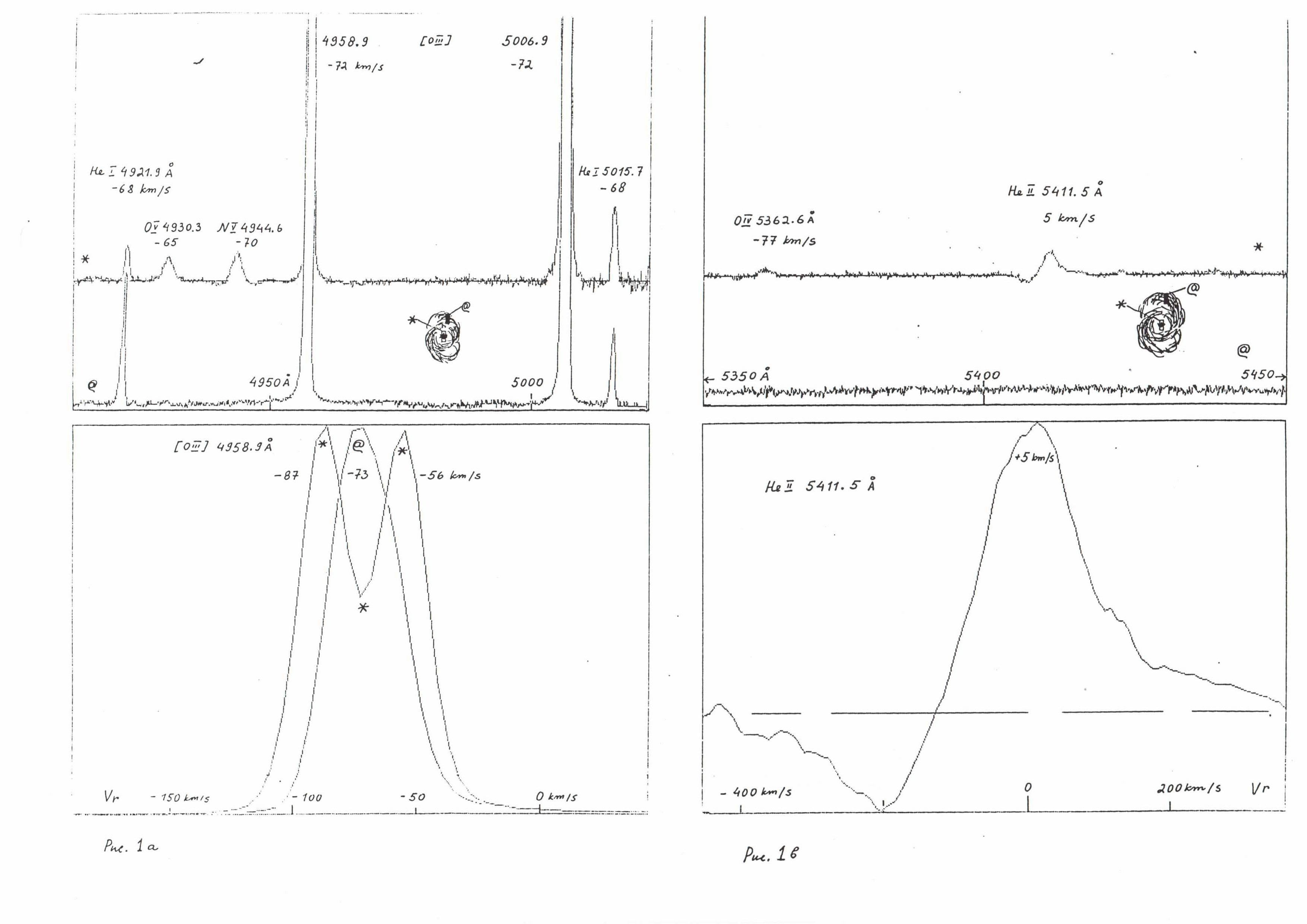
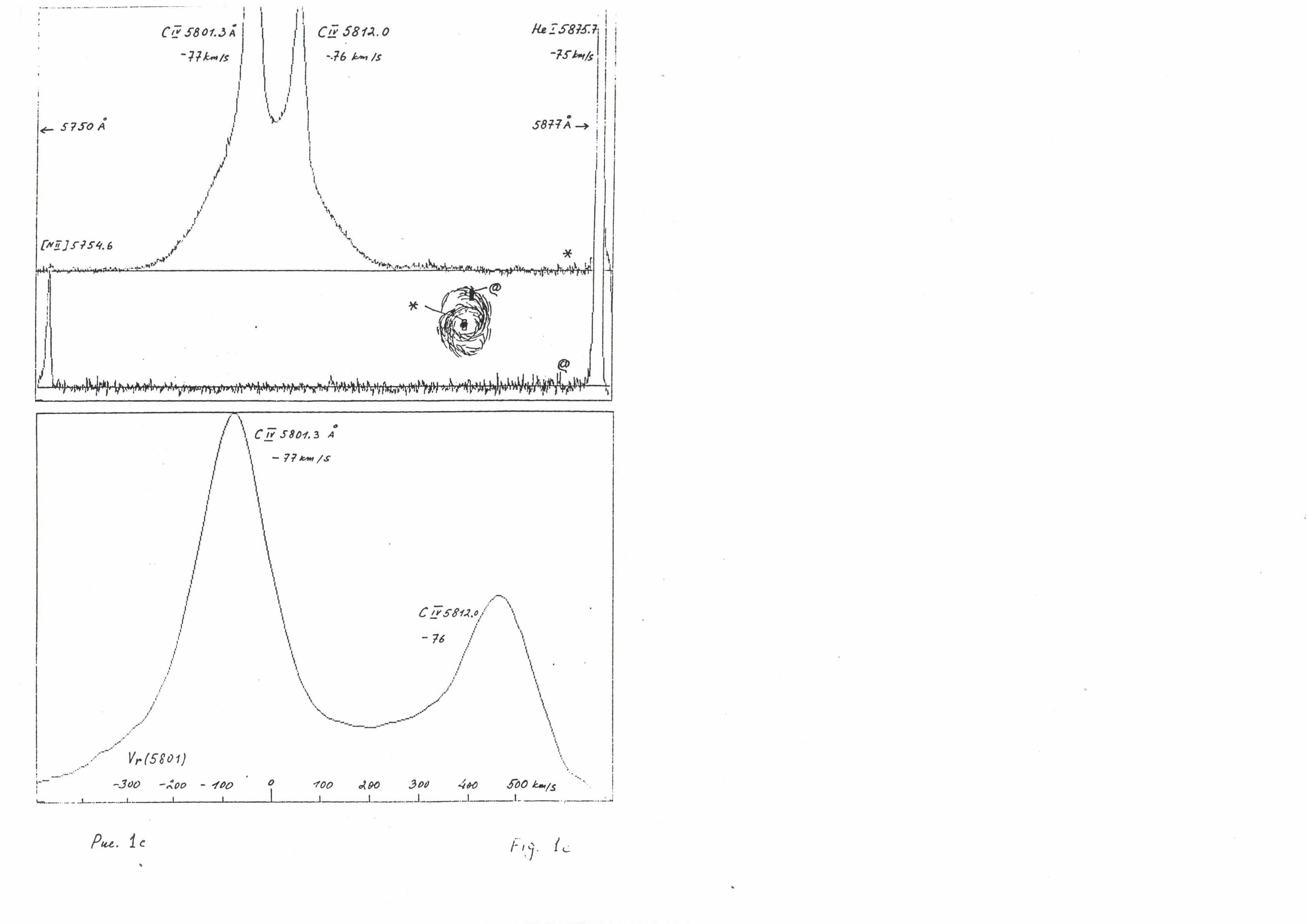
The spectrum of the central star generating the nebula NGC 6543 and exciting its glow, as well as the spectrum of the nebula itself were obtained in the course of study of the late stages of stellar evolution. The high-resolution spectrograph of the 6-meter telescope of SAO was used. The star and a peripheral part of the nebula were alternately projected onto its slit. These positions of the slit marked by a sign ' * ' for the first one and by a sign ' @ ' for the second one in Fig 1a, 1b, 1c.
Task:
The upper parts of Fig. 1a, 1b, 1c show the parts of spectra as intensity vs wavelength given from the mentioned regions. In each of them the interesting lines are selected, and their profiles of are presented in the lower fragments as a relation between intensity and radial velocity. The figures show also the values of radial velocities measured by the tops of profiles of separate lines.
Determine which lines belong to the star and which to the nebula; fill in the appended table:
Lines in the spectra of NGC 6543 and its central star:
| Figure | Lines belonging to the nebula | Lines belonging to the star |
|---|---|---|
| 2a | ||
| 2b | ||
| 2c |
What is the difference between them?
What can be said about the character of motion in the nebula and in the star's atmosphere from the form of the line profiles?
Estimate the velocity of these motions.
Решение
Линии в спектрах NGC 6543 и ее центральной звезды
| Рис. | Линии туманности | Линии звезды |
|---|---|---|
| 1a | HeI 4922 | OV 4930 |
| [OIII] 4959 | NV 4945 | |
| [OIII] 5007 | ||
| HeI 5016 | ||
| 1b | OIV 5363 | |
| HeII 5412 | ||
| 1c | [NII] 5755 | CIV 5801 |
| HeI 5876 | CIV 5812 |
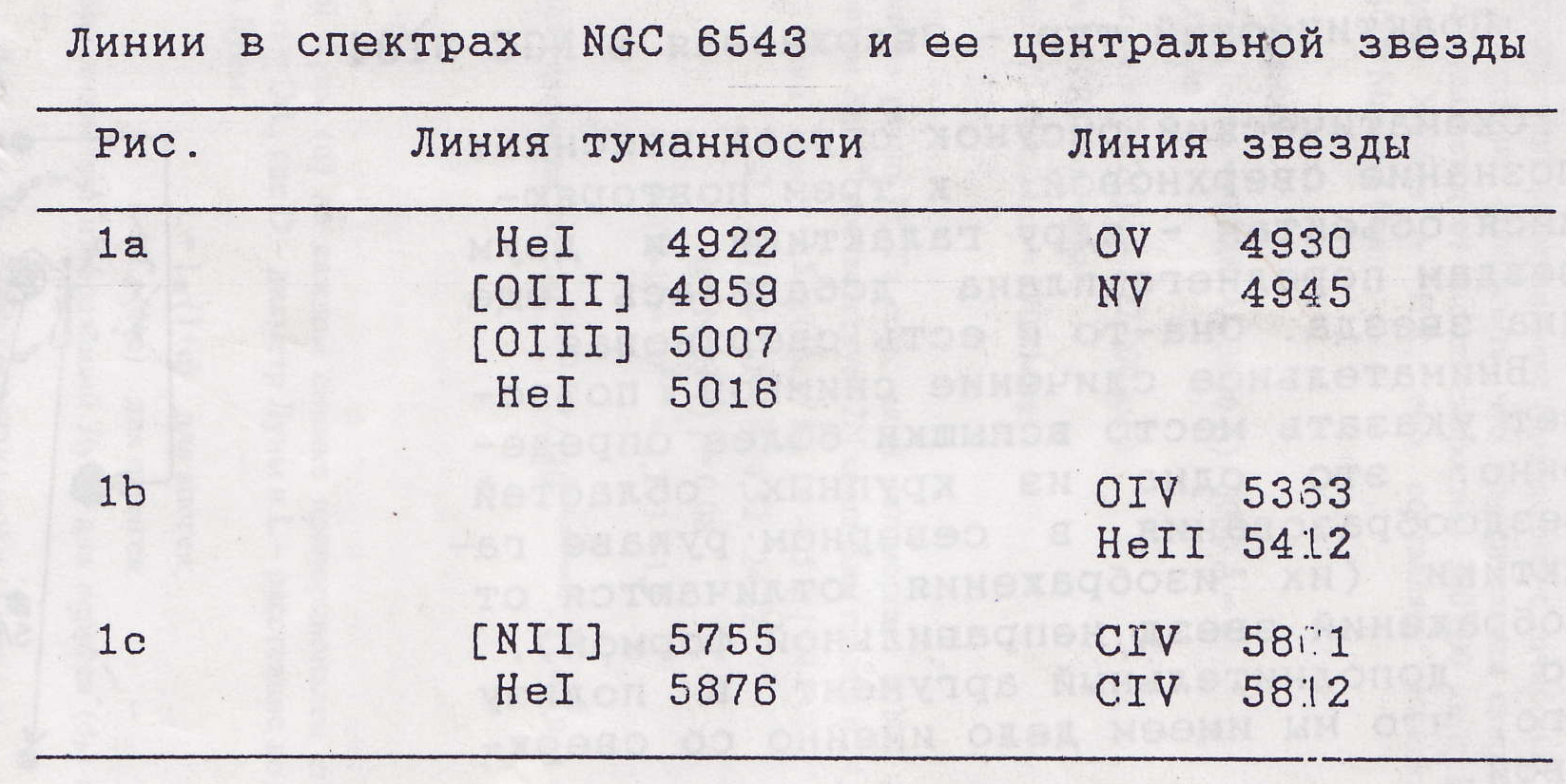
Линии туманности принадлежат нейтральным атомам или атомам, потерявшим по 1–2 электрона. Атомы в атмосфере звезды ионизованы сильнее: они потеряли до 4 электронов. Атмосфера звезды гораздо горячее возбуждаемой ею туманности.
Линии туманности заметно уже линий звезды.
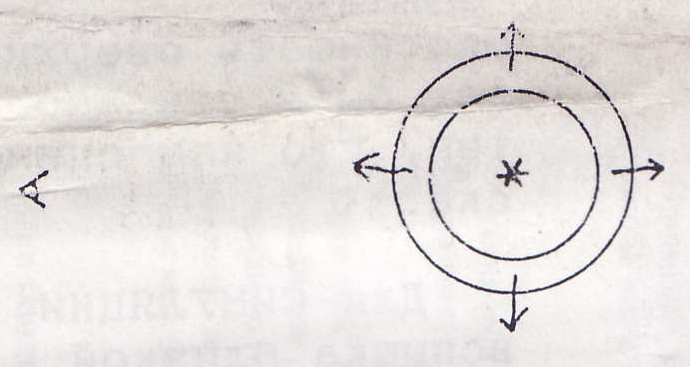
Линии туманности в ее центре раздвоенные, а на периферии одиночные (рис. 1a, нижний фрагмент). Это объясняется так. В центре мы видим и переднюю и заднюю стенки пузыря туманности, поскольку она прозрачна в линиях. Этот пузырь расширяется. Передняя стенка стенка приближается к нам (относительно ЗВЕЗДЫ), задняя удаляется от нас — допплеровское смещение расщепляет линию. На периферии газ движется почти поперек луча зрения, поэтому линия не расщеплена.
Линии в спектре звезды уширены ее осевым вращением (рис. 1a, верхний фрагмент, сравните линии HeI 4922 и OV 4930).
Линия HeII 5412 имеет профиль типа P Лебедя, что говорит о расширении атмосферы звезды.
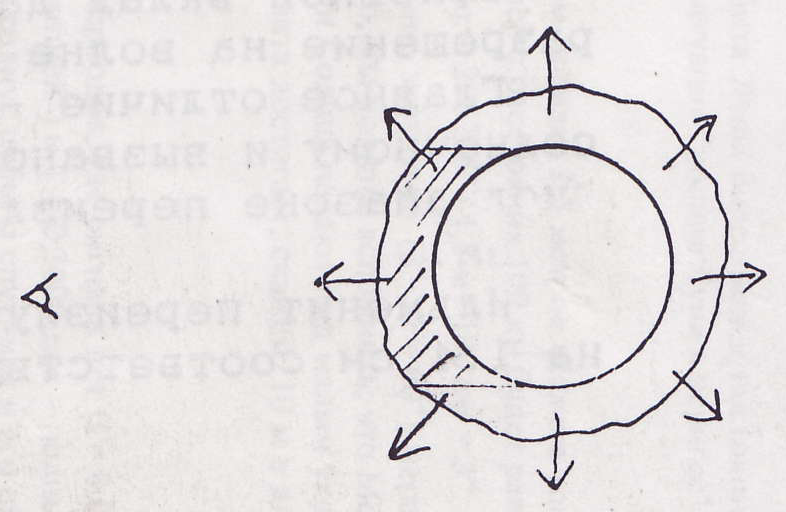
Лучевые скорости для большинства линий звезды и туманности близки к . Это составляющая скорости движения всей системы вдоль луча зрения. Скорость расширения туманности, оцененная по рис. 1a:
Скорость расширения атмосферы по линии HeII 5412 (рис. 1b, нижний фрагмент) с учетом скорости системы в целом:
Оригинал в Архива: betapract2.doc · допълнителни данни: betapract2data1.jpg · допълнителни данни: betapract2data2.jpg · допълнителни данни: proceedings_2.PDF