IAO 2003, Практически тур, Група B — Задача 8. Оценка массы Сатурна
5 октомври 2003 г.
Внимание: Бележка към темата
Русское условие сохранено как отдельная языковая версия. Официальное решение в архиве — на английском языке.
Условие
Введение
С тех пор, как кольцо Сатурна было обнаружено в телескоп Галилео Галилеем, оно стало одним из главных астрономических достопримечательностей. То, что кольцо – это не твёрдое тело, а неисчислимое множество «маленьких лун», обращающихся вокруг Сатурна по кеплеровским орбитам, было доказано спектроскопическим методом одновременно Аристархом Аполлоновичем Белопольским и Джеймсом Э. Килером. Результаты Э.Килера опубликованы в первом выпуске Астрофизического Журнала за 1895 г. В этой задаче Вам предстоит повторить рассуждения этих ученых, используя недавние наблюдения, а также оценить массу Сатурна.
Детали наблюдений
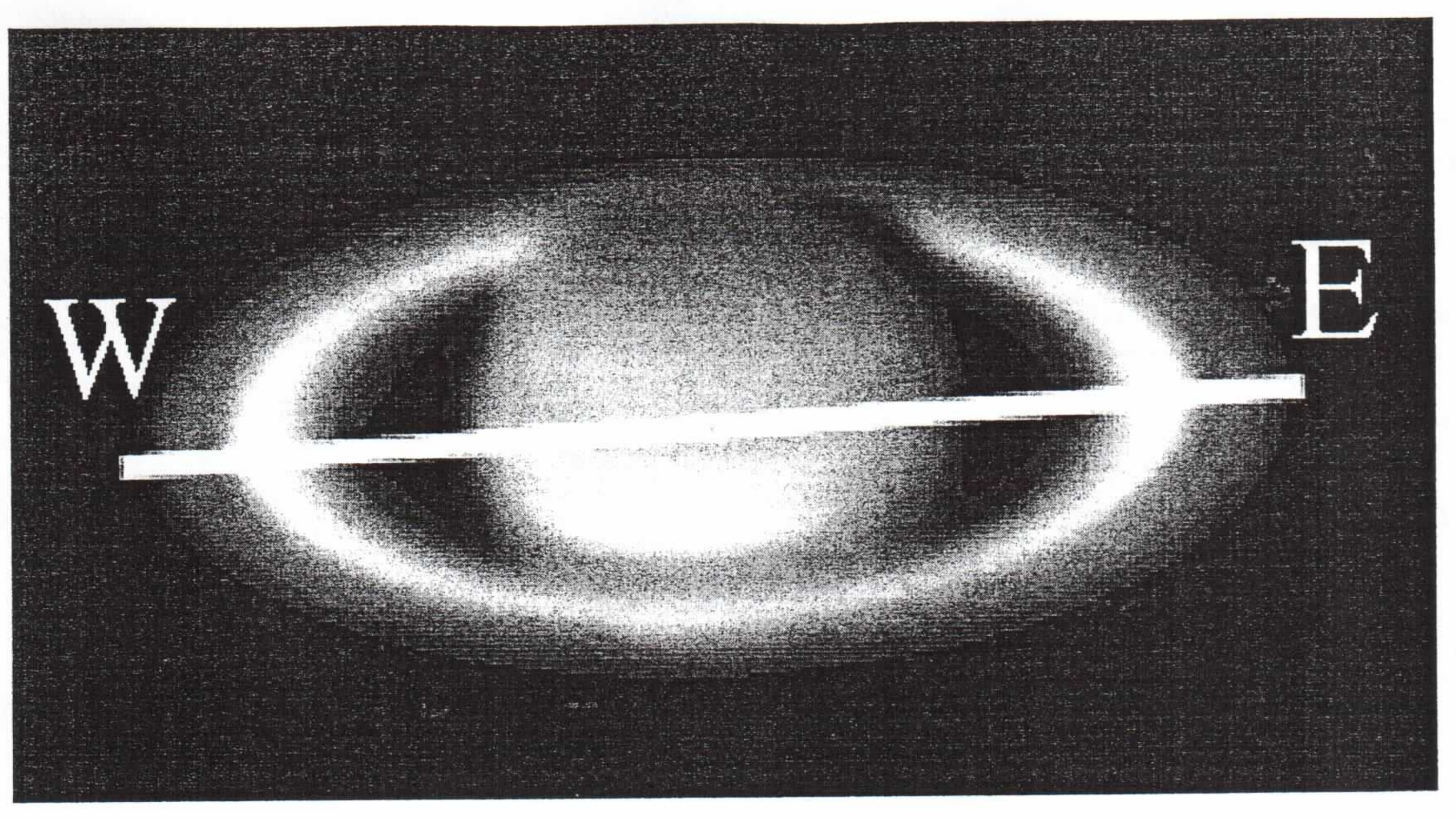
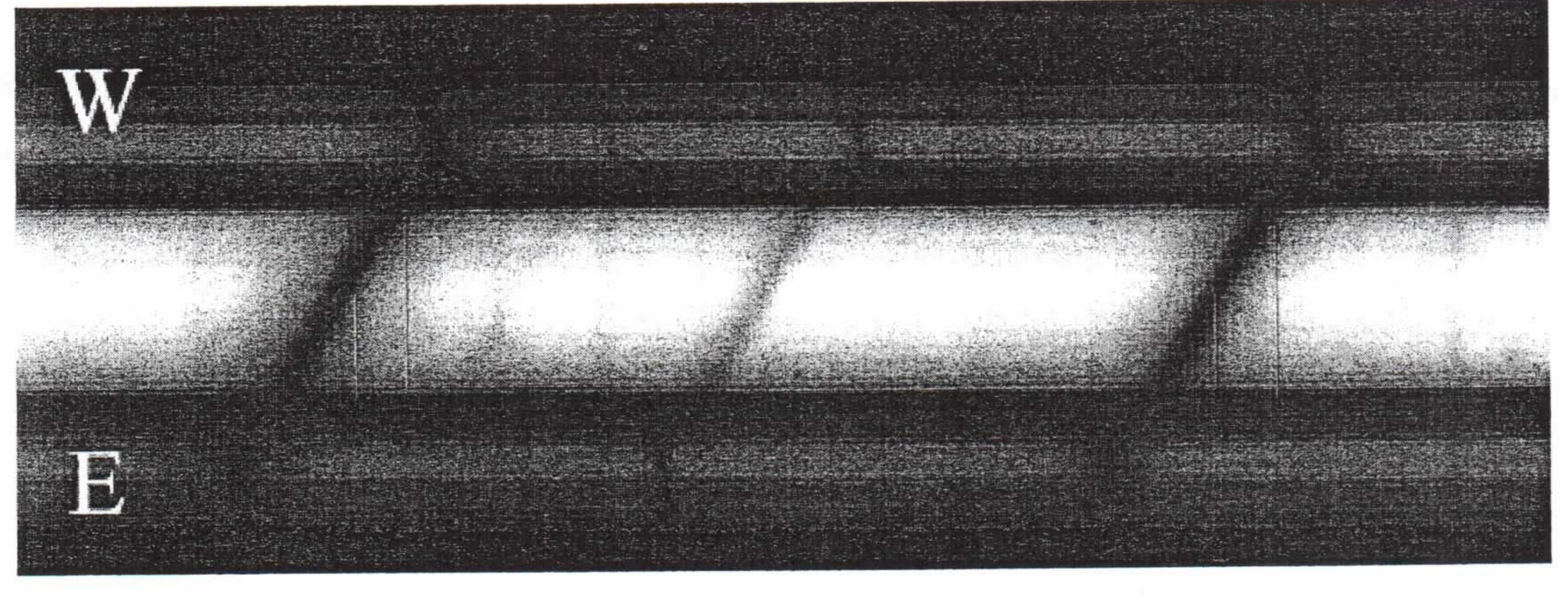
Сатурн наблюдался на Скандинавском Оптическом Телескопе (the Nordic Optical Telescope, NOT, 2,5-метровый телескоп на канарском острове Ла Пальма) 25.02.2002 г. в 23:25 Всемирного времени. Щель спектрографа по отношению к наблюдаемому Сатурну была расположена так, как показано на рис. 1. Полученный спектр (рис. 2) представляет собой солнечный спектр, отражённый от планеты. Прямые вертикальные линии поглощения – теллурические, то есть линии поглощения, возникающие при прохождении света через атмосферу Земли. Наклоненные линии – линии поглощения Солнца, отражённые от планеты. Две самых сильных линии поглощения, замеченные в спектре, – переходы и Na I (нейтрального натрия), их длины волн в покоящейся системе отсчета – 589,00 нм и 589,59 нм соответственно.
[[figure:p8-slit]]
[[figure:p8-spectrum]]
Задания
Вы должны тщательно объяснять каждый шаг в ваших вычислениях. Ответы без обоснования не принимаются.
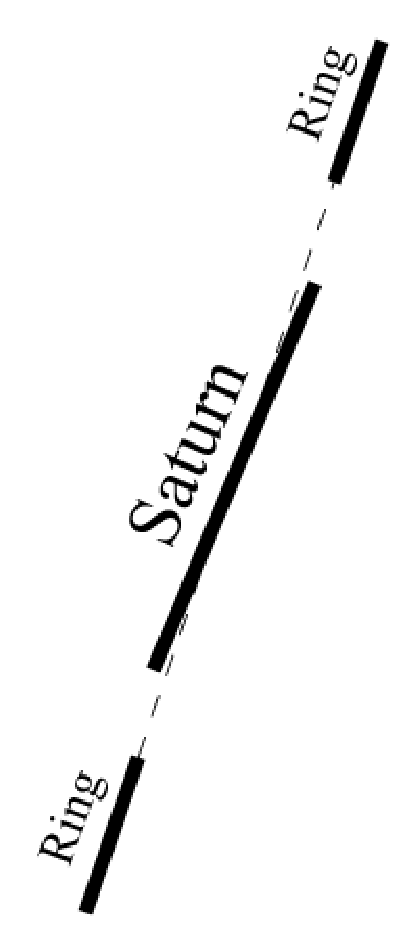
8.1. Приведённый на рис. 2 спектр наглядно демонстрирует, что кольцо Сатурна не может быть единым вращающимся телом. Нарисуйте, каким был бы спектр, если бы кольцо вращалось как единое твёрдое тело. (~20%)
8.2. Известно, что сидерический период вращения Сатурна равен 10,66 час. Используя приведённый на рис. 2 спектр, оцените экваториальный диаметр Сатурна. (~30%)
8.3. По спектру рис. 2 оцените массу Сатурна. Если Вы не помните гравитационную постоянную, можете использовать данные: 1 а.е. = км, масса Солнца кг. (~50 %)
Вы можете использовать тот факт, что кольцо Сатурна является плоским и параллельным экватору планеты, чтобы вычислить, под каким углом наблюдателю была видна система.
Решение
Official sketches for solutions. The millimetre measurements refer to the original printed sheets.
8.1. A rigid ring
If Saturn’s ring was a rigidly rotating body, its outer edge would be faster than its inner edge, and the spectrum would look like Fig. 3.
8.2. Equatorial diameter
We start by determining the scale of the spectrum. The distance between the two Na I lines in the spectrum of Fig. 2 is 84 mm. Since we know the two D lines of Na I to differ by 0.59 nm, we have the spectral scale 0.59/84 nm/mm = 0.007024 nm/mm.
Light from the solar spectrum is received by the reflecting surface of Saturn at a Doppler shift depending on the velocity of the surface with respect to the Sun. With respect to an observer, the light reflected on the surface is then again Doppler shifted with the velocity between the observer and the surface. From the small shadow of Saturn on its ring in Fig. 1, we note that the angle between the Earth and the Sun, as seen from Saturn, is small. Thus the Doppler shift differences between different parts of the surface (and the rings) are approximately just doubled, i.e. .
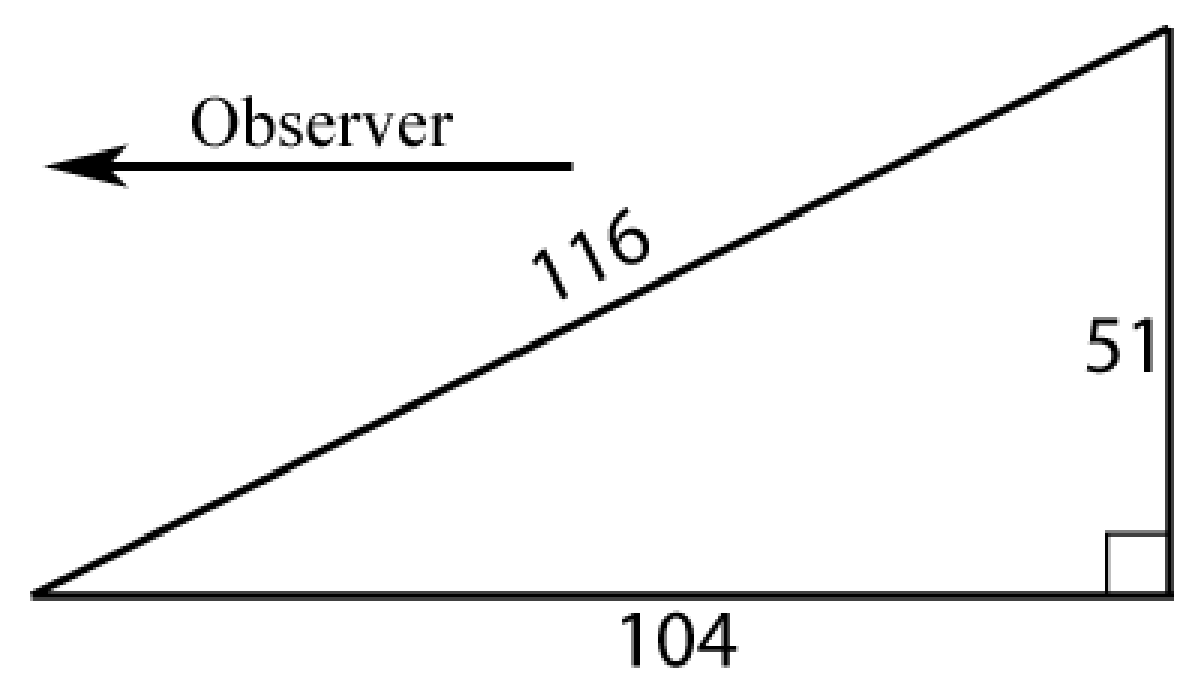
However, we observe Saturn at an inclination, meaning that we observe only the component of the velocity pointing in our direction. Since the ring system is circular in shape and planar, we can measure the projection factor by measuring the dimensions of the projected ring. The major axis of the ring measured in Fig. 1 is 116 mm, while the minor axis is 51 mm. By Pythagoras’s theorem (see Fig. 4), this gives the projection factor
For the spectrum of Fig. 2, this translates to the velocity scale
We can now calculate the difference in velocity between the different edges of the planetary disc. The difference is about 10 mm, meaning 20 km/s. During the period 10.66 h = 38000 s, the surface thus travels , which is the equatorial circumference of Saturn. Dividing by we get the diameter 121000 km.
8.3. Mass of Saturn
Since the equatorial diameter of the planet is 121000 km but 18 mm in the spectrum of Fig. 2, the image scale is 121000/18 km/mm = 6700 km/mm. Looking at the inner part of the ring, the displacement of an absorption line between the two sides is 20 mm, corresponding to the velocity difference . The diameter of the inner ring is 26 mm in Fig. 2, meaning . Using Kepler’s third law,
where , and . The circumference of the ring of diameter 175000 km is 549000 km, giving the period . Thus Saturn’s mass is calculated as
What is the expected accuracy of this number? Assuming our measurements on paper are accurate to mm, one can derive the formal error . The mass of Saturn, as measured accurately by Voyager, is , consistent with our value.
Reference data
Parameters of orbits. Physical characteristics of some planets, Moon and Sun. Groups A,B.
| Body | Average distance (AU) | Average distance (million km) | Sidereal or analogous period (tropical years) | Period (days) | Eccentricity | Equatorial diameter (km) | Mass ( kg) | Average density (g/cm³) | Surface gravity (m/s²) | Maximum magnitude from Earth | Albedo |
|---|---|---|---|---|---|---|---|---|---|---|---|
| Sun | 1392000 | 1989000 | 1.409 | −26.8 | |||||||
| Mercury | 0.387 | 57.9 | 0.241 | 87.97 | 0.206 | 4879 | 0.3302 | 5.43 | 3.70 | −2.2 | 0.06 |
| Venus | 0.723 | 108.2 | 0.615 | 224.70 | 0.007 | 12104 | 4.8690 | 5.24 | 8.87 | −4.7 | 0.78 |
| Earth | 1.000 | 149.6 | 1.000 | 365.26 | 0.017 | 12756 | 5.9742 | 5.515 | 9.81 | 0.36 | |
| Moon | 0.00257 | 0.38440 | 0.0748 | 27.3217 | 0.055 | 3475 | 0.0735 | 3.34 | 1.62 | −12.7 | 0.07 |
| Mars | 1.524 | 227.9 | 1.880 | 686.98 | 0.093 | 6794 | 0.6419 | 3.94 | 3.71 | −2.0 | 0.15 |
| Jupiter | 5.204 | 778.6 | 11.862 | 4332.59 | 0.048 | 142984 | 1899.8 | 1.33 | 24.86 | −2.7 | 0.66 |
For outer planets and Moon — in mean opposition. Blank cells are blank in the original bilingual Russian/English reference sheet.
Оригинал в Архива: pract_ru_3.jpg · официални решения: pract8sol.doc · допълнителни данни: pract_ru_4.jpg · допълнителни данни: data.pdf