IAO 2003, Практически тур, Групи A и B — Задача 7. Measuring the speed of light
VIII Международная астрономическая олимпиада / VIII International Astronomy Olympiad / VIII:e Internationella Astronomiolympiaden — Задачи практического тура / Practical round. Problems to solve — Groups A,B · 2 октомври 2003 г.
Условие
Note: You must carefully account for every step in your calculations. Answers without motivation will not be accepted.
Imagine that the solar system in a distant future becomes inhabited by our descendants. On the asteroid Saltis, a small robotic mining establishment is supervised by Celesta Spacedigger, who also happens to be a dedicated amateur astronomer. Being bored by her job, Celesta spends the long nights of Saltis studying the stars and the planets, in particular the glorious planet Saturn. An old but reliable astronomical almanac helps her keeping track of celestial events like eclipses of the moon Titan by its planet Saturn. To her dismay, however, Celesta starts to note large deviations between her observed times of the eclipses of Titan and the tabulated ones. After years of careful observations (she has a long term assignment on Saltis) she begins to see a pattern; the deviations are largest when Saturn is close to opposition or conjunction (with the Sun, as seen from Saltis). She realises that this must be due to the finite speed of light, and a check in her almanac confirms that the tabulated timings are heliocentric, that is, as seen from the Sun, and not as seen from Saltis. Quite satisfied with her discovery, Celesta use her observations to calculate the speed of light.
In this problem you are asked to repeat Celesta's calculations by using her observations. The units of length and time that Celesta uses are a bit different from what you are used to. The unit of time is called pinit, and is defined such that there are 1000 pinit in one synodic rotation of Saltis. The length unit is called seter and is defined to be one billionth () of the mean distance between the Sun and Saltis.
Table 1 Eclipses of Titan by Saturn
| Tabulated (pinit) | Celesta (pinit) | Comment |
|---|---|---|
| 456.47 | 450.32 | Opposition |
| 18.50 | 12.28 | Opposition |
| 821.41 | 815.29 | Opposition |
| 444.70 | 450.85 | Conjunction |
| 615.43 | 621.52 | Conjunction |
| 791.94 | 798.02 | Conjunction |
The tabulated values refer to when an observer located at the Sun would observe the beginning of the eclipse.
Celesta observed timing of the beginning of the eclipses from Saltis. Her estimated accuracy in the timing is 0.03 pinit.
The position of Saturn during an eclipse of Titan was never exactly in opposition or conjunction, but close to.
7.1. Celesta observed eclipses of Titan when Saturn was close to opposition or conjunction during six occasions (Table 1). Analyse her data carefully and estimate the speed of light, in units of seter per pinit, and give the expected error of your estimate. (50%)
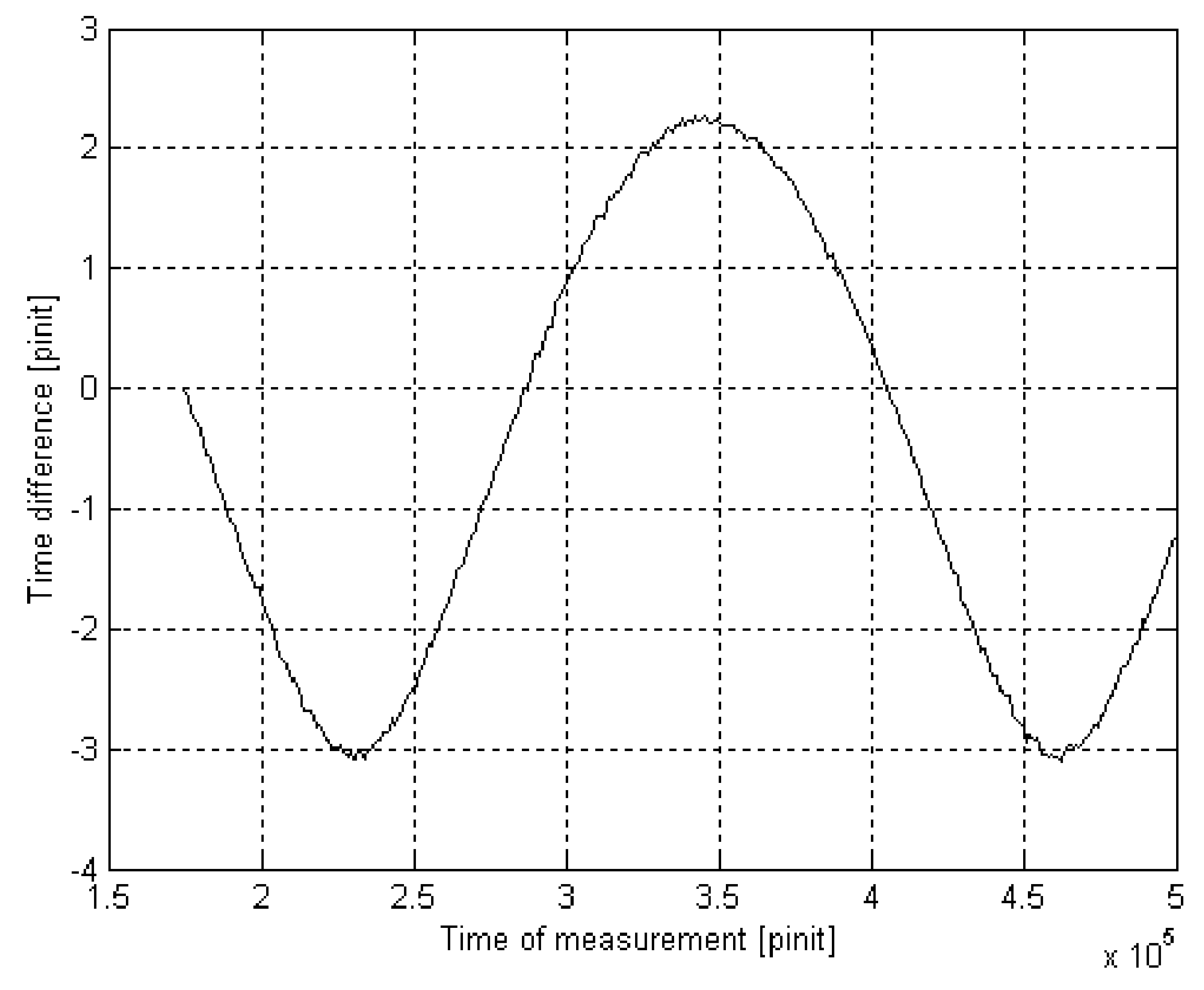
7.2. Celesta also enjoys listening to radio signals from Earth during her lonely days. With her re-discovery of the finite speed of light, Celesta gained enough confidence to try and measure the orbital radius of Earth (in seter). She synchronises her very accurate watch with a radio time signal from Earth, and then regularly follows how the time of her watch differs from the periodic time signal. Her measurements are presented in Fig. 1.
Use Celesta's data in Fig. 1 to estimate the radius of Earth's orbit in seter. (20%)
7.3. With 1 AU = 149.6·10 km and c = 2.998·10 m/s, how many meter is a seter? How many seconds is a pinit? (10%)
7.4. Estimate the orbital period (in years) of Saltis from Fig. 1 and the answer to problem 3. (20%)
Решение
Official sketches for solutions. Measurements refer to the original printed sheets.
7.1. Speed of light
Let be Saturn’s orbital radius, be Saltis’s orbital radius and be the velocity of light. It takes light the time to reach the Sun from Saturn. At opposition it takes light to reach Saltis from Saturn, and at conjunction . This means that the difference in the timings from the tabulated values will be at opposition (i.e. the eclipse will be seen earlier) and at conjunction (i.e. the eclipse will be observed later than tabulated values).
Looking at the differences in Table 1, one sees that the spread in value is greater than the estimated timing error of 0.03 pinit. Thus the spread is mainly due to Saturn not being exactly at opposition/conjunction at the time of eclipse. Thus the extreme value is the best approximation, 6.23 pinit. Since the three opposition values are ranging from 6.12–6.23 pinit, the true opposition difference is probably not larger than 6.30 pinit. Thus a sensible estimated error is ~0.1 pinit. We ignore the conjunction values since they are further from true conjunction, probably due to difficulties in observing Saturn near the Sun.
With a time difference pinit, and defined to seter, we readily compute
Table 1. Eclipses of Titan by Saturn
| Tabulated (pinit) | Celesta (pinit) | Difference (pinit) |
|---|---|---|
| 456.47 | 450.32 | 6.15 |
| 18.50 | 12.28 | 6.23 |
| 821.41 | 815.29 | 6.12 |
| 444.70 | 450.85 | −6.14 |
| 615.43 | 621.52 | −6.08 |
| 791.94 | 798.02 | −6.08 |
Source note: this is the printed official table and its subsequent calculation. Several printed differences disagree with direct subtraction of the first two columns (18.50−12.28=6.22, 444.70−450.85=−6.15, 615.43−621.52=−6.09). The original key’s values are retained.
7.2. Earth’s orbital radius
The difference between the largest and smallest distance between Saltis and Earth is equal to 2 Earth orbital radii. From Fig. 1 we estimate the time difference to 5.3 pinit. With estimated as above, we get seter. Thus seter.
7.3. Units
seter gives 1 seter = 348 meter. With seter/pinit we have 1 pinit = 187 seconds.
7.4. Saltis’s orbital period
From Fig. 1 we estimate the interval between oppositions to pinit = 1.4 yr. Since the period of Earth is 1 yr, we use the formula for the synodic period to get the period of 3.7 yr. Alternatively, one may use the orbital radius of Saltis and Kepler’s law, , to get .
Attention
For group A there is the only problem Nr.7 on the Practical round for 3 hours; for group B there are the two problems: Nr.7 and Nr.8 for 4 hours.
Reference data
Parameters of orbits. Physical characteristics of some planets, Moon and Sun. Groups A,B.
| Body | Average distance (AU) | Average distance (million km) | Sidereal or analogous period (tropical years) | Period (days) | Eccentricity | Equatorial diameter (km) | Mass ( kg) | Average density (g/cm³) | Surface gravity (m/s²) | Maximum magnitude from Earth | Albedo |
|---|---|---|---|---|---|---|---|---|---|---|---|
| Sun | 1392000 | 1989000 | 1.409 | −26.8 | |||||||
| Mercury | 0.387 | 57.9 | 0.241 | 87.97 | 0.206 | 4879 | 0.3302 | 5.43 | 3.70 | −2.2 | 0.06 |
| Venus | 0.723 | 108.2 | 0.615 | 224.70 | 0.007 | 12104 | 4.8690 | 5.24 | 8.87 | −4.7 | 0.78 |
| Earth | 1.000 | 149.6 | 1.000 | 365.26 | 0.017 | 12756 | 5.9742 | 5.515 | 9.81 | 0.36 | |
| Moon | 0.00257 | 0.38440 | 0.0748 | 27.3217 | 0.055 | 3475 | 0.0735 | 3.34 | 1.62 | −12.7 | 0.07 |
| Mars | 1.524 | 227.9 | 1.880 | 686.98 | 0.093 | 6794 | 0.6419 | 3.94 | 3.71 | −2.0 | 0.15 |
| Jupiter | 5.204 | 778.6 | 11.862 | 4332.59 | 0.048 | 142984 | 1899.8 | 1.33 | 24.86 | −2.7 | 0.66 |
For outer planets and Moon — in mean opposition. Blank cells are blank in the original bilingual Russian/English reference sheet.
Оригинал в Архива: pract7.doc · официални решения: pract7sol.doc · допълнителни данни: data.pdf