IAO 2003, Практически тур, Група B — Задача 8. Estimating the mass of Saturn
VIII International Astronomy Olympiad, Stockholm, Sweden, 2 – 8. 10. 2003, Practical round. Problems to solve, Group B · 2 октомври 2003 г.
Условие
Introduction
Ever since Galileo Galilei observed the ring of Saturn through a telescope for the first time, it has been regarded as one of the prime astronomical sights. The ring itself is not a rigid body, but consists of innumerable moonlets in Keplerian orbits around the planet, as shown spectroscopically almost simultaneously by Aristarkh A. Belopolsky and by James E. Keeler. The results of the latter were published in the very first issue of the Astrophysical Journal in 1895. In this problem, you are asked to repeat their argument using recent observations, and estimate the mass of Saturn.
Observational details
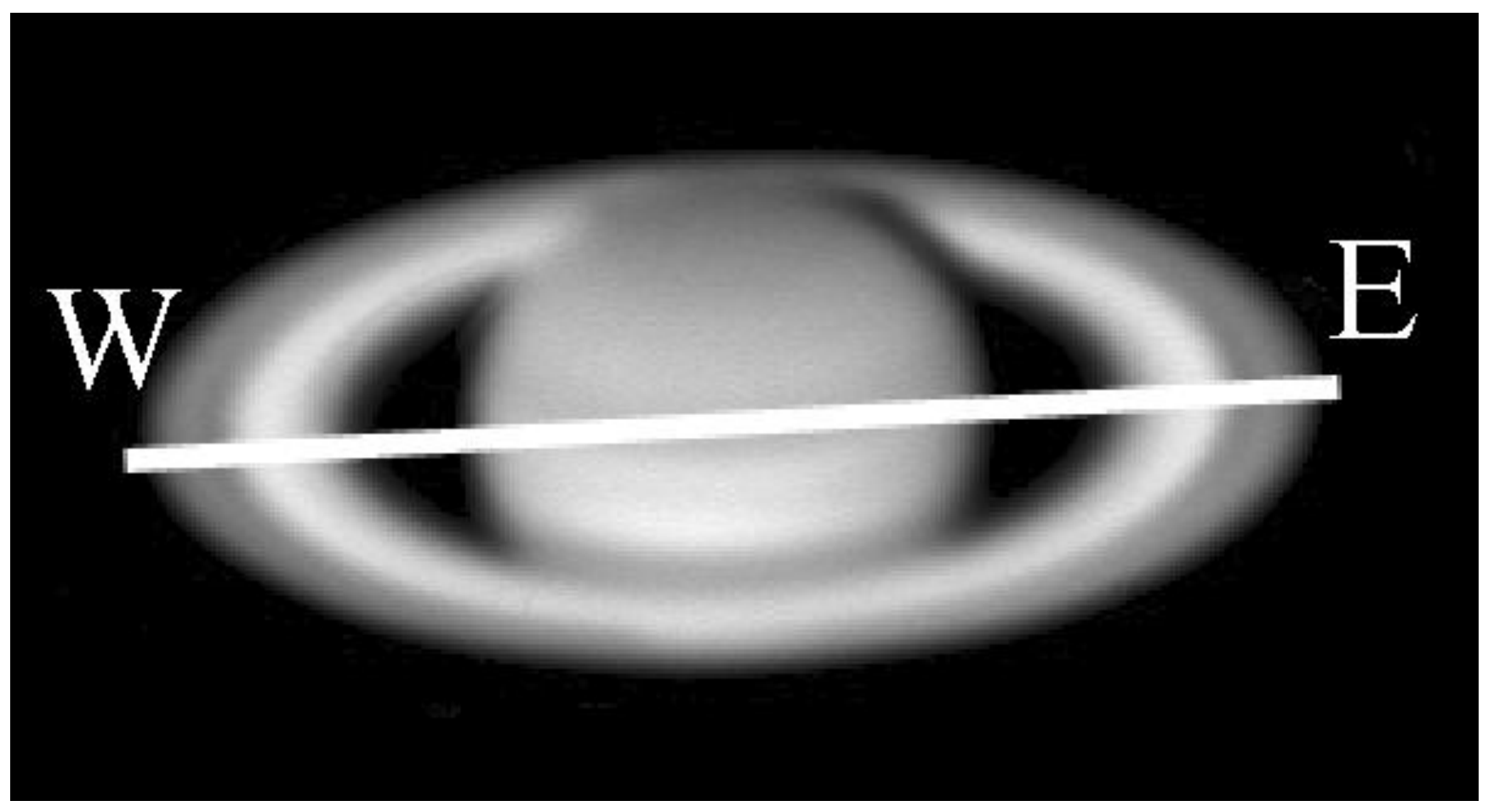
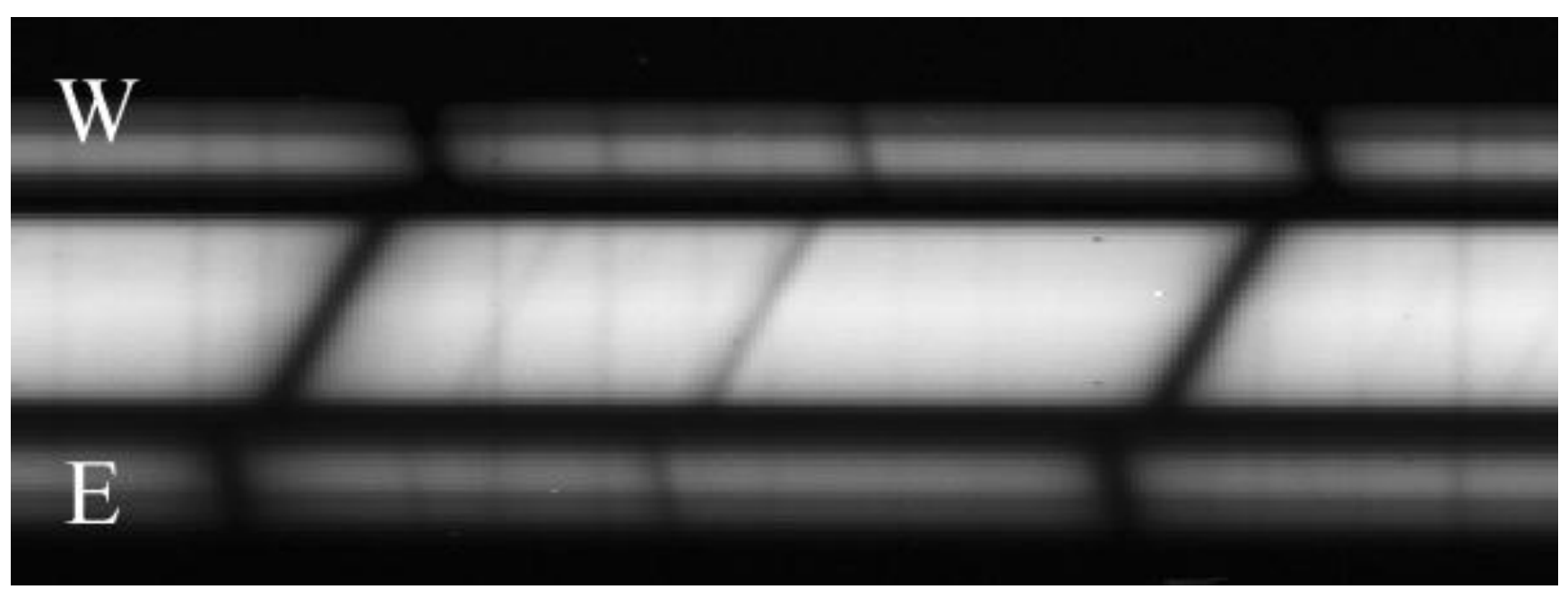
Saturn was observed by the Nordic Optical Telescope (NOT, a 2.5 m telescope on the Canary Island La Palma) 2002-02-25 at 23:25 Universal Time. A spectroscopic slit was placed over the planet as shown by Fig. 1. The retrieved spectrum (Fig. 2) shows the solar spectrum reflected on the planet. The straight vertical absorption lines are telluric, i.e. absorption lines arising when the light travels through the Earth's atmosphere, while the lines seen at inclination are the solar absorption lines reflected against the planet. The two strongest absorption lines seen in the spectrum are from the Na I (neutral sodium) and transitions, at rest wavelengths 589.00 nm and 589.59 nm respectively.
Problems
Note: You must carefully account for every step in your calculations. Answers without motivation will not be accepted.
8.1. The spectrum of Fig. 2 implies that the ring of Saturn cannot be a rigidly rotating body. Draw a figure that qualitatively shows what the spectrum would look like, if the ring was indeed rotating rigidly. (~20%)
8.2. The sidereal rotation period of Saturn is known to be 10.66 hours. Estimate the equatorial diameter of Saturn from the spectrum of Fig. 2. (~30%)
8.3. Estimate the mass of Saturn implied by the spectrum of Fig. 2. If you cannot remember the gravitational constant, you may use that and the mass of the Sun is . (~50%)
Inclination of the system
You may use the fact that the ring of Saturn is planar and parallel to the planet's equator to calculate the inclination of the system relative to the line of sight.
Решение
Official sketches for solutions. The millimetre measurements refer to the original printed sheets.
8.1. A rigid ring
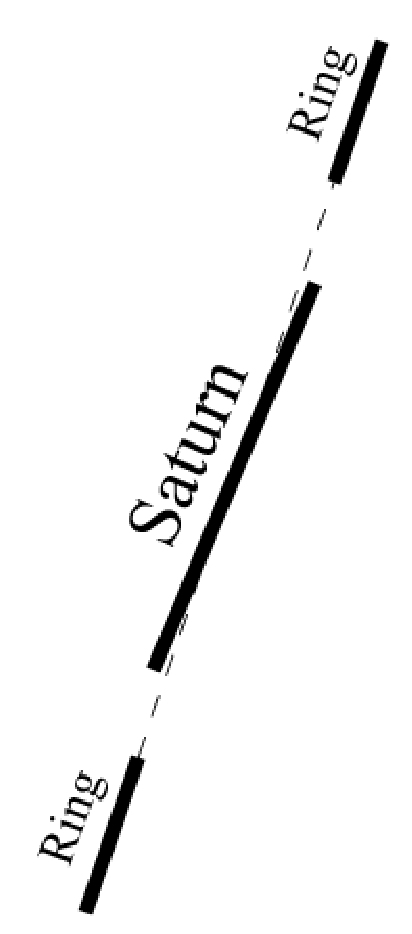
If Saturn’s ring was a rigidly rotating body, its outer edge would be faster than its inner edge, and the spectrum would look like Fig. 3.
8.2. Equatorial diameter
We start by determining the scale of the spectrum. The distance between the two Na I lines in the spectrum of Fig. 2 is 84 mm. Since we know the two D lines of Na I to differ by 0.59 nm, we have the spectral scale 0.59/84 nm/mm = 0.007024 nm/mm.
Light from the solar spectrum is received by the reflecting surface of Saturn at a Doppler shift depending on the velocity of the surface with respect to the Sun. With respect to an observer, the light reflected on the surface is then again Doppler shifted with the velocity between the observer and the surface. From the small shadow of Saturn on its ring in Fig. 1, we note that the angle between the Earth and the Sun, as seen from Saturn, is small. Thus the Doppler shift differences between different parts of the surface (and the rings) are approximately just doubled, i.e. .
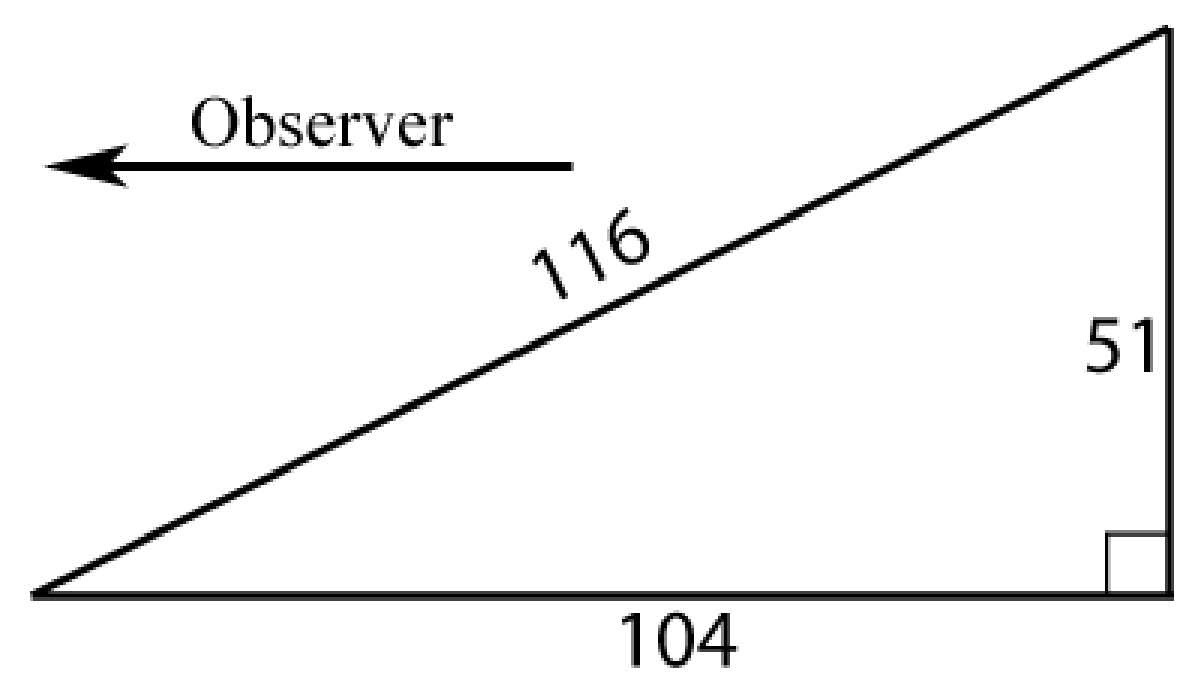
However, we observe Saturn at an inclination, meaning that we observe only the component of the velocity pointing in our direction. Since the ring system is circular in shape and planar, we can measure the projection factor by measuring the dimensions of the projected ring. The major axis of the ring measured in Fig. 1 is 116 mm, while the minor axis is 51 mm. By Pythagoras’s theorem (see Fig. 4), this gives the projection factor
For the spectrum of Fig. 2, this translates to the velocity scale
We can now calculate the difference in velocity between the different edges of the planetary disc. The difference is about 10 mm, meaning 20 km/s. During the period 10.66 h = 38000 s, the surface thus travels , which is the equatorial circumference of Saturn. Dividing by we get the diameter 121000 km.
8.3. Mass of Saturn
Since the equatorial diameter of the planet is 121000 km but 18 mm in the spectrum of Fig. 2, the image scale is 121000/18 km/mm = 6700 km/mm. Looking at the inner part of the ring, the displacement of an absorption line between the two sides is 20 mm, corresponding to the velocity difference . The diameter of the inner ring is 26 mm in Fig. 2, meaning . Using Kepler’s third law,
where , and . The circumference of the ring of diameter 175000 km is 549000 km, giving the period . Thus Saturn’s mass is calculated as
What is the expected accuracy of this number? Assuming our measurements on paper are accurate to mm, one can derive the formal error . The mass of Saturn, as measured accurately by Voyager, is , consistent with our value.
Reference data
Parameters of orbits. Physical characteristics of some planets, Moon and Sun. Groups A,B.
| Body | Average distance (AU) | Average distance (million km) | Sidereal or analogous period (tropical years) | Period (days) | Eccentricity | Equatorial diameter (km) | Mass ( kg) | Average density (g/cm³) | Surface gravity (m/s²) | Maximum magnitude from Earth | Albedo |
|---|---|---|---|---|---|---|---|---|---|---|---|
| Sun | 1392000 | 1989000 | 1.409 | −26.8 | |||||||
| Mercury | 0.387 | 57.9 | 0.241 | 87.97 | 0.206 | 4879 | 0.3302 | 5.43 | 3.70 | −2.2 | 0.06 |
| Venus | 0.723 | 108.2 | 0.615 | 224.70 | 0.007 | 12104 | 4.8690 | 5.24 | 8.87 | −4.7 | 0.78 |
| Earth | 1.000 | 149.6 | 1.000 | 365.26 | 0.017 | 12756 | 5.9742 | 5.515 | 9.81 | 0.36 | |
| Moon | 0.00257 | 0.38440 | 0.0748 | 27.3217 | 0.055 | 3475 | 0.0735 | 3.34 | 1.62 | −12.7 | 0.07 |
| Mars | 1.524 | 227.9 | 1.880 | 686.98 | 0.093 | 6794 | 0.6419 | 3.94 | 3.71 | −2.0 | 0.15 |
| Jupiter | 5.204 | 778.6 | 11.862 | 4332.59 | 0.048 | 142984 | 1899.8 | 1.33 | 24.86 | −2.7 | 0.66 |
For outer planets and Moon — in mean opposition. Blank cells are blank in the original bilingual Russian/English reference sheet.
Оригинал в Архива: pract8.doc · официални решения: pract8sol.doc · допълнителни данни: data.pdf