IAO 2004, Всички кръгове — Задача 16. β8. Sunrise
IX International Astronomy Olympiad · 1 октомври 2004 г.
Внимание: Бележка към темата
Old photocopy scan. Two short passages of the official solutions are lost where the photocopied pages join (problem 4 between pages 4 and 5, the Sunrise solution between pages 13 and 14). The sky maps of the observational round are not in the archive file.
Условие
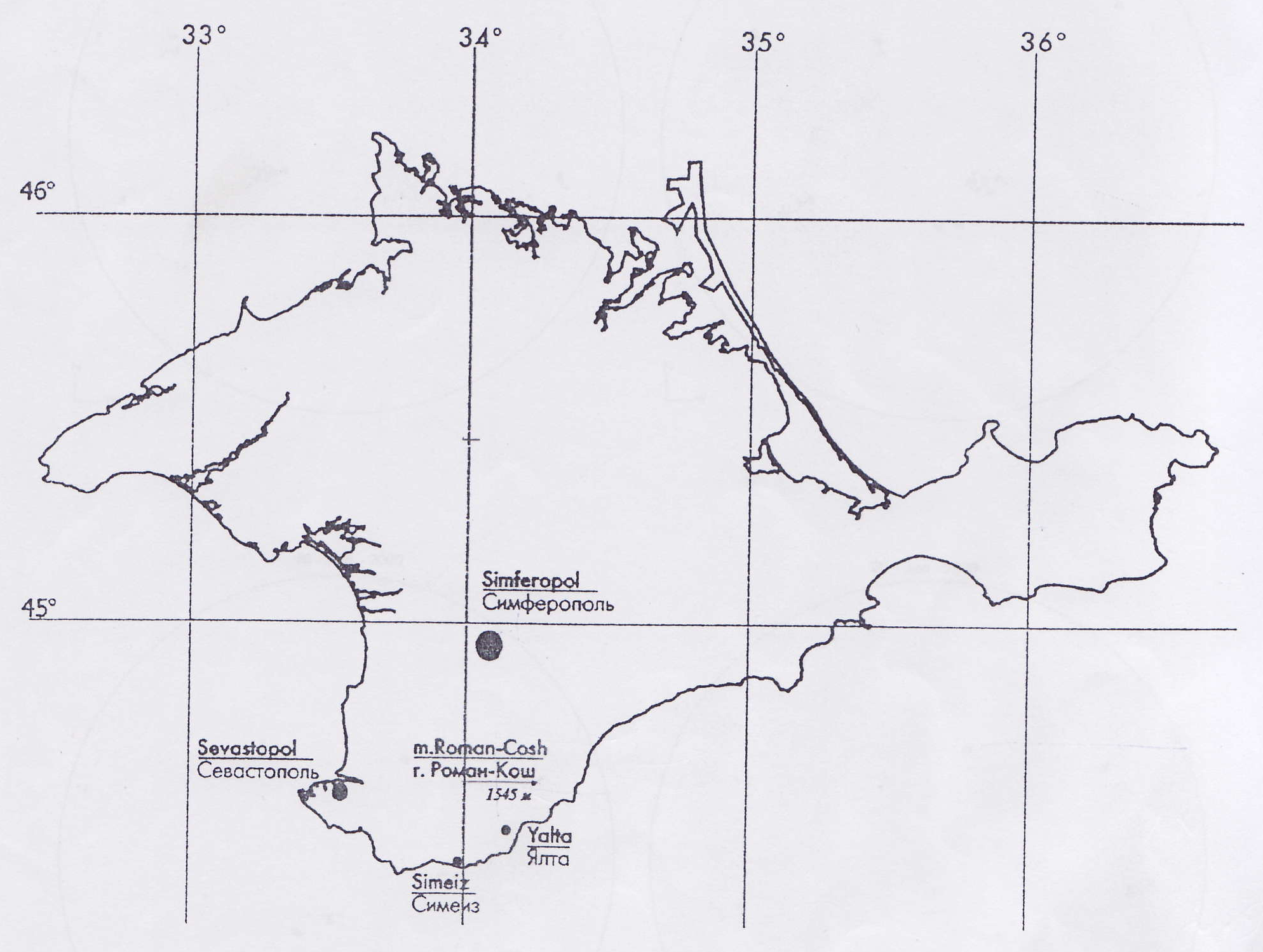
The White Bear and Penguin (whom was already met in the texts of the VII and VIII International Astronomy Olympiads) decided to meet each other. For this purpose they arrived to Crimea a few days before the IX Olympiad and they decided to observe sunrise at the day of the autumnal equinox. «I shall go to the Eastern point of Crimea and see the sunrise before others», – the Penguin has said. «No, I shall see the sunrise earlier, because I’ll climb to the highest mountain in Crimea – Roman-Kosh», – the Bear parried. Who is right? On how many minutes or seconds earlier will he see the sunrise? Make a table with all data, which you have found or recollected and used in solving the problem. The solution has to include a picture with an image of the Bear on the mountain Roman-Kosh and the Penguin at the coast of the Kerch channel; the necessary linear or angular sizes should be in the picture. Assume that the Earth is spherical. Recollect for yourself the necessary information about the White Bear and the Penguin.
A map of Crimea is attached.
(Note: the answer «Медведь / Bear» or «Пингвин / Penguin» has to be written in English or Russian.)
Отговори
Пингвин-Penguin, 2 minutes 12 seconds earlier
The official solution also gives a refined estimate with the Penguin's own horizon dip (printed 2м47с in the formula and „2 минуты 23 секунды“ in the answer).
Решение
See the solution of α8 (Groups α β, problem 8 Sunrise): the official solution is common to both groups.
Group α, theoretical round
Data from the “Table of planetary data” may be used for the solving of every problem.
And the White Bear and Penguin are waiting for you on the practical round.
Group β, theoretical round
Data from the “Table of planetary data” may be used for the solving of every problem.
And the White Bear and Penguin are waiting for you in the practical round.
Parameters of orbits. Physical characteristics of some planets, Moon and Sun
Элементы орбит. Физические характеристики некоторых планет, Луны и Солнца
| Body, planet | Average distance to central body, in astr. units | Average distance to central body, in mln. km | Sidereal (or analogous) period, in trop. years | Sidereal (or analogous) period, in days | Eccentricity e | Equat. diameter, km | Mass, kg | Av. density, g/cm | Grav. acceler. at surf., m/s | Max. magn. from Earth **) | Albedo |
|---|---|---|---|---|---|---|---|---|---|---|---|
| Солнце Sun | 1392000 | 1989000 | 1,409 | ||||||||
| Меркурий Mercury | 0,387 | 57,9 | 0,241 | 87,97 | 0,206 | 4 879 | 0,3302 | 5,43 | 3,70 | 0,06 | |
| Венера Venus | 0,723 | 108,2 | 0,615 | 224,70 | 0,007 | 12 104 | 4,8690 | 5,24 | 8,87 | 0,78 | |
| Земля Earth | 1,000 | 149,6 | 1,000 | 365,26 | 0,017 | 12 756 | 5,9742 | 5,515 | 9,81 | 0,36 | |
| Луна Moon | 0,00257 | 0,38440 | 0,0748 | 27,3217 | 0,055 | 3 475 | 0,0735 | 3,34 | 1,62 | 0,07 |
**) Для внешних планет и Луны – в среднем противостоянии.
**) For outer planets and Moon – in mean opposition.
Оригинал в Архива: iao2004.pdf