IAO 2006, Практически тур, Група β — Задача 6. Monitoring of a star.
Practical round. Problems to solve · 10 ноември 2006 г.
Source annotations
The arc in 7.8 is DPB; an adjacent overwritten mark is not a further point. The Russian alternate explicitly annotates DPB. The original graph-paper orbit and the separate schematic are both preserved.
Archive workbook
The supplied workbook contains only the table and graph for 7.1. The complete chart is retained from a derived chart appendix because the original print layout splits it across two pages. Original workbook values and chart are unchanged.
Условие
There was a monitoring of a bright star in Mumbai over a whole night. It has been done with a 14" telescope in three wavelength bands (B, V and R bands). Assume that the observed wavelengths can be approximated by effective wavelengths of 450 nm, 550 nm and 700 nm for the observed star. As the night progresses, the star is seen at different zenith angles and hence the starlight passes through different thickness of the Earth's atmosphere. Consequently, the extinction due to the Earth's atmosphere changes; it is minimum when the star is closest to the zenith and maximum when the star is rising or setting. Sample data are given in the table. The air-mass in the second column gives effective air-mass of the atmosphere normalized with the air mass at zero zenith angle taken as one. Magnitudes are correct to .
| Zenith Angle (deg) | Air-mass | B magnitude | V magnitude | R magnitude |
|---|---|---|---|---|
| 15 | 1.035 | 2.80 | 0.85 | -1.00 |
| 30 | 1.154 | 2.85 | 0.85 | -1.00 |
| 45 | 1.412 | 3.00 | 0.95 | -0.90 |
| 60 | 1.991 | 3.20 | 1.10 | -0.85 |
| 69 | 2.762 | 3.50 | 1.30 | -0.75 |
| 75 | 3.785 | 3.90 | 1.55 | -0.55 |
| 81 | 6.053 | 4.90 | 2.15 | -0.25 |
6.1. Plot the appropriate graph and find the apparent magnitude of the star in the three wavelengths, in the absence of Earth's atmosphere.
6.2. The Hipparcos satellite gave a parallax of 0.0076 arcseconds for this star. Mark the location of the star in the H-R Diagram given separately.
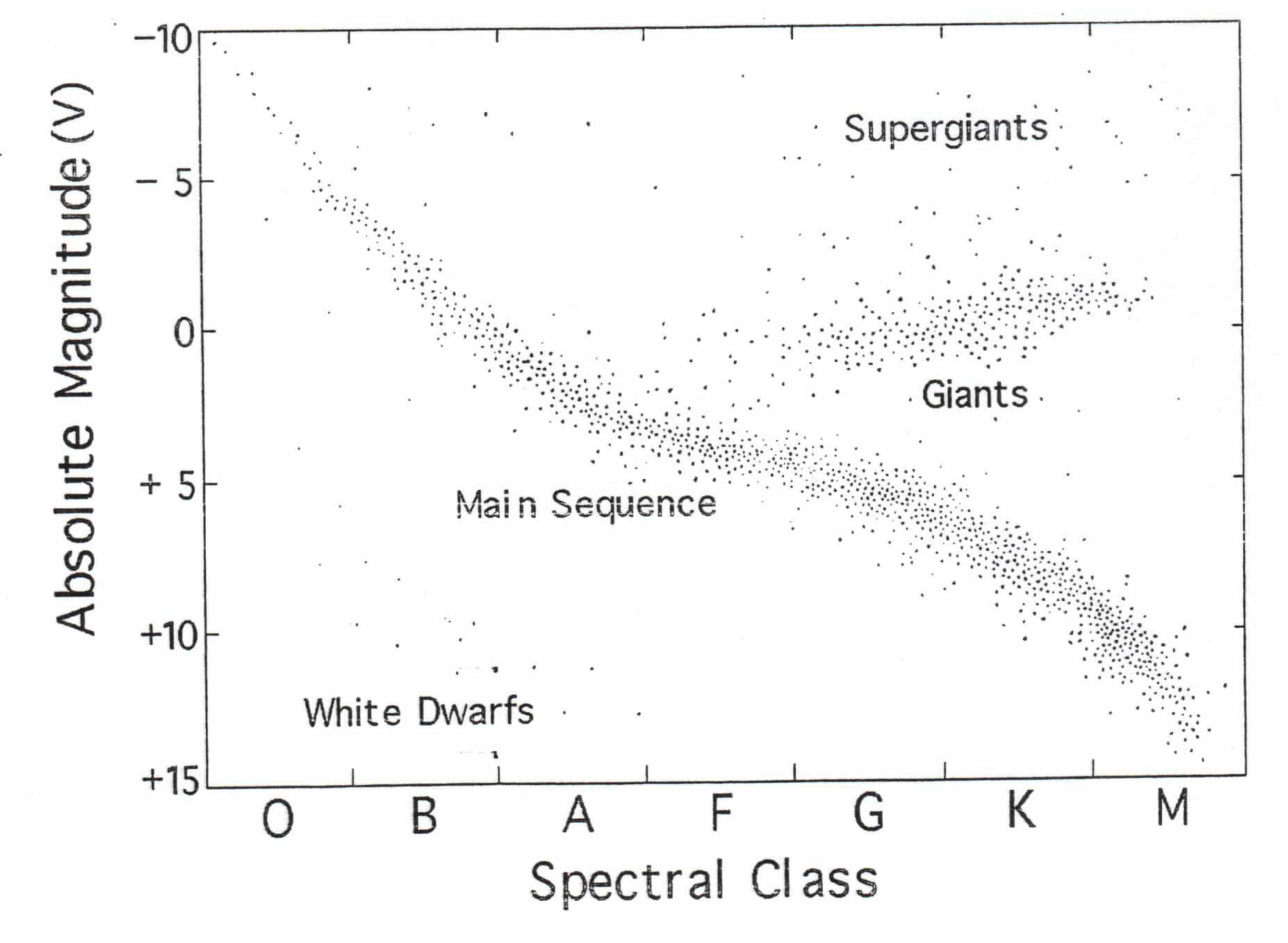
6.3. The colour index can be calibrated in terms of the stellar temperature. An empirical fit (for the region of H-R diagram to which this star belongs) is given by:
(where T is the absolute temperature).
Estimate the temperature of the star.
6.4. If the particular star was in the constellation Orion, which is the most likely candidate out of the four brightest stars in the constellation? Write the Latin name of the star (you have to write in roman script, spelling mistakes will be tolerated as long as the name of the star is understandable).
6.5. In Mumbai, let us assume the extinction varies as (where is the wavelength). From the given data, find parameter .
Решение
Внимание: Непълно решение
В архива няма официално решение на тази задача.
Оригинал в Архива: betapract1.jpg · официални решения: practsol.xls · допълнителни данни: betapract2.jpg · допълнителни данни: betapractdata1.jpg · допълнителни данни: betapractdata2.jpg