IAO 2006, Теория, Група β — Задача 5. Lunar satellite.
Theoretical round. Problems to solve · 10 ноември 2006 г.
Бележка
Maybe not all problems have correct questions. Some questions (maybe the main question of the problem, maybe one of the subquestions) may have no real sense. In this case you have to write in your answer (in English or Russian): «situation is impossible – ситуация невозможна». Of course, this answer has to be explained numerically or logically.
Source annotations
Printed source inconsistencies are retained: the English telescope key repeats Δx_m on the right of its displacement identity; the galaxy key uses both1.89×10⁻³ and1.86×10⁻³rad; the alpha eccentricity ratio has a sign inconsistency before the later positive0.07 result. The English polar key prints71°06′N/72°48′S; the Russian copy has handwritten70°06′N/71°48′S. No scientific correction has been silently substituted.
Условие
These are two photos of the Moon taken by the same camera mounted on a lunar satellite. The first photo has been made while the satellite was near its periselenion and the second one near the aposelenion. Estimate from these data the maximum possible period of orbit around the Moon of this satellite. Consider the lunar orbit around Earth as circular.
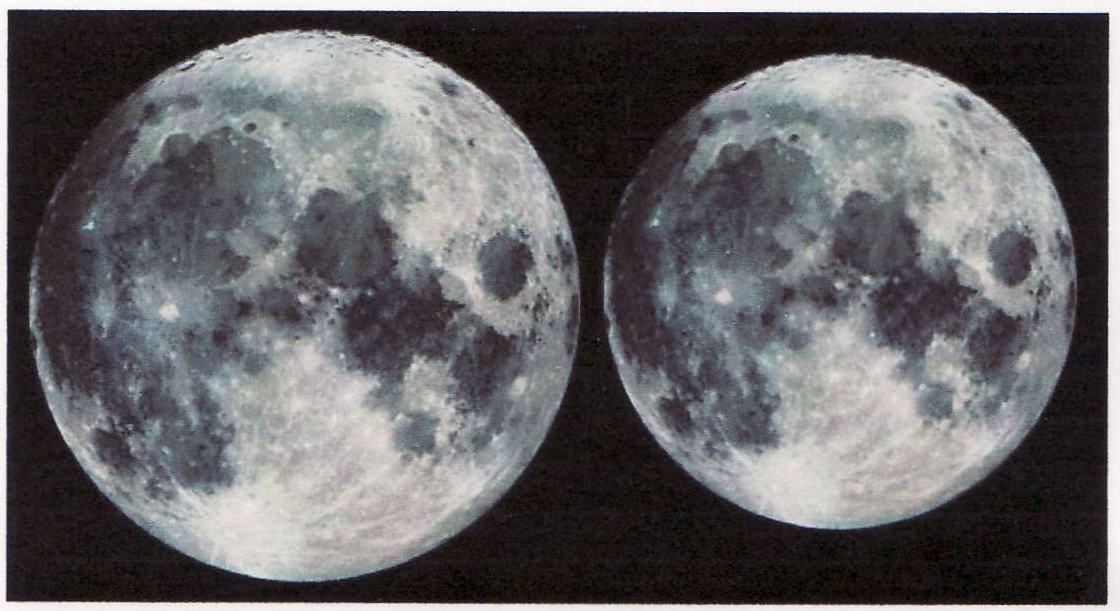
Table of planetary data
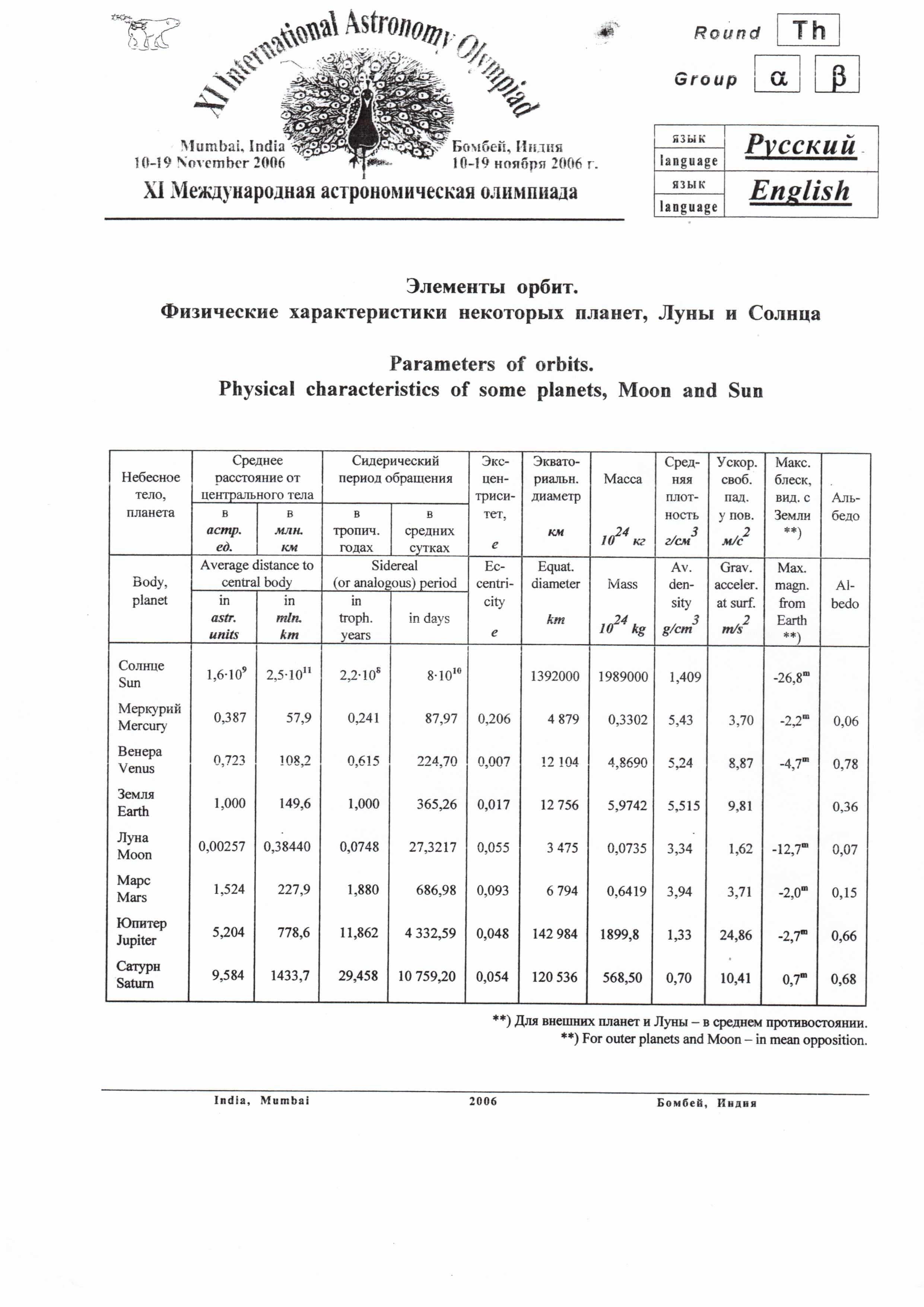
Data from the “Table of planetary data” may be used for the solving of every problem.
Решение
The hemisphere of the Moon at photos is about the same as we see it from the Earth.
Taking into account that the Moon is faced to us by one side all the times, it is possible to draw a conclusion that photographing was made from the points of space located approximately between the Earth and the Moon.
From the ratio of the sizes of images ( mm, mm) we can find that the ratio of distances from the Moon to the satellite in periselenion “P” and aposelenion “A” is equal to .
The satellite may be the satellite of only the Moon in the case even at the maximal distance from the Moon it would be in sphere of an attraction of the Moon, instead of the Earth. In other words, in case of the satellite in aposelenion is on a line the Moon – Earth, it should be closer to the Moon than the internal Lagrange point.
Let us find the position of this Lagrange point, the distance “” from the center of the Moon. This point is rotating around the Earth with same angular speed as the Moon. Equation of the balance of a body in the Lagrange point is:
where and – masses of Earth and Moon, – distance from the Earth to Moon. Since we have estimating type of the problem, let us consider that many times less than , and reformat the first term as:
so
Equation of rotating of the Moon around the Earth is and we have: .
By substituting this value to the third formula we have:
or .
So .
By substituting the value km and , we can receive km.
So the distance in aposelenion of the satellite orbit should not exceed 61 500 km, and one in periselenium should not exceed km. So the major axis of the satellite’s orbit should not exceed km. The sidereal period of a satellite with such a major axis is equal to
or 14.3 days. The correct answer (taking into account that we made only estimations) – about 14 days.
Note for Jury members
Note for Jury members, problems4 and5. Due to difference in printers the scales of pictures were different in different copies of pictures. So the values of the lengths may be different from those written here. But the ratios, which are necessary for solutions, of the lengths should be the same.
Оригинал в Архива: theo1.jpg · официални решения: theosol1.jpg · допълнителни данни: theo2.jpg · допълнителни данни: theodata1.pdf · допълнителни данни: theodata2.jpg · допълнителни данни: constants.jpg · допълнителни данни: theosol2.jpg · допълнителни данни: theosol3.jpg · допълнителни данни: theosol4.jpg