IAO 2008, Теория, Група α — Задача 4. Jump of bear
XIII International Astronomy Olympiad · Theoretical round. Problems to solve · 13 октомври 2008 г.
Note for jury and team leaders.
The proposed sketches are not full; the team leaders have to give more detailed explanations for students. But the correct solutions in the students’ papers (enough for 8 pts) may be shorter.
Элементы орбит. Физические характеристики некоторых планет, Луны и Солнца
Parameters of orbits.
Physical characteristics of some planets, Moon and Sun
| Небесное тело, планета / Body, planet | Среднее расстояние от центрального тела / Average distance to central body, астр. ед. / astr. units | Среднее расстояние от центрального тела / Average distance to central body, млн. км / mln. km | Сидерический (или аналогичный) период обращения / Sidereal (or analogous) period, тропич. годах / troph. years | Сидерический (или аналогичный) период обращения / Sidereal (or analogous) period, средних сутках / days | Эксцентриситет / Eccentricity, e | Экваториальн. диаметр / Equat. diameter, km | Масса / Mass, kg | Средняя плотность / Av. density, g/cm³ | Ускор. своб. пад. у пов. / Grav. acceler. at surf., m/s² | Макс. блеск, вид. с Земли / Max. magn. from Earth **) | Альбедо / Albedo |
|---|---|---|---|---|---|---|---|---|---|---|---|
| Солнце / Sun | 1,6·10⁹ | 2,5·10¹¹ | 2,2·10⁸ | 8·10¹⁰ | 1392000 | 1989000 | 1,409 | −26,8ᵐ | |||
| Меркурий / Mercury | 0,387 | 57,9 | 0,241 | 87,97 | 0,206 | 4 879 | 0,3302 | 5,43 | 3,70 | 0,06 | |
| Венера / Venus | 0,723 | 108,2 | 0,615 | 224,70 | 0,007 | 12 104 | 4,8690 | 5,24 | 8,87 | 0,78 | |
| Земля / Earth | 1,000 | 149,6 | 1,000 | 365,26 | 0,017 | 12 756 | 5,9742 | 5,515 | 9,81 | 0,36 | |
| Луна / Moon | 0,00257 | 0,38440 | 0,0748 | 27,3217 | 0,055 | 3 475 | 0,0735 | 3,34 | 1,62 | −12,7ᵐ | 0,07 |
| Марс / Mars | 1,524 | 227,9 | 1,880 | 686,98 | 0,093 | 6 794 | 0,6419 | 3,94 | 3,71 | 0,15 | |
| Юпитер / Jupiter | 5,204 | 778,6 | 11,862 | 4 332,59 | 0,048 | 142 984 | 1899,8 | 1,33 | 24,86 | 0,66 | |
| Сатурн / Saturn | 9,584 | 1433,7 | 29,458 | 10 759,20 | 0,054 | 120 536 | 568,50 | 0,70 | 10,41 | 0,68 |
**) Для Луны – в среднем противостоянии.
**) For Moon – in mean opposition.
Координаты на эпоху 2000
Epoch 2000 coordinates
| α | δ | |
|---|---|---|
| Полярная звезда / Polar star | 2ʰ 31ᵐ 48ˢ.7 | 89° 15′ 51″ |
Условие
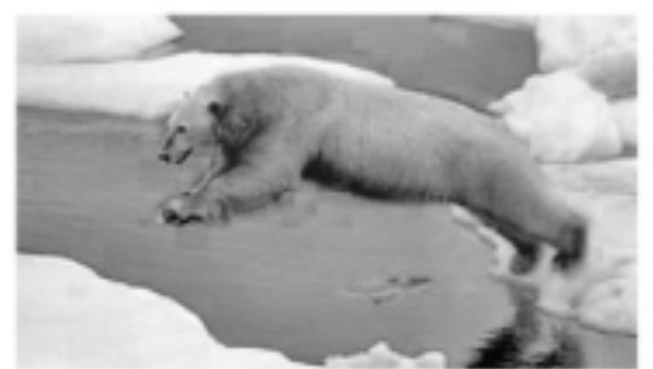
The beginning of XXI century. One may find in guidebooks about Spitsbergen a phrase that “a polar bear jumps 8 meters without warning”. The middle of XXVI century. In order for settling remote areas of Solar system by fauna, biologists plan to deliver polar bears from Spitsbergen onto ice asteroids of the Kuiper belt. However, physicists warn, that some jumping bears can become independent objects of the Kuiper belt. Estimate, on asteroids of what sizes (diameters) it is possible to place polar bears comfortably from the physicists’ point of view. You should give an answer in form of formula-inequality.
Отговори
Решение
4αβ. Jump of bear. So, the bear makes a start and flies... On Spitsbergen (that is, on the Earth) the length of jump is equal to
so
here is the initial speed of jump of the bear from the surface, – acceleration of gravity at the Earth. If we consider that this speed is not depend on the angle (in general it is not absolutely true, but we shall use this assumption in our model), the maximum length of jump is reached when ,
So, if m, we may obtain, that speed with which the bear makes a start from the Earth is approximately equal to
If this speed will be larger than the second cosmic speed for the asteroid, the bear will depart and surely become an independent object of the Kuiper belt. The second cosmic speed may be used for the solution. Nevertheless, the first cosmic speed is better in the situation. Even, if this speed will be less the second cosmic speed, but larger than the first cosmic speed, it would be quite uncomfortable for the bear after it has jumped of the surface: it will follow an orbit of suborbital flight during many hours.
The relationship between the first cosmic speed and the size and density of the asteroid is
The first cosmic speed for an asteroid of the Kuiper belt is equal
So
Taking into account that the planned for settling by bears objects of the Kuiper belt consist basically of ice, their characteristic density is about . So we have that the first cosmic speed is equal to for the asteroids with diameter of order
Thus, from the physicists’ point of view it is possible to place polar bears comfortably on ice asteroids with diameters more than about 35 km.
Answer: km.
Теми и трудност
Оценена трудност: 4/5.
Механика · Слънчева система · Работа и енергия · Гравитация · Астероиди, комети и метеори
Предпоставки: Разширена олимпиадна подготовка
Оригинал в Архива: alphatheo.pdf · официални решения: theosol.pdf · допълнителни данни: IAO2008-data.pdf