IAO 2009, Практически тур, Група β — Задача 6. Light echo
Practical round. Problems to solve · 8 ноември 2009 г.
Условие
Light echoes are produced when the initial flash from a rapidly brightening object (such as a nova) is reflected by the surrounding interstellar dusts which may or may not be associated with the object. Light from the initial flash arrives at the viewer first, while light reflected by the dusts begins to arrive shortly afterward. The variable star V838 Monocerotis was seen to have a violent outburst in March 09, 2002 (Modified Julian Day 52342).
Then the Hubble Space Telescope (HST) captured its light echoes from the surrounding dusts in the next few months. Figure 1 presents two photos observed by HST. The black box shows a field of view of .
Figure 1
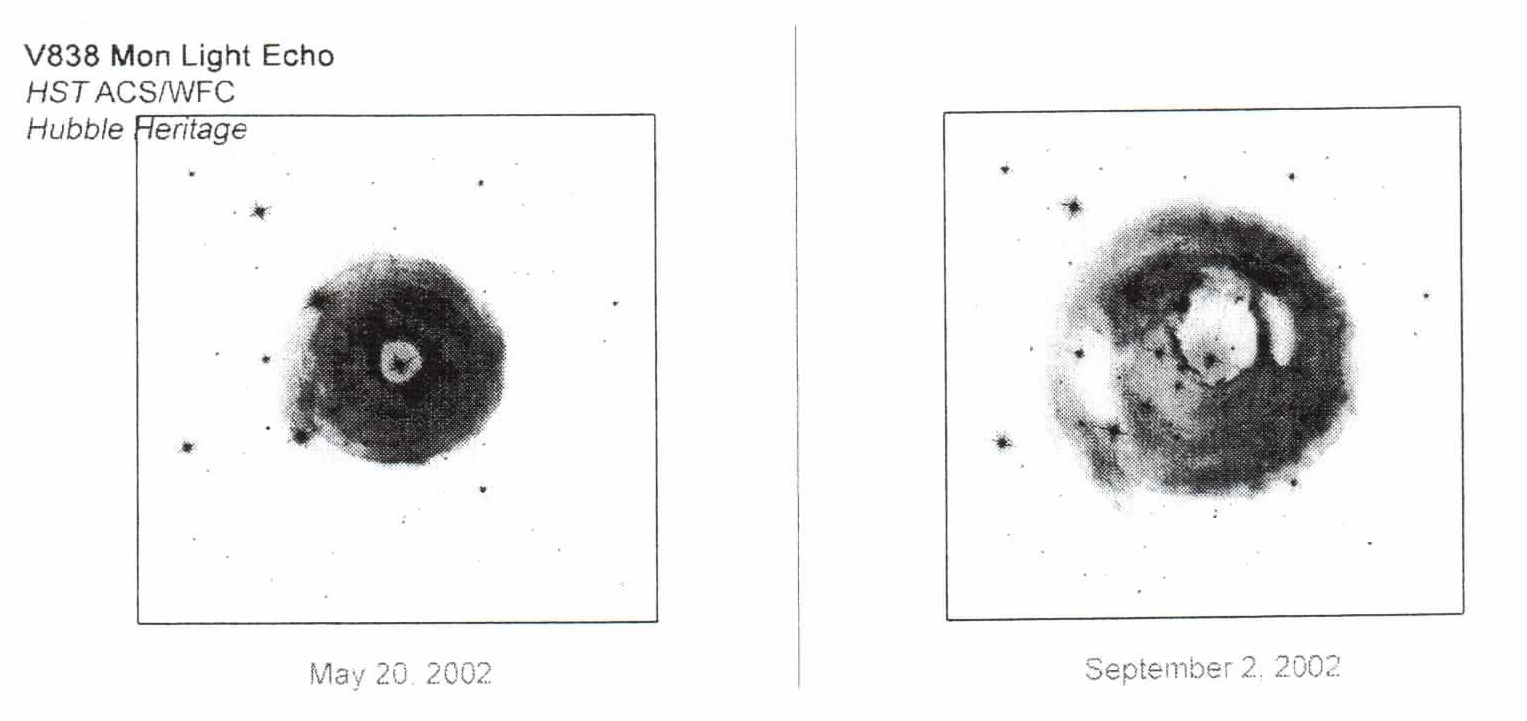
Table 1
Recently, astronomers found Monoceros V838 and other three adjacent main sequence stars are all members of an open cluster. Table 1 gives some observed data of the three stars, where V and B is apparent magnitude in V and B band, and is apparent magnitudes with extinction correction. is absolute V magnitude. It is known that for the cluster the interstellar extinction is in V-band and in B-band.
| Number | Spectral type | V | B | |||
|---|---|---|---|---|---|---|
| N1 | B6 V | 16.02 | 16.73 | -0.15 | ||
| N2 | B4 V | 15.00 | 15.63 | -0.19 | ||
| N3 | B3 V | 14.79 | 15.41 | -0.205 |
Distance to the open cluster in light years (ly):
6.1.
According to the Hertzsprung-Russell diagram (Figure 2) and the known data in Table 1, fill in the blank of Table 1.
6.2.
An astronomer at the Shanghai Observatory proposed a theoretical model for V838 Mon. He found the velocity of the expanding envelope of V838 Mon varies with time, as listed in table 2. Plot the data in figure 3 and estimate the angular diameters of the envelopes when the photos in figure 1 were taken. Write your answers in Table 3.
6.3.
According to the two photos of figure 1, estimate the radii of the dust shells which produced the outermost light echoes. Write your answers in Table 3.
Table 2
| Modified Julian Day | velocity (km/s) |
|---|---|
| 52351 | 800 |
| 52397 | 630 |
| 52421 | 560 |
| 52435 | 503 |
| 52467 | 432 |
| 52583 | 333 |
| 52676 | 305 |
| 52769 | 263 |
| 52825 | 227 |
| 52895 | 220 |
| 52988 | 200 |
| 53095 | 190 |
| 53174 | 180 |
| 53267 | 158 |
| 53351 | 150 |
Figure 2
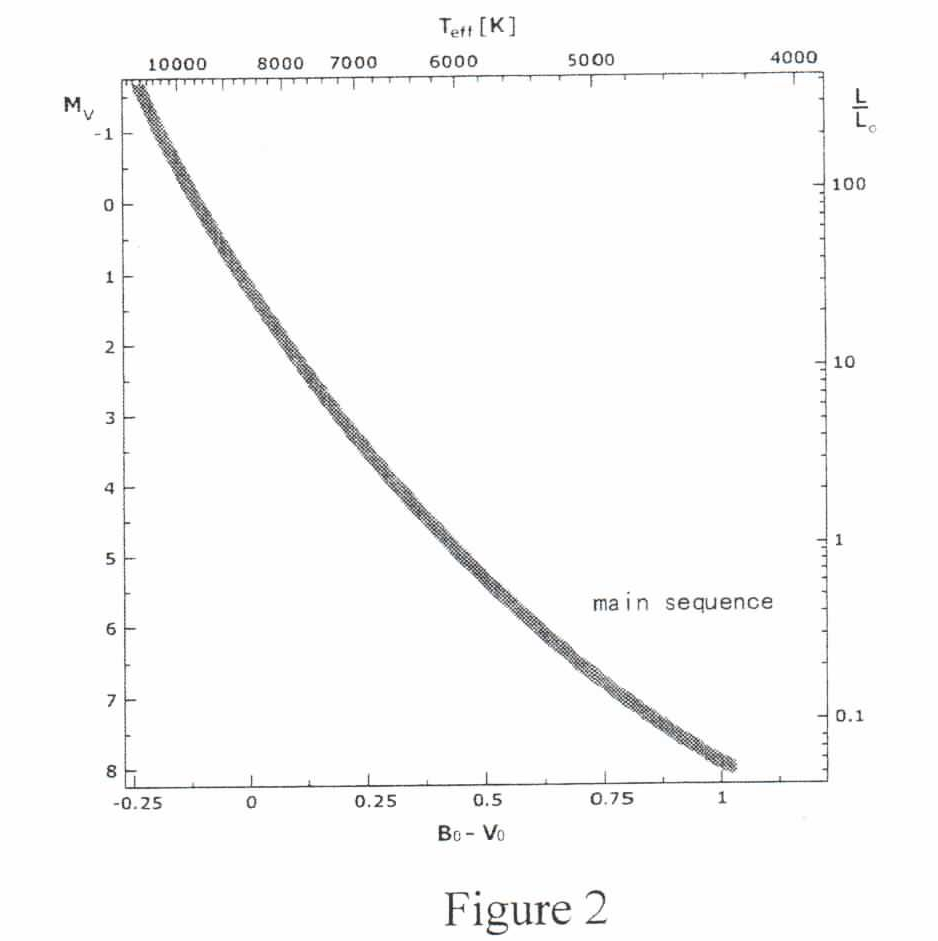
Figure 3
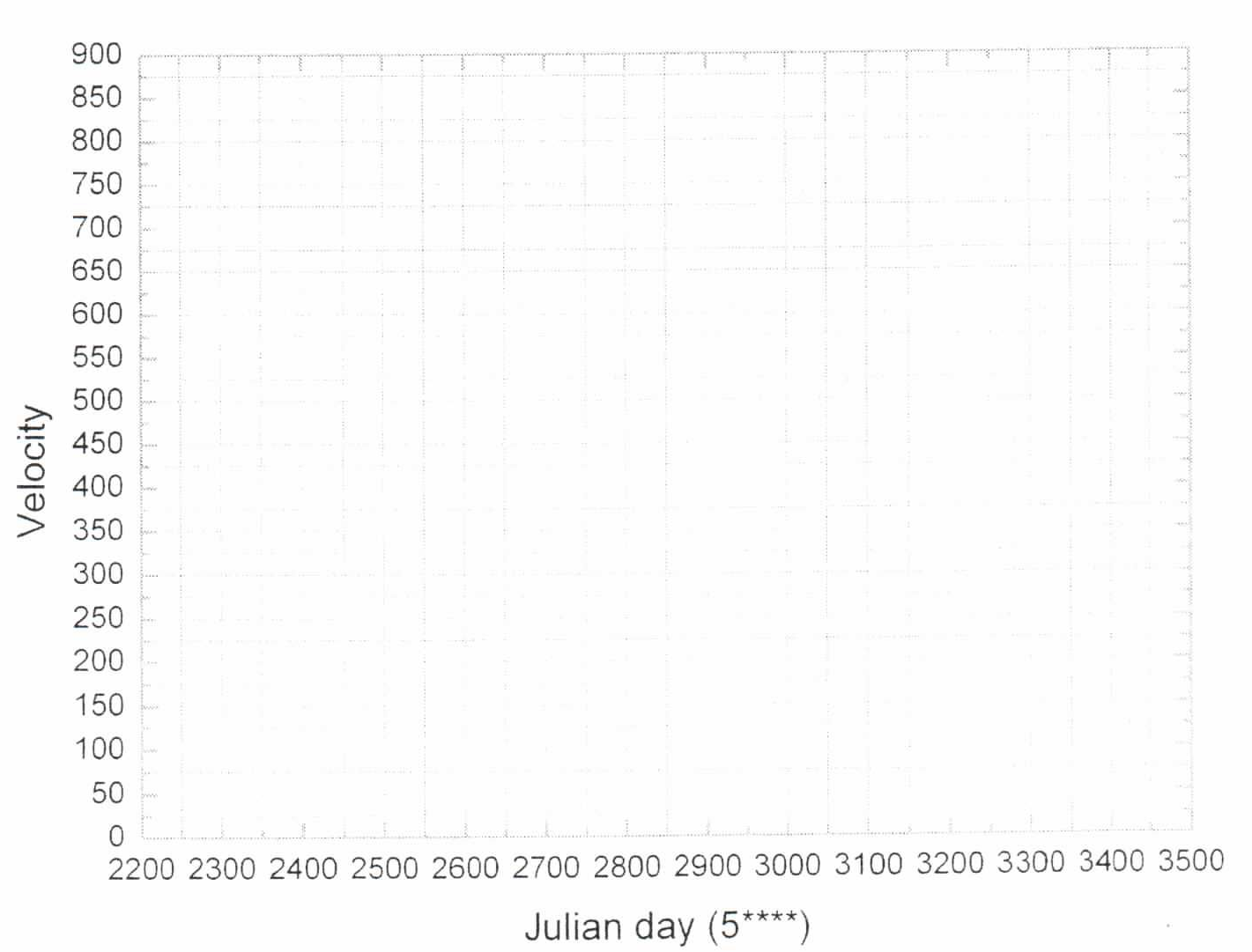
Table 3
| time (days from 3/9/2002) | Visual diameter of stellar envelope (″) | Visual diameter of dust shell (″) | Radius of dust shell (ly) |
|---|---|---|---|
Решение
1)
The intrinsic color of the stars is , and the can be obtained through the H-R diagram.
| Number | Spectral type | V | B | |||
|---|---|---|---|---|---|---|
| N1 | B6 V | 16.02 | 16.73 | -0.15 | 13.42 | |
| N2 | B4 V | 15.00 | 15.63 | -0.21 | 12.40 | |
| N3 | B3 V | 14.79 | 15.41 | -0.22 | 12.19 |
According to , we can get the distance modules of the three stars. And the distance of the cluster is the mean value of these stars, i.e. .
2)
This question is a hint to remind the students that the shells in figure 1 are not envelopes of V838 Mon but interstellar dusts that brightened by the outburst of V838 Mon.
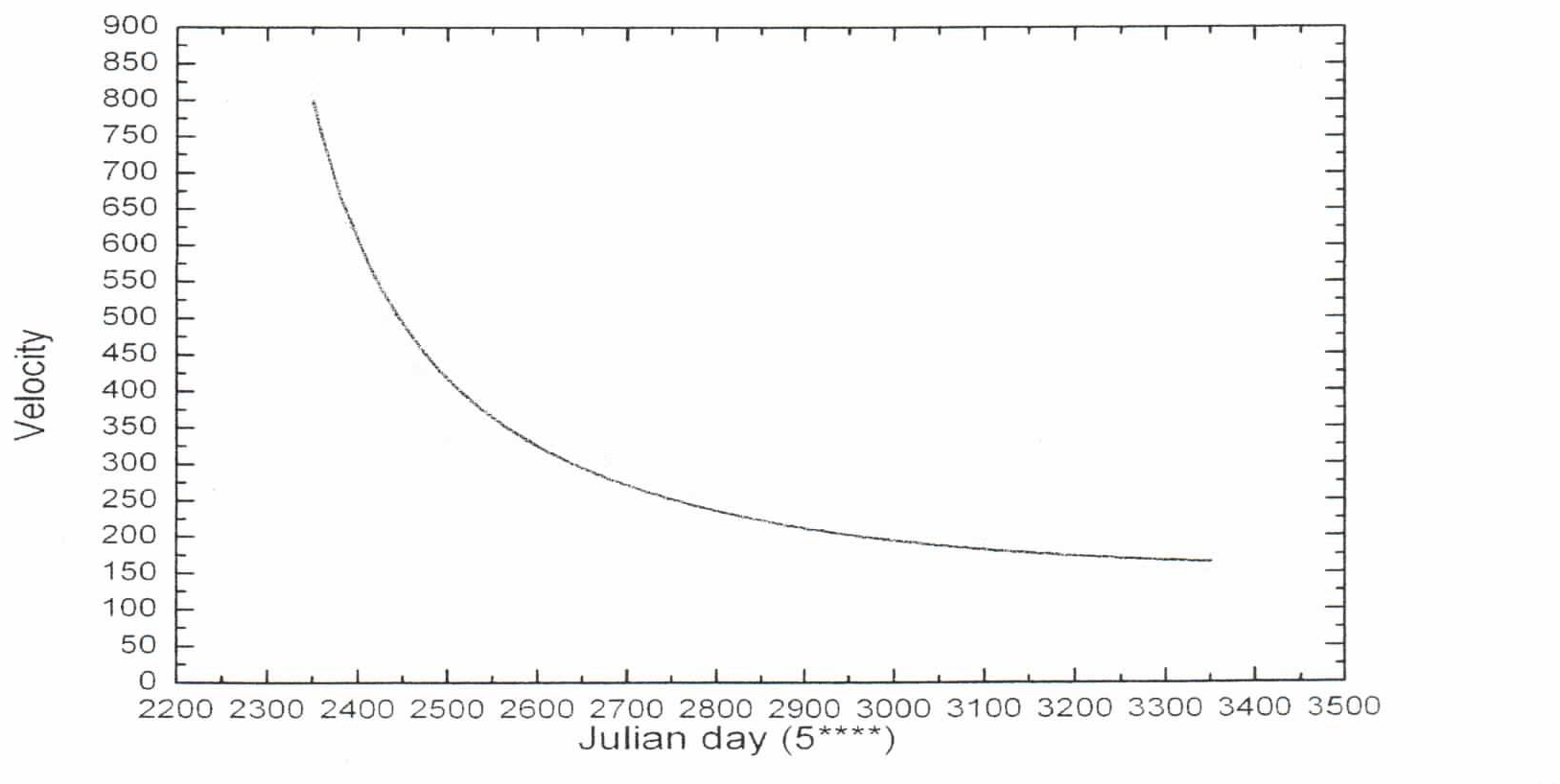
The graph is plotted here. The black solid line is a fitted curve through the data in table 2.
The area of the curve in figure 1 indicates the distance that the envelope expanded. The area of a unit rectangle is:
The julian day of May 20, 2002 and Sep. 2, 2002 is 52414 and 52519. It can be counted in the figure that on May 20, 2002 and Sep. 2, 2002, the envelope expands about and . Thus, the angular diameters of the envelopes are respectively:
3)
Let "0" be the time of the observation of the original outburst, i.e. March 09, 2002, and be the time when the outermost light echoes were observed. The light echos delayed because of the speed of light is limited, as displayed by the following figure.
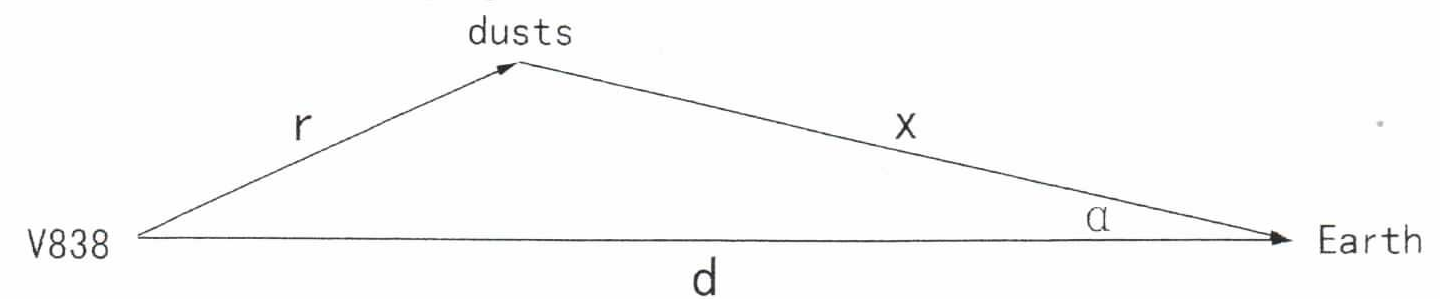
From the figure, we get:
Then we can find:
where is the visual radius of the outermost dusts shell and can be measured from the HST figure, is the speed of light, is the distance of the star. , . The final result is listed in the following table.
| time (days from 3/9/2002) | Diameter of stellar envelope (″) | Visual diameter of dust shell (″) | Radius of dust shell (ly) |
|---|---|---|---|
| 72 (0.1971 year) | 0.01 | 40 (±5) | 9.0 |
| 177 (0.4846 year) | 0.02 | 60 (±5) | 7.5 |
Оригинал в Архива: 6betapract1.jpg · официални решения: practsol2.jpg · допълнителни данни: 6betapract2.jpg · допълнителни данни: practsol3.jpg