IAO 2009, Практически тур, Групи α и β — Задача 7. The Vernal Equinox Day of Saturn
Practical round. Problems to solve · 8 ноември 2009 г.
Условие
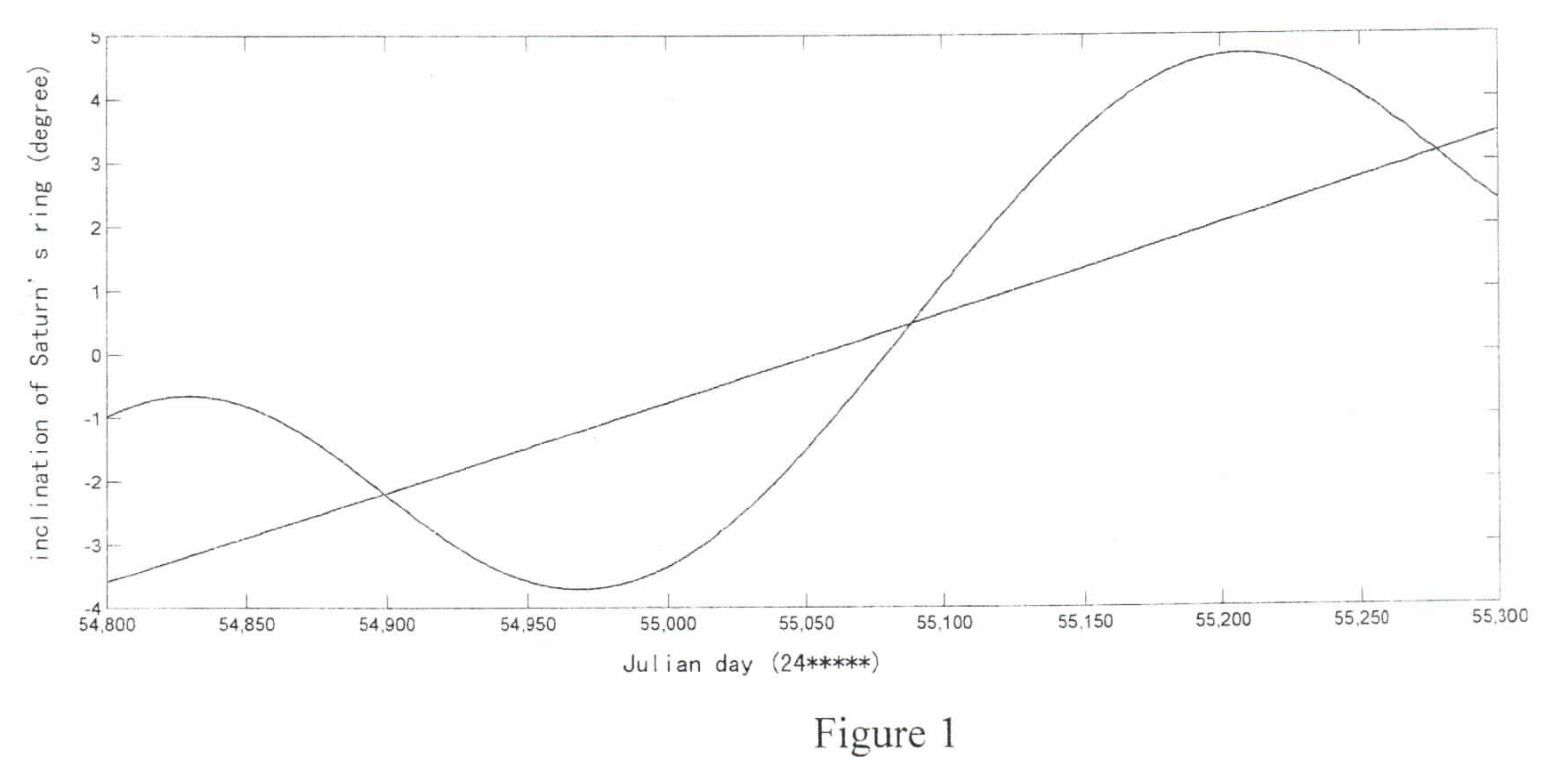
One day this year, Saturn ushers in its own vernal equinox day. Through observations and calculations, a research group of Beijing Planetarium obtained the inclination angle of Saturn's ring which is varying with time. The result is plotted in figure 1. The horizontal axis is Julian Day and the vertical axis is the observed inclination angle in degrees. The curved line is the result observed from Beijing Planetarium and the (almost) straight line is the result observed by an imaginary observer on the Sun. The differences between them result from the revolution of the Earth and the inclination of the orbital plane of Saturn which inclines to the ecliptic plane with an angle of .
On January 13, 2005 (Julian day 2453383), Saturn is at opposition. Saturn's orbital period is known as 29.46 years, and its equator inclines to its orbital plane with an angle of . Suppose the Earth and Saturn's orbits are circular and the radius of Saturn's orbit is 9.54 AU.
Figure 1
7.1.
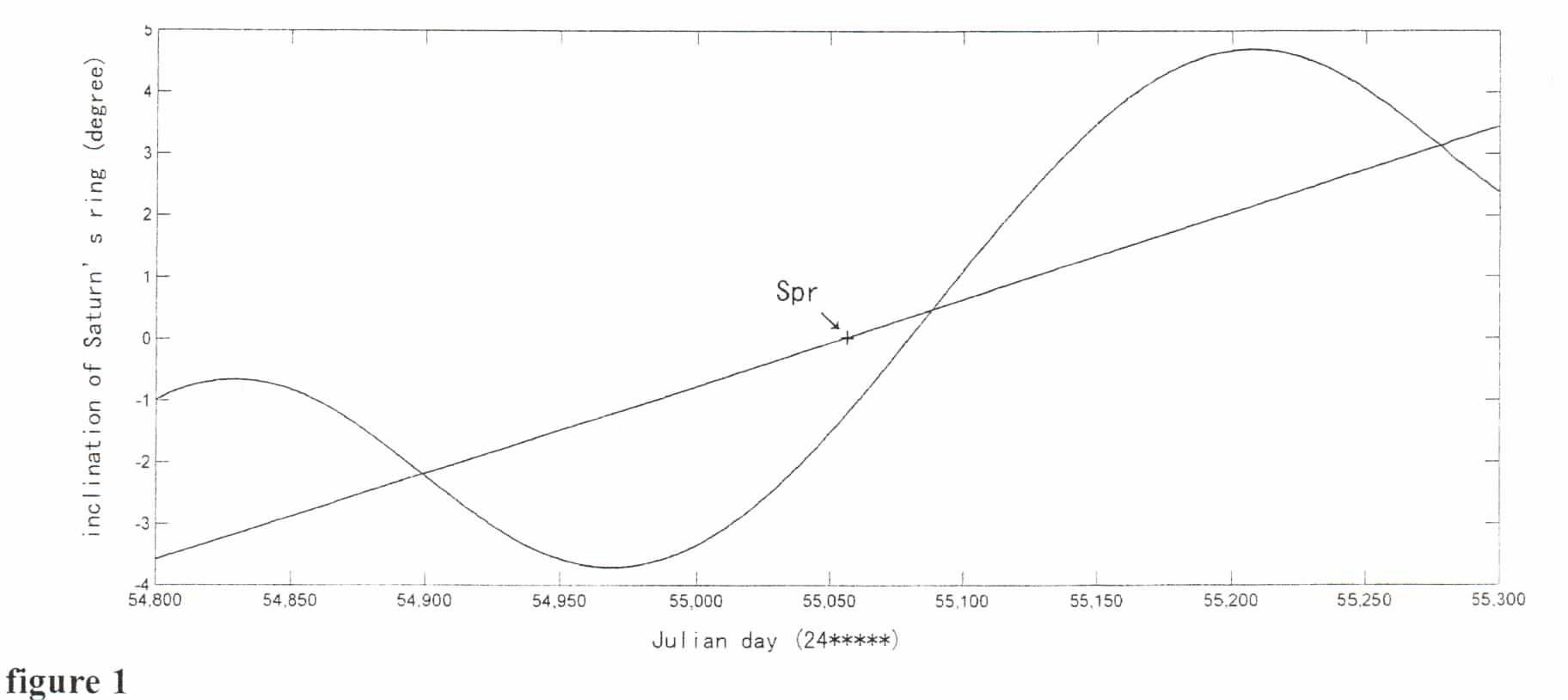
According to Figure 1, find out which day is Saturn's Vernal Equinox Day. Give the integer value of Julian day. And mark it in Figure 1 as “Spr”.
7.2.
According to Figure 1, estimate the largest inclination angle of Saturn's ring that can be observed from Beijing Planetarium and the Sun.
7.3.
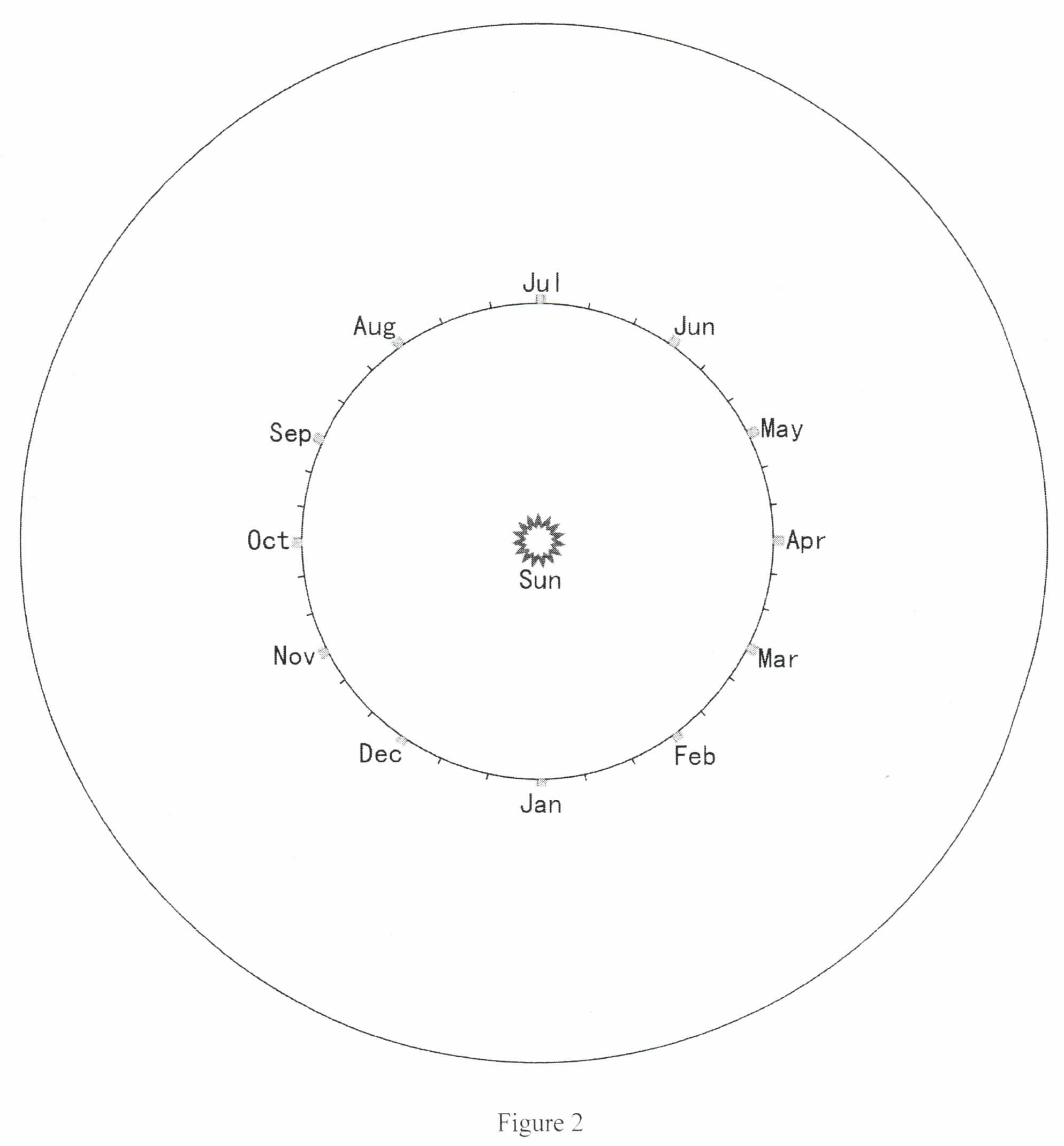
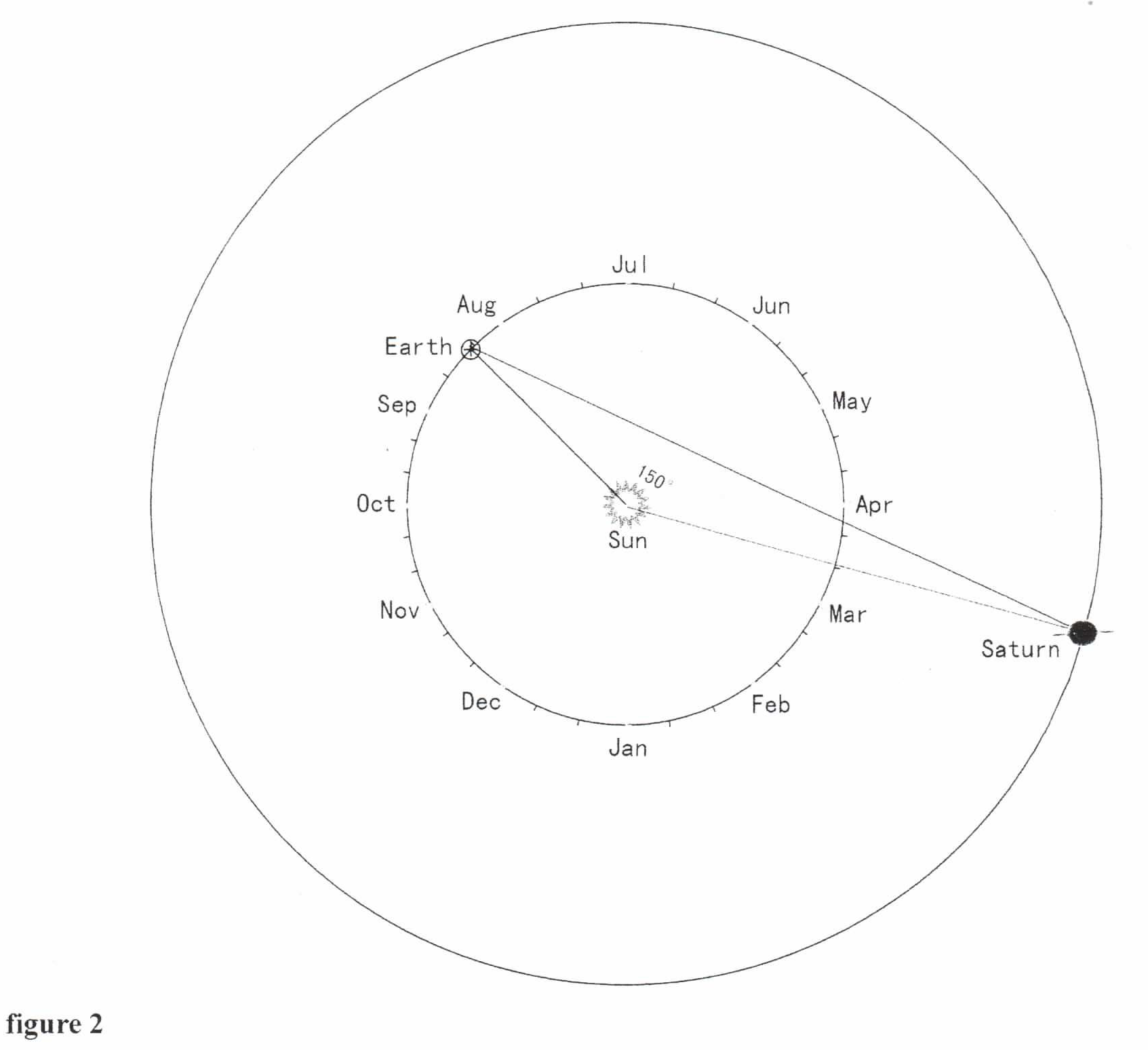
Mark the approximate position of the Earth and Saturn on Saturn's Vernal Equinox Day in Figure 2. Please indicate on the figure the angular relationship of the Earth, Saturn, and Sun. The inner circle is Earth's orbit and the outer is Saturn's (not to scale). Jan means the of January, Feb means the of February, and so on.
7.4.
On Saturn's Vernal equinox day, what's the distance between Earth and Saturn (in AU)? Ignore the inclination of Saturn's orbit.
7.5. (group β only)
Ignoring the inclination of Saturn's orbit, calculate the maximum difference of the inclination angle of Saturn's ring between Beijing Planetarium and the Sun-observer (at the same moment).
Решение
1)
On the vernal equinox day, the sun-observer will see a inclination angle of the ring of Saturn. It can be found that the day is Julian day 2455055, and the corresponding date is August 11, 2009.
group
group
2)
From figure 1, the maximum difference of the observed inclination angle of Saturn's ring between Beijing Planetarium and the sun-observer can be measured and its value is about . The maximum inclination angle of Saturn's ring observed by the sun-observer is equal to the inclination angle of its equator, i.e. (when Saturn is on solstices).
Thus the maximum inclination angle of Saturn's ring observed by Beijing Planetarium is about:
Note: In fact, when Saturn is on solstices, the Earth is not exactly at the right position that makes the difference maximum in the past decades. Actually, the maximum angle observed is about .
3)
The angle that Saturn revolute from Jan 13, 2005 to Aug 11, 2009 is:
The angle that Earth revolute from Jan 13 to Aug 11 is about:
Thus, on Aug 11, the angle of Earth-Sun-Saturn is about .
group
group
4)
On the vernal equinox day of Saturn, the distance between Saturn and Earth can be derived from the triangle Earth-Sun-Saturn in figure 2:
5) (group β)
For the sun-observer, the inclination angle of the ring of Saturn (noted as ) varies with time and follows the law below:
Where is the angle that Saturn revolute since its vernal equinox and is .
Ignoring the inclination of Saturn's orbit, for Beijing Planetarium, the inclination angle of the ring of Saturn (noted as ) changes following the law below (see figure 3):
where is the angular distance between Earth and Sun as seen on Saturn. At the same moment, when is maximum, the difference of the inclination angle of Saturn's ring between the earth-observer and the sun-observer reaches maximum. It's easy to find that .
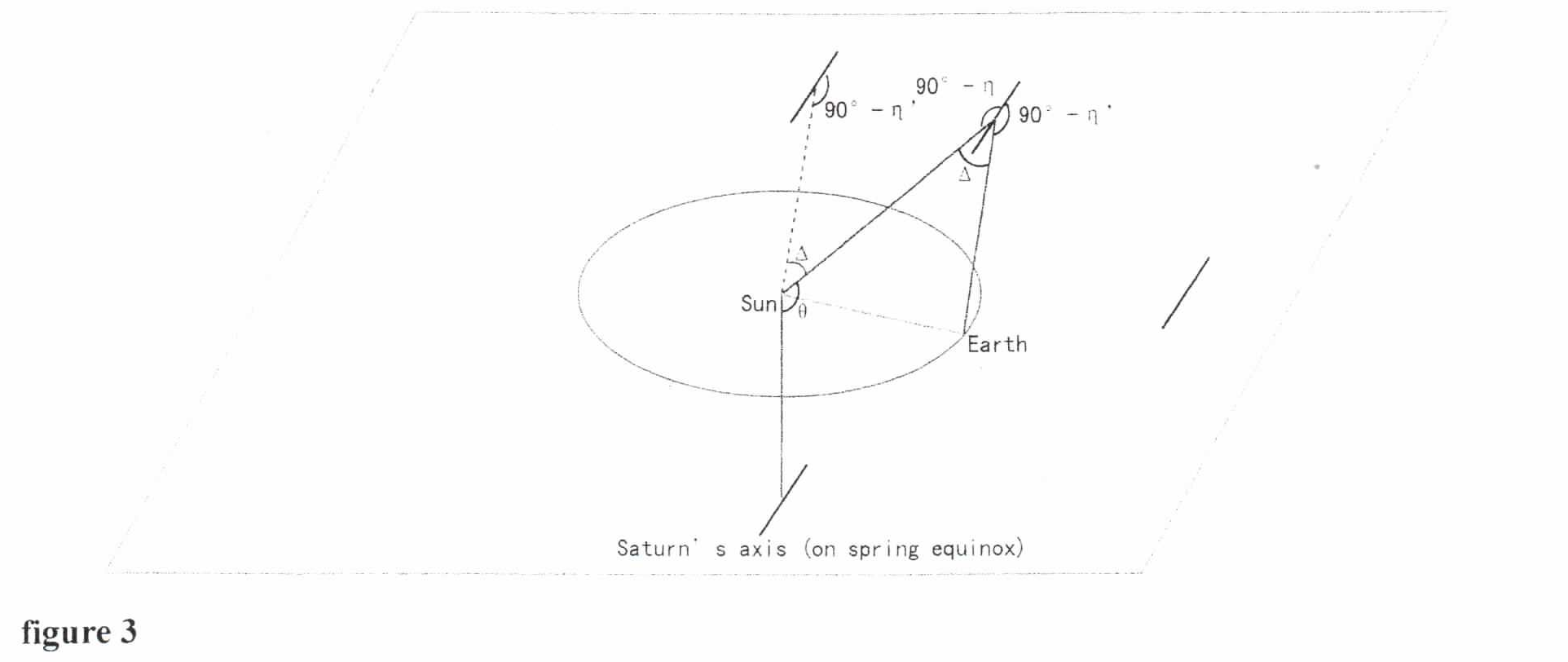
Now we need to find the value . According to symmetry, it's enough to consider the situation that .
On the vernal equinox day of Saturn: , , , ;
On the summer solstice day of Saturn: , , , . It can be deduced that decreases monotonously from vernal equinox to around summer solstice. Thus , and it happens when Saturn is on vernal equinox and the angular distance between Earth and the Sun seen on Saturn reaches maximum.
group
Оригинал в Архива: 7pract1.jpg · официални решения: practsol3.jpg · допълнителни данни: 7pract2.jpg · допълнителни данни: practsol4.jpg · допълнителни данни: obssol1.jpg