IAO 2009, Теория, Група β — Задача 5. Galaxy pair.
Theoretical round. Problems to solve · 8 ноември 2009 г.
Бележка
Maybe not all problems have correct questions. Some questions (maybe the main question of the problem, maybe one of the subquestions) may have no real sense. In this case you have to write in your answer (in English or Russian): “impossible situation – ситуация невозможна”. Of course, this answer has to be explained numerically or logically.
Data from the table of planetary data may be used for solving every problem.
The answers «Да-Yes» or «Нет-No» has to be written in English or Russian.
Note for jury and team leaders.
The proposed sketches are not full: the team leaders have to give more detailed explanations for students. But the correct solutions in the students’ papers (enough for 8 pts) may be shorter.
Parameters of orbits. Physical characteristics of some planets, Moon, Sun and Eris
| Body, planet | Average distance (astr. units) | Average distance (mln. km) | Sidereal period (troph. years) | Period (days) | Eccentricity | Equat. diameter (km) | Mass ( kg) | Av. density (g/cm³) | Grav. acceler. (m/s²) | Max. magn. from Earth | Albedo |
|---|---|---|---|---|---|---|---|---|---|---|---|
| Sun | 1392000 | 1989000 | 1.409 | ||||||||
| Mercury | 0.387 | 57.9 | 0.241 | 87.97 | 0.206 | 4879 | 0.3302 | 5.43 | 3.70 | 0.06 | |
| Venus | 0.723 | 108.2 | 0.615 | 224.70 | 0.007 | 12104 | 4.8690 | 5.24 | 8.87 | 0.78 | |
| Earth | 1.000 | 149.6 | 1.000 | 365.26 | 0.017 | 12756 | 5.9742 | 5.515 | 9.81 | 0.36 | |
| Moon | 0.00257 | 0.38440 | 0.0748 | 27.3217 | 0.055 | 3475 | 0.0735 | 3.34 | 1.62 | 0.07 | |
| Mars | 1.524 | 227.9 | 1.880 | 686.98 | 0.093 | 6794 | 0.6419 | 3.94 | 3.71 | 0.15 | |
| Jupiter | 5.204 | 778.6 | 11.862 | 4332.59 | 0.048 | 142984 | 1899.8 | 1.33 | 24.86 | 0.66 | |
| Saturn | 9.584 | 1433.7 | 29.458 | 10759.20 | 0.054 | 120536 | 568.50 | 0.70 | 10.41 | 0.68 | |
| Eris | 68.01 | 204862 | 0.434 | 2600 | 0.0167 | 0.8 | 0.86 |
**) For Moon: in mean opposition.
Some constants and formulae
| Constant or formula | Value |
|---|---|
| Speed of light in vacuum, (m/s) | 299792458 |
| Constant of gravitation, (N·m²/kg²) | |
| Solar constant, (W/m²) | 1367 |
| Hubble constant, (km/s/Mpc), mean value | 70 |
| Hubble constant, diapason of values | 50–100 |
| Plank constant, (J·s) | |
| Charge of electron, (C) | |
| Mass of electron, (kg) | |
| Proton-to-electron ratio | 1836.15 |
| Faraday constant, (C/mol) | 96485 |
| Magnetic constant, (H/m) | |
| Universal gas constant, (J/mol/K) | 8.314 |
| Boltzmann constant, (J/K) | |
| Standard atmosphere (Pa) | 101325 |
| Stefan-Boltzmann constant, (W/m²/K⁴) | |
| Wien's displacement constant, (m·K) | 0.002897 |
| Laboratory wavelength of H (Å) | 6563 |
| Refractive index of water for20°C, | 1.334 |
| Area of sphere | |
| 3.14159265 |
Data of some stars
| Star | Designation | RA | DEC | m | SC |
|---|---|---|---|---|---|
| Arcturus | Boo | -0.05 | K1 | ||
| Vega | Lyr | 0.03 | A0 | ||
| Deneb | Cyg | 1.25 | A2 | ||
| Polaris | UMi | 2.02 | F7 | ||
| Sirius | CMa | -1.46 | A1 |
Бележки от източника
The original two-up official key photographs clip some right-hand line endings. Ellipses mark those unreadable endings; visible formulae and printed numerical values are retained. The reference table gives the Eris period as 204862 days, whereas the key uses 204852 days. Original inline slash notation is retained in the key. The photographed alpha masthead is cropped, but the original filename and distinct alpha tasks in the official key establish its group.
Условие
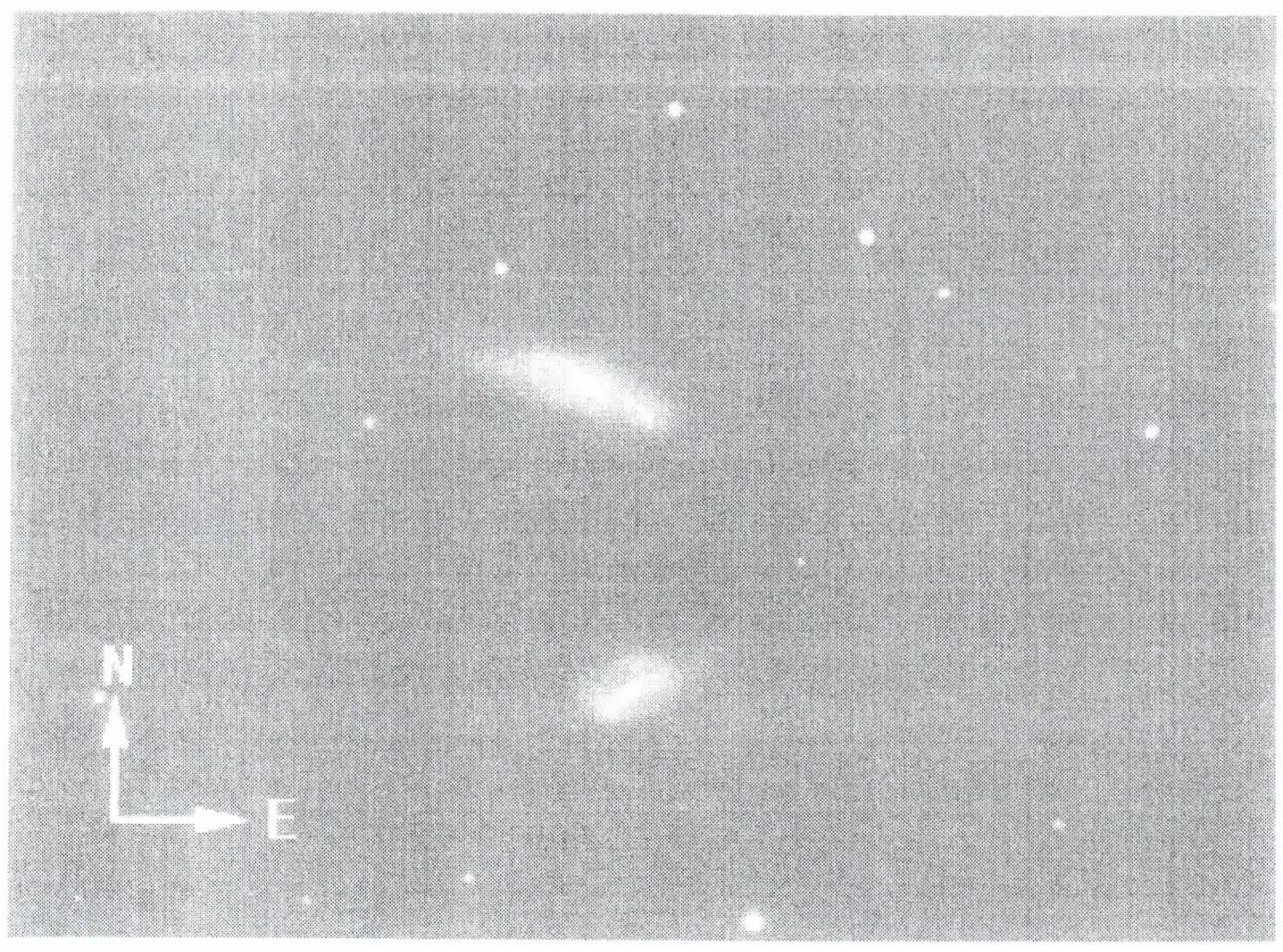
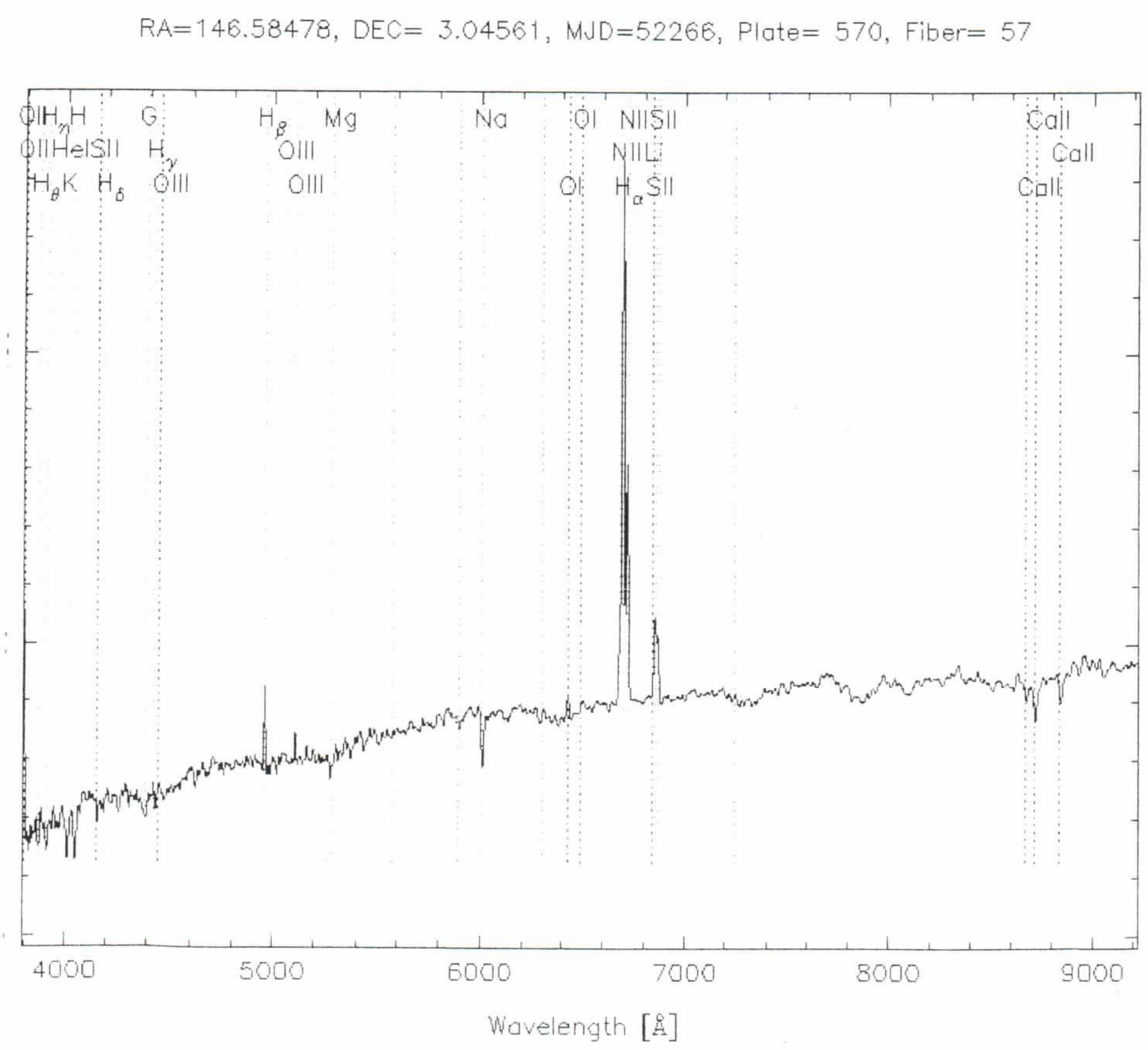
This famous galaxy pair contains two interacting galaxies, IC563 and IC564. The coordinates of the centers of IC563 and IC564 are respectively RA 146.58479, DEC 3.04558 and RA 146.58783, DEC 3.07137. Using the 2.16m telescope of The National Astronomical Observatories of China (NAOC), their R-band image in 2009 has been obtained, which is presented at the fig.1. The spectrum of the center of IC563 is shown at the fig.2.
5.1.
We were assigned two periods of time in 2009 to carry out our observation. One was in April and another was in September. Please find out, when IC563, IC564 has been observed? (Write "Apr" or "Sep" in English.)
5.2.
Mark IC563 and IC564 at the fig.1.
5.3.
Find out the redshift of the galaxies. Consider the redshift of one of them can be realized as the redshift for the other.
5.4.
NAOC astronomers want to take H photo of IC563 and IC564 next year, to seek the star formation regions in or around them. There is a series narrow band H transmission filters in NAOC, as listed in table (the center wavelength is given in the terms of velocity). Select the most suitable filter for the observation.
| № of filter | maximum transmission (%) | peak value of redshift for H (km/s) |
|---|---|---|
| C1 | 80 | 0 |
| C2 | 78 | 2150 |
| C3 | 89 | 3600 |
| C4 | 78 | 6720 |
| C5 | 82 | 9006 |
| C6 | 81 | 11290 |
| C7 | 87 | 13570 |
| C8 | 78 | 15400 |
| C9 | 84 | 18600 |
| C10 | 84 | 20890 |
5.5.
How many parsecs away are the galaxies? What is the projected distance between the two galaxies?
Решение
Внимание: Непълно решение
The original official key photograph clips several right-hand line endings. All visible text, formulae and diagrams are retained; ellipses mark unreadable source endings.
5.1.
In April and September, the right ascension of the sun is about 0.5–2.5 h and 10.5–12.5 h respectively. An… the right ascension of the galaxy is . Thus, April is the better choice because i… September the visual position of the galaxies is too close to the sun. Answer: Apr.
5.2.
According to the DECs of the two galaxies, it's easy to find that the upper one is IC564.
5.3.
The wavelength of H emission line measured in figure 2 is approximately 6680–6700 Å.
Taking into account (see table of constants) that the laboratory wavelength of H emission is 6563 Å, th… redshift of the galaxy is approximately:
5.4.
Since , the recession velocity of the galaxy is:
We should choose the filter whose peak value of redshift is close to 6000 km/s. The suitable one is № C4.
5.5.
According to Hubble's law, the distance to the galaxies is:
The two galaxies are close to each other and the curvature of the celestial sphere can be neglected. Th… angular distance of the centers of the galaxies is:
Where, , . As a result:
The distance between the two galaxies is:
Printed marginal allocations
5.1: 1
5.2: 0.5
5.3: 1 + 1
5.4: 1 + 1
5.5: 1 + 1 + 0.5
Оригинал в Архива: betatheo.jpg · допълнителни данни: theosol1.jpg · допълнителни данни: theosol2.jpg · допълнителни данни: constants.jpg · допълнителни данни: betatheodata.jpg