IAO 2010, Теория, Група β — Задача 5. International Space Station.
Theoretical round. Problems to solve · 16 октомври 2010 г. · 8 т.
Бележка
Maybe not all problems have correct questions. Some questions (maybe the main question of the problem, maybe one of the subquestions) may have no real sense. In this case you have to write in your answer (in English or Russian): «impossible situation – ситуация невозможна». Of course, this answer has to be explained numerically or logically.
Data from the table of planetary data may be used for solving every problem.
The answers «Да-Yes» or «Нет-No» has to be written in English or Russian.
Note for jury and team leaders.
The proposed sketches are not full; the team leaders have to give more detailed explanations for students. But the correct solutions in the students’ papers (enough for 8 pts) may be shorter.
Some constants and formulae
| Constant | Value |
|---|---|
| Speed of light in vacuum, (m/s) | 299792458 |
| Constant of gravitation, (N·m²/kg²) | |
| Solar constant, (W/m²) | 1367 |
| Hubble constant, (km/s/Mpc), mean value | 70 |
| Hubble constant, diapason of values | 50–100 |
| Plank constant, (J·s) | |
| Charge of electron, (C) | |
| Mass of electron, (kg) | |
| Proton-to-electron ratio | 1836.15 |
| Faraday constant, (C/mol) | 96485 |
| Magnetic constant, (H/m) | |
| Universal gas constant, (J/mol/K) | 8.314 |
| Boltzmann constant, (J/K) | |
| Standard atmosphere (Pa) | 101325 |
| Stefan-Boltzmann constant, (W/m²/K⁴) | |
| Wien’s displacement constant, (m·K) | 0.002897 |
| Laboratory wavelength of H (Å) | 6563 |
| Refractive index of water for 20°C, | 1.334 |
| Area of sphere | |
| 3.14159265 |
Data of some stars
| Star | Designation | RA | DEC | m | SC | |
|---|---|---|---|---|---|---|
| Arcturus | Boo | 14h 15m 40s | 19° 10′ 57″ | 0″.089 | −0.05 | K1 |
| Vega | Lyr | 18h 36m 56s | 38° 47′ 01″ | 0″.129 | 0.03 | A0 |
| Deneb | Cyg | 20h 41m 26s | 45° 16′ 49″ | 0″.001 | 1.25 | A2 |
| Polaris | UMi | 02h 31m 51s | 89° 15′ 51″ | 0″.007 | 2.02 | F7 |
| Sirius | CMa | 06h 45m 09s | −16° 42′ 58″ | 0″.379 | −1.46 | A1 |
Parameters of orbits. Physical characteristics of some planets, Moon, Sun and Eris
| Body, planet | Average distance to central body (astr. units) | Average distance (mln. km) | Sidereal (or analogous) period (troph. years) | Period (days) | Eccentricity | Equat. diameter (km) | Mass ( kg) | Av. density (g/cm³) | Grav. acceler. at surf. (m/s²) | Max. magn. from Earth **) | Albedo |
|---|---|---|---|---|---|---|---|---|---|---|---|
| Sun | 1392000 | 1989000 | 1.409 | ||||||||
| Mercury | 0.387 | 57.9 | 0.241 | 87.97 | 0.206 | 4879 | 0.3302 | 5.43 | 3.70 | 0.06 | |
| Venus | 0.723 | 108.2 | 0.615 | 224.70 | 0.007 | 12104 | 4.8690 | 5.24 | 8.87 | 0.78 | |
| Earth | 1.000 | 149.6 | 1.000 | 365.26 | 0.017 | 12756 | 5.9742 | 5.515 | 9.81 | 0.36 | |
| Moon | 0.00257 | 0.38440 | 0.0748 | 27.3217 | 0.055 | 3475 | 0.0735 | 3.34 | 1.62 | 0.07 | |
| Mars | 1.524 | 227.9 | 1.880 | 686.98 | 0.093 | 6794 | 0.6419 | 3.94 | 3.71 | 0.15 | |
| Jupiter | 5.204 | 778.6 | 11.862 | 4332.59 | 0.048 | 142984 | 1899.8 | 1.33 | 24.86 | 0.66 | |
| Saturn | 9.584 | 1433.7 | 29.458 | 10759.20 | 0.054 | 120536 | 568.50 | 0.70 | 10.41 | 0.68 | |
| Eris | 68.01 | 204862 | 0.434 | 2600 | 0.0167 | 0.8 | 0.86 |
**) For Moon – in mean opposition.
Source discrepancies
Printed data and formulae are retained. The official key uses several ungrouped slash expressions. The Venus key initially prints divisor 1.406 before using 19.6 later. The ISS key prints 6371 + 350 = 6720 km.
Условие
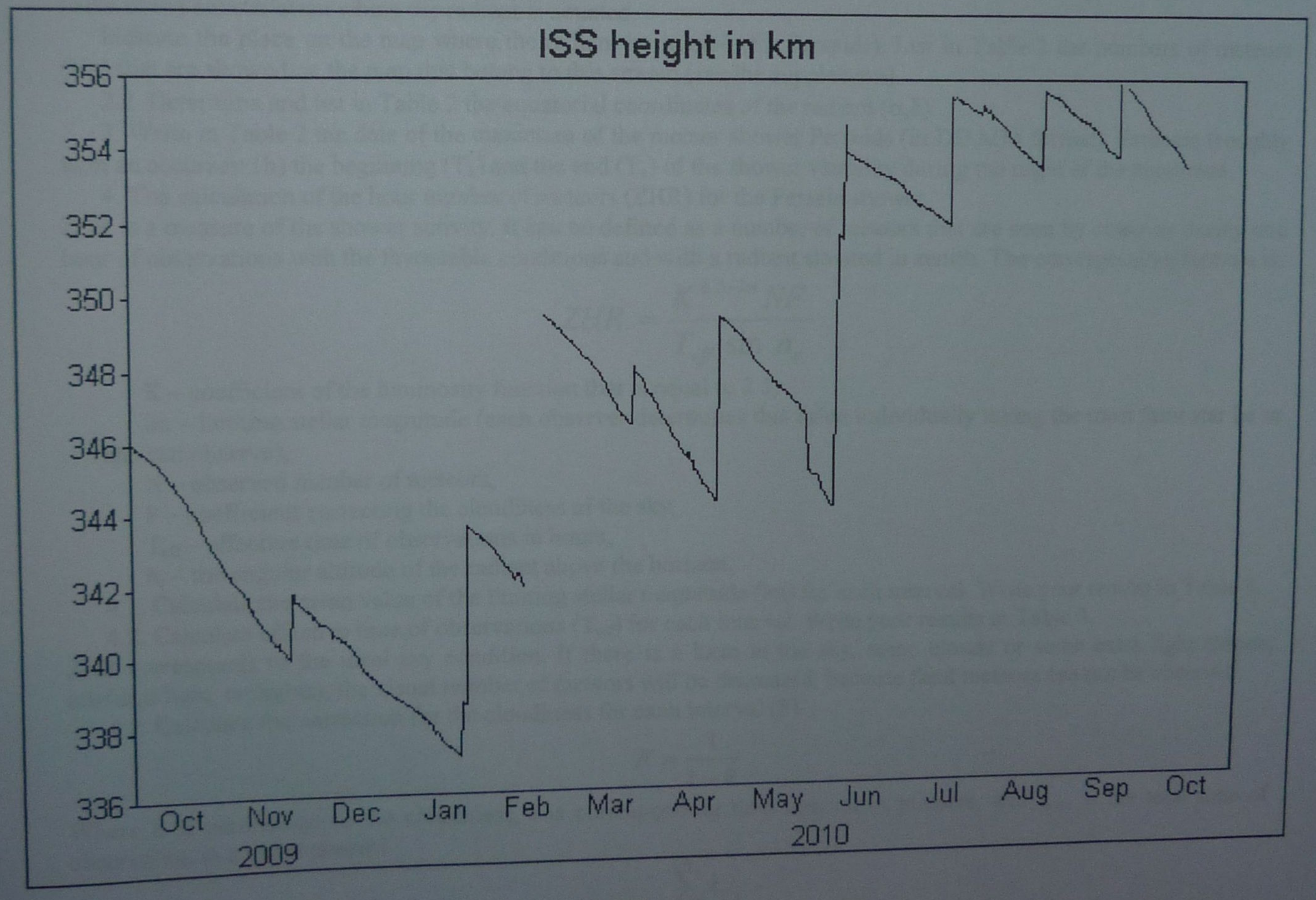
The graph presents the change in height of the ISS orbit depending on time. Estimate the average density of the atmosphere at heights around 340–360 km. Consider the orbit to be circular. The mass of ISS is 362 ton. Consider the cross-section of the ISS-complex to be (including the sections of the solar cell array).
Решение
Let us consider the orbit of station as circular, and its average radius was
where – radius of the Earth, and – the height of the orbit). It is obvious, that the upward jumps are corrections of the orbit by engines, and its slow descent during the lowering is due to loss of energy by the station due to friction in the upper atmosphere. We see that all these parts have an average inclination of approximate 2-2.5 kilometers per month or about 75 meters per day, that is, the change in the altitude of the orbit per day is
To consider correctly all the events, it is better to use energetic approach, calculating the total energy of the station
and not only kinetic or potential . (Here is gravitational constant, is mass of the Earth, is orbital speed of station.) By the way, note that speed of station increases with lowering of the height (the station is braked, and speed increases!). From conditions of moving on circular orbit
Whence
Note. The formulae written above are fair for the values of potential energy of gravitational interaction counted from infinity (bodies are removed from each other on infinite distance). Generally speaking, the absolute value of potential energy is not meaningful in physics, only the change of potential energy is important.
Thus,
The process of loss of energy by station and simultaneous increase in its speed with lowering of radius of the orbit can be imagined as follows. Let us imagine a quasistationary process with circular orbit all the time, and the work done by forces of resistance of friction
changes the parameters of this circular orbit. Here – force of resistance, – the distance moved. The force may be found from the following arguments: during each period of time a mass of averagely motionless molecules collides with the station ( – density of atmosphere at height of orbit of the station). As result of elastic collisions their speed relative to the station varies from to , and relative to the Earth – from 0 to . That is, during the period of time the station transmits to the molecules the momentum
Whence
Thus, during time hours the station moves a distance , and the work of forces of friction (and, accordingly, loss of energy by station) is
Change in energy
On the other hand, change in energy of the station in this time is
where – change in height of the orbit (value of is negative!).
and, taking into account that ,
Numerical calculations:
So the numerical answer is:
(more accuracy is not reasonable).
Basic criteria. For work of Jury
General note: the frame work of school physics using only the energetic approach to obtain the solution, and usage the total energy , not only or is correct.
Max 8 pt criteria for solutions using total energy approach:
- Understanding that using is necessary – 2 pt.
- Correct understanding that the slow descent during the lowering is due to loss of energy, correct finding that the rate is about 75 m/day – 1 pt.
- Algebra steps and correct finding: total energy – 1 pt.
- Correct finding work of forces – 1 pt.
- Algebra steps and final correct formula – 2 pt in total.
- Correct calculation of numerical answer – 1 pt.
Оригинал в Архива: betatheo.jpg · допълнителни данни: theosol1.jpg · допълнителни данни: theosol2.jpg · допълнителни данни: theosol3.jpg · допълнителни данни: theosol4.jpg · допълнителни данни: theosol5.jpg · допълнителни данни: theocriteria1.jpg · допълнителни данни: theocriteria2.jpg · допълнителни данни: constants.jpg · допълнителни данни: orbital-elements.jpg · допълнителни данни: theodata.jpg