IAO 2011, Практически тур, Група α — Задача 7. Exoplanet
XVI International Astronomy Olympiad. Round Prac. Group α. Practical round. Problems to solve · 22 септември 2011 г.
Внимание: Бележка към темата
The p7 grading allocations printed in the shared key sum to 80%; the remaining 20% is not specified. The key also prints an unparenthesized flux-ratio expression; the source expression and stated radius ratio are both retained. The December 23 question photograph says LCM 237°, while the p6 solution table uses 287°. Both values are preserved with an explicit note.
Условие
Recently astronomers discovered an exoplanet that practically reflects no light and belongs to the class of hot Jupiters. Its mass corresponds to 12 Jupiter's masses, the average orbit radius is 0.036 AU and the period is 2.47 days. The given data about the exoplanet has been obtained with the help of the data from the "Kepler" telescope which continuously monitors the sky region between the constellations Cygnus and Lyra. The device was launched in March 2009 and is capable of seeing not only gas giants, but also planets with the size of Earth. Recently scientists have discovered that exoplanets are capable of causing huge tidal waves in the stars that have a significant influence on the spectral parameters of the emitted light from the star. In fact, with the help of this effect scientists have been able to prove that the planet moves around a star in a circular orbit.
In the graph (see separate sheet) the flux of radiation from the system vs. the phase (phase given in radians) can be seen, normalized to the radiation flux from the star.
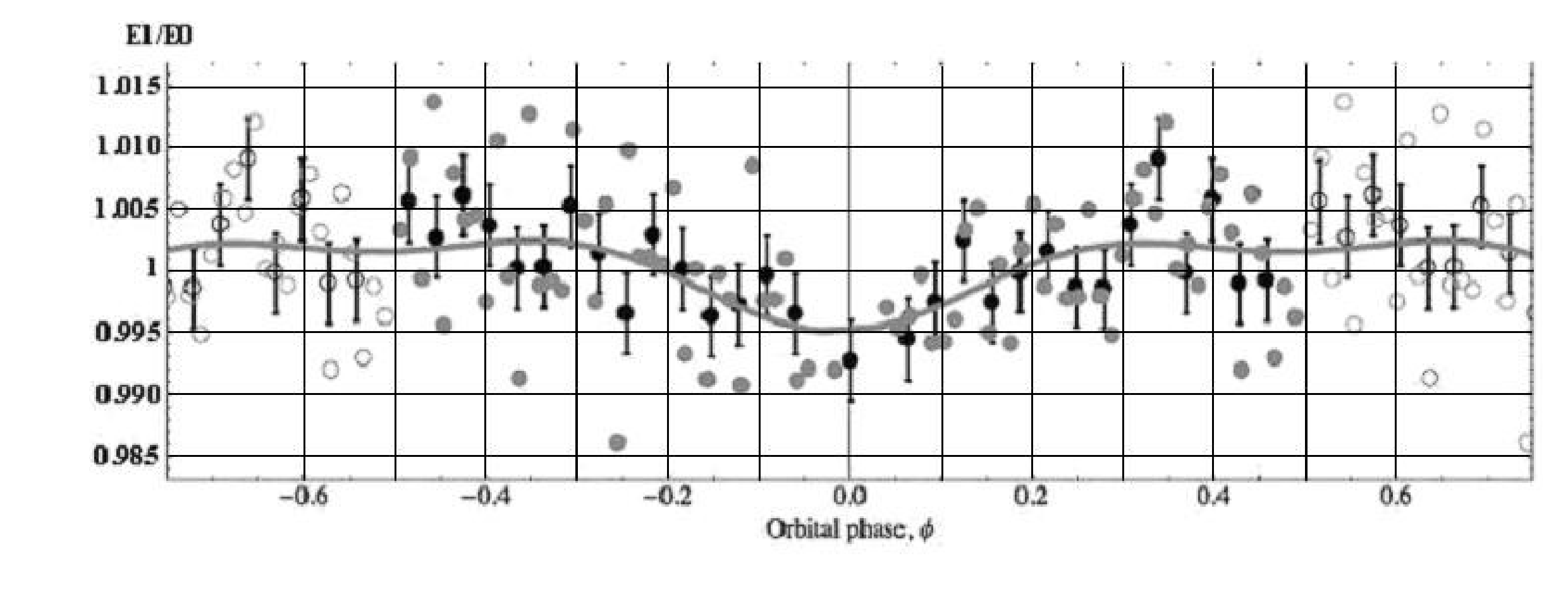
7.1. During the transit there are four "contacts" when the contour of the smaller object touches the contour of the larger object at one point. The contacts take place in the following order:
- First contact: The smaller body is completely outside of the larger and moving inside.
- Second contact: The smaller body is completely inside of the larger and continues to move inwards.
- Third contact: The smaller body is completely inside of the larger and moves outwards.
- Fourth contact: The smaller body is completely outside of the larger and starts to move away.
In the given graph mark the points of the first, second, third and the fourth contacts. Write in the copybook the value of the phase for each contact.
7.2. Determine the duration of the transit (duration of the passage of the disk of planet over the disk of the star).
7.3. Determine the inclination of the orbit (for exoplanets and binary stars the reference plane is assumed to be the "image plane" – the plane that is perpendicular to the line of sight).
7.4. Calculate the radius of the star.
7.5. Calculate the radius of the planet.
Отговори
- 7.1.
- 7.2.
- 7.3.
- 7.4.
- 7.5.
Решение
Official solution source: the shared Russian document alphabeta7sol.doc. The question and observed light curve are already reproduced above; the supplied solution below retains its original language.
1) Контакты — 10%
- (10%)
- Первый контакт:
- Второй контакт:
- Третий контакт:
- Четвёртый контакт:
2) Длительность прохождения — 20%
- (20%) время (длительность) прохождения планеты
период суток, разность фаз между первым и последним контактами рад.,
полный период соответствует рад., отсюда время прохождения
3–5) Наклонение орбиты и радиусы
определение наклонения орбиты (20%)
определение радиуса звезды (15%)
определение радиуса планеты (15%)
Обозначим — радиус звезды, — радиус экзопланеты.
Из графика можем найти соотношение радиусов планеты и звезды: при прохождении поток излучения на минимуме соответствует покрытию планетой звезды, отсюда соотношение потоков будет соответствовать соотношению площадей поверхностей:
Transcription note: the unparenthesized quotient is printed in the key; its stated radius ratio corresponds to . The source expression and result are retained.
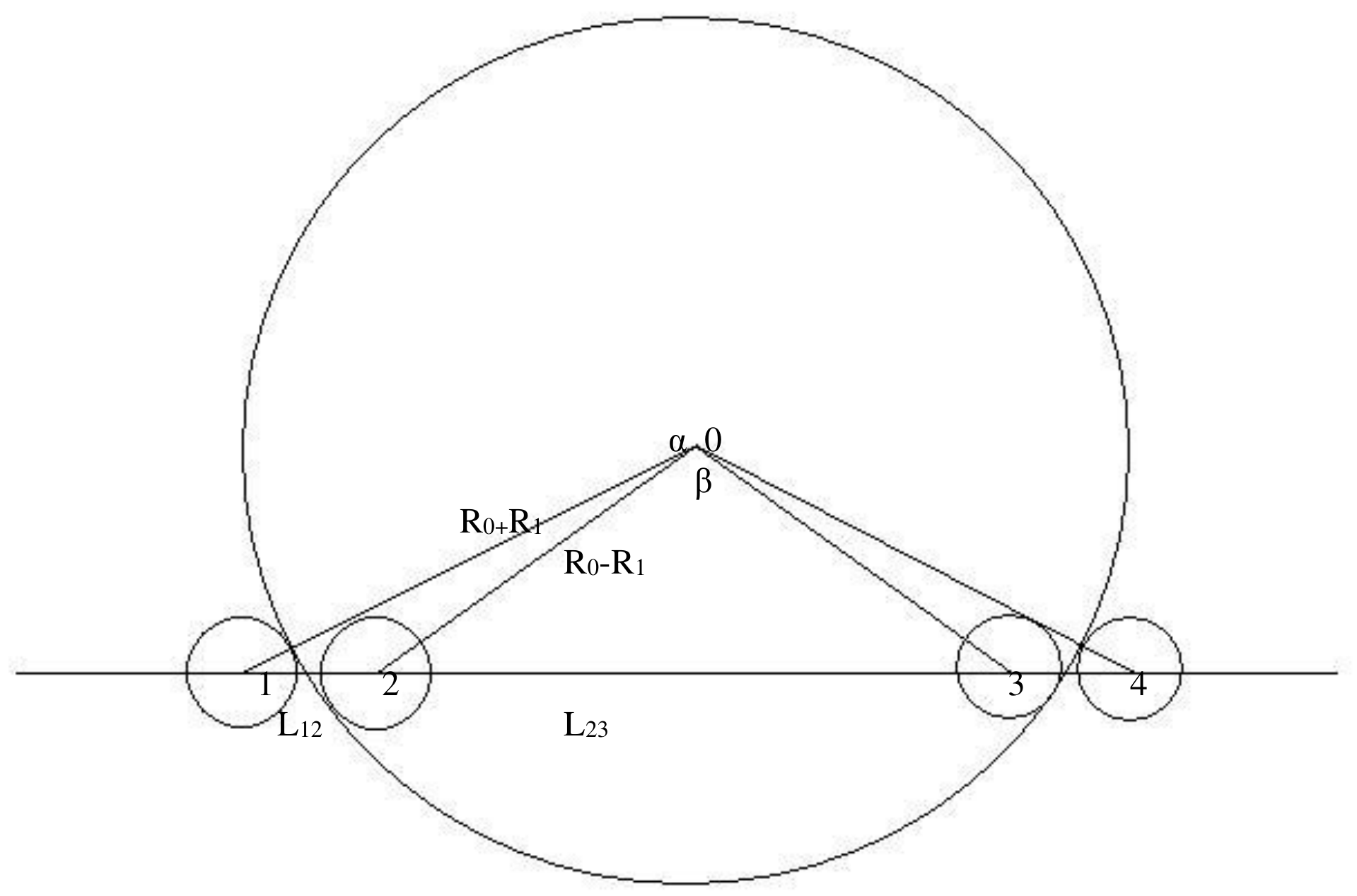
Рассмотрим рисунок 1.
На рисунке цифрами обозначены точки, соответствующие контактам, и — расстояния между соответствующими контактами:
Для треугольников 012, 023 и 013 можем написать
Используя соотношения для радиусов, получим систему
отсюда а.е., а.е.
Теперь, если найдем высоту равнобедренного треугольника
можем вычислить наклонение
Source grading note
The source lists 10%, 20%, 20%, 15%, and 15% for the five items. These total 80%; no allocation for the remaining 20% is supplied. The printed percentages are preserved without normalization.
Оригинал в Архива: alphapract.pdf · официални решения: alpha6sol.doc · допълнителни данни: alphabeta7sol.doc