IAO 2012, Практически тур, Група β — Задача 7. Fireball
IAO2012 — Practical round (β) · 10 т.
Practical round. Problems to solve
XVII International Astronomy Olympiad. Gwangju, Korea,16–24 X 2012. Group β.
Note. If you find somewhere in the problems an impossible situation, write in English «impossible situation».
Бележки от източника
The official Fireball solution explicitly acknowledges an incorrectly plotted observing point II. It gives A/B latitudes36.47°/36.10° in7.2, then36.49°/36.11° in7.4 and its final table. These printed values are retained.
Missing plotting form
The original blank Cluster graph papers(A) and(B) referred to in8.1/8.2 are absent from the complete same-year source inventory; the available paper.png is the Fireball geographic grid.
Printed solution details
The official Clusters solution says NGC2686 in its8.4 explanation and NGC2682 elsewhere; both are retained. Its Hyades magnitude formula and stated answer0.75 are preserved without recalculation.
Shared source pack
The six official practical solution images and grading sheet cover both group editions; this edition includes only its matching problem8. Four theory-labelled reference sheets were inspected. The orbital-properties table supports Moon, and the Hertzsprung-Russell diagram is explicitly mentioned by the Clusters solution. The constants and individual-star tables supply reference context, not extra practical tasks. The geographic grid belongs to Fireball.
Условие
A fireball was observed from three different observing sites I, II, III. The position of the observing sites, the altitude and azimuth of start and end points of the fireball’s trajectory are given in Table 1. Azimuth is measured eastward from the North direction, and altitude measured above the horizon, and both the angular measurements are in degrees. Following the steps below, find true trajectory and location on the surface of Earth of fallen debris of the fireball (meteorite).
Table 1. Observational Data for a Fireball
| Observing position | Longitude | Latitude | Starting point (A): azimuth | Starting point (A): altitude | End point (B): azimuth | End point (B): altitude |
|---|---|---|---|---|---|---|
| I | 127.3°E | +35.7° | 17° | 35° | 77° | 10° |
| II | 128.5°E | +37.0° | 235° | - | 139° | - |
| III | 128.5°E | +35.4° | 325° | - | 48° | - |
7.1–7.4
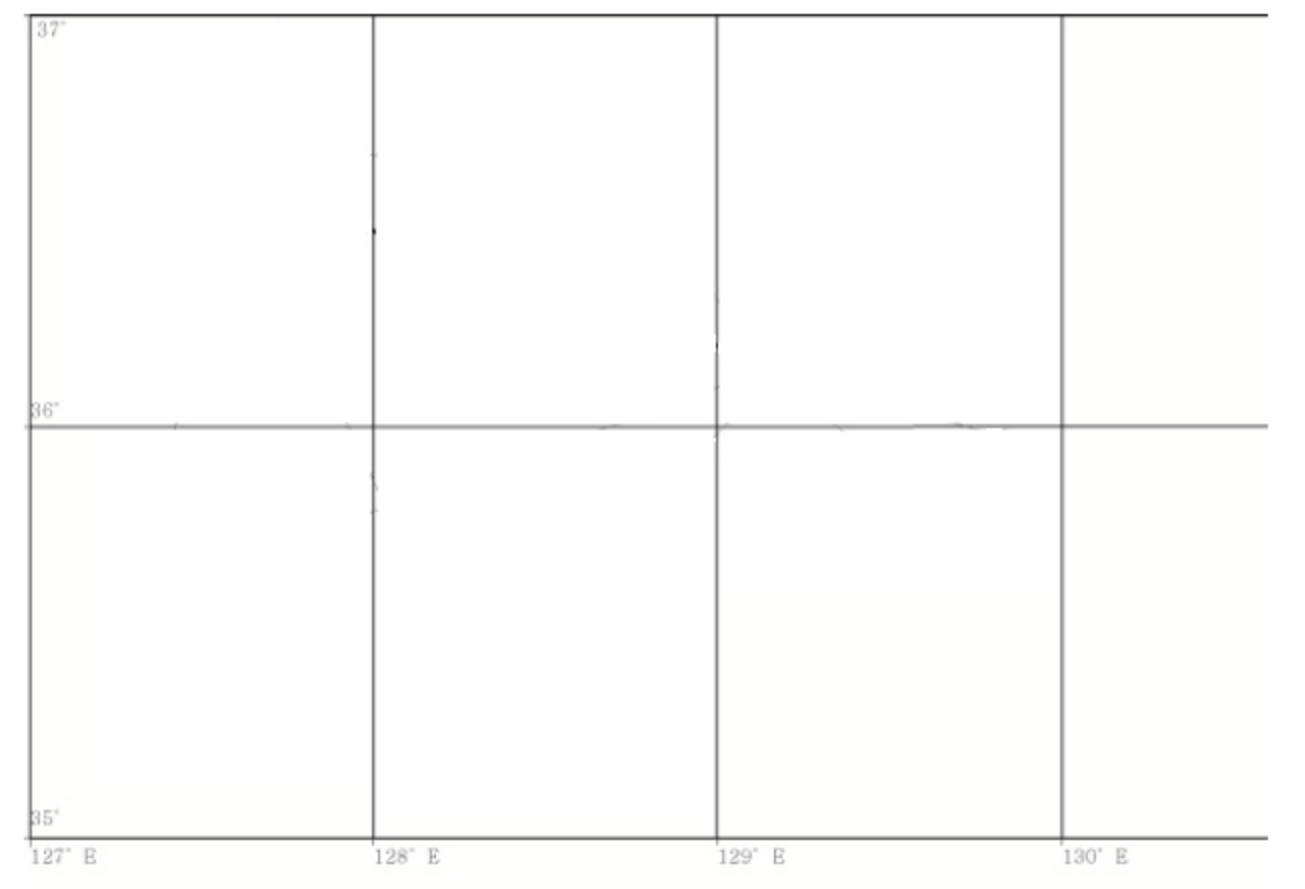
7.1 You are provided by a scaled marked graph paper. Mark the 3 observing positions (I, II, III) and draw a projected trajectory of the fireball as seen on the surface of Earth.
7.2 Calculate the longitude and latitude of start and end points of the fireball and total length of the trajectory projected on the earth surface.
7.3 Find the heights of starting point and end point . of the fireball’s trajectory above the surface of Earth.
7.4 Where can you find a meteorite, if it survives passage through the atmosphere and hits the ground? Calculate the longitude and latitude of the location of the meteorite on the surface of Earth’s.
Answer table
Finally, redraw the table below to your answer-book and fill the empty cells with your results.
| Point | Longitude | Latitude | (km) | (km) | (km) | You may find the meteorite at: longitude | Latitude |
|---|---|---|---|---|---|---|---|
| A | |||||||
| B |
Scaled marked graph paper
Решение
7.1
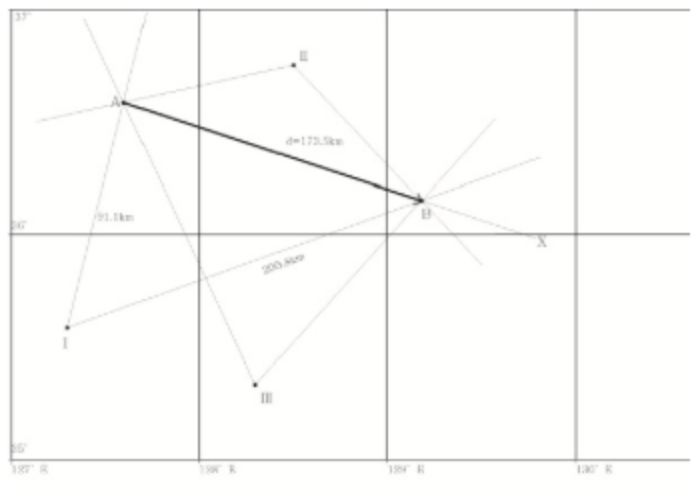
Observing points I, II and III are plotted as in the figure (point II is not correctly plotted below, but when plotted correctly on the gridded paper, the answer becomes clear). Then by drawing only using azimuthal angles, projected points A and B can be obtained, as intersecting points.
7.2
Read off from the grid, and coordinates can be easily obtained as (127.60°E, 36.47°N) for point A, and (129.45°E, 36.10°N) for point B.
Then one should first convert the differences in angle into distance, and then use Pythagorean principle, such that
where the conversion factor 4.8/5.8 for longitudinal distance per one degree longitude can be read off from the correctly scaled gridded paper or using , and one can use 110 km / (latitude degree). Then km.
7.3
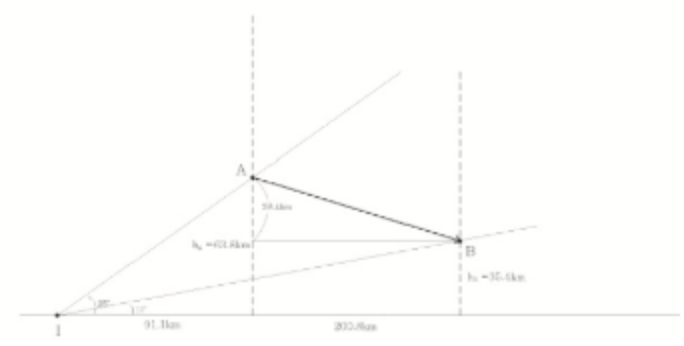
Once points I, A & B are correctly marked, the distance and can be calculated using Pythagorean principle just as in problem 2, which are 91.1 km and 200.8 km. And using altitudes observed from point I, one can get
7.4
If the fireball hits the surface, the full projected trajectory from point A to the hitting point (let’s call it C), AC, is the multiple of the projected distance AB by a factor of . The same multiplication factor can be used to get the trajectory on the longitude and latitude separately, such that
| Point | Longitude | Latitude | (km) | (km) | (km) | Meteorite longitude | Meteorite latitude |
|---|---|---|---|---|---|---|---|
| A | 127.60°E | +36.49°N | 173.5 | 63.8 km | 35.4 km | 131.76°E | 35.64°N |
| B | 129.45°E | +36.11°N |
Practical round. Basic grading criteria
| Part | Criteria | Points |
|---|---|---|
| 7.1 | Marking points I, II, III correctly. Marking and drawing the fireball trajectory correctly | 3 |
| 7.2 | Getting longitude and latitude of Points A, B correctly. Getting distance with correct scaling over longitude and latitude | 2 |
| 7.3 | Getting the right geometry. Final values of heights within 10 percent of error | 3 |
| 7.4 | Getting the right geometry. Final values of the correct position within 10 percent of error | 2 |
Теми и трудност
Трудност: неоценена.
Слънчева система · Небесна сфера и сферична астрономия · Астероиди, комети и метеори · Астрономическа навигация
Предпоставки: Разширена олимпиадна подготовка
Оригинал в Архива: betapract.pdf · официални решения: practsol1.png · допълнителни данни: practsol2.png · допълнителни данни: practsol3.png · допълнителни данни: practsol4.png · допълнителни данни: practsol5.png · допълнителни данни: practsol6.png · допълнителни данни: pract_cr.png · допълнителни данни: paper.png · допълнителни данни: data_1.png · допълнителни данни: data_2.png · допълнителни данни: data_3.png · допълнителни данни: data_4.png