IAO 2013, Теория, Група β — Задача 1. RadioAstron
XVIII International Astronomy Olympiad. Vilnius, Lithuania, 6 – 14. IX. 2013. Theoretical round. Problems to solve. Group β · 6 септември 2013 г. · 8 т.
Бележка
General note. Maybe not all problems have correct questions. Some questions (maybe the main question of the problem, maybe one of the subquestions) may make no real sense. In this case you have to write in your answer (in English or Russian): «impossible situation – ситуация невозможна». Of course, this answer has to be explained numerically or logically.
Data from the tables (Planetary data, stars, constants, etc.) may be used for solving every problem.
The answers «Да-Yes» or «Нет-No» have to be written in English or Russian.
Parameters of orbits and physical characteristics
The bilingual source sheet gives the following values. Blank cells reproduce blank source cells.
| Body / planet | Average distance (AU) | Average distance ( km) | Sidereal period (tropical years) | Sidereal period (days) | Orbital inclination | Eccentricity | Equatorial diameter (km) | Mass ( kg) | Average density (g/cm³) | Gravity at surface (m/s²) | Axial tilt | Maximum magnitude from Earth | Albedo |
|---|---|---|---|---|---|---|---|---|---|---|---|---|---|
| Sun | 1392000 | 1989000 | 1.409 | −26.74 | |||||||||
| Mercury | 0.387 | 57.9 | 0.241 | 87.969 | 7.00° | 0.206 | 4879 | 0.3302 | 5.43 | 3.70 | 0.01° | 0.06 | |
| Venus | 0.723 | 108.2 | 0.615 | 224.7007 | 3.40 | 0.007 | 12104 | 4.8690 | 5.24 | 8.87 | 177.36 | 0.78 | |
| Earth | 1.000 | 149.6 | 1.000 | 365.2564 | 0.00 | 0.017 | 12756 | 5.9742 | 5.515 | 9.81 | 23.44 | 0.36 | |
| Moon | 0.00257 | 0.38440 | 0.0748 | 27.3217 | 5.15 | 0.055 | 3475 | 0.0735 | 3.34 | 1.62 | 6.7 | −12.7 | 0.07 |
| Mars | 1.524 | 227.9 | 1.880 | 686.98 | 1.85 | 0.093 | 6794 | 0.6419 | 3.94 | 3.71 | 25.19 | −2.0 | 0.15 |
| Jupiter | 5.204 | 778.6 | 11.862 | 4332.59 | 1.30 | 0.048 | 142984 | 1899.8 | 1.33 | 24.86 | 3.13 | −2.7 | 0.66 |
| Saturn | 9.584 | 1433.7 | 29.458 | 10759.20 | 2.48 | 0.054 | 120536 | 568.50 | 0.70 | 10.41 | 26.73 | 0.7 | 0.68 |
For outer planets and Moon — in mean opposition.
Some constants and formulae
| Constant or formula | Value |
|---|---|
| Speed of light in vacuum, c (m/s) | 299792458 |
| Constant of gravitation, G (N·m²/kg²) | |
| Solar constant, A (W/m²) | 1367 |
| Hubble parameter, (km/s/Mpc), mean value | 71 |
| Hubble parameter, diapason of values | 50–100 |
| Planck constant, h (J·s) | |
| Charge of electron, e (C) | |
| Mass of electron, (kg) | |
| Proton-to-electron ratio | 1836.15 |
| Faraday constant, F (C/mol) | 96485 |
| Magnetic constant, (H/m) | |
| Universal gas constant, R (J/mol/K) | 8.314 |
| Boltzmann constant, k (J/K) | |
| Stefan–Boltzmann constant, (W/m²/K⁴) | |
| Wien’s displacement constant, b (m·K) | 0.002897 |
| Laboratory wavelength of Hα (Å) | 6562.81 |
| Tropical year length, T (days) | 365.242199 |
| Standard atmosphere (Pa) | 101325 |
| Visible light extinction by the terrestrial atmosphere in zenith (minimum) | 19%, 0.23 mag |
| Refractive index of water for 20°C, n | 1.334 |
| Moment of inertia of a solid ball | |
| Volume of ball | |
| Area of sphere | |
| 3.14159265 | |
| e | 2.71828183 |
| Golden ratio, | 1.61803399 |
Data of some stars
| Star | Designation | RA | DEC | Parallax | Apparent magnitude | Spectral class | Mass () |
|---|---|---|---|---|---|---|---|
| Sun | ⊙ | 0h–24h | −23°26′ to +23°26′ | 8.794″ | vis −26.74; bol −26.82 | G2 | 1 |
| Proxima Centauri | V645 Cen, α Cen C | 14h 29m 43s | −62°40′46″ | 0.769″ | 11.05 | M5.5 | 0.123 |
| Alpha Centauri A | α Cen A | 14h 39m 37s | −60°50′02″ | 0.747″ | −0.01 | G2 | 1.1 |
| Alpha Centauri B | α Cen B | 14h 39m 35s | −60°50′14″ | 1.34 | K1 | 0.9 | |
| Beta Centauri | β Cen | 14h 03m 49s | −60°22′23″ | 0.009″ | 0.61 | B1 | 21 |
| Epsilon Eridani | ε Eri | 03h 32m 56s | −09°27′30″ | 0.311″ | 3.74 | K2 | 0.82 |
| Gliese 581 | HO Lib | 15h 19m 27s | −07°43′20″ | 0.16″ | vis 10.57; bol 8.0 | M3V | 0.31 |
The Alpha Centauri parallax is printed once beside the pair; the second cell is left blank here as in the source.
Historical units
Units of power
1 horse-power (hp) = 735.49875 W.
Local units of length in the end of XVIII century
- 1 arshin (arsh) = 0.711187 m
- 1 span (sp) = 1/4 arshin
- 1 vershok (vrsh) = 1/4 span
- 1 sajene (sj) = 3 arshin
- 1 verst (vrst) = 500 sajene
Условие
The RadioAstron project is an international collaborative mission lead by Astro-Space Center of Russian Academy of Sciences. On July 18, 2011 a satellite, «Spektr-R», carrying a 10-m (in diameter) space radio-telescope was launched into an elliptical orbit around the Earth. Together with Earth-based radio-telescopes, «Spektr-R» works as interferometer. RadioAstron operates at the standard radio astronomical wavelengths of 1.19–1.63 cm (K-band), 6.2 cm (C-band), 18 cm (L-band), and 92 cm (P-band). Now «Spektr-R» is rotating in a very elongated orbit with a period days and a height of perigee h = 600 km from the Earth surface.
1.1. Estimate the maximum resolving power (angular resolution in arcsec) of RadioAstron. Draw a schematic picture, explaining your choice of the situation when it may occur. [3,5 т.]
1.2. Estimate the resolving power of RadioAstron if the target is observed in the direction of the major axis of «Spektr-R» orbit, and also draw a schematic picture. [3 т.]
Решение
Official English solution sketch. The proposed sketches are not full; the team leaders have to give more detailed explanations for students. But the correct solutions in the students’ papers (enough for 8 pts) may be shorter.
Resolution and base
The resolution of the instrument is determined by the working wavelength , and the base . For telescopes the base is just the diameter of the front lens or mirrors, and for interferometers it is the distance between its elements, or, rather, the projection of this distance on the plane perpendicular to the direction to the object under research.
Thus, the maximum resolution is achieved in the case of the minimum wavelength and the maximum base.
1.1. Maximum resolving power
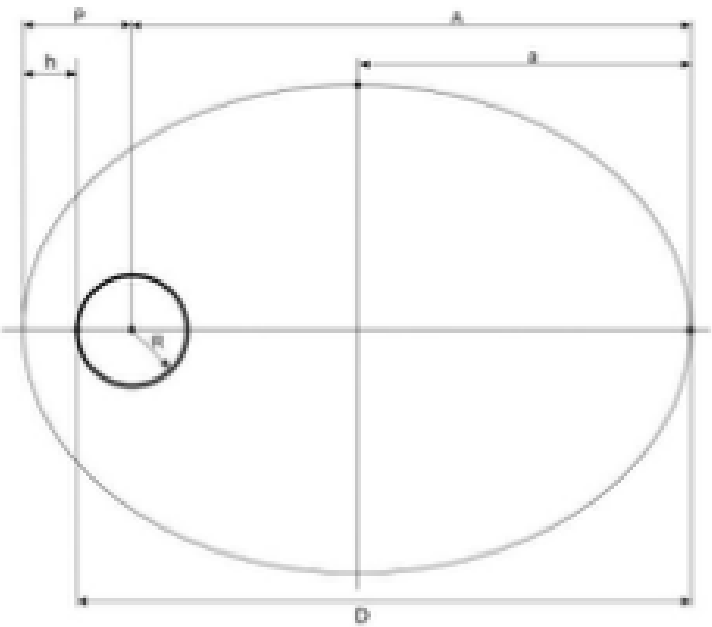
In our case it is achieved at the wavelength and the base of the Earth–“Spektr-R”, in which “Spektr-R” is at apogee, and the ground-based telescope is at the opposite side of the globe; and while the observations are held in the directions perpendicular to the base of Earth–“Spektr-R”, that is perpendicular to the major axis of the orbit:
where A is the distance at apogee, and R is radius of the Earth. The apogee distance can be found as
where a is semi-major axis of the orbit, which, in turn, follows Kepler’s third law. Comparing the motion of the satellite with the motion of the Moon we get:
or in angular seconds:
1.2. Observation along the major axis
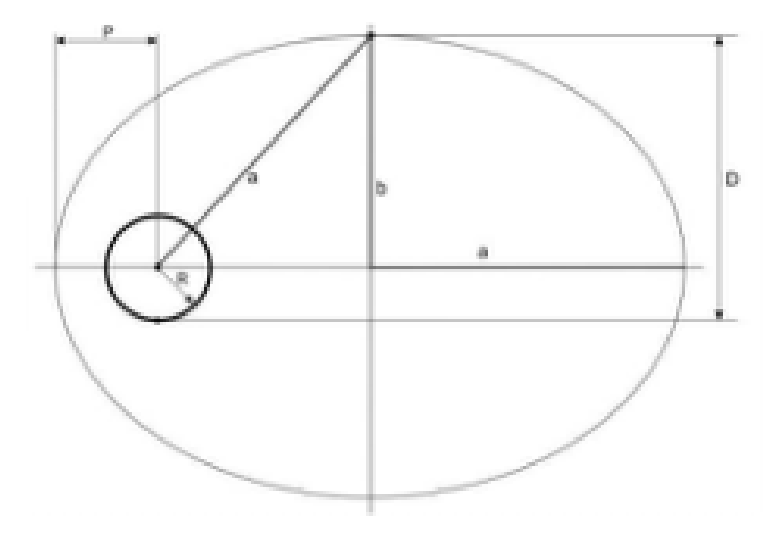
In observations of objects located in the direction of the major axis of the orbit of “Spektr-R” the maximum base D will be equal to the sum of the semi-minor axis of the orbit and the radius of Earth:
Semi-minor axis can be found from the geometric properties of the ellipse:
or in angular seconds:
Source note: the key prints on the left of the square-root formula, and in the final angular conversion after in the preceding line. These printed discrepancies are retained; its stated result is 45 μas.
Official basic criteria
1.common. Totally 1.5 pt, including:
- General approach, formula — 0.5 pt.
- The base for interferometers it is the distance between its elements — 0.5 pt.
- Understanding — 0.5 pt.
1.1. Totally 3.5 pt, including:
- Understanding cm — 0.5 pt.
- The maximum base of the Earth–“Spektr-R”, in which “Spektr-R” is at apogee, and the ground-based telescope is at the opposite side of the globe — 0.5 pt.
- The directions perpendicular to the base of Earth–“Spektr-R” — perpendicular to the major axis — 0.5 pt.
- The apogee distance can be found as — 0.5 pt.
- Using Kepler’s third law to find a, — 0.5 pt.
- Final calculations and correct result — 1 pt.
1.2. Totally 3 pt, including:
- The maximum base — 1 pt.
- Calculation semi-minor axis using the geometric properties of the ellipse — 1 pt.
- Final calculations and correct result — 1 pt.
Official solution sketches: note for jury and team leaders
The proposed sketches are not full; the team leaders have to give more detailed explanations for students. But the correct solutions in the students’ papers (enough for 8 pts) may be shorter.
Basic criteria: note for jury
Jury members should evaluate the students’ solutions in essence, and not by looking on formal existence the mentioned sentences or formulae. The formal presence of the mentioned positions in the text is not necessary to give the respective points. Points should be done if the following steps de facto using these positions.
Оригинал в Архива: betatheo.pdf · официални решения: theosol.pdf · допълнителни данни: theodata.pdf · допълнителни данни: theo_cr_1.pdf · допълнителни данни: theo_cr_2.pdf · допълнителни данни: theo_cr_3.pdf · допълнителни данни: constants.pdf · допълнителни данни: hrd.pdf