IAO 2013, Теория, Група β — Задача 4. XVIII century. Midday.
XVIII International Astronomy Olympiad. Vilnius, Lithuania, 6 – 14. IX. 2013. Theoretical round. Problems to solve. Group β · 6 септември 2013 г. · 8 т.
Бележка
General note. Maybe not all problems have correct questions. Some questions (maybe the main question of the problem, maybe one of the subquestions) may make no real sense. In this case you have to write in your answer (in English or Russian): «impossible situation – ситуация невозможна». Of course, this answer has to be explained numerically or logically.
Data from the tables (Planetary data, stars, constants, etc.) may be used for solving every problem.
The answers «Да-Yes» or «Нет-No» have to be written in English or Russian.
Parameters of orbits and physical characteristics
The bilingual source sheet gives the following values. Blank cells reproduce blank source cells.
| Body / planet | Average distance (AU) | Average distance ( km) | Sidereal period (tropical years) | Sidereal period (days) | Orbital inclination | Eccentricity | Equatorial diameter (km) | Mass ( kg) | Average density (g/cm³) | Gravity at surface (m/s²) | Axial tilt | Maximum magnitude from Earth | Albedo |
|---|---|---|---|---|---|---|---|---|---|---|---|---|---|
| Sun | 1392000 | 1989000 | 1.409 | −26.74 | |||||||||
| Mercury | 0.387 | 57.9 | 0.241 | 87.969 | 7.00° | 0.206 | 4879 | 0.3302 | 5.43 | 3.70 | 0.01° | 0.06 | |
| Venus | 0.723 | 108.2 | 0.615 | 224.7007 | 3.40 | 0.007 | 12104 | 4.8690 | 5.24 | 8.87 | 177.36 | 0.78 | |
| Earth | 1.000 | 149.6 | 1.000 | 365.2564 | 0.00 | 0.017 | 12756 | 5.9742 | 5.515 | 9.81 | 23.44 | 0.36 | |
| Moon | 0.00257 | 0.38440 | 0.0748 | 27.3217 | 5.15 | 0.055 | 3475 | 0.0735 | 3.34 | 1.62 | 6.7 | −12.7 | 0.07 |
| Mars | 1.524 | 227.9 | 1.880 | 686.98 | 1.85 | 0.093 | 6794 | 0.6419 | 3.94 | 3.71 | 25.19 | −2.0 | 0.15 |
| Jupiter | 5.204 | 778.6 | 11.862 | 4332.59 | 1.30 | 0.048 | 142984 | 1899.8 | 1.33 | 24.86 | 3.13 | −2.7 | 0.66 |
| Saturn | 9.584 | 1433.7 | 29.458 | 10759.20 | 2.48 | 0.054 | 120536 | 568.50 | 0.70 | 10.41 | 26.73 | 0.7 | 0.68 |
For outer planets and Moon — in mean opposition.
Some constants and formulae
| Constant or formula | Value |
|---|---|
| Speed of light in vacuum, c (m/s) | 299792458 |
| Constant of gravitation, G (N·m²/kg²) | |
| Solar constant, A (W/m²) | 1367 |
| Hubble parameter, (km/s/Mpc), mean value | 71 |
| Hubble parameter, diapason of values | 50–100 |
| Planck constant, h (J·s) | |
| Charge of electron, e (C) | |
| Mass of electron, (kg) | |
| Proton-to-electron ratio | 1836.15 |
| Faraday constant, F (C/mol) | 96485 |
| Magnetic constant, (H/m) | |
| Universal gas constant, R (J/mol/K) | 8.314 |
| Boltzmann constant, k (J/K) | |
| Stefan–Boltzmann constant, (W/m²/K⁴) | |
| Wien’s displacement constant, b (m·K) | 0.002897 |
| Laboratory wavelength of Hα (Å) | 6562.81 |
| Tropical year length, T (days) | 365.242199 |
| Standard atmosphere (Pa) | 101325 |
| Visible light extinction by the terrestrial atmosphere in zenith (minimum) | 19%, 0.23 mag |
| Refractive index of water for 20°C, n | 1.334 |
| Moment of inertia of a solid ball | |
| Volume of ball | |
| Area of sphere | |
| 3.14159265 | |
| e | 2.71828183 |
| Golden ratio, | 1.61803399 |
Data of some stars
| Star | Designation | RA | DEC | Parallax | Apparent magnitude | Spectral class | Mass () |
|---|---|---|---|---|---|---|---|
| Sun | ⊙ | 0h–24h | −23°26′ to +23°26′ | 8.794″ | vis −26.74; bol −26.82 | G2 | 1 |
| Proxima Centauri | V645 Cen, α Cen C | 14h 29m 43s | −62°40′46″ | 0.769″ | 11.05 | M5.5 | 0.123 |
| Alpha Centauri A | α Cen A | 14h 39m 37s | −60°50′02″ | 0.747″ | −0.01 | G2 | 1.1 |
| Alpha Centauri B | α Cen B | 14h 39m 35s | −60°50′14″ | 1.34 | K1 | 0.9 | |
| Beta Centauri | β Cen | 14h 03m 49s | −60°22′23″ | 0.009″ | 0.61 | B1 | 21 |
| Epsilon Eridani | ε Eri | 03h 32m 56s | −09°27′30″ | 0.311″ | 3.74 | K2 | 0.82 |
| Gliese 581 | HO Lib | 15h 19m 27s | −07°43′20″ | 0.16″ | vis 10.57; bol 8.0 | M3V | 0.31 |
The Alpha Centauri parallax is printed once beside the pair; the second cell is left blank here as in the source.
Historical units
Units of power
1 horse-power (hp) = 735.49875 W.
Local units of length in the end of XVIII century
- 1 arshin (arsh) = 0.711187 m
- 1 span (sp) = 1/4 arshin
- 1 vershok (vrsh) = 1/4 span
- 1 sajene (sj) = 3 arshin
- 1 verst (vrst) = 500 sajene
Условие
(Dubingiai is the nearest town to the accommodation place of XVIII IAO.).
There were different systems of units of measurement in the history of science. This problem is to use historical (at present obsolete) units of measurement.
Units of power
1 horse-power (hp) = 735.49875 W.
Local units of length in the end of XVIII century
- 1 arshin (arsh) = 0.711187 m
- 1 span (sp) = 1/4 arshin
- 1 vershok (vrsh) = 1/4 span
- 1 sajene (sj) = 3 arshin
- 1 verst (vrst) = 500 sajene
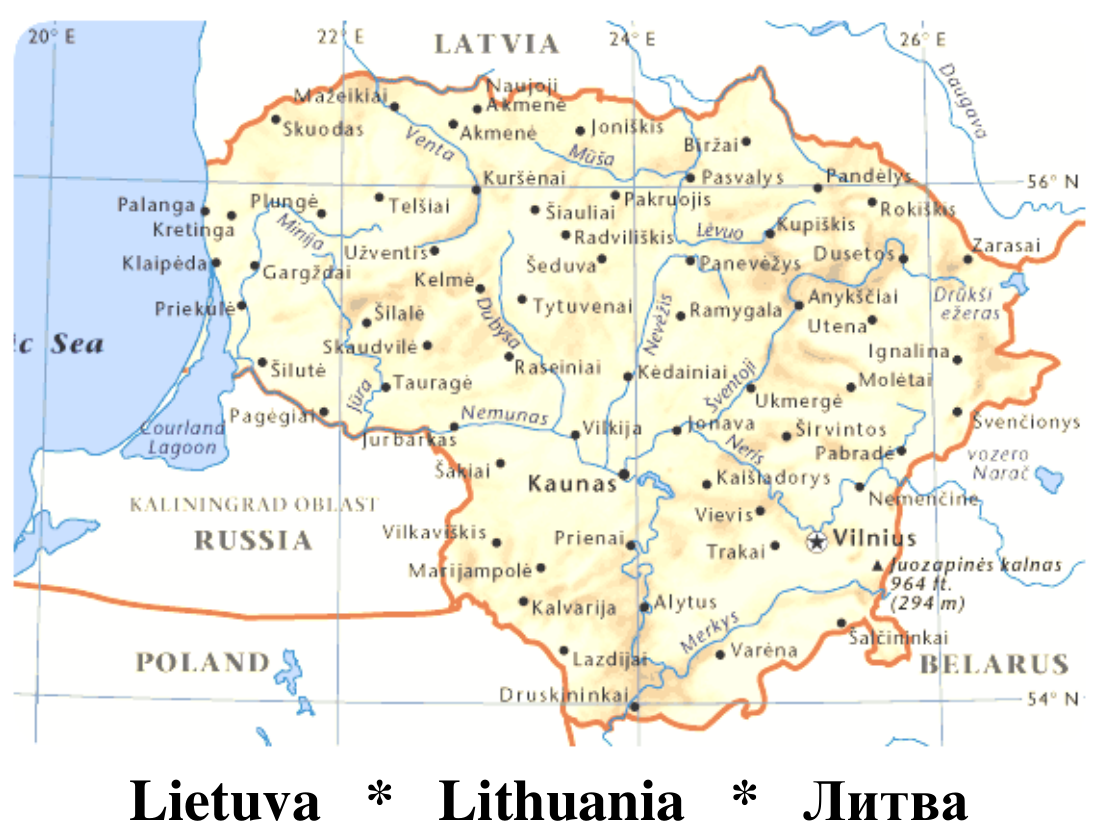
4.1. Calculate the capacity of the solar energy that in the end of the XVIII century fell on the unit of area of the territory in the outskirts of Dubingiai at midday time:
in winter, in spring, in autumn, and in summer.
The answer must be given using only the «new» physical units, which were coming into operation in those days in this area: horse-powers per square verst.
[3 т.]
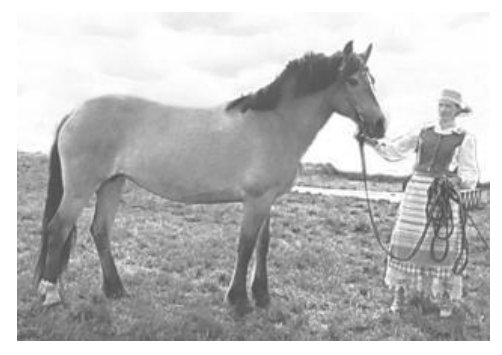
4.2. Estimate also the capacity of the solar energy incident on a local horse those times. The answer must also be expressed in physical units, which were coming into operation in those days. What can be surprising about the right answer? [3 т.]
Решение
Official English solution sketch. The proposed sketches are not full; the team leaders have to give more detailed explanations for students. But the correct solutions in the students’ papers (enough for 8 pts) may be shorter.
Solar constant in historical units
Horse-powers per square verst is a power per unit of area, the quantity that dimension is similar to the solar constant. In physics, it is properly called the “power flux”.
Let us calculate the solar constant in units, which were coming into operation in the end of the XVIII century.
I method — visual.
The energy-release of the Sun has not changed since the end of the XVIII century and in units of the horse-power is
The distance from the Sun to Earth has not changed since the end of the XVIII century as well, and in versts is
Thus, the solar constant in units of the end of the XVIII century is
II method — formal.
Source note: the key’s subscript “XIX” is retained although the problem concerns the XVIII century.
4.1. Midday power flux
The outskirts of Dubingiai in the XVIII century were located on the same latitude as where they are located in the XXI century, that is, at about latitudes 54.7°–55.2° (latitudes of Vilnius and Moletai respectively, may be found from the map). The value of 23.5°, the inclination of the equatorial plane of the ecliptic, also almost has not changed (strictly speaking, it had declined by about one arc minute). Thus, at the middays of the winter solstice in the XVIII century in the outskirts of the town Dubingiai the sun was at an altitude about
at the middays of spring and autumn — at an altitude about
at the middays of the summer solstice — at an altitude about
While the altitude of the Sun is h, the power flux to the unit of the territory is
Thus, the target values are:
- in winter — ;
- in spring and autumn — ;
- in summer — .
4.2. Solar power incident on a horse
And what is the capacity of the solar energy incident at those times on a local horse? This value largely depends on the orientation of the horse relative to the Sun than the altitude of the sun above the horizon. Let us assume that the cross-sectional area of a horse perpendicular to the sun-rays is 1–3 arsh² (depending on the mentioned above orientation of the horse) and recalculate the value of the solar constant into horse-powers per square arshin.
Distance from the Sun
The solar constant in these units equals to
Thus, a horse standing in the sun, receives about one to three horse-powers of solar radiation! Just this can be a surprise.
Answer: 1–3 hp.
Note. In solving the problem we emphasize very often that many of the physical parameters are not changed in the last two centuries: the solar constant, the distance from Earth to the Sun, the latitude of location, inclination of the ecliptic to the equatorial plane. Students who also record this constancy, should be encouraged to add points.
Source note: the distance conversion prints arsh, but the following formula uses arsh. Both printed exponents are retained.
Official basic criteria
4.common. Totally 2 pt, including:
- Calculation of the solar constant in necessary units, result hp/vrst² or 0.94 hp/arsh² — 2 pt.
4.1. Totally 3 pt, including:
- Latitudes the same as now (about 54.7°–55.2°) — 1 pt.
- Calculation of altitudes of midday Sun in winter, spring, autumn, summer — 1 pt.
- , correct final calculations — 1 pt.
4.2. Totally 3 pt, including:
- Correct understanding on what the answer may depend — 0.5 pt.
- Correct model of horse, including the picture — 0.5 pt.
- The cross-sectional area of a horse perpendicular to the sun-rays is 1÷3 arsh² — 0.5 pt.
- Correct calculations and result about 1–3 hp — 1 pt.
- Common conclusion about surprise that a horse standing in the sun, receives about one to three horse-powers of solar radiation — 0.5 pt.
Official solution sketches: note for jury and team leaders
The proposed sketches are not full; the team leaders have to give more detailed explanations for students. But the correct solutions in the students’ papers (enough for 8 pts) may be shorter.
Basic criteria: note for jury
Jury members should evaluate the students’ solutions in essence, and not by looking on formal existence the mentioned sentences or formulae. The formal presence of the mentioned positions in the text is not necessary to give the respective points. Points should be done if the following steps de facto using these positions.
Оригинал в Архива: betatheo.pdf · официални решения: theosol.pdf · допълнителни данни: theodata.pdf · допълнителни данни: theo_cr_1.pdf · допълнителни данни: theo_cr_2.pdf · допълнителни данни: theo_cr_3.pdf · допълнителни данни: constants.pdf · допълнителни данни: hrd.pdf