IAO 2013, Теория — Задача 9. αβ-6. Остатък от взрив на свръхнова
XVIII Международная астрономическая олимпиада. XVIII International Astronomy Olympiad. Литва, Вильнюс, 6 – 14. IX. 2013, Vilnius, Lithuania. Round Theo · 6 септември 2013 г. · 8 т.
Внимание: Бележка към темата
Ръкописни български условия за групи α, β и общи αβ; решенията и критериите са на английски. В αβ-6 ръкописът дава 3400 km, а английският оригинал и ключът — 3400 pc. Източниковите разминавания са запазени и отбелязани.
Общо указание
Общо указание. Възможно е не във всички задачи въпросите да са поставени коректно. Някои въпроси (възможно е това да е основният въпрос в задачата, а може и да е някой подвъпрос) може да нямат смисъл. В такива случаи в отговора трябва да се напише (на руски или на английски): „ситуация невозможна - impossible situation“. Разбира се, отговорът трябва да е подкрепен с пресмятания или логически разсъждения.
Данните от таблиците (Слънчева система, звезди, константи) могат да се използват във всички задачи.
Отговорите „Да - Yes“ или „Нет - No“ трябва да бъдат написани на руски или на английски.
Parameters of orbits and physical characteristics
The bilingual source sheet gives the following values. Blank cells reproduce blank source cells.
| Body / planet | Average distance (AU) | Average distance ( km) | Sidereal period (tropical years) | Sidereal period (days) | Orbital inclination | Eccentricity | Equatorial diameter (km) | Mass ( kg) | Average density (g/cm³) | Gravity at surface (m/s²) | Axial tilt | Maximum magnitude from Earth | Albedo |
|---|---|---|---|---|---|---|---|---|---|---|---|---|---|
| Sun | 1392000 | 1989000 | 1.409 | −26.74 | |||||||||
| Mercury | 0.387 | 57.9 | 0.241 | 87.969 | 7.00° | 0.206 | 4879 | 0.3302 | 5.43 | 3.70 | 0.01° | 0.06 | |
| Venus | 0.723 | 108.2 | 0.615 | 224.7007 | 3.40 | 0.007 | 12104 | 4.8690 | 5.24 | 8.87 | 177.36 | 0.78 | |
| Earth | 1.000 | 149.6 | 1.000 | 365.2564 | 0.00 | 0.017 | 12756 | 5.9742 | 5.515 | 9.81 | 23.44 | 0.36 | |
| Moon | 0.00257 | 0.38440 | 0.0748 | 27.3217 | 5.15 | 0.055 | 3475 | 0.0735 | 3.34 | 1.62 | 6.7 | −12.7 | 0.07 |
| Mars | 1.524 | 227.9 | 1.880 | 686.98 | 1.85 | 0.093 | 6794 | 0.6419 | 3.94 | 3.71 | 25.19 | −2.0 | 0.15 |
| Jupiter | 5.204 | 778.6 | 11.862 | 4332.59 | 1.30 | 0.048 | 142984 | 1899.8 | 1.33 | 24.86 | 3.13 | −2.7 | 0.66 |
| Saturn | 9.584 | 1433.7 | 29.458 | 10759.20 | 2.48 | 0.054 | 120536 | 568.50 | 0.70 | 10.41 | 26.73 | 0.7 | 0.68 |
For outer planets and Moon — in mean opposition.
Some constants and formulae
| Constant or formula | Value |
|---|---|
| Speed of light in vacuum, c (m/s) | 299792458 |
| Constant of gravitation, G (N·m²/kg²) | |
| Solar constant, A (W/m²) | 1367 |
| Hubble parameter, (km/s/Mpc), mean value | 71 |
| Hubble parameter, diapason of values | 50–100 |
| Planck constant, h (J·s) | |
| Charge of electron, e (C) | |
| Mass of electron, (kg) | |
| Proton-to-electron ratio | 1836.15 |
| Faraday constant, F (C/mol) | 96485 |
| Magnetic constant, (H/m) | |
| Universal gas constant, R (J/mol/K) | 8.314 |
| Boltzmann constant, k (J/K) | |
| Stefan–Boltzmann constant, (W/m²/K⁴) | |
| Wien’s displacement constant, b (m·K) | 0.002897 |
| Laboratory wavelength of Hα (Å) | 6562.81 |
| Tropical year length, T (days) | 365.242199 |
| Standard atmosphere (Pa) | 101325 |
| Visible light extinction by the terrestrial atmosphere in zenith (minimum) | 19%, 0.23 mag |
| Refractive index of water for 20°C, n | 1.334 |
| Moment of inertia of a solid ball | |
| Volume of ball | |
| Area of sphere | |
| 3.14159265 | |
| e | 2.71828183 |
| Golden ratio, | 1.61803399 |
Data of some stars
| Star | Designation | RA | DEC | Parallax | Apparent magnitude | Spectral class | Mass () |
|---|---|---|---|---|---|---|---|
| Sun | ⊙ | 0h–24h | −23°26′ to +23°26′ | 8.794″ | vis −26.74; bol −26.82 | G2 | 1 |
| Proxima Centauri | V645 Cen, α Cen C | 14h 29m 43s | −62°40′46″ | 0.769″ | 11.05 | M5.5 | 0.123 |
| Alpha Centauri A | α Cen A | 14h 39m 37s | −60°50′02″ | 0.747″ | −0.01 | G2 | 1.1 |
| Alpha Centauri B | α Cen B | 14h 39m 35s | −60°50′14″ | 1.34 | K1 | 0.9 | |
| Beta Centauri | β Cen | 14h 03m 49s | −60°22′23″ | 0.009″ | 0.61 | B1 | 21 |
| Epsilon Eridani | ε Eri | 03h 32m 56s | −09°27′30″ | 0.311″ | 3.74 | K2 | 0.82 |
| Gliese 581 | HO Lib | 15h 19m 27s | −07°43′20″ | 0.16″ | vis 10.57; bol 8.0 | M3V | 0.31 |
The Alpha Centauri parallax is printed once beside the pair; the second cell is left blank here as in the source.
Historical units
Units of power
1 horse-power (hp) = 735.49875 W.
Local units of length in the end of XVIII century
- 1 arshin (arsh) = 0.711187 m
- 1 span (sp) = 1/4 arshin
- 1 vershok (vrsh) = 1/4 span
- 1 sajene (sj) = 3 arshin
- 1 verst (vrst) = 500 sajene
Условие
С помощта на космическия телескоп „Чандра“ е получено рентгеново изображение на остатъка от взрива на свръхновата (SNR) в Cas A, намиращ се от нас на разстояние . Негативът на тази снимка е даден на фиг. SNR. С кръг са отбелязани границите на областта на SNR. В горния ляв ъгъл на фигурата е даден мащаб. Точката, разположена близо до центъра на кръга, е неутронната звезда (ядрото на избухналата звезда). Правоъгълните знаци извън кръга са реперните точки, послужили за построяване на центъра на кръга. Да предположим, че количеството енергия, освободена при взрива на свръхновата, е било от порядъка на . 1% от тази енергия движи разширяващата се материя. Средната плътност на веществото в SNR е от порядъка на .
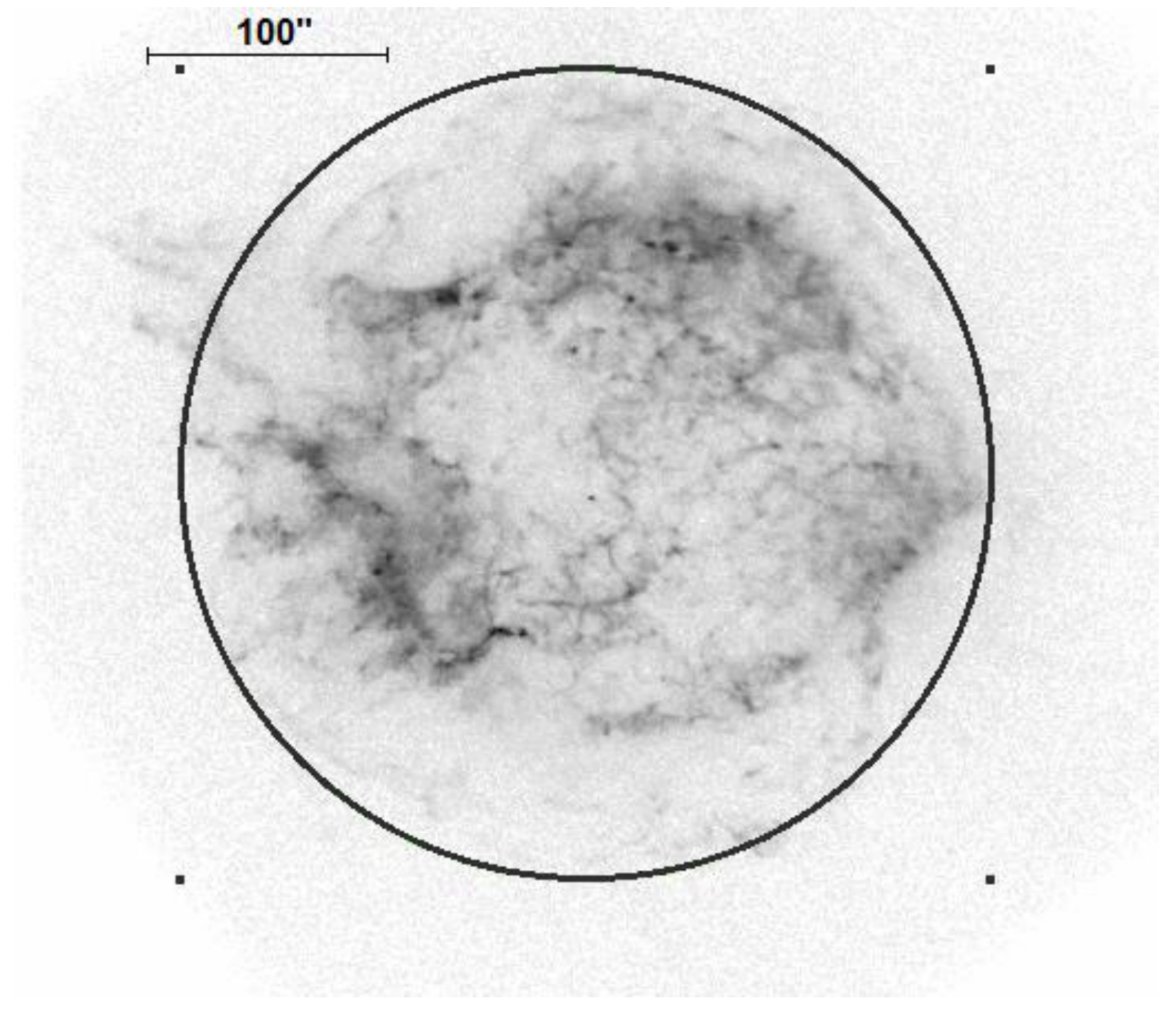
6.1. Оценете възрастта на SNR Cas A. [4 т.]
6.2. Определете средната скорост на движение на неутронната звезда от центъра на SNR. [2 т.]
Отговори
- Using the official key’s 3400 pc: approximately 200 years and 1000 km/s.
Решение
Официалното решение и критериите по-долу са на английски, както в източника.
Official English solution sketch. The proposed sketches are not full; the team leaders have to give more detailed explanations for students. But the correct solutions in the students’ papers (enough for 8 pts) may be shorter.
Разминаване между източниците: българският ръкопис отпечатва ; оригиналните английски условия и официалното решение използват . Българската единица в условието е запазена.
6.1. Age of the supernova remnant
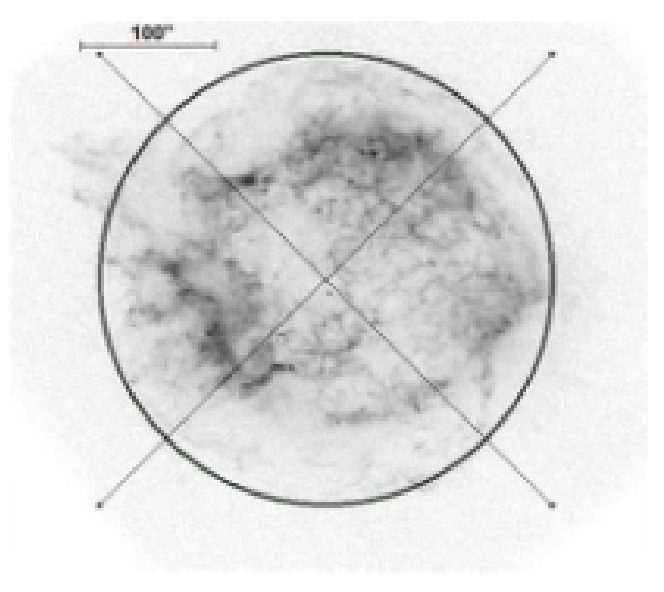
Assume that the SNR is a sphere with the linear radius R. Using a ruler we accurately measure the diameter of the circle and the scale length (e.g. in mm) in Fig. SNR (see the figure below, the initial figure was almost 2 times larger). From these measurements we get the radius of the circle and 100″ scale length . With these data we can calculate the angular radius of the SNR
If the radius R of the SNR is measured in au, the distance d in pc, and its angular radius in arcsec, then
The mass of the SNR is confined within the sphere of the radius R.
The expansion speed of the SNR is calculated using the expression of the kinetic energy of the SNR
As we see from the image, the darkest parts of it are distributed at distances about 60% of its radius. So we may propose that most mass of the SNR is distributed at these distances. Thus, by the above formulae we have found the average speed of matter at 0.6 R.
Assuming that the expansion velocity was constant we get the age of the SNR:
Taking into account that most data in the problem conditions was done very roughly, with maximum 1 significant digit (and even with zero significant digits as only order of magnitude is done: the energy was about J, 1% of which drives the expansion; the average density is kg/m³), the answer should be expressed also with only one significant digit.
So the answer is: ~200 years.
Source note: the key uses both for the measured image radius and for the matter density, and uses m in the mass calculation after m above. These are retained.
6.2. Neutron-star velocity
Using a ruler we measure the distance of the neutron star from the center of circle in Fig. SNR. Say that we get . Then the angular distance of the neutron star from the center of the SNR is
The linear distance of the neutron star from the center of the SNR is
The velocity of the motion of the neutron star is
Also taking into account that most data was done very roughly, the answer should be expressed also as an order of magnitude only or with only one significant digit.
The answer is: ~ km/s.
Source note: the key prints although the substituted 10.5 is the angular distance ; its notation is preserved.
Official basic criteria
6.1. Totally 4 pt, including:
- Correct measurements of distances — 0.5 pt.
- Finding necessary distances and mass — 1.5 pt.
- Energy, finding typical speeds — 1 pt.
- Final the time, correct calculations — 1 pt.
6.2. Totally 2 pt, including:
- Correct measurements of distance from the center — 0.5 pt.
- Calculations and correct answer — 1.5 pt.
6.common. Totally 2 pt, including:
- The most data in the problem conditions was done very roughly, with maximum 1 significant digit, so the answer should be expressed also with only one significant digit, follow this principle — 2 pt.
Official solution sketches: note for jury and team leaders
The proposed sketches are not full; the team leaders have to give more detailed explanations for students. But the correct solutions in the students’ papers (enough for 8 pts) may be shorter.
Basic criteria: note for jury
Jury members should evaluate the students’ solutions in essence, and not by looking on formal existence the mentioned sentences or formulae. The formal presence of the mentioned positions in the text is not necessary to give the respective points. Points should be done if the following steps de facto using these positions.
Оригинал в Архива: bgtheo.pdf · официални решения: theosol.pdf · допълнителни данни: theodata.pdf · допълнителни данни: theo_cr_1.pdf · допълнителни данни: theo_cr_2.pdf · допълнителни данни: theo_cr_3.pdf · допълнителни данни: constants.pdf · допълнителни данни: hrd.pdf · допълнителни данни: alphatheo.pdf · допълнителни данни: betatheo.pdf · допълнителни данни: theo_cr_1.png · допълнителни данни: theo_cr_2.png · допълнителни данни: theo_cr_3.png