IAO 2015, Теория, Група β — Задача 5. Spiral galaxy
XX International Astronomy Olympiad. Theoretical round. Group β · 15 октомври 2015 г.
Read once more before you start your work
General note. Maybe not all problems have correct questions. Some questions (maybe the main question of the problem, maybe one of the subquestions) may make no real sense. In this case you have to write in your answer (in English or Russian): «impossible situation – ситуация невозможна». Of course, this answer has to be explained numerically or logically.
Data from the tables (Planetary data, stars, constants, etc.) may be used for solving every problem.
The answers «Да-Yes» or «Нет-No» have to be written in English or Russian.
Ещё раз прочитайте перед началом работы.
Общее замечание. Не исключено, что не во всех задачах вопросы поставлены корректно. Некоторые вопросы (возможно, главный вопрос задачи, возможно – подвопрос) могут не иметь смысла. В этом случае следует написать в ответе (по-русски или по-английски): «ситуация невозможна – impossible situation». Естественно, ответ должен быть подкреплён вычислениями или логическими рассуждениями.
Данные из таблиц (Солнечная система, звёзды, константы) могут быть использованы в любой задаче.
Ответы «Да-Yes» или «Нет-No» должны быть написаны по-русски или по-английски.
Условие
A spiral galaxy consisting mainly of A7-A8 spectral class stars was discovered in the Southern Cross (Crux) constellation. The galaxy may be seen as oval of about 40 by 30 arcsec in the sky. The broadened H line is observed at wavelengths approximately from 7054 Å to 7057 Å in the spectrum of the galaxy. Other lines in the spectrum are also shifted and broadened proportionally. Estimate the number of stars in the galaxy.
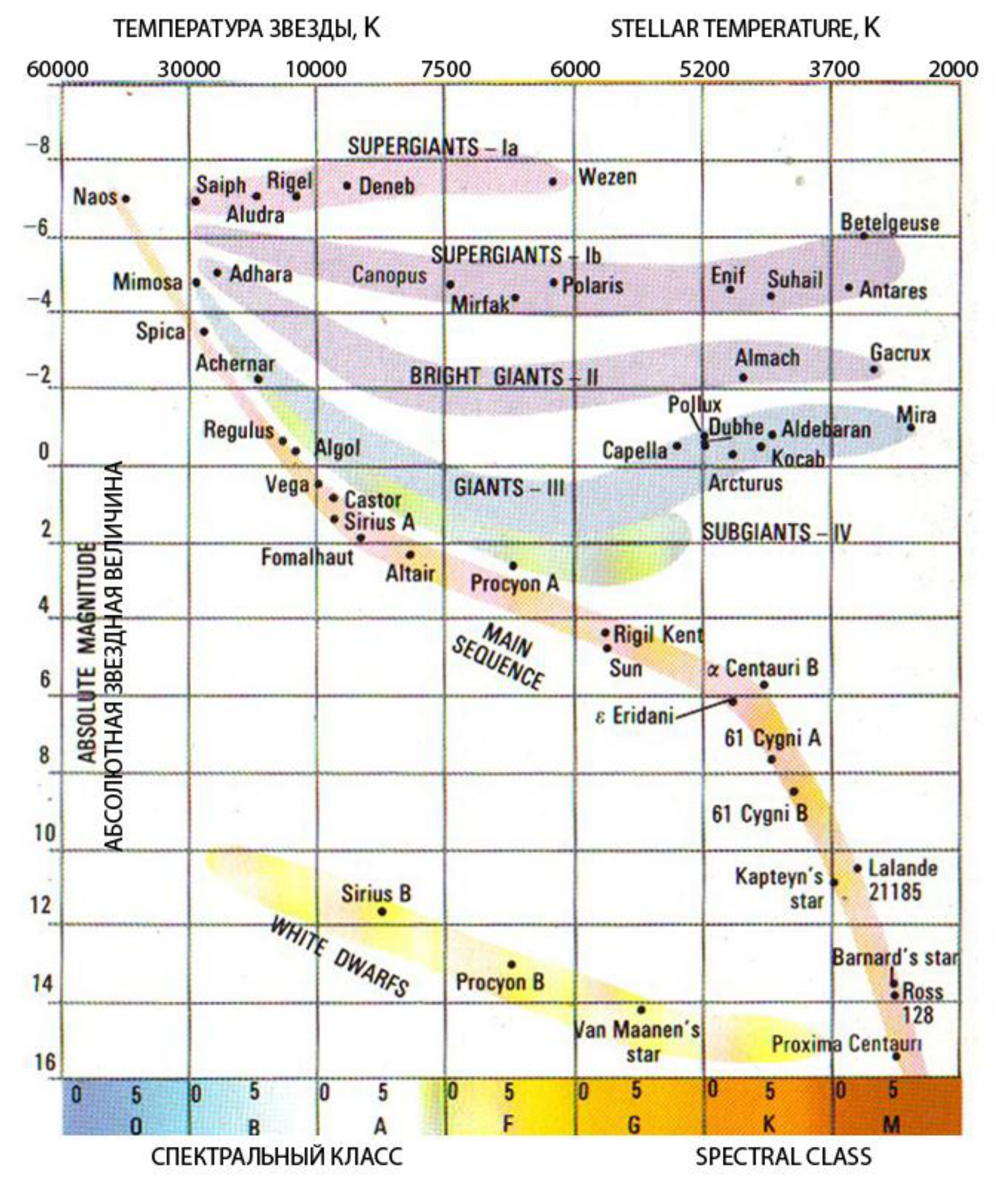
Source Hertzsprung–Russell diagram
Отговори
- Approximately 4×10¹⁰ stars.
Решение
Official sketches for solutions; for jury work only. The given sketches are not full; team leaders have to give more detailed explanations to students. Correct solutions in students' papers (enough for 8 points) may be shorter.
Jury note. Evaluate the solution in essence, not by formal existence of mentioned sentences or formulae. Their formal presence is not necessary to give the respective points. Give points if the following steps de facto use these positions.
The first source page prints these notes twice, under both “Sketches for solutions” and “Basic criteria”. No item-by-item numerical grading breakdown appears in the archived five images. The running headers on images 2–4 print “XX IAO 2014”, while their footers and the cover identify 2015.
Solution
First, the values are given with accuracy of one digit, and the wavelength difference can also be obtained with only one digit, so a more accurate final answer is inappropriate. The redshift is , so the galaxy recedes with km/s. By Hubble's law, with km/s/Mpc,
The angular size is 40″, so the source prints
The denominator 205265 is printed in the source.
The spiral galaxy appears elliptical, so its plane is inclined to the line of sight at angle :
The spectral broadening is due to stellar motion. The solution text gives a range 6854 Å to 6857 Å, a broadening of 1.5 Å in either direction. The radial speed of the outermost stars is
and their total speed is
Source discrepancy: the solution prose says 6854–6857 Å, while the question says 7054–7057 Å and the solution's velocity calculation uses 7055 Å.
Assume the outermost stars move in circular orbits with this speed and the galactic mass is concentrated at the centre. Kepler's law gives
For stars of spectral class A7–A8 take Altair as typical, with mass 1.7 solar masses, or kg. Then
or about 40 billion stars.
Parameters of orbits and physical characteristics; local coordinates
| Body | Average distance to central body (AU) | Average distance to central body (10⁶ km) | Sidereal (or analogous) period (tropical years) | Sidereal (or analogous) period (days) | Eccentricity | Equatorial diameter (km) | Mass (10²⁴ kg) | Density (g/cm³) | Gravity (m/s²) | Maximum magnitude | Albedo |
|---|---|---|---|---|---|---|---|---|---|---|---|
| Sun | 1392000 | 1989000 | 1.409 | −26.8 | |||||||
| Mercury | 0.387 | 57.9 | 0.241 | 87.969 | 0.206 | 4879 | 0.3302 | 5.43 | 3.70 | −2.2 | 0.06 |
| Venus | 0.723 | 108.2 | 0.615 | 224.701 | 0.007 | 12104 | 4.8690 | 5.24 | 8.87 | −4.7 | 0.78 |
| Earth | 1.000 | 149.6 | 1.000 | 365.256 | 0.017 | 12756 | 5.9742 | 5.515 | 9.81 | 0.36 | |
| Moon | 0.00257 | 0.38440 | 0.0748 | 27.3217 | 0.055 | 3475 | 0.0735 | 3.34 | 1.62 | −12.7 | 0.07 |
| Mars | 1.524 | 227.9 | 1.880 | 686.980 | 0.093 | 6794 | 0.6419 | 3.94 | 3.71 | −2.0 | 0.15 |
| Jupiter | 5.204 | 778.6 | 11.862 | 4332.59 | 0.048 | 142984 | 1899.8 | 1.33 | 24.86 | −2.7 | 0.66 |
| Saturn | 9.584 | 1433.7 | 29.458 | 10759.20 | 0.054 | 120536 | 568.50 | 0.70 | 10.41 | 0.7 | 0.68 |
| Uranus | 19.191 | 2871.0 | 84.015 | 30685.93 | 0.046 | 51118 | 86.625 | 1.30 | 8.44 | 5.5 | 0.74 |
| Neptune | 30.071 | 4498.6 | 164.778 | 60187.64 | 0.008 | 49532 | 102.78 | 1.76 | 11.20 | 7.8 | 0.58 |
For outer planets and Moon — in mean opposition. Blank cells are blank in the source.
| Coordinates | Observatory | Kazan kremlin | Petrovskoye |
|---|---|---|---|
| Longitude E | 48°49′ | 49°06′ | 49°06′ |
| Latitude N | 55°50′ | 55°48′ | 55°41′ |
| Timezone | UT+3 | UT+3 | UT+3 |
Some constants and formulae
| Constant or formula | Value |
|---|---|
| Speed of light in vacuum c (m/s) | 299792458 |
| Constant of gravitation G (N·m²/kg²) | |
| Solar constant A (W/m²) | 1367 |
| Hubble parameter H₀ (km/s/Mpc), mean | 68 |
| Hubble parameter, range | 50–100 |
| Planck constant h (J·s) | |
| Charge of electron e (C) | |
| Mass of electron mₑ (kg) | |
| Proton-to-electron ratio | 1836.15 |
| Faraday constant F (C/mol) | 96485 |
| Magnetic constant μ₀ (H/m) | |
| Universal gas constant R (J/mol/K) | 8.314 |
| Boltzmann constant k (J/K) | |
| Stefan–Boltzmann constant σ (W/m²/K⁴) | |
| Wien displacement constant b (m·K) | 0.002897 |
| Laboratory wavelength Hα (Å) | 6562.81 |
| Tropical year length T (days) | 365.242199 |
| Nodal period of lunar orbit (years) | −18.6 |
| Standard atmosphere (Pa) | 101325 |
| Visible light extinction by terrestrial atmosphere in zenith (minimum) | 19%, 0.23 magnitudes |
| Height of homogeneous atmosphere (m) | 7991 |
| Refractive index of water for 20°C n | 1.334 |
| Moment of inertia of a solid ball | |
| Volume of a ball | |
| Area of sphere | |
| π | 3.14159265 |
| e | 2.71828183 |
| Golden ratio φ | 1.61803399 |
20 brightest stars, other stars and Greek alphabet
| Name | Designation | RA | Dec | Parallax (arcsec) | Magnitude | Spectral class |
|---|---|---|---|---|---|---|
| Altair | α Aql | 19h50m47s | 08°52′06″ | 0.195 | 0.77 | A7 |
| Capella | α Aur | 05h16m41s | 45°59′53″ | 0.073 | 0.08 | G5+G0 |
| Arcturus | α Boo | 14h15m38s | 19°10′57″ | 0.089 | −0.04ᵛ | K1 |
| Canopus | α Car | 06h23m57s | −52°41′45″ | 0.028 | −0.72 | F0 |
| Toliman (Rigel Kent) | α Cen A; B | 14h39m36s | −60°50′07″ | 0.747 | −0.01; 1.33 | G2; K1 |
| Hadar | β Cen | 14h03m49s | −60°22′23″ | 0.009 | 0.61 | B1 |
| Sirius | α CMa | 06h45m09s | −16°42′58″ | 0.375 | −1.46 | A1 |
| Procyon | α CMi | 07h39m18s | 05°13′30″ | 0.288 | 0.38 | F5 |
| Acrux | α Cru | 12h26m36s | −63°05′57″ | 0.010 | 0.77 | B0 |
| Becrux | β Cru | 12h47m43s | −59°41′20″ | 0.009 | 1.30 | B0 |
| Deneb | α Cyg | 20h41m26s | 45°16′49″ | 0.002 | 1.25 | A2 |
| Achernar | α Eri | 01h37m43s | −57°14′12″ | 0.026 | 0.46 | B3 |
| Pollux | β Gem | 07h45m19s | 28°01′35″ | 0.097 | 1.14 | K0 |
| Vega | α Lyr | 18h36m56s | 38°47′01″ | 0.123 | 0.03 | A0 |
| Betelgeuse | α Ori | 05h55m10s | 07°24′25″ | 0.005 | 0.5ᵛ | M2 |
| Rigel | β Ori | 05h14m32s | −08°12′06″ | 0.013 | 0.12 | B8 |
| Fomalhaut | α PsA | 22h57m39s | −29°37′20″ | 0.130 | 1.16 | A3 |
| Antares | α Sco | 16h29m24s | −26°25′55″ | 0.024 | 0.96 | M1+B4 |
| Aldebaran | α Tau | 04h35m55s | 16°30′33″ | 0.048 | 0.85ᵛ | K5 |
| Spica | α Vir | 13h25m12s | −11°09′41″ | 0.023 | 0.98 | B1 |
Some other stars
| Name | Designation | RA | Dec | Parallax (arcsec) | Magnitude | Spectral class |
|---|---|---|---|---|---|---|
| Hamal | α Ari | 02h07m10s | 23°27′45″ | 0.050 | 2.01 | K2 |
| Polaris | α UMi | 02h31m49s | 89°15′51″ | 0.007 | 1.97ᵛ | F7 |
| Kochab | β UMi | 14h50m42s | 74°09′20″ | 0.025 | 2.07 | K4 |
| Proxima Centauri | V645 Cen, α Cen C | 14h29m43s | −62°40′46″ | 0.769 | 11.05 | M5.5 |
Greek alphabet
| Uppercase | Lowercase | Name |
|---|---|---|
| Α | α | alpha |
| Β | β | beta |
| Γ | γ | gamma |
| Δ | δ | delta |
| Ε | ε | epsilon |
| Ζ | ζ | zeta |
| Η | η | eta |
| Θ | θ | theta |
| Ι | ί | iota |
| Κ | κ | kappa |
| Λ | λ | lambda |
| Μ | μ | mu |
| Ν | ν | nu |
| Ξ | ξ | xi |
| Ο | ο | omicron |
| Π | π | pi |
| Ρ | ρ | rho |
| Σ | σ | sigma |
| Τ | τ | tau |
| Υ | υ | upsilon |
| Φ | φ | phi |
| Χ | χ | chi |
| Ψ | ψ | psi |
| Ω | ω | omega |
Теми и трудност
Трудност: неоценена.
Галактики и космология · Светлина и астрономически измервания · Галактики · Доплерово отместване и червено отместване
Оригинал в Архива: theo_beta.pdf · официални решения: theosol1.jpg · допълнителни данни: theosol2.jpg · допълнителни данни: theosol3.jpg · допълнителни данни: theosol4.jpg · допълнителни данни: theosol5.jpg · допълнителни данни: theo_instr.pdf · допълнителни данни: data_1.pdf · допълнителни данни: data_2.pdf · допълнителни данни: data_3.pdf · допълнителни данни: hrd.pdf · допълнителни данни: sky_map.pdf