IAO 2017, Практически тур, Група α — Задача 7. Extinction in terrestrial atmosphere.
XXII International Astronomy Olympiad · Practical round. Problems to solve · 27 октомври 2017 г.
Внимание: Бележка към темата
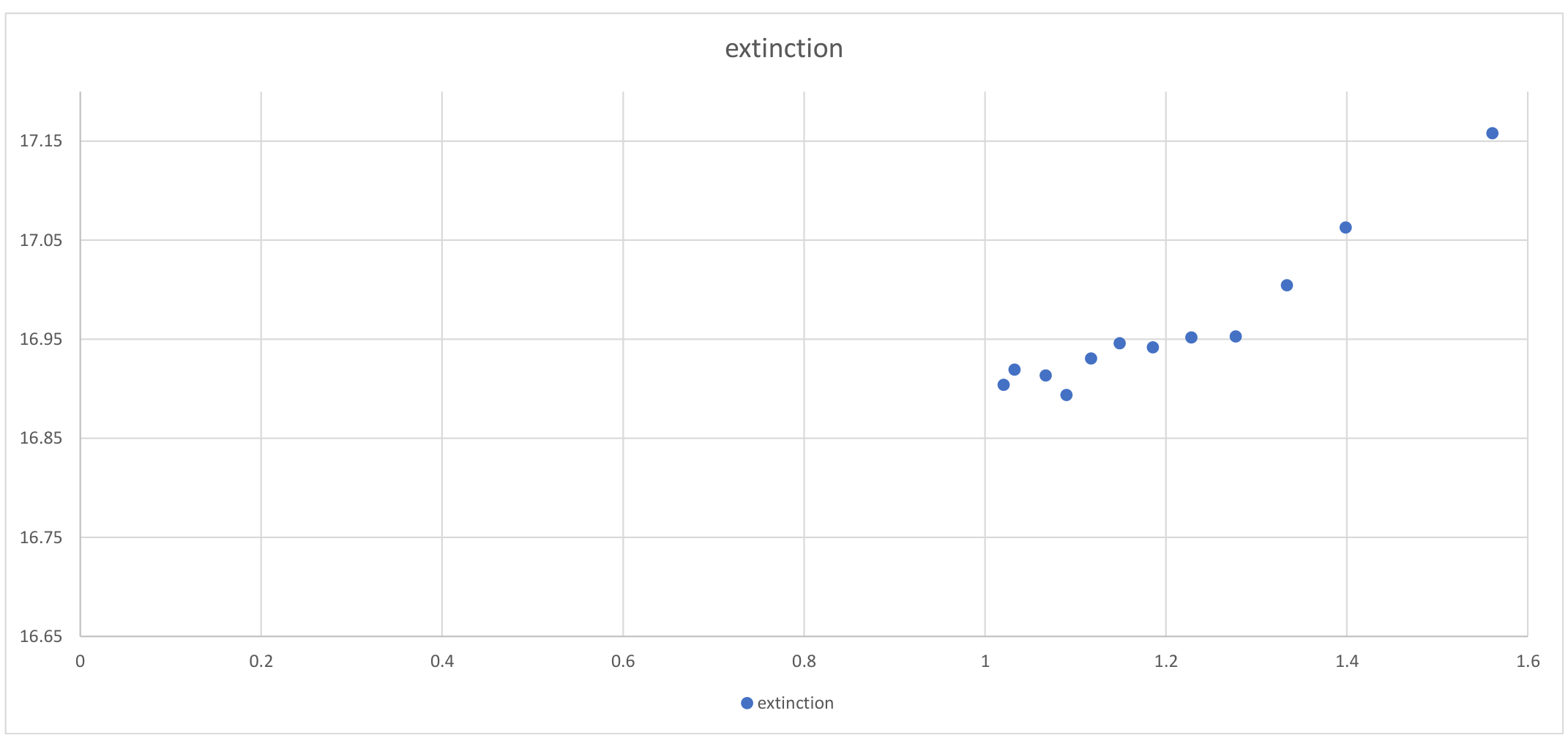
The archived solution workbook contains only the calculation table and scatter chart for problem 7. It has no solution for problem 6 and no final estimates for parts 7.3–7.4. Workbook pages are a native Excel PDF conversion; the complete chart is retained from a labeled derived chart appendix.
Условие
Extinction is a term used in astronomy to describe light attenuation due to its absorption and scattering.
A star (, ) was observed at different zenith distances on October 26, 2017 (after its upper culmination at 11:34:20 UT), at the Weihai Observatory (WHO) of Shandong University. Astronomers use parameter , air mass, as an extinction characteristic, if the zenith distance () is smaller than 60°. The atmospheric extinction equation can be written as: , where is the magnitude of the star without atmospheric extinction, is the atmospheric extinction coefficient. Table 7 (see separate sheet) gives the observing times (UT, in units of hour) and the measured magnitudes () of the star.
7.1. Draw the table (similar to that you see below) in your answer book. Calculate zenith distances, , in unit of degrees (°), for given observing times in 1 column, and write the result into the 2 column. Calculate the air mass () for different zenith distances, and write the result into the 3 column.
| UT_obs (hour) | (°) | |
|---|---|---|
| 12.49484 | ||
7.2. Plot the scatter diagram between magnitudes () vs. air mass (). Draw a straight dashed line on the plot to indicate the linear relation between vs. .
7.3. Estimate the atmospheric extinction coefficient () and the magnitude of this star without atmospheric extinction () with help of graphical method, and write results in forms of «», «».
7.4. Determine the magnitude () of this star as it was observed in zenith, and write result in form of «».
Таблица к задаче 7.
Table for problem 7.
| (hour) | |
|---|---|
| 12.49484 | 16.9040 |
| 12.76648 | 16.9195 |
| 13.30982 | 16.9135 |
| 13.58151 | 16.8938 |
| 13.85316 | 16.9306 |
| 14.12483 | 16.9460 |
| 14.39651 | 16.9420 |
| 14.66817 | 16.9520 |
| 14.93982 | 16.9528 |
| 15.21151 | 17.0046 |
| 15.48372 | 17.0630 |
| 16.02750 | 17.1581 |
| Координаты / Coordinates | Обсерватория Вэйхай / WHO Observatory | Набл. станция Синлун / Xinglong Observatory |
|---|---|---|
| (N / с.ш.) | 37° 32′ | 40° 24′ |
| (E / в.д.) | 122° 03′ | 117° 35′ |
| Часовой пояс / Timezone | UT+08 | UT+08 |
Решение
Внимание: Непълно решение
The workbook supplies the calculation table and scatter chart, but no straight dashed fit line or final values for K, m₀ and mZ (parts 7.2–7.4).
| UT obs | alpha | z | z(deg) | F | mag |
|---|---|---|---|---|---|
| 12.49484 | 0.241541 | 0.202437 | 11.59878 | 1.020846 | 16.904 |
| 12.76648 | 0.312657 | 0.253019 | 14.4969 | 1.032886 | 16.9195 |
| 13.30982 | 0.454903 | 0.357081 | 20.45922 | 1.067326 | 16.9135 |
| 13.58151 | 0.526031 | 0.409658 | 23.47168 | 1.090207 | 16.8938 |
| 13.85316 | 0.597149 | 0.4623 | 26.48784 | 1.117282 | 16.9306 |
| 14.12483 | 0.668272 | 0.514894 | 29.50127 | 1.14897 | 16.946 |
| 14.39651 | 0.739397 | 0.567347 | 32.50658 | 1.185776 | 16.942 |
| 14.66817 | 0.810518 | 0.619578 | 35.4992 | 1.228315 | 16.952 |
| 14.93982 | 0.881636 | 0.671526 | 38.4756 | 1.277346 | 16.9528 |
| 15.21151 | 0.952764 | 0.723141 | 41.43295 | 1.333812 | 17.0046 |
| 15.48372 | 1.024028 | 0.774459 | 44.37322 | 1.398993 | 17.063 |
| 16.0275 | 1.16639 | 0.875563 | 50.16605 | 1.561122 | 17.1581 |
| delta | 42.24472 | 0.737309 | |||
| phi | 37.53333 | 0.65508 |
Теми и трудност
Трудност: неоценена.
Светлина и астрономически измервания · Небесна сфера и сферична астрономия · Междузвездно поглъщане · Небесни координати · Звездни величини
Предпоставки: Гимназиална подготовка, Разширена олимпиадна подготовка
Оригинал в Архива: alphapract.pdf · официални решения: practalphasol.xlsx