IAO 2018, Теория, Група α — Задача 2. α-2. Великите противостояния на Марс
XXIII Международна астрономическа олимпиада — Теоретичен тур, група α, български · 6 октомври 2018 г. · 8 т.
Parameters of orbits and physical characteristics of Sun, planets, some dwarf planets and Moon
| Body, planet | Average distance to central body (astr. units) | Distance (mln. km) | Sidereal period (tropical years) | Period (days) | Eccentricity e | Equatorial diameter (km) | Mass (10²⁴ kg) | Average density (g/cm³) | Gravity at surface (m/s²) | Max. magnitude from Earth | Albedo |
|---|---|---|---|---|---|---|---|---|---|---|---|
| Sun | 1.6·10⁹ | 2.5·10¹¹ | 2.2·10⁸ | 8·10¹⁰ | 1392000 | 1989000 | 1.409 | −26.8ᵐ | |||
| Mercury | 0.387 | 57.9 | 0.241 | 87.969 | 0.206 | 4879 | 0.3302 | 5.43 | 3.70 | −2.2ᵐ | 0.06 |
| Venus | 0.723 | 108.2 | 0.615 | 224.701 | 0.007 | 12104 | 4.8690 | 5.24 | 8.87 | −4.7ᵐ | 0.78 |
| Earth | 1.000 | 149.6 | 1.000 | 365.256 | 0.017 | 12756 | 5.9742 | 5.515 | 9.81 | 0.36 | |
| Moon | 0.00257 | 0.38440 | 0.0748 | 27.3217 | 0.055 | 3475 | 0.0735 | 3.34 | 1.62 | −12.7ᵐ | 0.07 |
| Mars | 1.524 | 227.9 | 1.880 | 686.980 | 0.093 | 6794 | 0.6419 | 3.94 | 3.71 | −2.0ᵐ | 0.15 |
| Ceres | 2.77 | 414 | 4.60 | 1681 | 0.077 | 963 | 0.0009 | 2.16 | 0.27 | 6.7ᵐ | 0.09 |
| Jupiter | 5.204 | 778.6 | 11.862 | 4332.59 | 0.048 | 142984 | 1899.8 | 1.33 | 24.86 | −2.7ᵐ | 0.66 |
| Saturn | 9.584 | 1433.7 | 29.458 | 10759.20 | 0.054 | 120536 | 568.50 | 0.70 | 10.41 | 0.7ᵐ | 0.68 |
| Uranus | 19.191 | 2871.0 | 84.015 | 30685.93 | 0.046 | 51118 | 86.625 | 1.30 | 8.44 | 5.5ᵐ | 0.74 |
| Neptune | 30.071 | 4498.6 | 164.778 | 60187.64 | 0.008 | 49532 | 102.78 | 1.76 | 11.20 | 7.8ᵐ | 0.58 |
| Pluto | 39.482 | 5906.4 | 248.09 | 90613 | 0.249 | 2374 | 0.0130 | 1.86 | 0.61 | 15.1ᵐ | 0.6 |
For outer planets and Moon — in mean opposition.
| Coordinates | Hotel | Seafront in the center |
|---|---|---|
| λ (E) | 79°52′ | 79°51′ |
| φ (N) | 07°00′ | 06°54′ |
| Timezone | UT+05:30 | UT+05:30 |
Some constants and formulae
| Quantity | Value |
|---|---|
| Speed of light in vacuum, c (m/s) | 299792458 |
| Constant of gravitation, G (N·m²/kg²) | 6.674·10⁻¹¹ |
| Solar constant, A (W/m²) | 1367 |
| Hubble parameter, H₀ (km/s/Mpc): mean value | 68 |
| Hubble parameter: diapason of values | 50–100 |
| Planck constant, h (J·s) | 6.626·10⁻³⁴ |
| Charge of electron, e (C) | 1.602·10⁻¹⁹ |
| Mass of electron, mₑ (kg) | 9.109·10⁻³¹ |
| Proton-to-electron mass ratio | 1836.15 |
| Faraday constant, F (C/mol) | 96485 |
| Magnetic constant, μ₀ (H/m) | 1.257·10⁻⁶ |
| Universal gas constant, R (J/mol/K) | 8.314 |
| Boltzmann constant, k (J/K) | 1.381·10⁻²³ |
| Stefan-Boltzmann constant, σ (W/m²/K⁴) | 5.670·10⁻⁸ |
| Wien’s displacement constant, b (m·K) | 0.002897 |
| Laboratory wavelength of Hα (Å) | 6563 |
| Laboratory wavelength of Hβ (Å) | 4861 |
| Tropical year length, T (days) | 365.242199 |
| Sidereal year length, T (days) | 365.25636 |
| Anomalistic year length, T (days) | 365.259636 |
| Nodal period of lunar orbit (years) | −18.6 |
| Standard pressure (Pa) | 101325 |
| Visible light extinction by the terrestrial atmosphere in zenith (minimum) | 19%, 0.23ᵐ |
| Height of homogeneous atmosphere (m) | 7991 |
| Refractive index of water for 20°C, n | 1.334 |
| Moment of inertia of solid ball | |
| Moment of inertia of sphere | |
| Volume of a ball | |
| Area of sphere | |
| π | 3.14159265 |
| e | 2.71828183 |
| Golden ratio, φ | 1.61803399 |
Theoretical round. Basic criteria. For work of Jury
Note. The given sketches of solutions are not full; the team leaders have to give more detailed explanations to students. The correct solutions in the students’ papers (enough for 8 pts) may be shorter.
Note. Jury members should evaluate the student’s solutions in essence, and not by looking on formal existence the mentioned sentences or formulae. The formal presence of the mentioned positions in the text is not necessary to give the respective points. Points should be done if the following steps de facto using these positions.
Note. Jury members should elaborate more detailed criteria, and also create criteria for other correct ways of the student’s solutions.
Printed source discrepancies
The galaxy key prints nm for the wavelengths 6563 and 4861, while the constants sheet gives Å. The Martian key reverses the question’s subpart order, prints a lunar-radius term 0.17·10⁵ km, and reuses L₂ for the semimajor axis. The satellite key calls R a diameter and prints 10h20m after subtracting 62 minutes from 11h12m. Printed formulas and labels are retained rather than silently corrected. The satellite key refers to a drawing absent from the supplied solution packet.
Език на решенията
Приложени са съответните официални решения и критерии на английски език от архива. Българският ръкопис съдържа задачи α-1, α-2 и общите αβ-3–5. Допълнението 1.2 към α-1 е записано на следващата страница и е включено към същата задача.
Условие
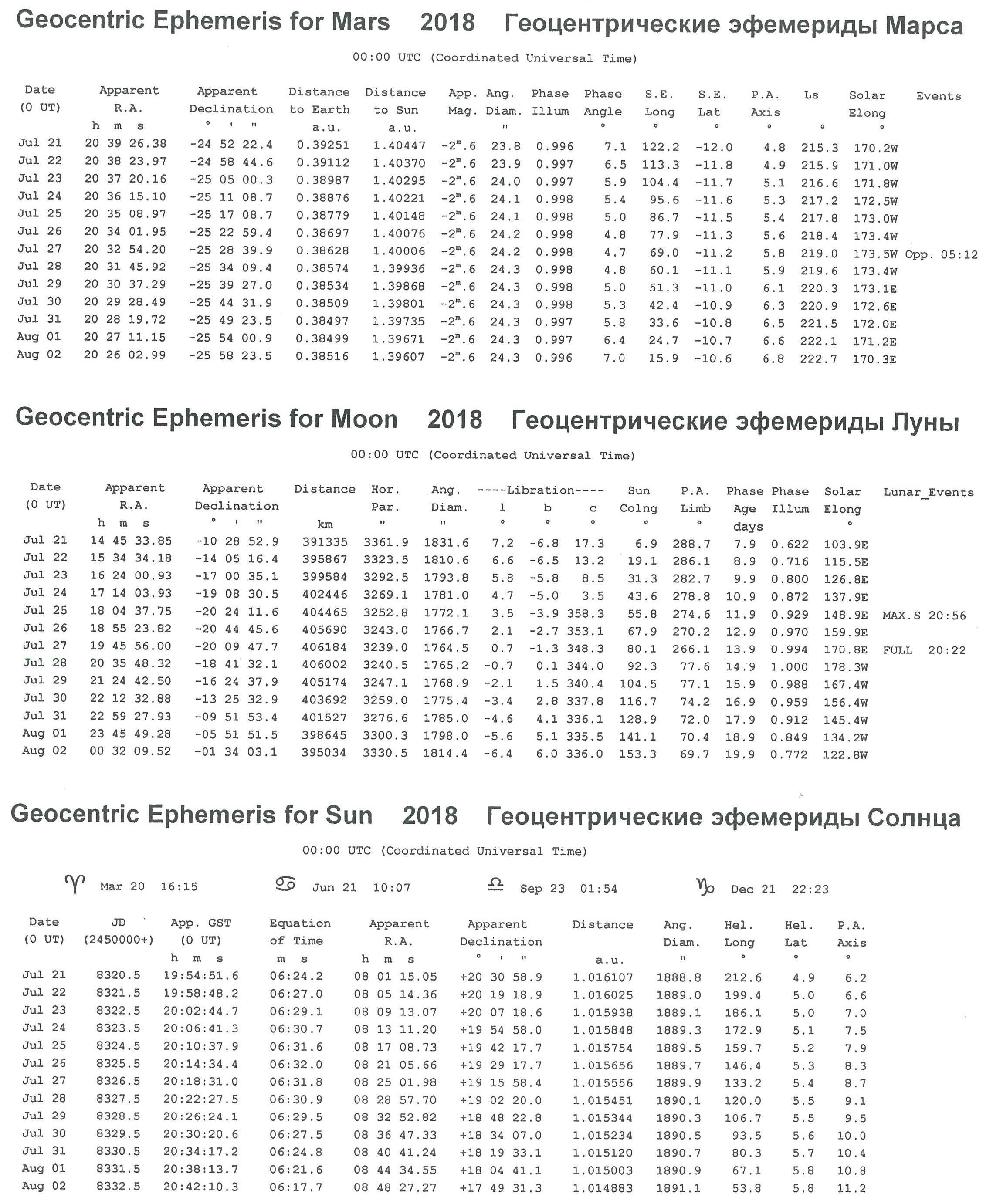
Сутринта на 27 юли 2018 г. Марс е бил във велико противостояние (вижте приложените ефемериди). Великите противостояния на Марс са положенията, при които планетата се вижда с най-ярък блясък в сравнение с видимия ѝ блясък по време на други противостояния. Великите противостояния се повтарят през всеки 15 или 17 години. Така предходното противостояние на Марс (което е било наричано „най-велико“, понеже толкова ярък Марс става само веднъж на много векове) е било на 28 август 2003 г., а следващото велико противостояние ще бъде в 2035 г.
2.1.
Определете в кое съзвездие се е намирал Марс по време на сегашното противостояние (през тази година)?
2.2.
Като считате орбитите на Земята и Марс за кръгови и като се основавате на датата на противостоянието през 2003 г., пресметнете на кои дати би трябвало да са се случили противостоянията в 2018 и 2035 г.
2.3.
Обяснете защо е възникнала разлика между изчислената от вас дата и реалната дата на противостоянието в 2018 г. Нарисувайте схема, която нагледно демонстрира вашето обяснение.
2.4.
В кое от противостоянията през 2018 или 2035 г. Марс ще е по-ярък? (Отговорът трябва да се обоснове, като се направи схема).
Решение
2.1.
During the opposition, the planet is at a point approximately (up to an angular distance from the ecliptic at this moment) opposite to the Sun, that is, located where the Sun was six months ago. The Sun is in the constellation Capricorn on January 27.
2.2.
The oppositions are repeated every synodic period. The synodic period of Mars is:
Approximately 15 years passed from 2003 to 2018 and there are synodic periods of Mars during this period. So, the opposition 2018 was to occur after 7 synodic periods, earlier on August 28.
The easiest way to calculate the date is as follows. For 7 synodic periods of Mars days pass. From August 28, 2003, to August 28, 2018, days passed. Thus, in 2018, the opposition of Mars should be 20 days earlier than August 28, that is, August 8.
Similarly, we calculate the date of opposition 2035. , 15 synodic periods: days. From August 28, 2003, to August 28, 2035, days pass. Thus, it turns out that in 2035 the opposition of Mars should be 11 days later than August 28, that is, September 8.
2.3.
The difference appears from the fact that in our calculations we take the average angular velocity of Mars in orbit, and in periods close to great oppositions, Mars is near the perihelion of its orbit, and its speed is larger. As a result, the difference in the angular velocities of the Earth and Mars is smaller. Therefore, to change the position of Mars relative to the Earth takes more time. That is why, the farther the opposition from the perihelion point of Mars orbit (which is at the ecliptic longitude that the Earth passes around August 28), the greater the error. Calculations in the approximation of circular orbits give about 1.5 times the underestimated interval between the date of the calculated opposition and the date on which the “greatest oppositions” take place (that is, August 28).
2.4.
The position of Mars during the opposition of 2035 is closer to the position of the perihelion of the orbit than in 2018, therefore in the opposition of 2035 Mars will be brighter.
Basic criteria
On the morning of July 27, 2018, Mars.
| Item | Points |
|---|---|
| 2.1. | 1 |
| 2.2. Calculation of synodic period | 1 |
| Calculation theoretical dates of the great opposition 2018 | 1 |
| Calculation theoretical dates of the great opposition 2035 | 1 |
| 2.3. | 2 |
| 2.4. | 2 |
Оригинал в Архива: iao2018_alpha.pdf · официални решения: theosol.pdf · допълнителни данни: theo.pdf