IAO 2019, Практически тур — Задача 7 (αβ). Аналемма
XXIV International Astronomy Olympiad — Задачи практического тура · 10 т.
Source availability / Неполнота источника
Рисунки 6.1 и 6.2, необходимые для измерений в задаче 6, отсутствуют в архивном файле условий. В решении сохранён размеченный рис. 1; он не заменяет исходные неразмеченные рисунки. Решение варианта β обрывается после направления начальной скорости α≈54°; модуль скорости, скорость встречи и формулы построения фокуса не приведены. На официальном ответном изображении к задаче 7 отсутствует линия эклиптики, о чём предупреждает сам текст решения.
Language and printed-source notes
Conditions are Russian; the matched official solutions use Romanian for task 6 and English for task 7. Task 7 is identical in the α and β editions and is represented once; the distinct task-6 variants remain separate. The asteroid solution changes the measured radius from 153 to 155 mm and uses Earth mass 5.972×10²⁴ kg rather than the data sheet’s 5.974×10²⁴ kg. The printed analemma formula A=−η sin φ is retained. The source’s figure numbering is retained, including the absent Fig. 6 reference.
Условие
Аналемма — это фигура, которая получается, если отмечать положения небесного тела в разные дни на протяжении года, но в одно и то же время (измеряемое по обычным часам). В случае наблюдения Солнца с Земли она напоминает по форме неправильную восьмёрку. Происходит это благодаря действию уравнения времени и изменению склонения Солнца в течение года.
Прилагаемая на отдельном листе фотография сделана вчера вечером с верхнего этажа гостиницы в Пьятра-Нямц, точно в направлении востока. Масштаб напечатанной области фотографии — . На этом листе Вам нужно построить аналемму, привязав её к местности.
Для простоты считайте данный участок неба плоским, то есть, все горизонтальные линии небесной сферы считайте параллельными оси X, все линии, направленные в зенит — параллельными оси Y.
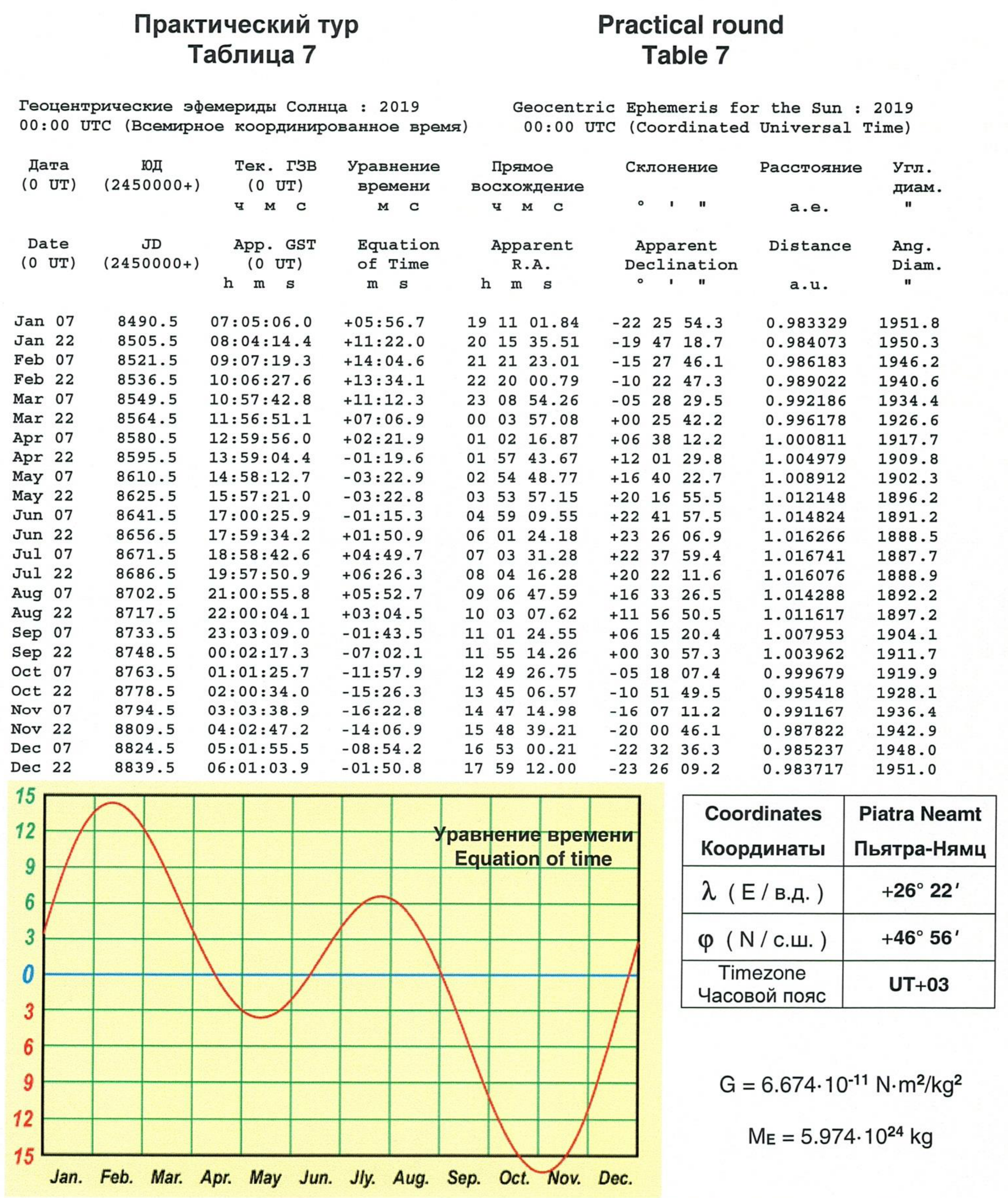
Учтите, что знак в значениях уравнения времени в эфемеридах указан по европейскому определению (см. прилагаемый к таблицам график уравнения времени).
7.1 Вычислите положения Солнца в по местному среднему солнечному времени для наблюдателя, находящегося в Пьятра-Нямц, в те дни, для которых приведены данные в Таблице 7. Приведите расчёты в своей тетради. Результаты запишите в тетради в виде таблицы.
7.2 На листе с фотографией проведите линию небесного экватора, пометьте её знаком “equ” (equator).
7.3 Для тех случаев, когда вычисленное положение Солнца попадает в кадр (независимо от того, находится ли оно на небе, под горизонтом или загорожено горой), нанесите на лист с фотографией изображения Солнца, подписав даты около каждого изображения.
7.4 Вычислите, в какое время (по времени местного часового пояса, указанному в таблице, переходы зимнее/летнее время не учитывать) следует делать фотографии, чтобы получить такую аналемму.
7.5 Добавьте на аналемму сегодняшнее положение Солнца.
7.6 Начертите положение эклиптики в момент времени, соответствующий сегодняшнему положению Солнца на аналемме. Пометьте её знаком “ecl” (ecliptic).
Фотография
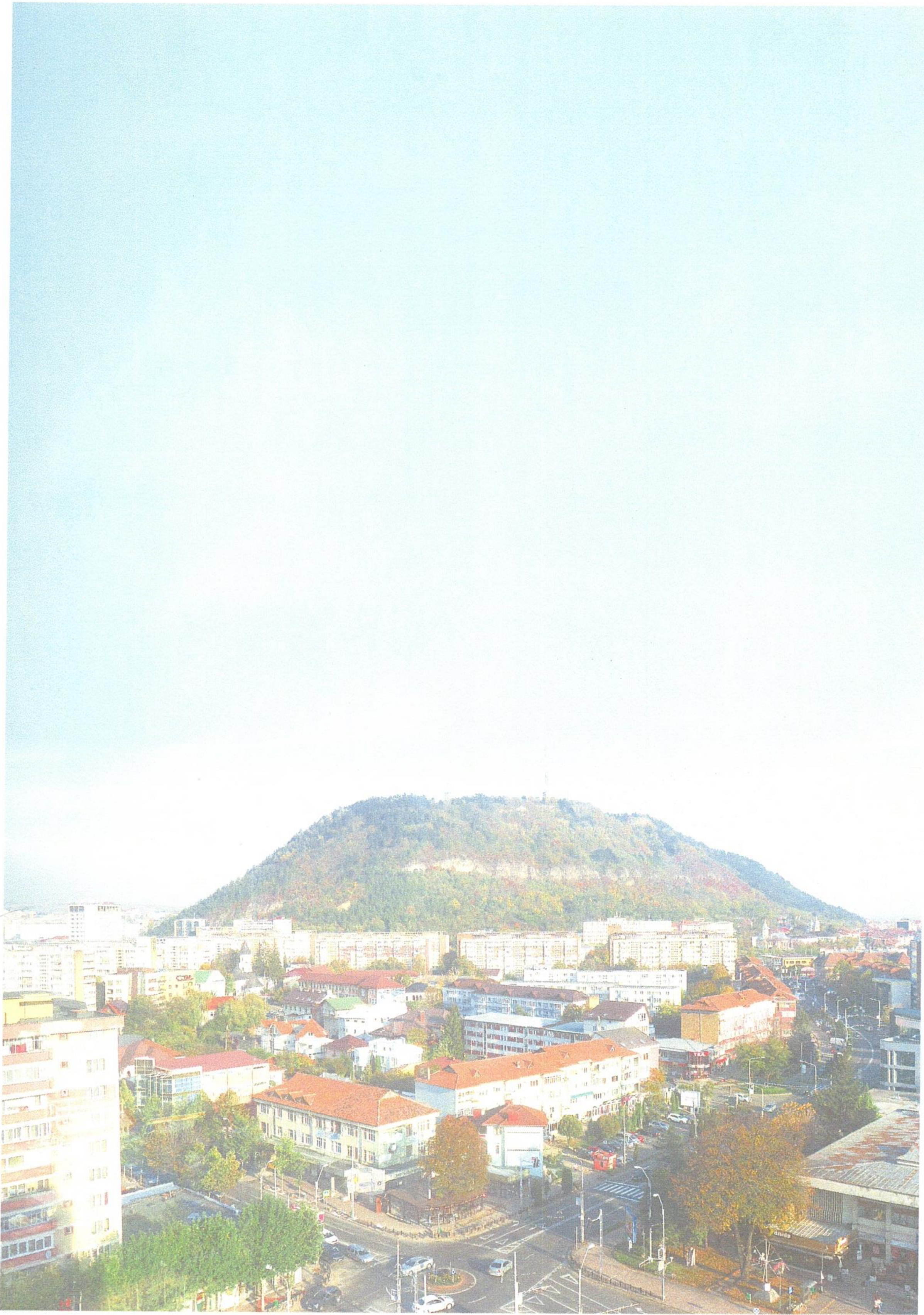
Таблица 7. Эфемериды Солнца / Sun ephemerides
Решение
Внимание: Непълно решение
The official answer picture omits the ecliptic line; the solution explicitly says to draw it by hand.
αβ-7. Analemma.
7.0. Preliminary notes and calculations.
At first we may calculate the scale of photo.
Horizontal scale: .
Vertical scale: .
So the scale is the same on horizontal and vertical axis.
As the photo was taken in East direction, we should assume that the prime vertical runs exactly in the middle of the page.
We may find approximately the horizon line by the reference landscape right to the mountain (to use position left to the mountain is not very good as there are some hills in that direction.
The center of “mean” Sun rises just at the point of East on the horizon at moments of equinoxes. So we may determine this point (crossing point of horizon and the prime vertical) as zero point for our drawings.
The position of the Sun depending on date is:
and and depending on date we may find in the ephemeris table.
7.1.
So, calculating with this formulae the students have to fill a table:
| Date | ||
|---|---|---|
7.2.
The equator passes through our zero point at an angle to the horizon, as it shown in the “picture of solution”.
7.3.
Using the calculated values, we may get approximately the following result (see background of this page, the scale fit to printing this page on A4 page, but the actual dates are different in this example). The analemma in the landscape of the actual picture is presented in separate answer page.
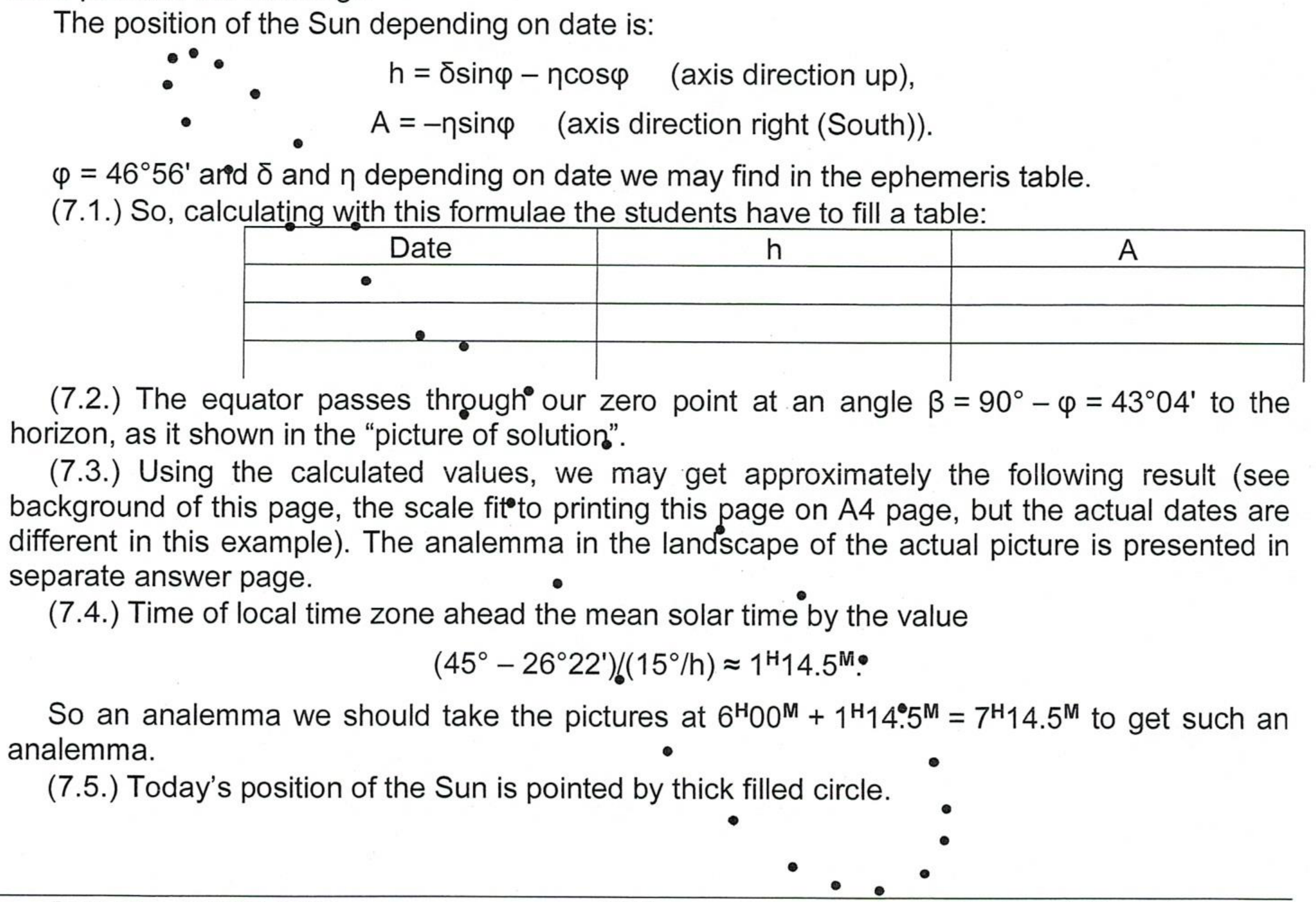
7.4.
Time of local time zone ahead the mean solar time by the value
So an analemma we should take the pictures at to get such an analemma.
7.5.
Today’s position of the Sun is pointed by thick filled circle.
7.6.
The ecliptic passes today’s position of the Sun and the point of autumn equinox at the celestial equator, which is in (as duration from September 23 till October 24) right-up along the celestial equator from the zero point, in our scale,
This point is marked also by thick filled circle. The line of ecliptic is shown in answer page with analemma. Sorry at the current version I cannot scan the picture, in the enclosed picture the line of ecliptic should be drawn by hand crossing the “thick” images of the Sun.
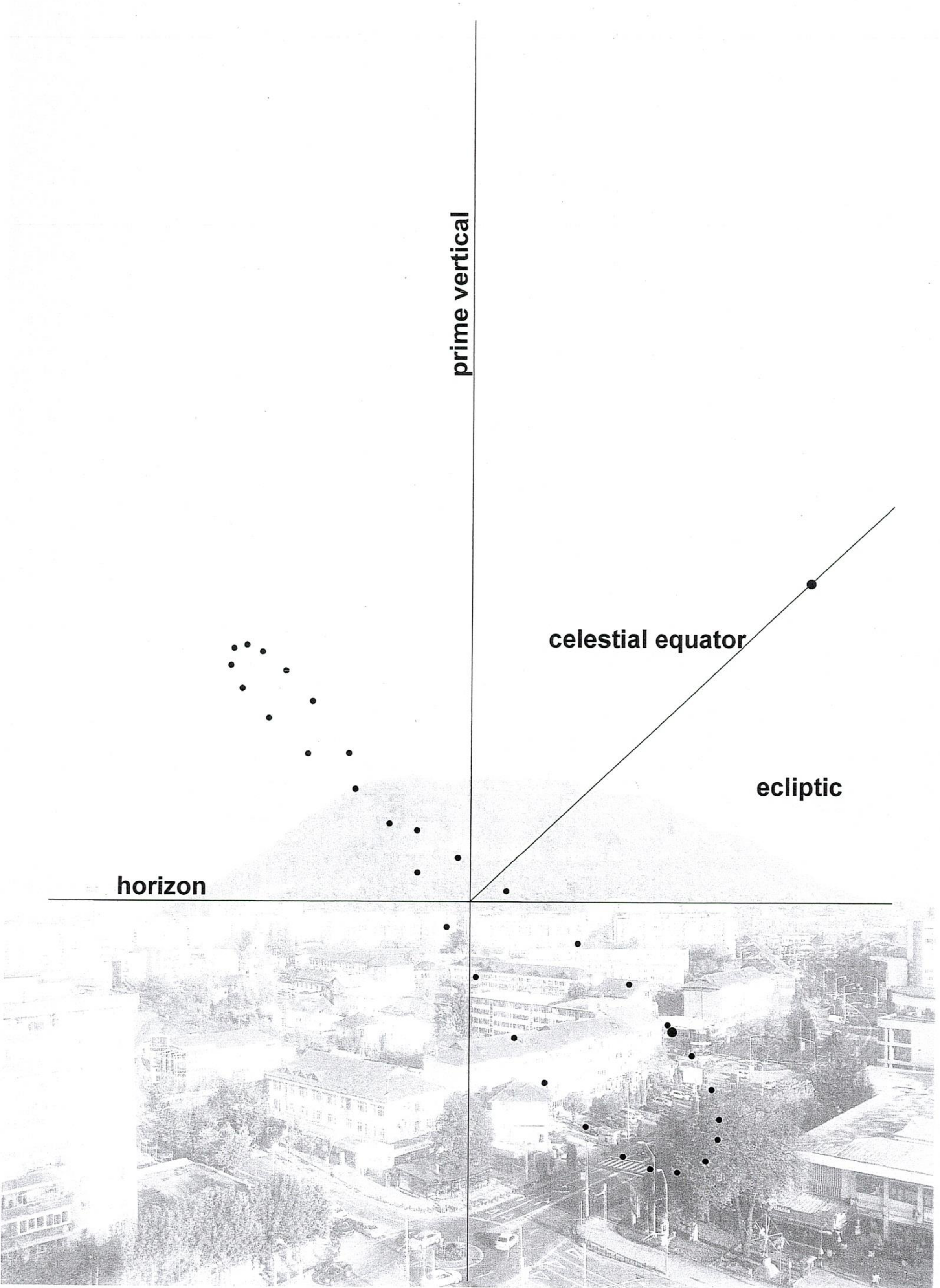
Practical round. Sketches for solutions. For jury job ONLY
Note. The given sketches are not full; the team leaders have to give more detailed explanations to students. But the correct solutions in the students’ papers (enough for 10 pts) may be shorter (and without any word, of course).
Note. Jury members should evaluate the student’s solutions in essence, and not by looking on formal existence the mentioned sentences or formulae. The formal presence of the mentioned positions in the text is not necessary to give the respective points. Points should be done if the following steps de facto using these positions.
Marking scheme
Marking scheme: proposed to be elaborated by the actual Jury members. Total number of points is 10 for each of two problems of the Practical round.
Теми и трудност
Трудност: неоценена.
Небесна сфера и сферична астрономия · Време и календари · Небесна сфера · Уравнение на времето
Предпоставки: Разширена олимпиадна подготовка
Оригинал в Архива: pract.pdf · официални решения: practsol.pdf