IAO 2019, Теория, α+β — α-3. Sunset in Chukotka.
XXIV International Astronomy Olympiad — Theoretical round, α and β · 19 октомври 2019 г. · 8 т.
For translation only.
Note for translators: in texts for Group β by the red color marked the text identical to that used for Group α.
Source availability
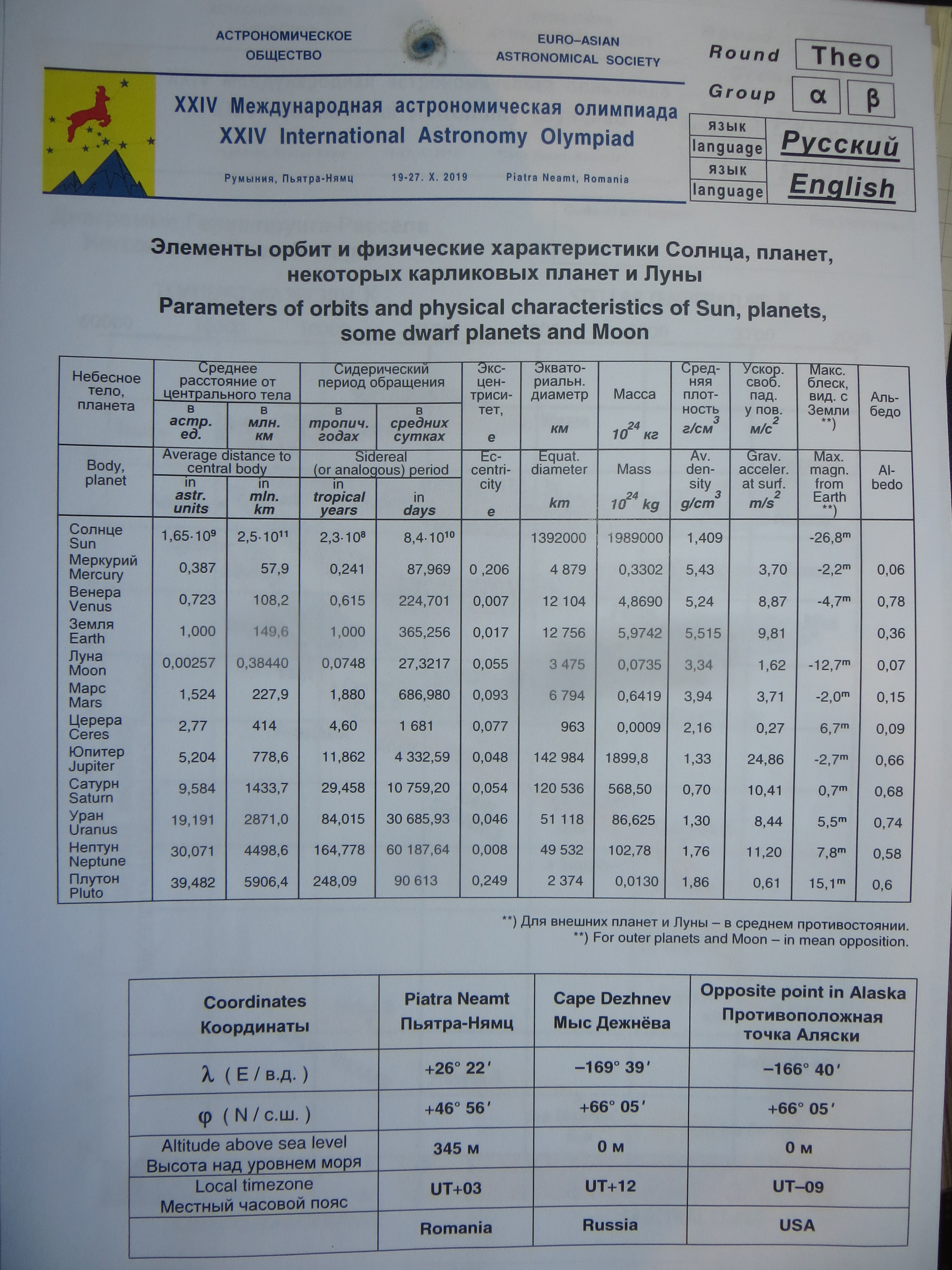
The three photographed sheets contain the combined English translator edition and the bilingual diagram for β-5. The archived data sheets contain Solar-System parameters, geographical coordinates, constants and the Hertzsprung–Russell diagram. The star-data table referred to in the key (including Ruchbah, Vega, Altair and UY Scuti) and the additional mid-round formula promised to Group α are not included in these archived theory/data sources. The surviving key supplies its own working values; no missing handout has been reconstructed.
Условие
The brown Bear-astronomer Chukchi, sitting on the shore of the Bering Strait on the easternmost point of the Eurasian continent (Cape Dezhnev, Chukotka) observes the sunset (the last ray of the Sun). At the same time his distant relative, the Bear-astronomer Eskimo, sitting on the other side of the Bering Strait exactly at the same latitude (the west coast of Alaska) sees the sunrise (the first ray).
3.1.
Find the approximate date of the event (±2 days).
3.2.
Calculate, whether this moment occurs on the same date or on different dates for Chukchi Bear and Eskimo Bear in the time of the local time zone for each of them.
3.3.
Accompany the solution with art drawings of Chukchi Bear and Eskimo Bear observing these astronomical events.
Решение
3.1.
In the supplement table we find that the longitudes of Cape Dezhnev and the opposite point on the coast of Alaska (respectively W and W) differ by . Since the Bear-Chukchi is located 3° west of the Bear-Eskimo, for him, all astronomical events associated with the rotation of the Earth occur 12 minutes later (1 degree in an hourly measure is 4 minutes).
So, 12 minutes after the described moment, the Bear-Chukchi will also see the sunrise. That is, the night (twilight) for him will last only minutes. Such a short duration of the Sun's stay under the horizon means that at the time of its lower culmination, the solar disk barely hides behind the horizon. Let us calculate the necessary value of the declination of the Sun . If we take the radius of the Sun , then we get that the “visible” height of the center of the Sun must satisfy the condition
whence
However, we know that the declination of the Sun during a year does not exceed . Does it mean that the situation is impossible?
However, possible. The fact is that in previous arguments refraction was not taken into account, which “raises” the visible position of the stars, at the horizon it is approximately . If we take it into account, it turns out:
whence
Thus, the case takes place on dates close to the day of the summer solstice. The approximate difference in days between the desired dates and June 22 can be found from the ratio:
where is the angle of inclination of the ecliptic plane to the celestial equator, 0.986° is the coefficient for converting days into degrees (360°/365). We get
Thus, the observations occur 10 days before the summer solstice, or 10 days after, that is, about June 12 or July 2.
Note. The value of refraction depends on atmospheric pressure and temperature. The value of at sea level (observers are sitting on the shore) at a normal pressure of 760 mmHg is realized at a temperature of +6°C. This is a very likely temperature for the month of June in the Bering Strait.
3.2.
On the same or different dates (local time for each the Bear) do the Bears-observers see sunrise and sunset? Based on so large difference in the time zones (UT+12 and UT−09, 21 zone difference), we can conclude that between them (that is, between Chukotka and Alaska) there is a line for changing dates. Indeed, the longer part of day Chukotka and Alaska live on different dates.
But consider our case. As we found out, the event takes place around local true midnight (or rather, for the Bear-Chukchi, minutes earlier, for the Bear-Eskimo, minutes later).
For the Chukchi Bear, the mean solar midnight occurs
earlier than on the Greenwich meridian, that is, at Greenwich time, adding the difference , we get of the same date as in Greenwich. The correction for sunrise and a possible correction by the equation of time never exceeding cannot change the date.
For the Eskimo Bear, the mean solar midnight occurs
later than on the Greenwich meridian, that is, at Greenwich time, subtracting the difference , we get of the same date as in Greenwich. Here, the correction for sunset and a possible correction of the time equation all the more cannot change the date.
Conclusion: for both the Bear-Chukchi and the Bear-Eskimo, the event occurs on the same date as at that moment in Greenwich, that is, on the same date.
3.3.
Picture.
Basic criteria
3.1.
- Explanations and conclusion: sunset and sunrise near lower culmination – 2.5 pt.
- Calculation lower culmination height at summer solstice – 0.5 pt.
- Using refraction – 1 pt.
- Calculation the possible dates – 2 pt.
3.2. Conclusions and result – 1 pt.
3.3. Artistic picture of the Bears-astronomers – 1 pt.
Theoretical round. Sketches for solutions. For jury job ONLY
Note. The given sketches are not full; the team leaders have to give more detailed explanations to students. But the correct solutions in the students’ papers (enough for 8 pts) may be shorter.
Note. Jury members should evaluate the student’s solutions in essence, and not by looking on formal existence the mentioned sentences or formulae. The formal presence of the mentioned positions in the text is not necessary to give the respective points. Points should be done if the following steps de facto using these positions.
Theoretical round. Basic criteria. For work of Jury
Note. The given sketches of solutions are not full; the team leaders have to give more detailed explanations to students. The correct solutions in the students’ papers (enough for 8 pts) may be shorter.
Note. Jury members should evaluate the student’s solutions in essence, and not by looking on formal existence the mentioned sentences or formulae. The formal presence of the mentioned positions in the text is not necessary to give the respective points. Points should be done if the following steps de facto using these positions.
Note. Jury members should elaborate more detailed criteria, and also create criteria for other correct ways of the student’s solutions.
Crossed-out source passage
A red handwritten cross on solution page 2 deletes the following duplicated block between the first estimate and “The physical diameter of the central part of the cluster is”. It is recorded here rather than treated as an active step of the α solution:
“The physical diameter of the cluster is:
By comparing the cluster size in the image with the total image size of , we can find that the angular diameter of the central region of the ‘sphere’ is approximately –. We may take the value for the solution.”
Printed-source discrepancies
The original key is retained literally, including its inconsistent numerical steps: the comet-radiation derivation prints ; the interstellar-comet key repeats pc/year for different speeds and ends with “only stars and brighter” followed by “No”. The sunset key calls the Chukchi correction “sunrise” and the Eskimo correction “sunset”. The satellite question uses , while the key uses , and its Fig. 3 is also called Figure 5.3. These are source discrepancies, not silently corrected calculations. The NGC rubric prints “The answer using the both criteria – pt.” without a numerical score; no value is invented.
Оригинал в Архива: theo1.JPG · официални решения: theosol.pdf · допълнителни данни: theo3.JPG · допълнителни данни: hrd.JPG · допълнителни данни: data_2.JPG · допълнителни данни: data_1.JPG · допълнителни данни: theo2.JPG