IAO 2019, Теория, α+β — αβ-4. Comet particles.
XXIV International Astronomy Olympiad — Theoretical round, α and β · 19 октомври 2019 г. · 8 т.
For translation only.
Note for translators: in texts for Group β by the red color marked the text identical to that used for Group α.
Source availability
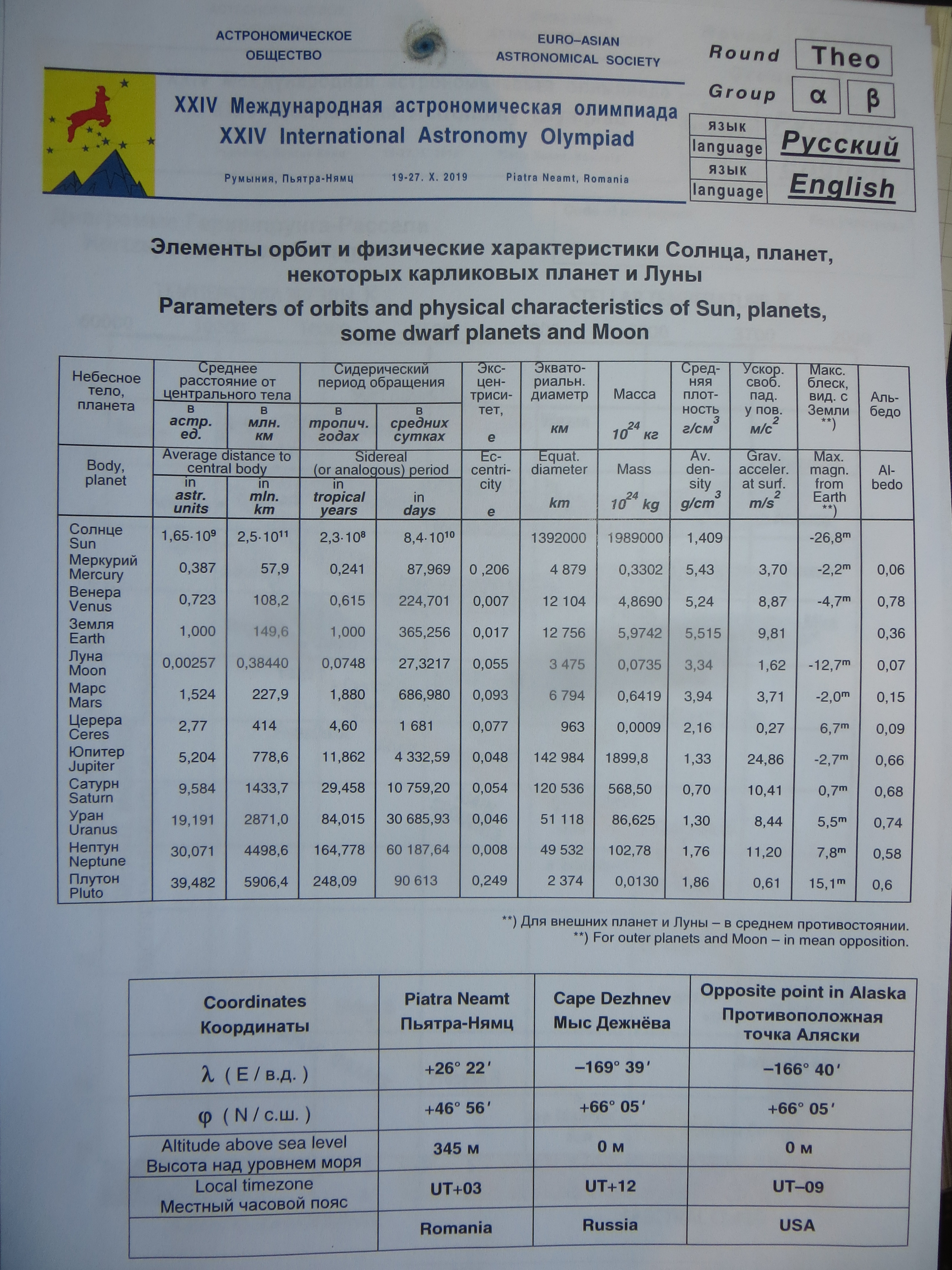
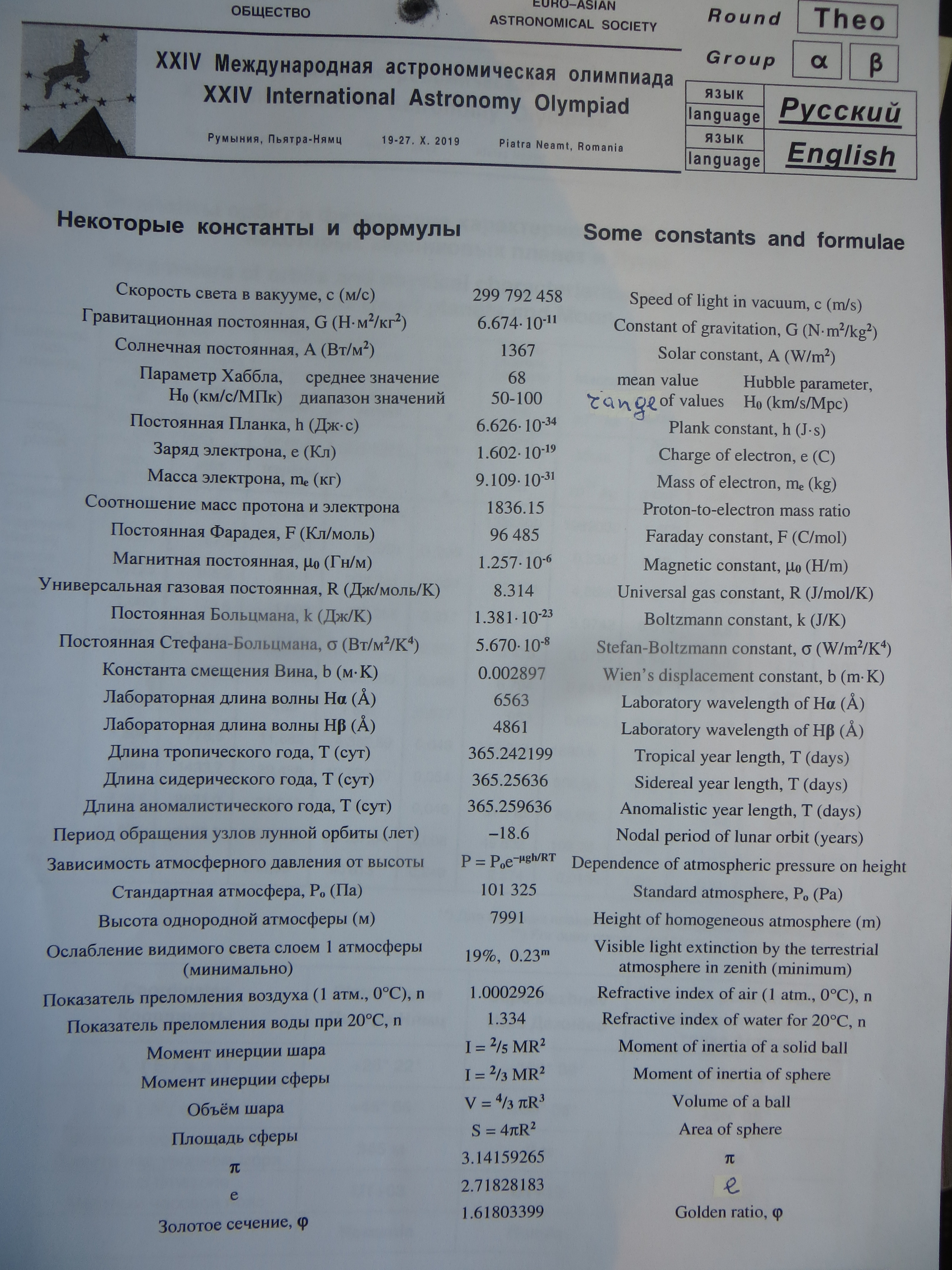
The three photographed sheets contain the combined English translator edition and the bilingual diagram for β-5. The archived data sheets contain Solar-System parameters, geographical coordinates, constants and the Hertzsprung–Russell diagram. The star-data table referred to in the key (including Ruchbah, Vega, Altair and UY Scuti) and the additional mid-round formula promised to Group α are not included in these archived theory/data sources. The surviving key supplies its own working values; no missing handout has been reconstructed.
Условие
Particles of characteristic cometary matter of various sizes come off a comet. Estimate, the characteristic sizes of the particles which are not ejected outside the Solar System due to the solar radiation pressure.
Note: You will get more points for the solution if you first derive the algebraic formula of the answer and only then get the numerical answer by inserting the numerical data into this formula.
For Group α only. Note: In the middle of the time of the round you will be provided with one additional formula.
Решение
Let us consider, that at some point, when the comet is at a distance from the Sun, as shown in Figure 4.1, comet particles with characteristic size the mass have detached from the comet, and their velocity with respect to the Sun being equal to the velocity of the comet, . Let us consider the shape of the particles as spherical with the radius , and that they reflect all the light falling on them.
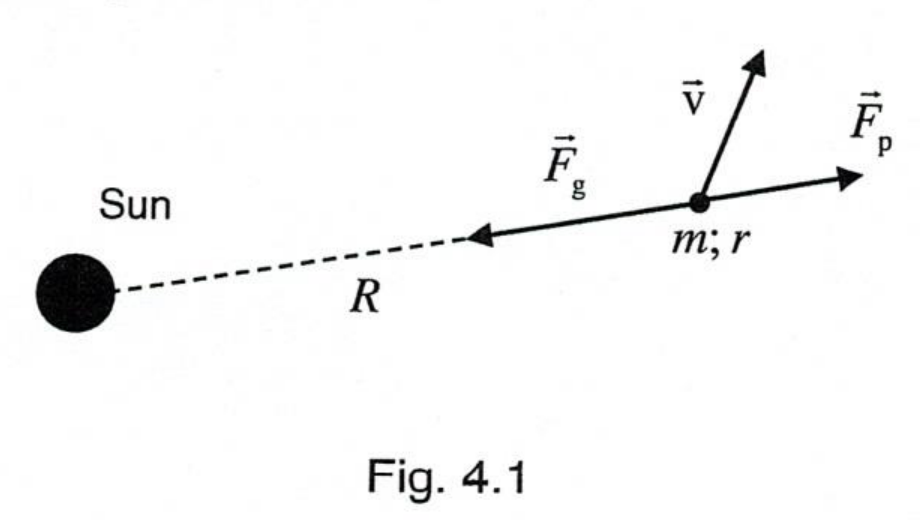
The forces acting on the comet particle are: – the gravitational force of the Sun; – the rejection force due to the solar radiation pressure;
Let us find formula for the force of solar radiation.
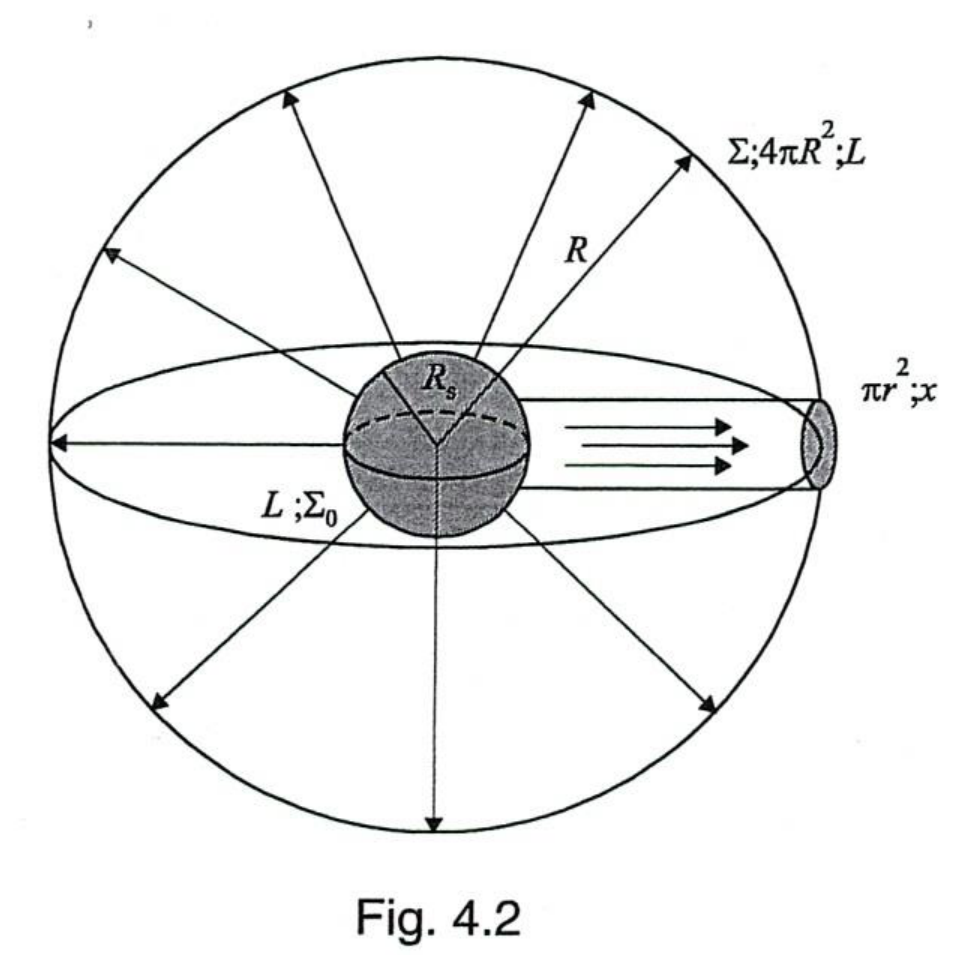
Let's admit, as in Figure 4.2, that the Sun is a sphere with surface, having radius. It is called integral luminosity of Sun, , the total radiation energy emitted per unit of time by Sun, on its entire surface, across all wavelengths in all directions (). Dimension of luminosity is a power.
If is the circumferential sphere, whose radius represents the instantaneous distance between the ice particle and the center of the Sun, then, obviously, the solar radiation energy per unit of time through surface is equal to .
If we use mirror reflection model of a disk, the solar radiation energy per unit of time which arrives on the surface of the particle, is:
As a result, the illumination of the surface of the circular disk (the solar radiation energy per unit of time, per unit area of the disk) is:
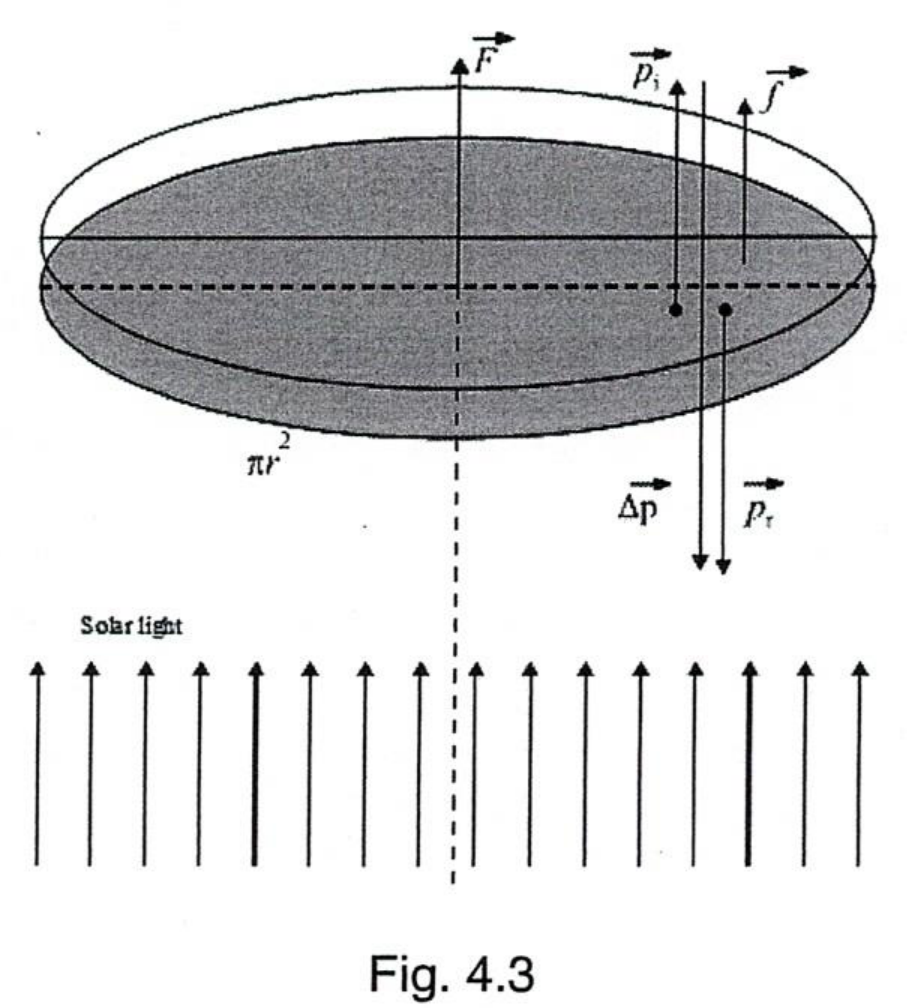
Using Figure 4.3 let's calculate the variation of photon momentum due to solar light reflection on the disk surface into a point:
where – the Planck constant, – light frequency, and – speed of light in vacuum.
As a result of principle of reciprocal action, on the disk will act a force:
If in time on the disk surface is reflecting photons with frequency, then the force that will act on ice particle will be:
where is the photon number with frequency which arrive on the unit surface area of the disk in unit time;
representing the illumination of the surface of the disk due to its component with frequency of the solar radiation;
representing the pressure exerted on disk by the light solar with frequency. According to all solar radiation components (), we calculate the resulting force acting on the disk:
representing the total illumination of the disk due to all solar radiation components:
representing the solar light pressure on the ice particle. So for mirror plate:
where: – the solar radiation pressure, – the Sun luminosity, and – speed of light in vacuum, so that the result of the two collinear and opposite forces, acting on the ice particle is:
This issue is correct for the photons reflect just to back direction (back to the Sun). But this coefficient is different for the spherical shape of the ice particles. To calculate the average coefficient for income of all the directions of the photons reflected from the sphere of radius , you should use integral:
(where 1 is the part of momentum due to coming photons, and is the is the part due to reflecting photons);
so for spherical shape the average coefficient is , and
The total force,
which is a central force resulting from the gravitational interaction of the comet particle and an equivalent Sun, having an effective mass:
These two interactions (gravitational and electromagnetic) between the ice particle and the Sun, with mass, can be replaced by a single interaction (gravitational) between the ice particle and an effective equivalent Sun, with mass, , as shown in Figure 4.4.
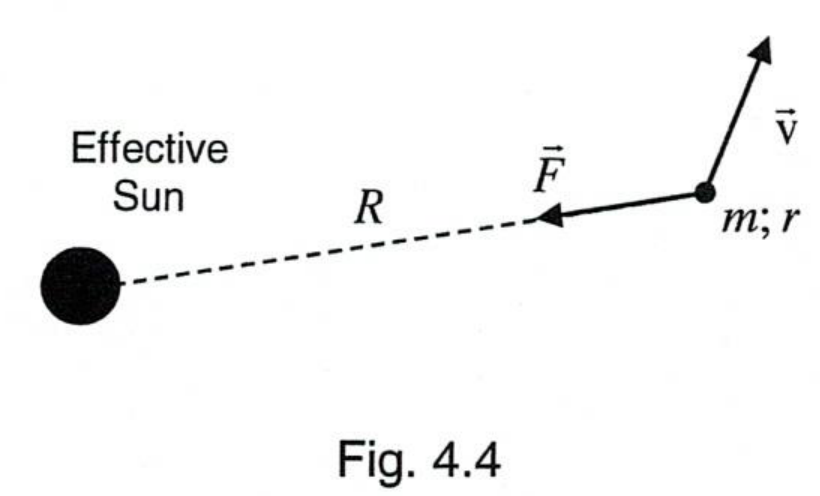
Because , the trajectory of the ice particle will no longer be the same as the comet trajectory. From that moment, the ice particle is in the gravitational field of an effective Sun with a smaller mass, so that the particle trajectory may be another ellipse, a parabola, or a hyperbolic, depending on the total energy of the particle – effective Sun system.
The total mechanical energy of the equivalent system, immediately after its formation (after detachment of the ice particle on the comet), is:
Depending on the algebraic sign of , the ice particle leaves the Solar System or not. In order for the ice particle not to leave the Solar System, the condition must be fulfilled:
so that, it follows:
Let's admit that the detachment of the ice particle from the comet occurred when the comet was at aphelion, where velocity is very small, so it follows:
The value of luminosity we may get from the solar constant and 1 au distance:
We may estimate the density of comet particles as the characteristic density of the ice matter in comets, about ~200–400 kg/m³. Let us take for calculation . Also we should take the values of speed of light in vacuum: , constant of gravitation: , and solar constant: , from the table of constants; 1 astronomical unit: 1 au = 149.6 mln.km, and mass of the Sun: , from the table of Solar System. The calculations give us the critical radius,
As the minimum accuracy of the used data is 1 significant digit (we consider ) the final answer should be done with 1 significant digit as well:
Basic criteria
α-4. Comet particles.
- Comparing the gravitational force and force due to solar radiation – 2.5 pt.
- Correct taking the value of density of comet substance – 1 pt.
- Final result – 2.5 pt.
Additionally for the method:
- If the student make calculation after each point – 0 pt.
- If the student first derive the algebraic formula of the answer and only then get the numerical answer by inserting the numerical data into this formula +2 pt.
Additionally:
- Wrong number of significant digits in the answer: minus 0.5 pt.
β-4. Comet particles.
- Formula for the force (or pressure) due to solar radiation – 2 pt.
- Comparing the gravitational force and force due to solar radiation – 1.5 pt.
- Correct taking the value of density of comet substance – 0.5 pt.
- Final result – 2 pt.
Additionally for the method:
- If the student make calculation after each point – 0 pt.
- If the student first derive the algebraic formula of the answer and only then get the numerical answer by inserting the numerical data into this formula: +2 pt.
Additionally:
- Wrong number of significant digits in the answer: minus 1 pt.
Theoretical round. Sketches for solutions. For jury job ONLY
Note. The given sketches are not full; the team leaders have to give more detailed explanations to students. But the correct solutions in the students’ papers (enough for 8 pts) may be shorter.
Note. Jury members should evaluate the student’s solutions in essence, and not by looking on formal existence the mentioned sentences or formulae. The formal presence of the mentioned positions in the text is not necessary to give the respective points. Points should be done if the following steps de facto using these positions.
Theoretical round. Basic criteria. For work of Jury
Note. The given sketches of solutions are not full; the team leaders have to give more detailed explanations to students. The correct solutions in the students’ papers (enough for 8 pts) may be shorter.
Note. Jury members should evaluate the student’s solutions in essence, and not by looking on formal existence the mentioned sentences or formulae. The formal presence of the mentioned positions in the text is not necessary to give the respective points. Points should be done if the following steps de facto using these positions.
Note. Jury members should elaborate more detailed criteria, and also create criteria for other correct ways of the student’s solutions.
Crossed-out source passage
A red handwritten cross on solution page 2 deletes the following duplicated block between the first estimate and “The physical diameter of the central part of the cluster is”. It is recorded here rather than treated as an active step of the α solution:
“The physical diameter of the cluster is:
By comparing the cluster size in the image with the total image size of , we can find that the angular diameter of the central region of the ‘sphere’ is approximately –. We may take the value for the solution.”
Printed-source discrepancies
The original key is retained literally, including its inconsistent numerical steps: the comet-radiation derivation prints ; the interstellar-comet key repeats pc/year for different speeds and ends with “only stars and brighter” followed by “No”. The sunset key calls the Chukchi correction “sunrise” and the Eskimo correction “sunset”. The satellite question uses , while the key uses , and its Fig. 3 is also called Figure 5.3. These are source discrepancies, not silently corrected calculations. The NGC rubric prints “The answer using the both criteria – pt.” without a numerical score; no value is invented.
Оригинал в Архива: theo1.JPG · официални решения: theosol.pdf · допълнителни данни: theo3.JPG · допълнителни данни: hrd.JPG · допълнителни данни: data_2.JPG · допълнителни данни: data_1.JPG · допълнителни данни: theo2.JPG