IAO 2021, Практически тур — Задача 14. Galilean Moons
IAO 2021 — Practical round (IRAO, α/β/γ) · 12 т.
Practical round. Problems to solve
International Remote Astronomy Olympiad. Milan, Italy, 5–13 XI 2021. Task 12: groups α, γ (β crossed out); task 13: α, β, γ; task 14: β, γ. The question pages carry the round label M&I. The text and matching solution/criteria identify the practical round.
Printed source details
The introduction calls the objects in task 13 open clusters, while question 13.1 says “globular cluster”; both wordings are retained. Table 14.a prints “rm” for Europa and has handwritten “km” for Ganymede and Callisto. The official solution retains “Sun-Eart”, the table-13.b heading refers to questions 12.1–12.3, and the final diagram prints “12th Nov, 021”. These are source defects, not transcription corrections.
Practical Round - Sketches for solutions. For jury job ONLY
These solutions are written for jury members, so they contain some explanations in the form of text. Students are instructed to use only formulas, calculations, drawings, graphs and filling tables. Writing texts is not allowed in the solutions.
Reference inventory
The separately archived constants sheet is labelled Theo (Russian/English). It was inspected as reference context; it supplies no additional practical task or requested answer form. The protractor sheet contains three identical copies; one complete copy is reproduced with task 12.
Условие
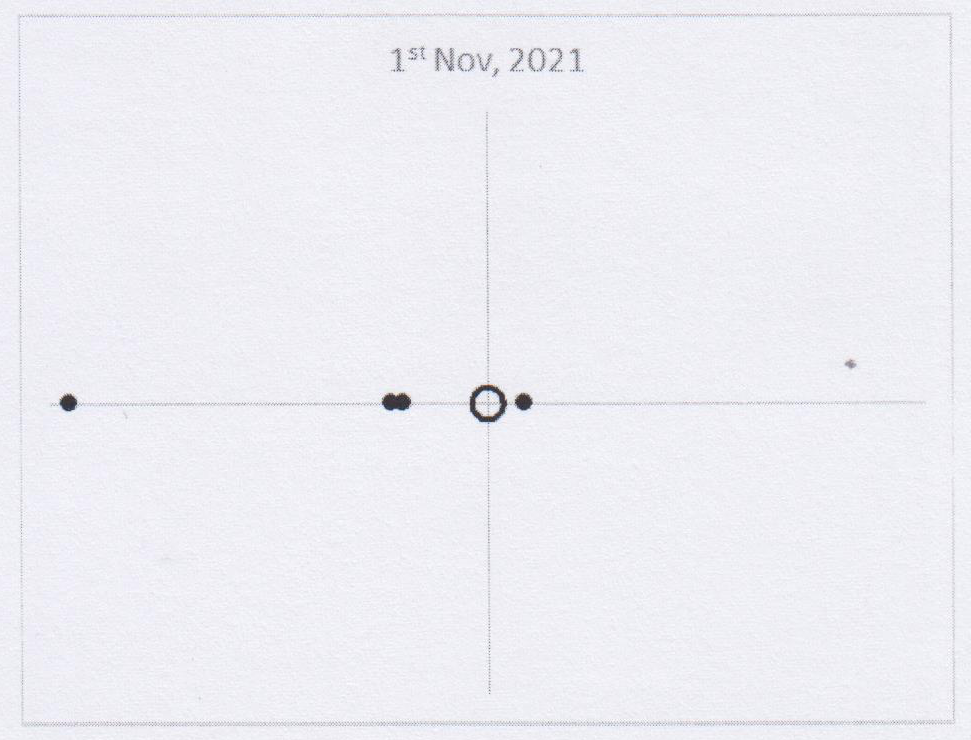
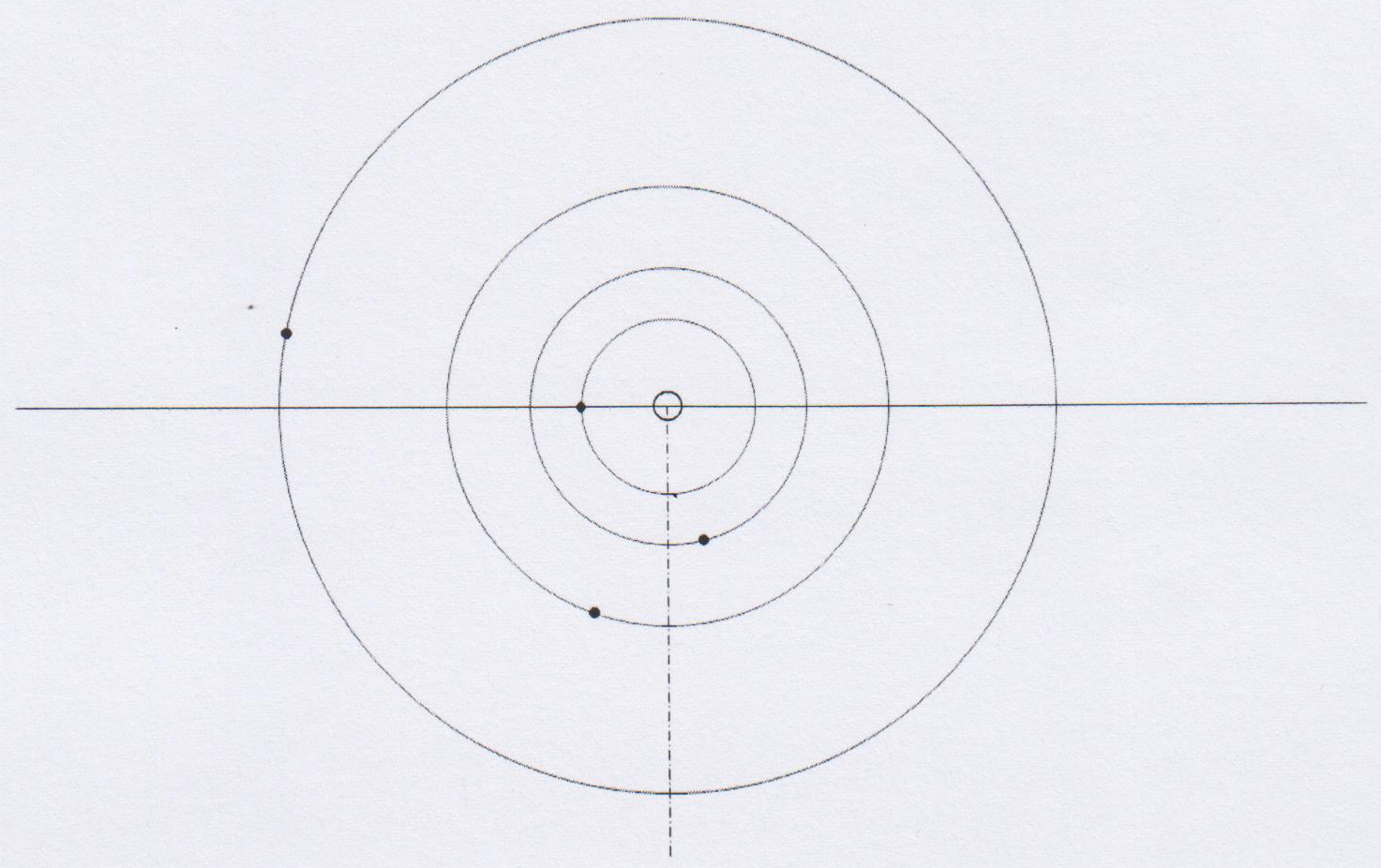
Let’s assume Jupiter equator and the orbits of its four Galilean Moons be coincident with the ecliptic. The position of Galilean Moons on 1st of November 2021, as observed from Earth, is shown in Figure 14.1. The in-scale corresponding orbital configuration, as could be observed from a distant point located on the extension Jupiter rotation axis, is shown in Figure 14.2, where the direction to Earth is represented as a dot-and-dash line.
The basic data for the four Galilean Moons of Jupiter are given in Table 14.a:
- Column 1: Moon name.
- Column 2: Semi-major axis in km.
- Column 3: Sidereal period (day, hours, minutes).
- Column 4: Azimuth on 1st November 2021 in degrees as measured anticlockwise with respect to Earth direction.
All moons orbits have a very low eccentricity and then they can be considered circular. The Jupiter average radius is assumed to be 69173 km.
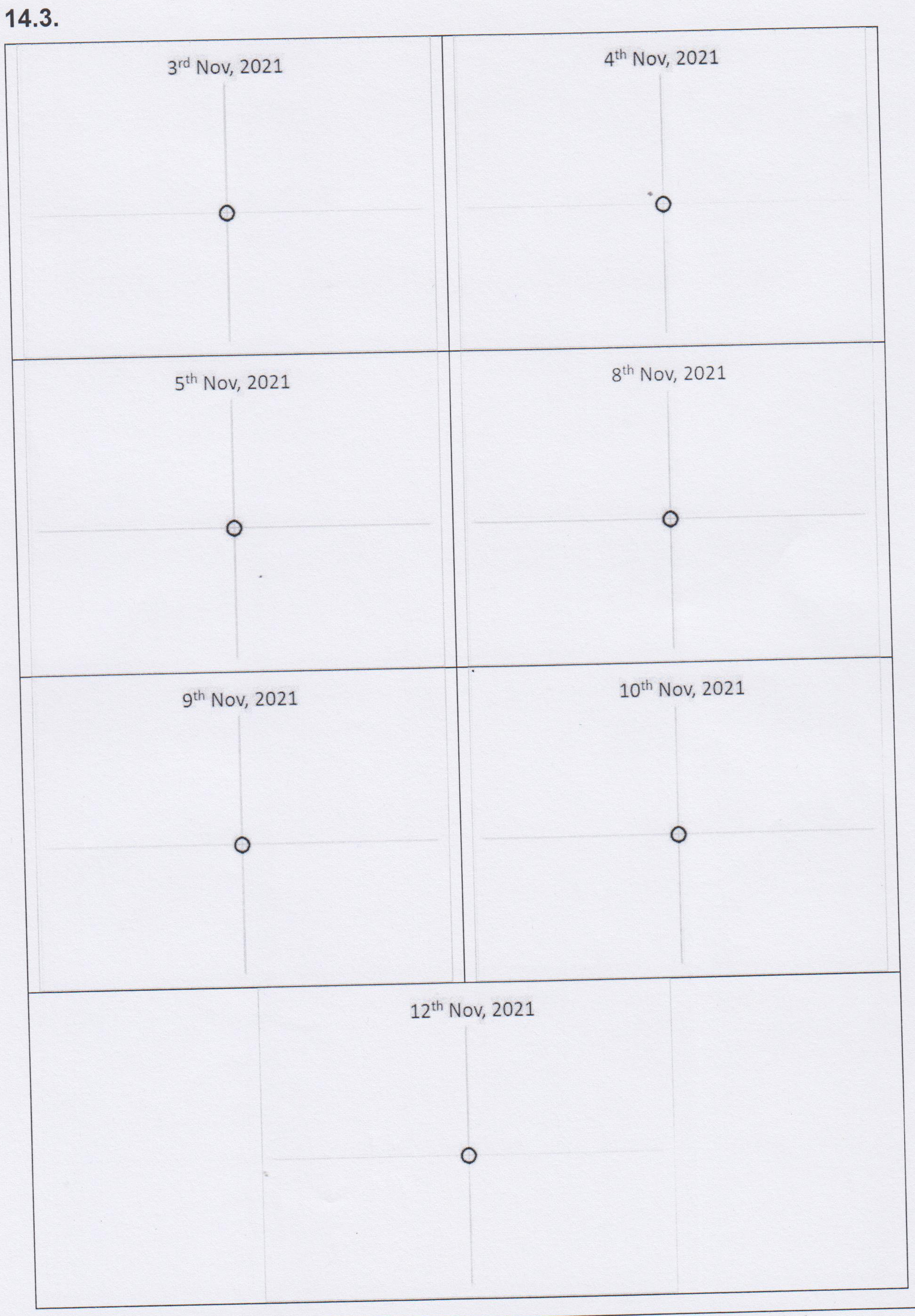
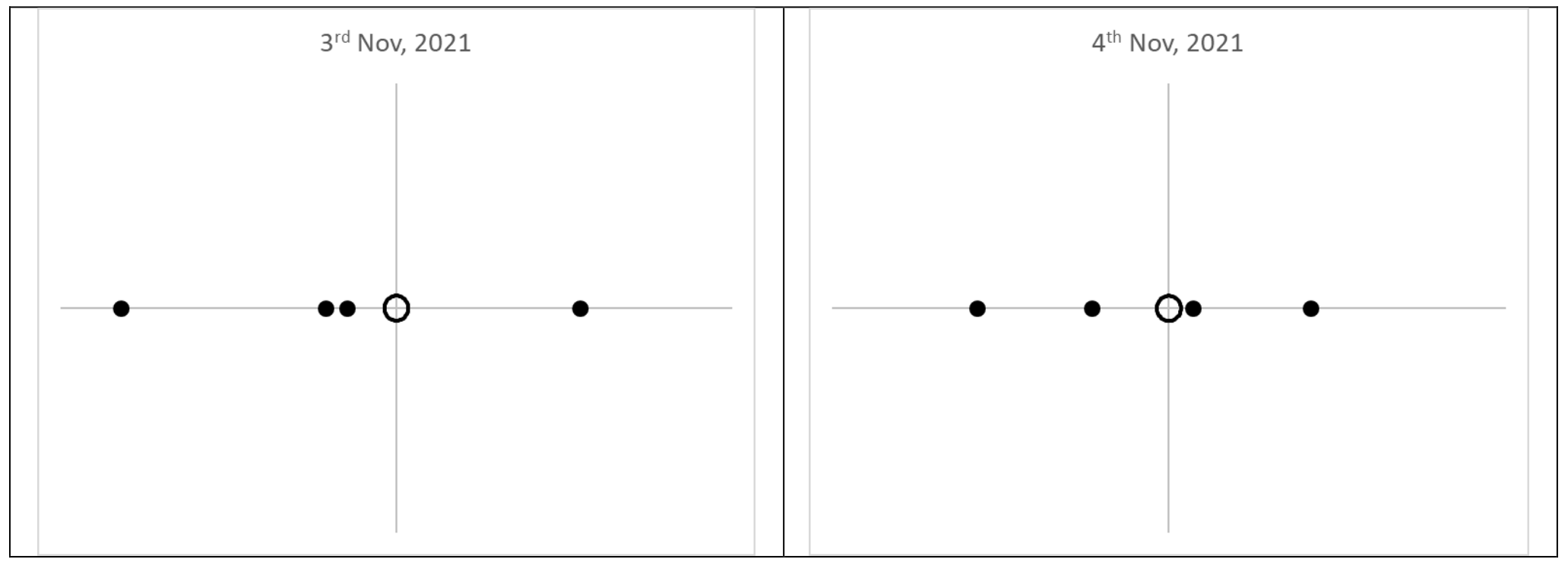
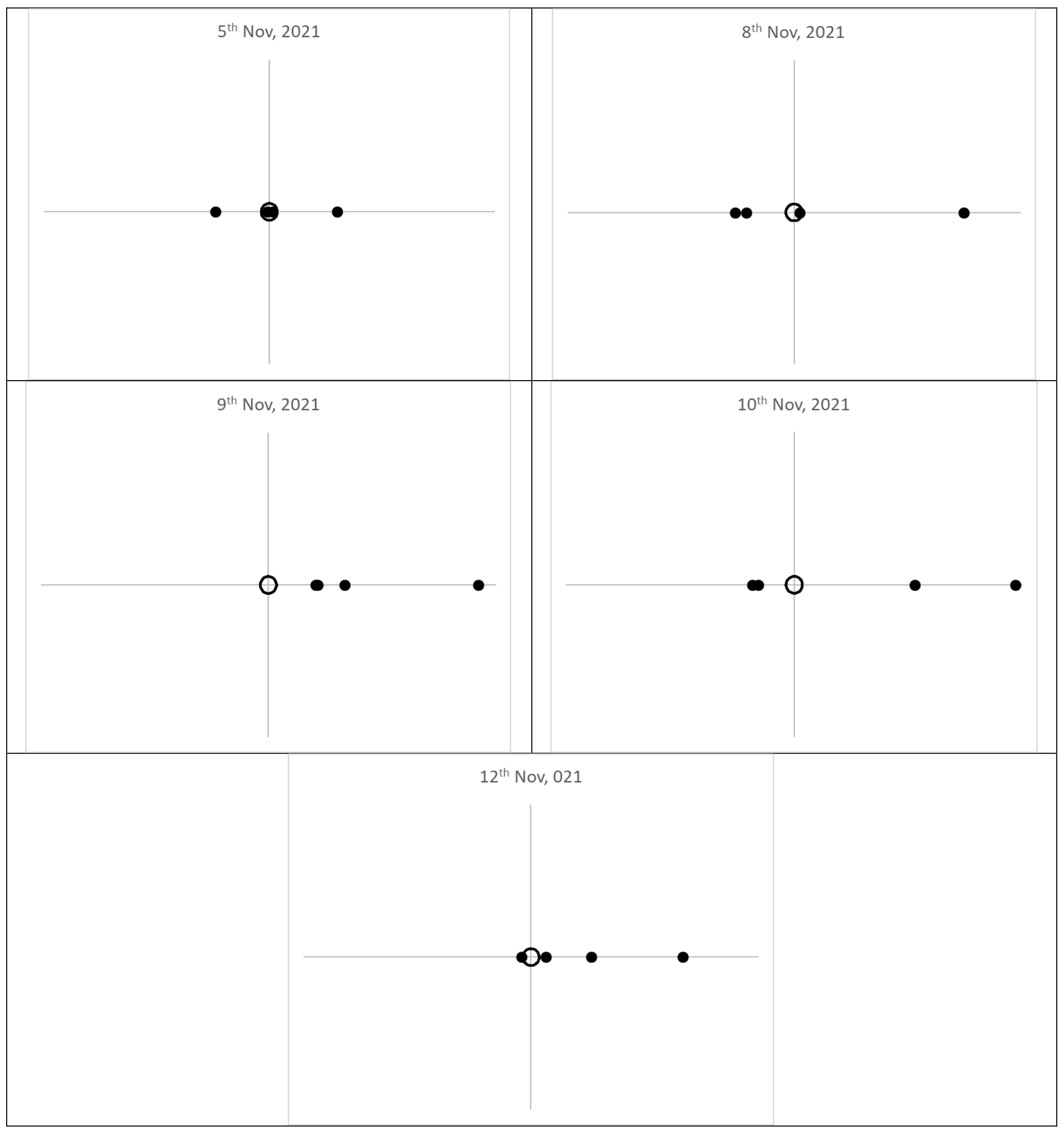
14.1 Draw in Figure 14.3 what will be the observed orbital configurations for observations made at the same hour in the following dates:
3rd of November, 2021
4th of November, 2021
5th of November, 2021
8th of November, 2021
9th of November, 2021
10th of November, 2021
12th of November, 2021.
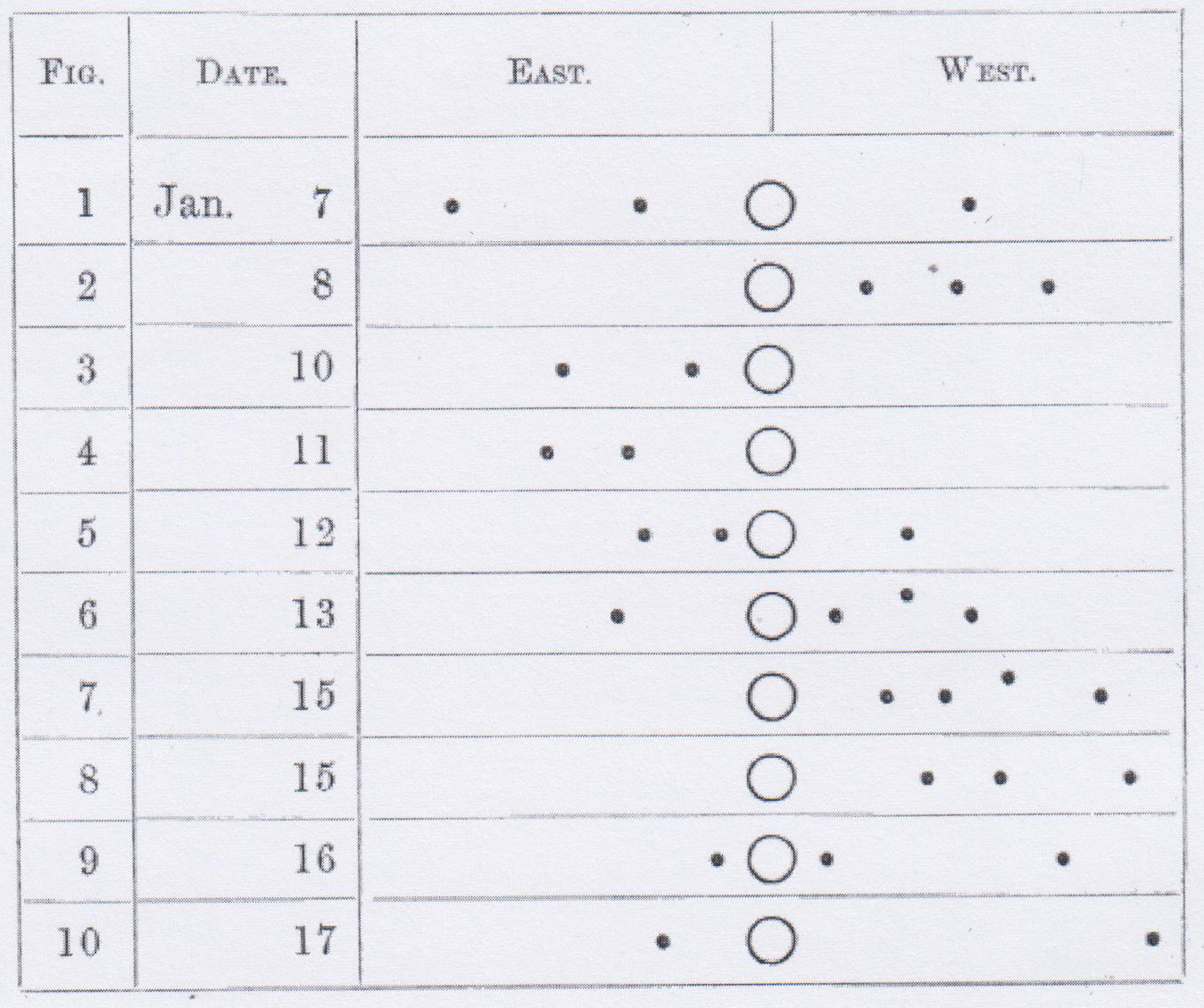
Taking into account the poor spatial resolution of Galileo’s telescope, one of the computed 2021 configurations appears quite similar (although not identical) to one of the 1610 configurations observed by Galileo that are shown in Figure 14.4.
14.2 Which one of the 2021 configurations is similar to one of the 1610 configurations? Write in English the two dates in the box below Figure 14.4.
14.1
14.2
14.a
| 1 · Moon | 2 · Semi-major axis | 3 · Sidereal Period | 4 · Azimuth on 01.11.2021. |
|---|---|---|---|
| Io | 421700 km | 1d 18h 27m | −90.0° |
| Europa | 671034 rm | 3d 13h 14m | +14.6° |
| Ganymede | 1070400 km | 7d 03h 42m | −20.4° |
| Callisto | 1882700 km | 16d 16h 32m | −100.6° |
14.3
14.4. – 1610:
| 2021 configuration | 1610 configuration |
|---|---|
Решение
Starting from the sidereal periods listed in Table 14.a, the angular velocity of each satellite around Jupiter can be computed. Then, from the initial configuration shown in Figure 14.1 and 14.2, all the other configurations can be inferred
14.3 – Configuration of the Galilean moons in the requested dates
14.2
among the computed 2021 configurations, the one of 9 nov appears quite similar (although not identical) to the second configuration observed by Galileo on 15 Jan 1610
| 2021 configuration | 1610 configuration |
|---|---|
| 9 Nov | 15 Jan |
Practical Round - Basic criteria. For work of Jury
Note. Everywhere terms as “positioning” means “correct positioning”, “values” means “correct values”, “identification” means “correct identification”, etc., ...
| N | Description | Points (up to) |
|---|---|---|
| 1 | Positioning of Galilean moons on 3 nov graph | 1.5 |
| 2 | Positioning of Galilean moons on 4 nov graph | 1.5 |
| 3 | Positioning of Galilean moons on 5 nov graph | 1.5 |
| 4 | Positioning of Galilean moons on 8 nov graph | 1.5 |
| 5 | Positioning of Galilean moons on 9 nov graph | 1.5 |
| 6 | Positioning of Galilean moons on 10 nov graph | 1.5 |
| 7 | Positioning of Galilean moons on 12 nov graph | 1.5 |
| 8 | Identification of 1610 configuration corresponding to the 9 nov 2021 one | 1.5 |
Теми и трудност
Трудност: неоценена.
Небесна механика · Слънчева система · Орбитални елементи · Планетни конфигурации
Предпоставки: Разширена олимпиадна подготовка
Оригинал в Архива: prac-EN.pdf · официални решения: Practical_Round_IRAO_2021_Solutions.pdf · допълнителни данни: Practical_Round_IRAO_2021_Criteria.pdf · допълнителни данни: protractor.pdf · допълнителни данни: Ia21_TABLE_Constants.pdf