IAO 2023, Теория — Задача 2 (αγ). Космический аппарат / Space apparatus
XXVII International Astronomy Olympiad — Theoretical round / Задачи теоретического тура · 8 т.
Только для перевода. / For translation only.
Напоминание. Большинство задач составлены таким образом, что при написании решений от участника требуется минимальное использование какого-либо языка. Таким образом, допускается минимум текстов в решениях задач (ни на родном языке, ни на одном из официальных языков IAO). Уделяйте больше внимания формулам, рисункам и графикам. Разрешается употреблять несколько ключевых слов на английском языке (например, “Yes”, “No”, “Assume”, “Answer”, “Average”, “Minimum”, “Maximum”, “Impossible situation” и т.д.), а также термины, содержащиеся в прилагаемых таблицах, и названия объектов.
Reminding. Most of the problems are compiled in such a way that when writing solutions, minimal use of any language is required from the participant. So minimum texts is allowed in solutions of the problems (neither in the native language, nor in one of the official languages of the IAO). Pay more attention to formulas, drawings and graphs. It is permitted to write a few keywords in English (for example, “Yes”, “No”, “Assume”, “Answer”, “Average”, “Minimum”, “Maximum”, “Impossible situation”, etc.), as well as terms contained in the accompanying tables and names of objects.
Source notes / Примечания к источнику
The scan repeats the Russian second statement page. Russian and English versions are retained as sections of the same seven tasks. The note after 6.6 prints 8.3/8.5/8.6; the English scan has a handwritten correction. The solution’s final magnitude for task 2 prints +5 rather than −5, the eclipse expression prints L₁−L₂, and the redshift relation prints a(tₑ)/a(tₒ); these source expressions are preserved. The criteria for 6.5/6.6 have unrelated white-dwarf text crossed out without replacement. Reference data are also present within the question PDF and are not extra tasks.
Условие
Русский
Искусственный спутник Земли или космическая станция обращается по круговой орбите на высоте 320 км и, как правило, хорошо виден при пролёте над местностью. В некоторый день из-за плохих условий наблюдения (смог или небольшой туман) аппарат был виден невооружённым глазом всего 1 минуту 50 секунд, причём в зените его звёздная величина составила . Какой была бы видимая звёздная величина аппарата в этой же местности в максимально благоприятных условиях.
English
An artificial Earth satellite or space station orbits in a circular orbit at an altitude of 320 km and, as a rule, is clearly visible when passing over the location. On one day, due to poor observation conditions (smog or a small fog), the apparatus was visible to the naked eye for only 1 minute 50 seconds, and at the zenith its magnitude was . What would be the apparent magnitude of the apparatus in the same location under the most favorable conditions.
Справочные данные / Reference data
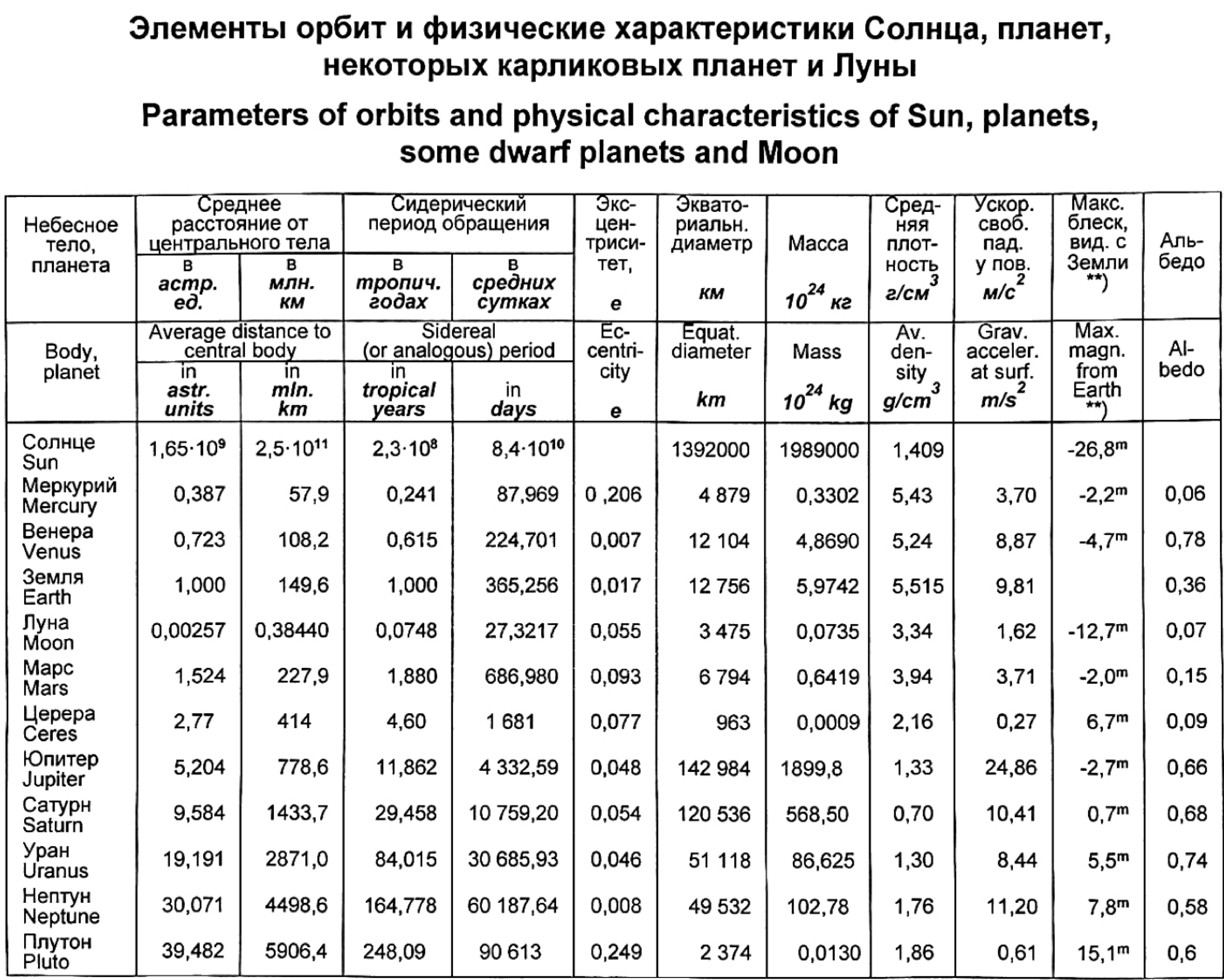
**) Для внешних планет и Луны – в среднем противостоянии.
**) For outer planets and Moon – in mean opposition.
Решение
From the condition
we get that the speed of the apparatus is equal to
During this time, the apparatus overcomes the distance
half of which it is visible before passing the zenith point, and half after. At such distances, we can neglect the curvature of the Earth and consider motion in a flat approximation. Thus, the satellite is visible at altitudes above
If from the zenith point the light from the device passes a layer of polluted air , then from a point at an altitude of 37° it passes a layer
We will assume that the limit of visibility with the naked eye is . Thus, an additional layer weakens the light by . Accordingly, the layer will weaken the light by . So we find that extra-atmospheric apparent magnitude of the apparatus is equal to . Under the most favorable conditions, a layer of one atmosphere weakens the light by . Thus, at the zenith, under the most favorable conditions, the device would be visible as an object of magnitude.
Basic criteria
| Criterion | pts |
|---|---|
| Speed of the apparatus | 1.5 |
| Distance in visibility | 0.5 |
| Limit altitudes | 1 |
| Apparent atmospheric extinction | 2 |
| Magnitude in ideal conditions | 1 |
| Calculations and final answer | 1 |
| Correct number significant digits in answer | 1 |
| Total | 8 |
Theoretical round. Sketches for solutions. For jury job ONLY
These solutions are written for jury members, so they contain a lot of explanations in the form of text. Students are instructed to minimize text, mostly use formulas, calculations, drawings and graphs, writing extra tests is not encouraged in the solutions. It is permitted to write a few keywords in English (for example, “Yes”, “No”, “Assume”, “Answer”, “Average”, “Minimum”, “Maximum”, “Impossible situation”, etc.), as well as terms contained in the accompanying tables and names of objects.
The given sketches are not full; the team leaders have to give more detailed explanations to students. But the correct solutions in the students’ papers (enough for 8 pts) may be shorter.
Jury members should evaluate the student’s solutions in essence, and not by looking on formal existence the mentioned sentences or formulae. The formal presence of the mentioned positions in the text is not necessary to give the respective points. Points should be done if the following steps de facto using these positions.
Theoretical round. Basic criteria. For work of Jury
Note. Jury members should evaluate the student’s solutions in essence, and not by looking on formal existence the mentioned sentences or formulae. The formal presence of the mentioned positions in the text is not necessary to give the respective points. Points should be done if the following steps de facto use these positions. (For example, except the final conclusion, all the points in solution of problem 2 may be in only one common formula.)
Note. Jury members should elaborate more detailed criteria, and also create criteria for other correct ways of the student’s solutions.
Note. Everywhere “formula” means “correct formula”, “calculation” means “correct calculation”, “picture” means “correct picture”, etc., and in all cases: based on correct facts and intermediate formulae or calculations.
Note. Everywhere final calculation means also using correct number of significant digits. Extra significant digits, especially in estimational problems, will lead to subtraction of the points.
Note. Solutions with absurd or almost absurd answers should be rated lower (maybe ignoring the scoring schemes below, and maybe down to zero).
Everywhere – excessive number of significant digits in the answer – minus 1–2 points.
Теми и трудност
Трудност: неоценена.
Небесна механика · Светлина и астрономически измервания · Орбитално движение · Междузвездно поглъщане
Предпоставки: Разширена олимпиадна подготовка
Оригинал в Архива: theo.pdf · официални решения: theosol.pdf · допълнителни данни: data.pdf