IAO 2023, Теория — Задача 7 (βγ). Гравитационные волны и космология / Gravitational waves and cosmology
XXVII International Astronomy Olympiad — Theoretical round / Задачи теоретического тура · 8 т.
Только для перевода. / For translation only.
Напоминание. Большинство задач составлены таким образом, что при написании решений от участника требуется минимальное использование какого-либо языка. Таким образом, допускается минимум текстов в решениях задач (ни на родном языке, ни на одном из официальных языков IAO). Уделяйте больше внимания формулам, рисункам и графикам. Разрешается употреблять несколько ключевых слов на английском языке (например, “Yes”, “No”, “Assume”, “Answer”, “Average”, “Minimum”, “Maximum”, “Impossible situation” и т.д.), а также термины, содержащиеся в прилагаемых таблицах, и названия объектов.
Reminding. Most of the problems are compiled in such a way that when writing solutions, minimal use of any language is required from the participant. So minimum texts is allowed in solutions of the problems (neither in the native language, nor in one of the official languages of the IAO). Pay more attention to formulas, drawings and graphs. It is permitted to write a few keywords in English (for example, “Yes”, “No”, “Assume”, “Answer”, “Average”, “Minimum”, “Maximum”, “Impossible situation”, etc.), as well as terms contained in the accompanying tables and names of objects.
Source notes / Примечания к источнику
The scan repeats the Russian second statement page. Russian and English versions are retained as sections of the same seven tasks. The note after 6.6 prints 8.3/8.5/8.6; the English scan has a handwritten correction. The solution’s final magnitude for task 2 prints +5 rather than −5, the eclipse expression prints L₁−L₂, and the redshift relation prints a(tₑ)/a(tₒ); these source expressions are preserved. The criteria for 6.5/6.6 have unrelated white-dwarf text crossed out without replacement. Reference data are also present within the question PDF and are not extra tasks.
Условие
Русский
В плоской Вселенной свет распространяется в течение интервала времени , удовлетворяющего , где – скорость света, – сопутствующее расстояние, пройденное светом, и – масштабный фактор в момент времени . В расширяющейся вселенной увеличивается со временем.
7.1. Для плоской вселенной с космологической постоянной Λ справедливы следующие соотношения для a(t) (для краткости некоторые константы опущены):
Нарисуйте схематически как a(t) изменяется со временем и
определите, как эволюционирует наша Вселенная, рассмотрев такие варианты: (A) Расширение; (B) Сжатие; (C) Расширение, за которым следует сжатие; (D) Сжатие, за которым следует расширение.
7.2. Известно, что сопутствующее расстояние между источником излучения и наблюдателем остается постоянным. If the radiation is emitted at time Если излучение происходит в момент времени и принимается в момент времени , выведите для него формулу космологического красного смещения , выражающую через и (в виде ). Если светимость источника равна , а освещённость от него равна , то из соотношения определяется так называемое фотометрическое расстояние .
Для момента выражающую формулу, выражающую через , и ().
7.3. На определенной стадии слияния тесных двойных систем частота гравитационной волны увеличивается со временем. Наблюдаемый параметр с размерностью массы может быть определён как , где – частота, а – скорость изменения. Учитывая амплитуду гравитационной волны, её расстояние до нас может быть рассчитано как .
С помощью необходимых формул и расчётов определите, является ли это расстояние сопутствующим (comoving distance) или фотометрическим (luminosity distance).
English
In a flat universe, the light travels within a time interval satisfies , where is the speed of light, is the comoving distance the light traveled, and is the scale factor at time . increases with time in an expanding universe.
7.1. Considering a flat universe with cosmological constant Λ, a(t) satisfies the following relationships (some constants are omitted for brevity):
Draw a schematic diagram of the evolution of a(t) with time and
determine how our universe evolves from the following options: (A) Expansion; (B) Contraction; (C) Expansion followed by contraction; (D) Contraction followed by expansion.
7.2. It is known that the comoving distance between a radiation source and an observer remains constant. If the radiation is emitted at time and received at , derive its cosmological redshift in form of and . Considering the luminosity of the source is and its brightness is , the luminosity distance is then defined from .
Derive at in the form of , and .
7.3. The gravitational wave in a certain phase of compact binary mergers have a frequency which is increasing over time. An observable parameter with the dimensionality of mass can be defined as , where is the frequency and is the rate of change. Considering the amplitude of the gravitational wave, its distance to us can be calculated as .
Determine whether this is comoving distance or luminosity distance with necessary formulae and calculations.
Справочные данные / Reference data
Решение
7.1.
Considering separately the cases of and , the schematic diagram of the evolution of is shown as follows. [1 point]
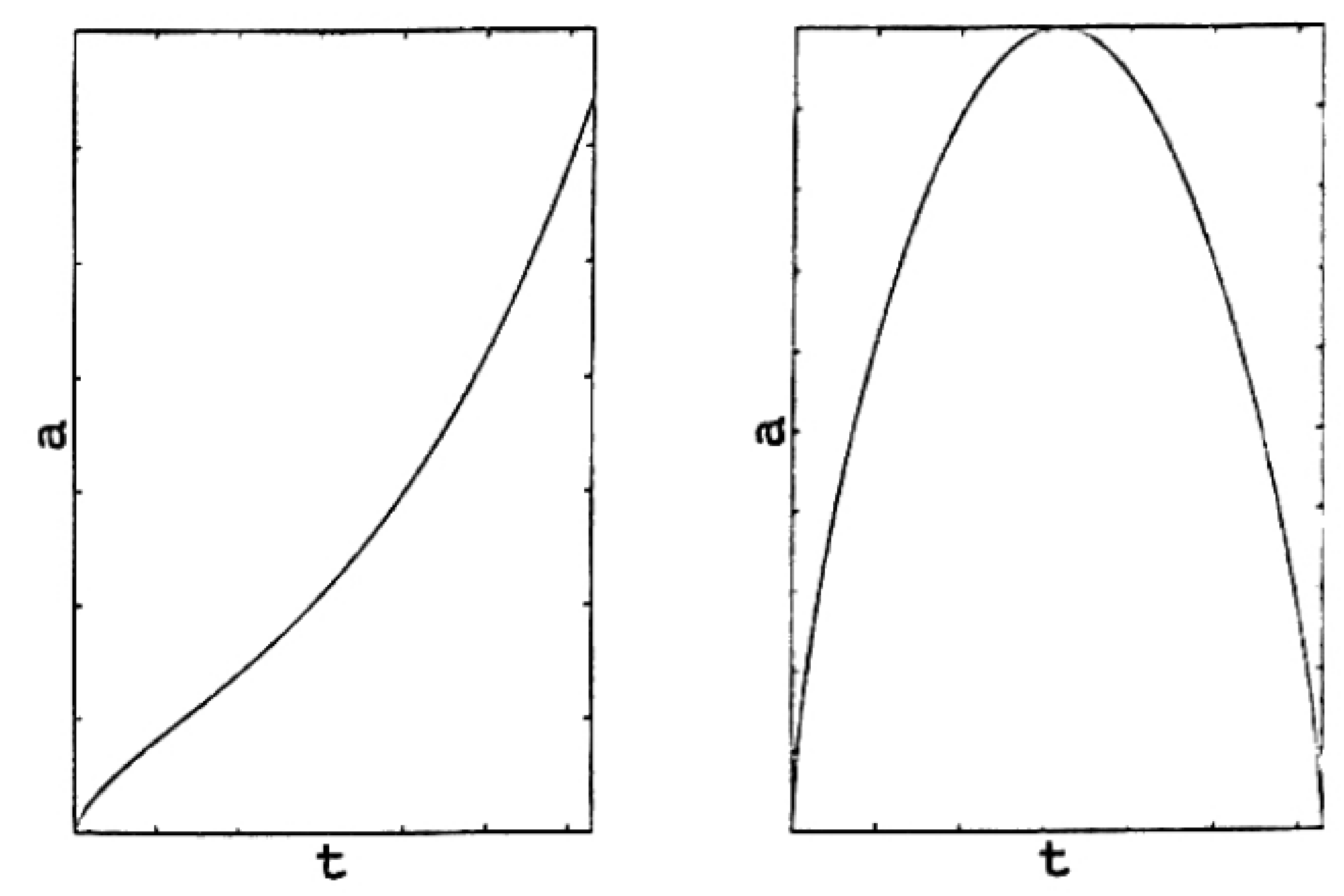
From the schematic diagram, it can be observed that when , the universe goes on (1) expansion; when , the universe goes on (3) expansion followed by contraction. [1 point]
7.2.
For electromagnetic waves emitted by a radiation source, when considering two successive peaks, their emission times are and , while the times of receiving them by an observer are and , respectively. We have [0.5 points]
which means
And the wavelength of light, λ, satisfies . Therefore, [0.5 points]
According to the definition of redshift, we have , so the relationship between cosmological redshift and the scale factor is [1 point]
The luminosity of the radiation source at time is the energy radiated per unit time, i.e.
and this radiation is observed by the observer at time . Considering cosmological redshift, the energy of the radiation becomes
and the time interval for this radiation becomes [0.5 points]
For the observer, the brightness of the radiation is the energy received per unit area in unit observation time, i.e. [0.5 points]
where is the physical distance between the radiation source and the observer. At observation time , this physical distance is , where is the comoving distance between them. Combining the above equations, we find [1 point]
so the luminosity distance at is [0.5 points]
7.3.
Considering cosmological redshift, the gravitational wave frequency seen by the observer at becomes [0.5 points]
and the rate of change of frequency with time becomes
Therefore, we see that
i.e. [0.5 points]
Furthermore, the distance of the gravitational wave source defined in the question satisfies
which means [0.5 points]
This means that this distance is the luminosity distance.
Luminosity distance. [1 point]
Basic criteria
| Criterion | pts |
|---|---|
| 7.1. → See criteria in the solutions | 2 |
| 7.2. → See criteria in the solutions | 4 |
| 7.3. → See criteria in the solutions | 2 |
| Total | 8 |
Theoretical round. Sketches for solutions. For jury job ONLY
These solutions are written for jury members, so they contain a lot of explanations in the form of text. Students are instructed to minimize text, mostly use formulas, calculations, drawings and graphs, writing extra tests is not encouraged in the solutions. It is permitted to write a few keywords in English (for example, “Yes”, “No”, “Assume”, “Answer”, “Average”, “Minimum”, “Maximum”, “Impossible situation”, etc.), as well as terms contained in the accompanying tables and names of objects.
The given sketches are not full; the team leaders have to give more detailed explanations to students. But the correct solutions in the students’ papers (enough for 8 pts) may be shorter.
Jury members should evaluate the student’s solutions in essence, and not by looking on formal existence the mentioned sentences or formulae. The formal presence of the mentioned positions in the text is not necessary to give the respective points. Points should be done if the following steps de facto using these positions.
Theoretical round. Basic criteria. For work of Jury
Note. Jury members should evaluate the student’s solutions in essence, and not by looking on formal existence the mentioned sentences or formulae. The formal presence of the mentioned positions in the text is not necessary to give the respective points. Points should be done if the following steps de facto use these positions. (For example, except the final conclusion, all the points in solution of problem 2 may be in only one common formula.)
Note. Jury members should elaborate more detailed criteria, and also create criteria for other correct ways of the student’s solutions.
Note. Everywhere “formula” means “correct formula”, “calculation” means “correct calculation”, “picture” means “correct picture”, etc., and in all cases: based on correct facts and intermediate formulae or calculations.
Note. Everywhere final calculation means also using correct number of significant digits. Extra significant digits, especially in estimational problems, will lead to subtraction of the points.
Note. Solutions with absurd or almost absurd answers should be rated lower (maybe ignoring the scoring schemes below, and maybe down to zero).
Everywhere – excessive number of significant digits in the answer – minus 1–2 points.
Теми и трудност
Трудност: неоценена.
Галактики и космология · Космология
Предпоставки: Разширена олимпиадна подготовка
Оригинал в Архива: theo.pdf · официални решения: theosol.pdf · допълнителни данни: data.pdf