IChO 1990, Теория — Задача 5. Problem 5 — Decomposition of Nitramide
Twenty-second International Chemistry Olympiad — 1990 — Theoretical problems (Volume 2, 2009)
Внимание: Бележка към темата
Attributed archive/compiler teaching source. Retain the Volume 2 attribution and native copying conditions; the printed teaching grant does not establish a broader commercial licence. This 2009 collection is not an unchanged complete jury packet: the editorial preface describes recreated presentation and schemes, numerical corrections, brief keys and omitted practical material. Printed errors, absent measurements, incomplete methods, missing forms and missing answers remain disclosed.
Compilation edition and teaching attribution
Anton Sirota (editor), The Competition Problems from the International Chemistry Olympiads, Volume 2, IChO International Information Centre, Bratislava, IUVENTA, 2009.
Attributed archive/compiler teaching source. Retain the Volume 2 attribution and native copying conditions; the printed teaching grant does not establish a broader commercial licence. This 2009 collection is not an unchanged complete jury packet: the editorial preface describes recreated presentation and schemes, numerical corrections, brief keys and omitted practical material. Printed errors, absent measurements, incomplete methods, missing forms and missing answers remain disclosed.
Native copyright and teaching-copy conditions
THE COMPETITION PROBLEMS FROM THE INTERNATIONAL CHEMISTRY OLYMPIADS,
Volume 2
21st – 40th IChO (1989 – 2008)
Editor: Anton Sirota
ISBN 978-80-8072-092-6
Copyright © 2009 by IUVENTA – IChO International Information Centre, Bratislava, Slovakia
You are free to copy, distribute, transmit or adapt this publication or its parts for unlimited teaching purposes,
however, you are obliged to attribute your copies, transmissions or adaptations with a reference to "The
Competition Problems from the International Chemistry Olympiads, Volume 2" as it is required in the
chemical literature. The above conditions can be waived if you get permission from the copyright holder.
Issued by IUVENTA in 2009
with the financial support of the Ministry of Education of the Slovak Republic
Number of copies: 250
Not for sale.
International Chemistry Olympiad
International Information Centre
IUVENTA
Búdková 2
811 04 Bratislava 1, Slovakia
Phone: +421-907-473367
Fax: +421-2-59296123
E-mail: anton.sirota@stuba.sk
Web: www.icho.sk
Native editorial preface
Preface
Preface
Preface
Preface
This publication contains the competition problems (Volume 2) from the 21st – 40th
International Chemistry Olympiads (IChO) organized in the years 1989 – 2008 and is a
continuation of the publication that appeared last year as Volume 1 and contained
competition problems from the first twenty IChOs. The whole review of the competition
tasks set in the IChO in its fourty-year history is a contribution of the IChO International
Information Centre in Bratislava (Slovakia) to the development of this world known
international competition. This Volume 2 contains 154 theoretical and 46 practical
competition problems from the mentioned years. The review as a whole presents
altogether 279 theoretical and 96 practical problems.
In the elaboration of this collection the editor had to face certain difficulties because
the aim was not only to make use of past recordings but also to give them such a form
that they may be used in practice and further chemical education. Consequently, it was
necessary to make some corrections in order to unify the form of the problems. However,
they did not concern the contents and language of the problems.
Unfortunately, the authors of the particular competition problems are not known and
due to the procedure of the creation of the IChO competition problems, it is impossible to
assign any author's name to a particular problem. As the editor I would appreciate many
times some discussion with the authors about any critical places that occurred in the text.
On the other hand, any additional amendments to the text would be not correct from the
historical point of view. Therefore, responsibility for the scientific content and language of
the problems lies exclusively with the organizers of the particular International Chemistry
Olympiads.
Some parts of texts, especially those gained as scanned materials, could not be used directly and thus, several texts, schemes and pictures had to be re-written or created again. Some solutions were often available in a brief form and necessary extent only, just for the needs of members of the International Jury.
Recalculations of the solutions were made in some special cases only when the numeric results in the original solutions showed to be obviously not correct. Although the numbers of significant figures in the results of several solutions do not obey the criteria generally accepted, they were left without change.
In this publication SI quantities and units are used and a more modern method of
chemical calculations is introduced. Only some exceptions have been made when, in an
effort to preserve the original text, the quantities and units have been used that are not SI.
There were some problems with the presentation of the solutions of practical tasks,
because most of the relatively simple calculations were based on the experimental results
of contestants. Moreover, the practical problems are accompanied with answer sheets in
the last years and several additional questions and tasks have appeared in them that were
not a part of the text of the original experimental problems. Naturally, answer sheets could
not be included in this publication and can only be preserved as archive materials.
When reading the texts of the IChO problems one must admire and appreciate the work of those many known and unknown people – teachers, authors, pupils, and organizers – who contributed so much to development and success of this important international competition.
I am sure about the usefulness of the this review of the IChO problems. It may serve not only as archive material but, in particular, this review should serve to both competitors and their teachers as a source of further inspiration in their preparation for this challenging competition.
Bratislava, July 2009
Anton Sirota, editor
Условие
Nitramide, , decomposes slowly in aqueous solution to nitrous oxide, , and water. The experimental rate law is:
Questions
5.1
What is the apparent order of this reaction in a buffer solution?
5.2
Which of the following mechanisms is consistent with the experimental rate law? Justify your choice.
Mechanism 1
Mechanism 2
Mechanism 3
5.3
Express the observed rate constant in terms of the rate constants of the elementary steps.
5.4
Show that hydroxyl ions catalyse the decomposition.
The decomposition is studied in a buffered solution of a constant volume at a constant temperature by measuring the partial pressure of the gas , considered to be insoluble in water, in a constant volume of the same value above the solution. The following results are obtained:
| 0 | 5 | 10 | 15 | 20 | 25 | |
|---|---|---|---|---|---|---|
| 0 | 6800 | 12400 | 17200 | 20800 | 24000 |
After a long time, the pressure is .
5.5
Derive the relationship between and , using .
5.6
Verify the relationship graphically.
5.7
Calculate and give its units.
Source notes
The rapid first step of mechanism 3 prints , whereas the following slow step and key use . Both native forms are retained. The printed claim that the slope is is retained alongside its equation .
Решение
5.1
In a buffer, is constant, so the reaction is first order:
5.2
For the three mechanisms:
The third mechanism is consistent with the rate law.
5.3
5.4
Since :
5.5
From :
The printed material balance is:
Consequently:
Integration gives:
5.6
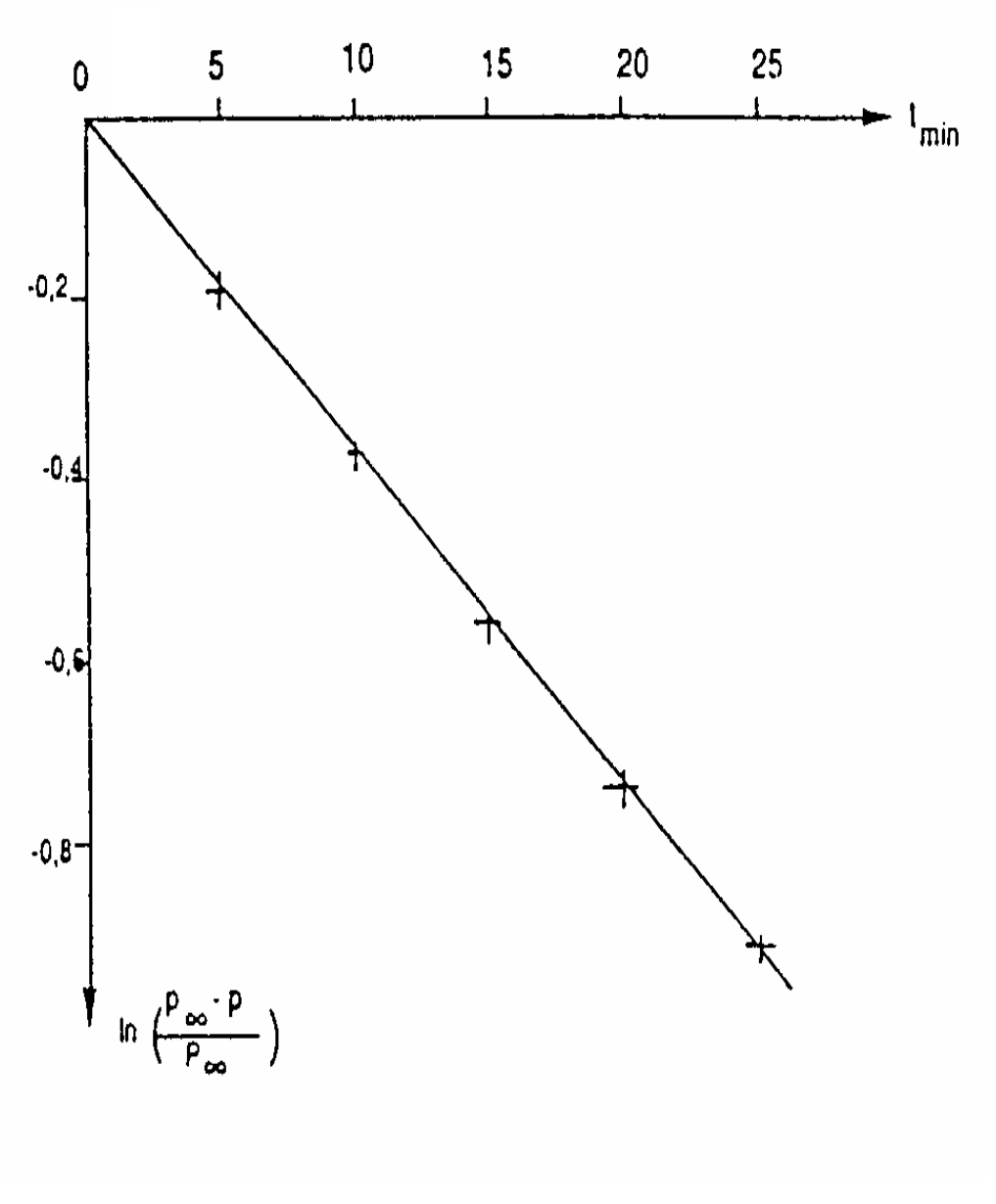
5.7
The graph of is a straight line. The printed key calls its slope .
Оригинал в Архива: IChO 21st-40th.pdf · решение от архива: IChO 21st-40th.pdf · допълнителни данни: IChO 21st-40th.pdf · допълнителни данни: IChO 21st-40th.pdf