IChO 1999, Експеримент — Задача 2. Isolation and Identification of an Essential Oil from Natural Source
Thirty-first International Chemistry Olympiad — 1999 — Practical problems (Volume 2, 2009)
Внимание: Бележка към темата
Attributed archive/compiler teaching source. Retain the Volume 2 attribution and native copying conditions; the printed teaching grant does not establish a broader commercial licence. This 2009 collection is not an unchanged complete jury packet: the editorial preface describes recreated presentation and schemes, numerical corrections, brief keys and omitted practical material. Printed errors, absent measurements, incomplete methods, missing forms and missing answers remain disclosed.
Compilation edition and teaching attribution
Anton Sirota (editor), The Competition Problems from the International Chemistry Olympiads, Volume 2, IChO International Information Centre, Bratislava, IUVENTA, 2009.
Attributed archive/compiler teaching source. Retain the Volume 2 attribution and native copying conditions; the printed teaching grant does not establish a broader commercial licence. This 2009 collection is not an unchanged complete jury packet: the editorial preface describes recreated presentation and schemes, numerical corrections, brief keys and omitted practical material. Printed errors, absent measurements, incomplete methods, missing forms and missing answers remain disclosed.
Native copyright and teaching-copy conditions
THE COMPETITION PROBLEMS FROM THE INTERNATIONAL CHEMISTRY OLYMPIADS,
Volume 2
21st – 40th IChO (1989 – 2008)
Editor: Anton Sirota
ISBN 978-80-8072-092-6
Copyright © 2009 by IUVENTA – IChO International Information Centre, Bratislava, Slovakia
You are free to copy, distribute, transmit or adapt this publication or its parts for unlimited teaching purposes,
however, you are obliged to attribute your copies, transmissions or adaptations with a reference to "The
Competition Problems from the International Chemistry Olympiads, Volume 2" as it is required in the
chemical literature. The above conditions can be waived if you get permission from the copyright holder.
Issued by IUVENTA in 2009
with the financial support of the Ministry of Education of the Slovak Republic
Number of copies: 250
Not for sale.
International Chemistry Olympiad
International Information Centre
IUVENTA
Búdková 2
811 04 Bratislava 1, Slovakia
Phone: +421-907-473367
Fax: +421-2-59296123
E-mail: anton.sirota@stuba.sk
Web: www.icho.sk
Native editorial preface
Preface
Preface
Preface
Preface
This publication contains the competition problems (Volume 2) from the 21st – 40th
International Chemistry Olympiads (IChO) organized in the years 1989 – 2008 and is a
continuation of the publication that appeared last year as Volume 1 and contained
competition problems from the first twenty IChOs. The whole review of the competition
tasks set in the IChO in its fourty-year history is a contribution of the IChO International
Information Centre in Bratislava (Slovakia) to the development of this world known
international competition. This Volume 2 contains 154 theoretical and 46 practical
competition problems from the mentioned years. The review as a whole presents
altogether 279 theoretical and 96 practical problems.
In the elaboration of this collection the editor had to face certain difficulties because
the aim was not only to make use of past recordings but also to give them such a form
that they may be used in practice and further chemical education. Consequently, it was
necessary to make some corrections in order to unify the form of the problems. However,
they did not concern the contents and language of the problems.
Unfortunately, the authors of the particular competition problems are not known and
due to the procedure of the creation of the IChO competition problems, it is impossible to
assign any author's name to a particular problem. As the editor I would appreciate many
times some discussion with the authors about any critical places that occurred in the text.
On the other hand, any additional amendments to the text would be not correct from the
historical point of view. Therefore, responsibility for the scientific content and language of
the problems lies exclusively with the organizers of the particular International Chemistry
Olympiads.
Some parts of texts, especially those gained as scanned materials, could not be used directly and thus, several texts, schemes and pictures had to be re-written or created again. Some solutions were often available in a brief form and necessary extent only, just for the needs of members of the International Jury.
Recalculations of the solutions were made in some special cases only when the numeric results in the original solutions showed to be obviously not correct. Although the numbers of significant figures in the results of several solutions do not obey the criteria generally accepted, they were left without change.
In this publication SI quantities and units are used and a more modern method of
chemical calculations is introduced. Only some exceptions have been made when, in an
effort to preserve the original text, the quantities and units have been used that are not SI.
There were some problems with the presentation of the solutions of practical tasks,
because most of the relatively simple calculations were based on the experimental results
of contestants. Moreover, the practical problems are accompanied with answer sheets in
the last years and several additional questions and tasks have appeared in them that were
not a part of the text of the original experimental problems. Naturally, answer sheets could
not be included in this publication and can only be preserved as archive materials.
When reading the texts of the IChO problems one must admire and appreciate the work of those many known and unknown people – teachers, authors, pupils, and organizers – who contributed so much to development and success of this important international competition.
I am sure about the usefulness of the this review of the IChO problems. It may serve not only as archive material but, in particular, this review should serve to both competitors and their teachers as a source of further inspiration in their preparation for this challenging competition.
Bratislava, July 2009
Anton Sirota, editor
Условие
Steam-distil a supplied natural source, determine the main essential oil S, and identify a product Y of its chemical conversion. Use organic qualitative tests to identify functional groups with the station's reagents. NMR data will be given only after functional-group tests are complete.
Chemicals available
A 1 g sample in a vial; unknown Y in a vial; anhydrous sodium sulphate in a plastic vial; dichloromethane; ceric ammonium nitrate solution; 2,4-dinitrophenylhydrazine labelled “2,4-DNP”; 2% aqueous ammonia; 5% aqueous silver nitrate, HCl, NaOH and sodium bicarbonate; 1% iron(III) chloride in ethanol; 0.2% aqueous potassium permanganate, decolourized by easily oxidized groups; acetone for washing.
Procedure and structure elucidation
1
Apparatus: assemble a distillation apparatus with a 25 cm³ round-bottomed distilling flask and 10 cm³ round-bottomed receiver. Heat sand bath to approximately before the next step.
Simplified steam distillation: mix 1 g ground sample with 15 cm³ water in the 25 cm³ flask; soak about ten minutes. Add a magnetic stirrer bar, turn on condenser water and stirring motor. Heat for a steady distillation rate, with sand bath not below . Collect at least 5 cm³ distillate. Turn off the hotplate, dismantle and rinse condenser with acetone. Ensure it is dry before reuse.
Extraction: transfer distillate to a capped 15 cm³ centrifuge tube. Add 1 cm³ dichloromethane; cap securely, shake vigorously, and cool in ice. Allow layers to separate. Transfer dichloromethane with a Pasteur pipette to a 10 cm³ test tube. Repeat twice with fresh 1 cm³ portions and combine all extracts.
Drying: add anhydrous ; stir occasionally for ten minutes.
Evaporation: with a clean dry cotton-plugged Pasteur pipette transfer organic liquid to a dry 5 cm³ conical vial. Wash the sulphate with approximately 1 cm³ clean dichloromethane and transfer the wash, without carrying sulphate into the vial. Use a Hickman still head and dry condenser to distil dichloromethane until 1 cm³ remains. Remove distilled solvent from the head with a pipette or syringe to the recovered-dichloromethane vial. Keep residue for tests.
Functional-group analysis: test the 1 cm³ residue with suitable station reagents. Dichloromethane is immiscible with water.
Tollen’s Reagent: add one drop 5% aqueous silver nitrate and one drop 5% aqueous NaOH to a small test tube. A brown precipitate appears. Add 2% aqueous ammonia until it all dissolves; the solution is ready.
2
Elucidate S. Reaction with gives X, . Oxidation of X gives Y, , as the main product, and carbon dioxide.
3
Identify Y's functional groups with station reagents. Fill the answer sheet and state which groups are present or absent. Hand in Part I (Demonstrator copy) and ask for NMR spectra, supplied only after these tests are completed.
4
Draw the main distilled essential-oil structure S. Assign every proton from the supplied NMR by labelling peak numbers on the answer-sheet structure.
5
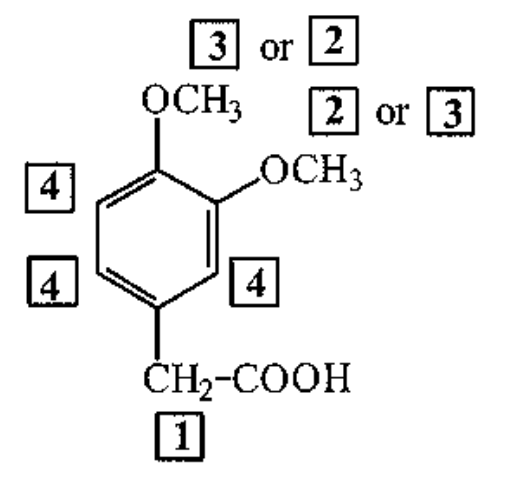
Draw X and Y. Assign each Y proton from the supplied NMR in the same manner.
Source notes
Attributed Volume 2, Anton Sirota / IChO International Information Centre / IUVENTA, Bratislava, 2009; physical335–340, printed737–742. Native expected test tables and NMR assignment tables are retained; actual participant observations, separately supplied spectra and answer sheets are not obtained. The S table's placement of peak numbers/blank lines differs from its assignment graphic; both remain explicit. The final Y graphic retains its erroneous S heading. No new experimental measurements or reconstructed spectra are supplied. Teaching copying, distribution and adaptation require Volume 2 attribution; no blanket commercial permission is asserted.
Решение
Внимание: Непълно решение
Attributed Volume 2, Anton Sirota / IChO International Information Centre / IUVENTA, Bratislava, 2009; Native expected test tables and NMR assignment tables are retained; actual participant observations, separately supplied spectra and answer sheets are not obtained. The S table's placement of peak numbers/blank lines differs from its assignment graphic; both remain explicit. The final Y graphic retains its erroneous S heading. No new experimental measurements or reconstructed spectra are supplied. Teaching copying, distribution and adaptation require Volume 2 attribution; no blanket commercial permission is asserted.
1
At least 5 cm³ distillate was expected.
2
The native expected functional tests for S:
| Reagent | Positive | Negative |
|---|---|---|
| 0.2% | ✓ | |
| 1% | ✓ | |
| 2,4-DNP | ✓ | |
| Ceric ammonium nitrate | ✓ | |
| Tollen’s Reagent | ✓ |
| Functional group in S | Present | Not present |
|---|---|---|
| C=C | ✓ | |
| Alcoholic OH | ✓ | |
| Phenolic OH | ✓ | |
| CHO | ✓ | |
| CO | ✓ | |
| COOH | ✓ |
3
The native expected tests for Y:
| Reagent | Positive | Negative |
|---|---|---|
| 5% HCl | ✓ | |
| 5% NaOH | ✓ | |
| 5% | ✓ | |
| 0.2% | ✓ | |
| 1% | ✓ | |
| 2,4-DNP | ✓ | |
| Ceric ammonium nitrate | ✓ | |
| Tollen’s Reagent | ✓ |
| Functional group in Y | Present | Not present |
|---|---|---|
| C=C | ✓ | |
| Alcoholic OH | ✓ | |
| Phenolic OH | ✓ | |
| CHO | ✓ | |
| CO | ✓ | |
| COOH | ✓ |
4
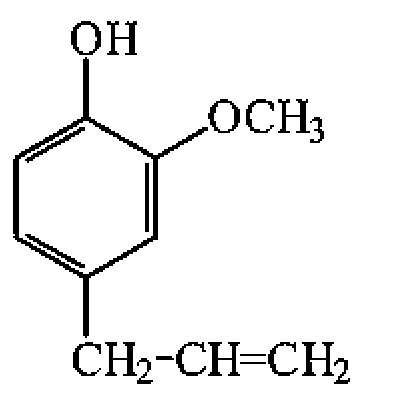
5
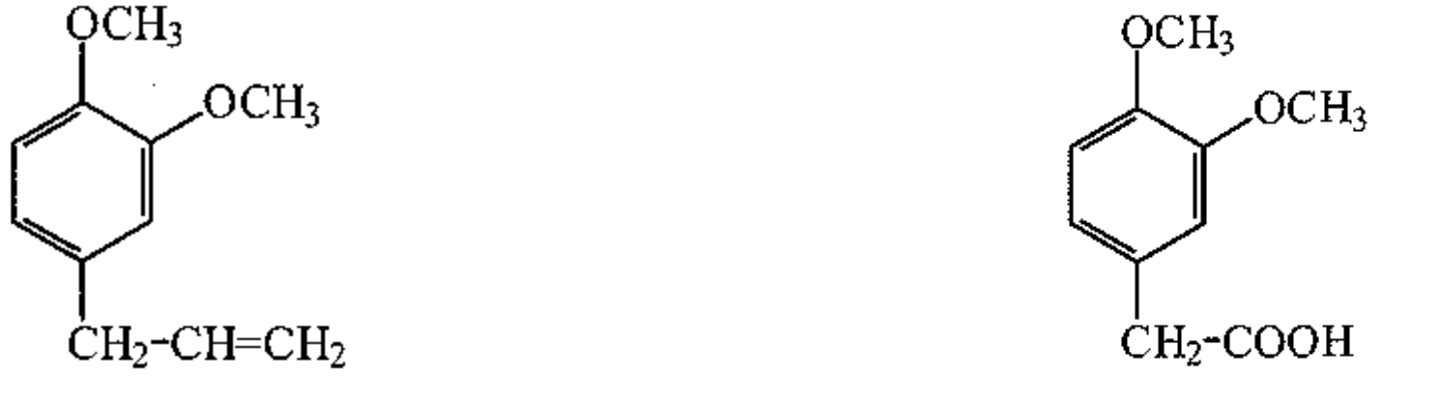
Native NMR table and assignment for S
The collection refers to peak numbers in the separately supplied spectrum. Its table is transcribed with blank cells and native capitalization retained.
| Peak number | / ppm | Protons | Multiplicity |
|---|---|---|---|
| 1 | 3.31 | 2H | d |
| 2 | 3.84 | 3H | S |
| 3 4 | 5.0–5.1 | 2H | m |
| 5 | 5.6 | 1H | S |
| — | 5.9–6.0 | 1H | m |
| 6 | 6.7 | 2H | S |
| — | — | — | d or m |
| 7 | 6.87 | 1H | d |
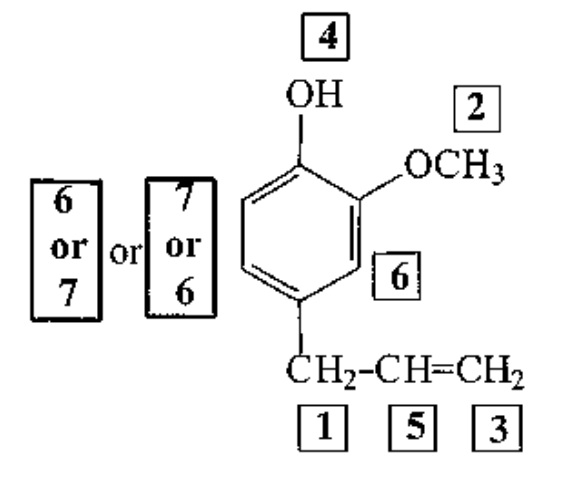
Native NMR table and assignment for Y
The key notes that the labile proton does not appear in the spectrum.
| Peak number | / ppm | Protons | Multiplicity |
|---|---|---|---|
| 1 | 3.59 | 2H | s |
| 2 | 3.86 | 3H | s |
| 3 | 3.88 | 3H | s |
| 4 | 6.81 | 3H | s |
The native heading above the following Y structure nevertheless says “NMR assignment of the main essential oil (S)”.
Оригинал в Архива: IChO 21st-40th.pdf · решение от архива: IChO 21st-40th.pdf · допълнителни данни: IChO 21st-40th.pdf · допълнителни данни: IChO 21st-40th.pdf