IChO 2009, Експеримент — Задача 3. Practical problem3 — The Critical Micelle Concentration of a Surfactant
41st International Chemistry Olympiad — Cambridge2009 — Practical problems (Volume3 collection edition2014)
Внимание: Бележка към темата
Source edition: The Competition Problems from the International Chemistry Olympiads, Volume 3, edited by Anton Sirota, IUVENTA / IChO International Information Centre, Bratislava, 2014. The collection normalizes task numbering and omits some original grading points, practical instructions and data-dependent key material. Every item actually printed in this Cambridge 2009 section is retained. The referenced practical answer booklet, TLC template and Practical 1 carbon NMR spectrum were not obtained. Reproduced for teaching purposes with the printed Volume 3 attribution and rights notice; commercial publication/distribution requires permission from the copyright holder.
Collection edition and native section
The Competition Problems from the International Chemistry Olympiads, Volume3,41st–45th IChO2009–2013. Edited by Anton Sirota. IUVENTA–Slovak Youth Institute, Bratislava2014. This scoped paper preserves only the41st International Chemistry Olympiad,18–27July2009, Cambridge, United Kingdom.
Native rights statement and archive qualification
You are free to copy, distribute, transmit or adapt this publication or its parts for unlimited teaching purposes, you are obliged, however, to attribute your copies, transmissions or adaptations with a reference to "The Competition Problems from the International Chemistry Olympiads, Volume 3" as it is commonly required in the chemical literature. The problems copied cannot be published and distributed for commercial proposes. The above conditions can only be waived if you get permission from the copyright holder.
Copyright2014IUVENTA–IChO International Information Centre; ISBN978-80-8072-154-1. Attribution: The Competition Problems from the International Chemistry Olympiads, Volume3, edited by Anton Sirota, Bratislava2014.
Source note: This wording permits copying, distribution, transmission and adaptation for unlimited teaching purposes with the required Volume3 reference. It forbids commercial publication/distribution unless the copyright holder waives the conditions. This free educational archive retains the required Volume 3 attribution and this rights notice. Reproduction is presented for teaching purposes under the printed grant; no commercially unrestricted permission is claimed. The publisher must assess this obtained statement before adoption.
Issued by IUVENTA – Slovak Youth Institute in 2014 with the financial support of the Ministry of Education of the Slovak Republic. Number of copies: 250. Not for sale.
International Chemistry Olympiad, International Information Centre, IUVENTA – Slovak Youth Institute, Búdková 2, SK 811 04 Bratislava 1, Slovakia. E-mail: anton.sirota@stuba.sk. Web: www.icho.sk.
Full native editorial preface
Preface This publication contains 39 theoretical and 14 practical competition problems from the 41st – 45th International Chemistry Olympiads (IChO) organized in the years 2009 – 2013. It has been published by the IChO International Information Centre in Bratislava (Slovakia) as a continuation of the preceding Volumes 1 and 2 published on the occasion of the 40th anniversary of the IChO with the titles: • The competition problems from the International Chemistry Olympiads, Volume 1, 1st – 20th IChO, 1968 – 1988 (IUVENTA, Bratislava, 2008). • The competition problems from the International Chemistry Olympiads, Volume 2, 21st – 40th IChO, 1989 – 2008 (IUVENTA, Bratislava, 2009). Not less than 318 theoretical and 110 practical problems were set in the IChO during the forty-five years of its existence. In the elaboration of this collection the editor had to face certain difficulties because the aim was not only to make use of past recordings but also to give them such a form that they may be used in practice and further chemical education. Consequently, it was necessary to make some corrections in order to unify the form of the problems (numbering the tasks of the particular problems, solution inserted immediately after the text of the problem, solutions without grading points and special graphs used for grading of practical problems). Nevertheless, the mentioned corrections and changes do not concern the contents and language of the competition problems. The practical problems set in the IChO competitions, contain as a rule some instructions, list of apparatuses available, chemicals on each desk and those available in the laboratory, and the risk and safety phrases with regard to the chemicals used. All of these items are important for the competitors during the competition but less important for those who are going to read the competition tasks of this collection and thus, they are omitted. Some parts of the solutions of practical problems are also left out since they require the experimental data which could be obtained by experiments during the practical part of the IChO competition. In this publication SI quantities and units are preferred. Only some exceptions have been made when, in an effort to preserve the original text, the quantities and units have been used that are not SI. Although the numbers of significant figures in the results of some solutions do not obey the criteria generally accepted, they were left without change.
Unfortunately, the authors of the particular competition problems are not known and due to the procedure of creation of the IChO competition problems, it is impossible to assign any author's name to a particular problem. Nevertheless, responsibility for the scientific content and language of the problems lies exclusively with the organizers of the particular International Chemistry Olympiads. This review of the competition problems from the 41st – 45th IChO should serve to both competitors and their teachers as a source of further ideas in their preparation for this difficult competition. For those who have taken part in some of these International Chemistry Olympiads the collection of the problems could be of help as archival and documentary material. In the previous forty-five years many known and unknown people - teachers, authors, pupils, and organizers proved their abilities and knowledge and contributed to the success of this already well known and world-wide competition. We wish to all who will organize and attend the future International Chemistry Olympiads, success and happiness. Bratislava, July 2014 Anton Sirota, editor
Source note: The preface describes general editorial omissions. This Cambridge section nevertheless prints practical chemical lists, procedures and selected grading graphs, all retained. Missing original answer-booklet/NMR material is not invented.
Условие
Surfactants are used extensively in many everyday cleaning products, such as shampoos or detergents for washing clothes. One such surfactant is SDS, sodium n-dodecyl sulfate, CH₃(CH₂)₁₁OSO₃Na (Relative Molecular Mass: 288.37). Very dilute aqueous solutions consist of solvated individual molecules of SDS. However, if the concentration is gradually increased beyond a specific concentration, the concentration of monomeric SDS does not change, but instead the surfactant begins to form clusters known as micelles. It is these micelles that assist in the removal of grease and dirt. The concentration at which the micelles form is called the critical micelle concentration. This process is shown schematically in the figure below.
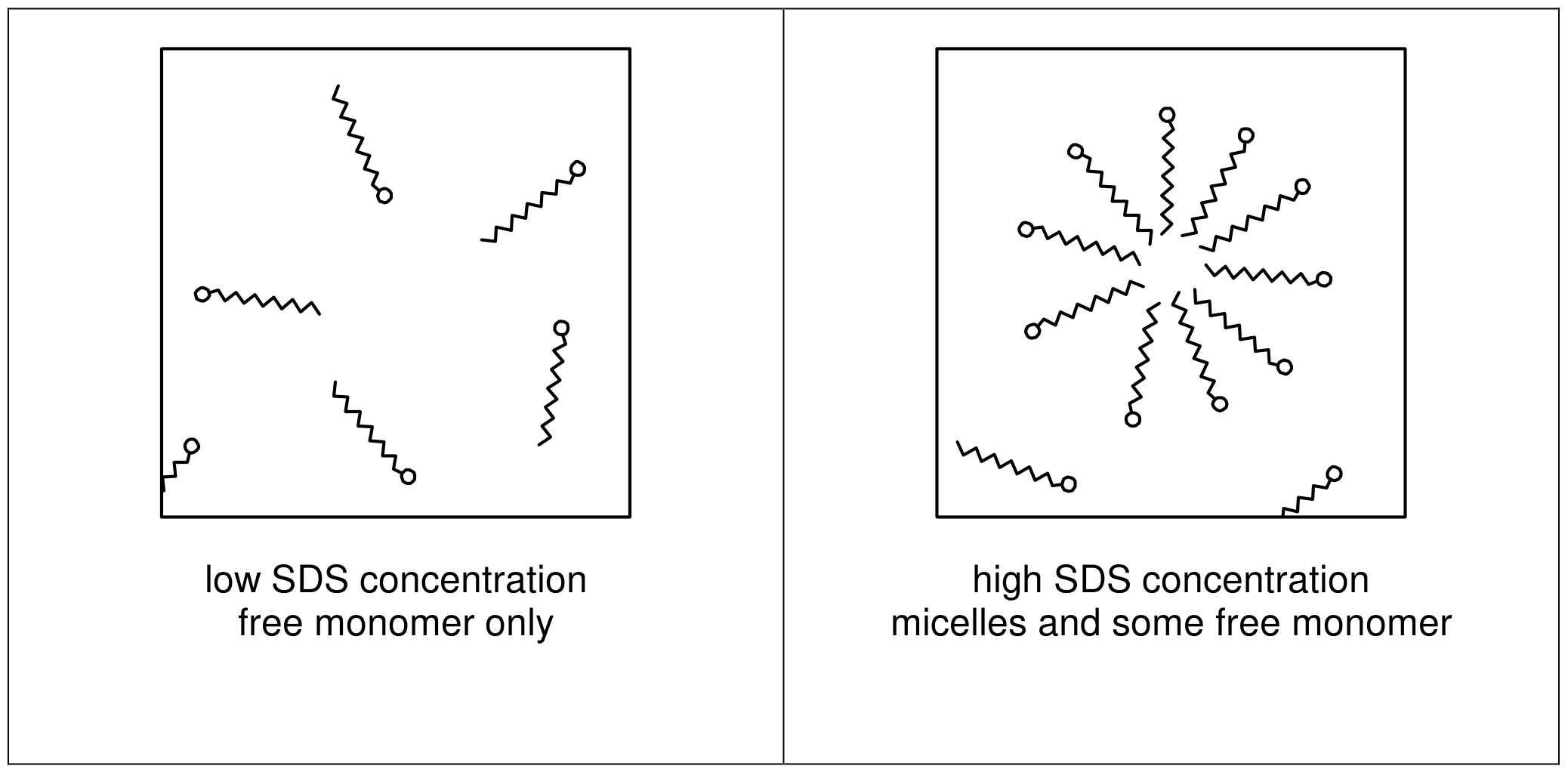
In this experiment, you will determine the critical micelle concentration of SDS by measuring the conductivity of different concentrations of SDS.
Chemicals
• Sodium dodecyl sulphate, (99%), approximately 4.3 g, accurately pre-weighed in vial labelled ‘SDS’.
- Conductivity solution ‘HI 70031’, 20 cm³ in pouch.
Procedure
(a) You are provided with approximately 4.3 g SDS, accurately pre-weighed in a vial, a 250 cm³ volumetric flask, a 50 cm³ burette, 50 cm³ bulb pipette, a conductivity meter, conductivity solution (used only for calibration), and a tall plastic vessel.
(b) You need to measure the conductivity (σ, in µS cm⁻¹) of various concentrations of aqueous SDS (c, up to 30 mmol dm⁻³). [Note: You may assume that all volumes are additive.]
3.1 Give the concentration of your stock SDS solution.
3.2 Use the table given in the answer booklet to record your results and plot a suitable graph to determine the critical micelle concentration (CMC) on the paper provided.
3.3 State the concentration at which micelles begin to form (the critical micelle concentration).
Notes
Solutions of SDS readily form bubbles if shaken.
The conductivity meter needs at least 50 cm³ of solution to be inside the plastic vessel in order to work correctly.
To calibrate the conductivity meter:
- Switch the meter on by pressing the ON/OFF button once.
- Press and hold the ON/OFF button again, this time for about 3 seconds, until you see the letters ‘CAL’ on the screen, indicating that the calibration mode has been entered. Let go of the ON/OFF button and ‘1413’ will start blinking on the display. To calibrate, carry out the next step immediately, before the meter has reverted back to reading ‘0’ on the screen (meaning you have exited the calibration mode)
- Immerse the probe in the pouch containing the ‘HI 70031’ calibration solution, without exceeding the maximum immersion level.
- Stir gently and wait for about 20 seconds to confirm the reading.
- Once the display stops blinking, the meter is calibrated and ready for use.
- Rinse the meter with distilled water and dry before making measurements.
- To record the reading:
- Switch the meter on by pressing the ON/OFF button.
- Immerse the probe in the sample without exceeding the maximum immersion level and being above the minimum immersion level.
- Stir gently and wait for the reading to stabilize. The meter automatically compensates for temperature variations.
- The conductivity value of the sample will be shown on the LCD.
Решение
3.1 Correct concentration with correct units is expected—full points. Correct concentration but with missing or incorrect units—½points.
Note
The evaluation of the graphs,constructed by competitors in this practical problem,differs from that used for grading especially titration results in the other practical problems. That is the reason why the evaluation in this particular case is given here more in detail.
3.2 Number and spread of data points
The graph should show two distinct gradients and the point at which the gradients change is the critical micelle concentration(CMC). The region where the concentrations are lower than the point at which the gradients change is referred to as“Region1”;“Region2”refers to the region where the concentrations are higher than this point. The gradient change will be taken from the data presented. If no gradient change is obvious the literature value of8.3mmol dm⁻³ will be used to distinguish between the two Sections.
Maximum marks are allotted if:
- a)in Region1at least three points are distributed with a spacing of approxCMC/(n+1)mmol(where n is the number of points).
- b)in Region2at least three points are distributed through a range of at least10mmol with a spacing of approxc/(n+1)mmol(where n is the number of points and c the concentration range andc≥10mmol dm⁻³).
Indicating gradients
Straight lines plotted through experimental points with different gradients and extended to identify crossing points are expected. Alternative graphs with marks allotted are shown below.
Accuracy of data
A transparent overlay will be used to judge the accuracy of the experimental measurements as plotted on the graph. If a systematic error in calculation can be determined from the table of data the graph will be re-plotted by the organisers for the purposes of this part of the marking. The overlay has a number of bands marked and the marking scheme has been devised to reward careful experimental technique. There is one set of bands for Region1and another for Region2. The bands are numbered from the innermost(band1)to the outermost(band5)(see Fig.3.1).
The maximum number of points for each band is shown in the following table:
| Band | 1 | 2 | 3 | 4 | 5 | Outside5 |
|---|---|---|---|---|---|---|
| Maximum number of points | 10 | 8 | 6 | 4 | 2 | 0 |
Alternative graphs with marks allotted
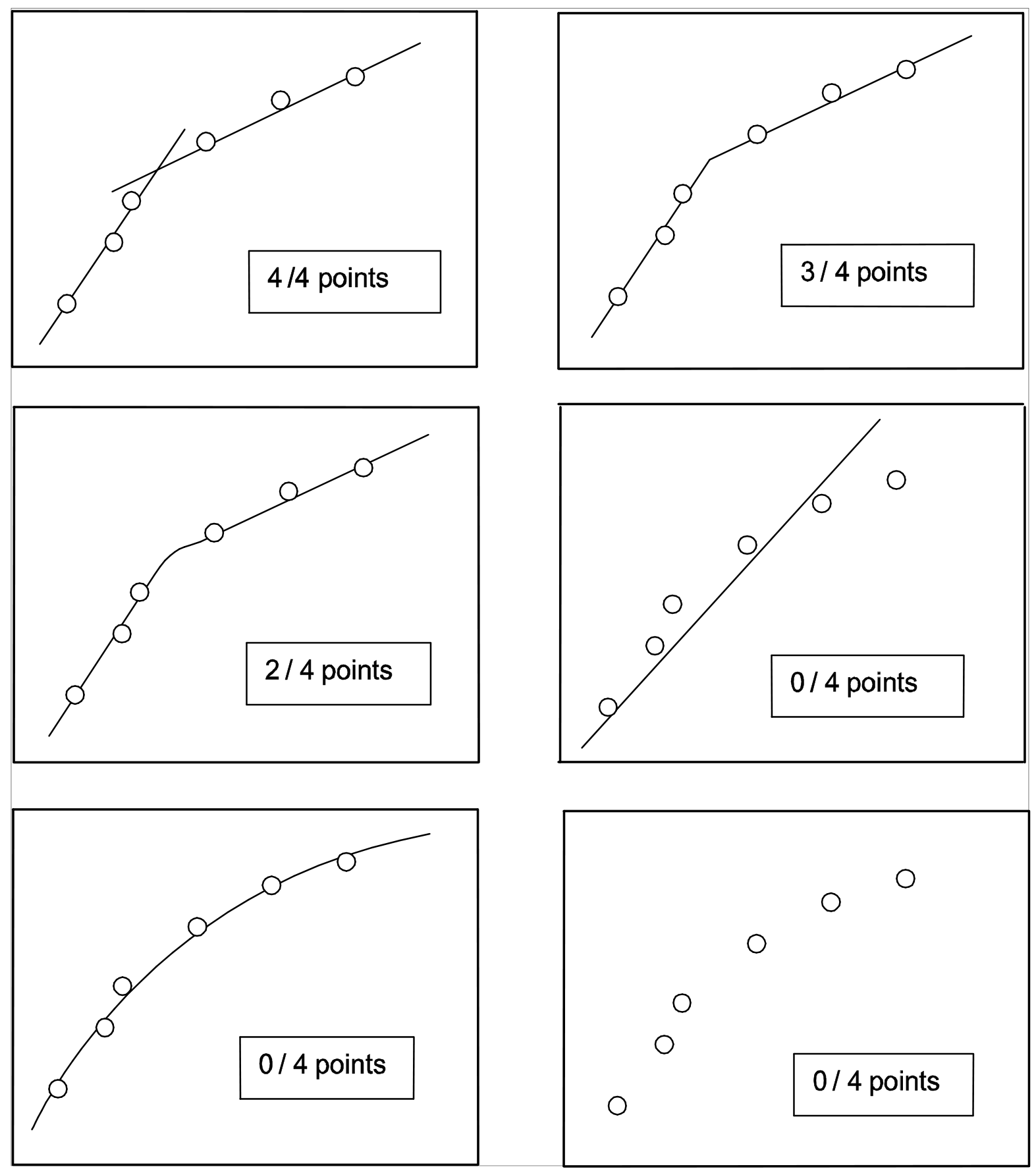
Points will be awarded as follows:
If there are three or more points in a Region and50%are in band m(where m is the number of the band)with none falling in band m+2or beyond,the full marks for band m are awarded.
If n,the number of points in the Region,is less than3,only(n/3)of the relevant band marks will be given(and rounded up to the nearest half-integer when necessary).
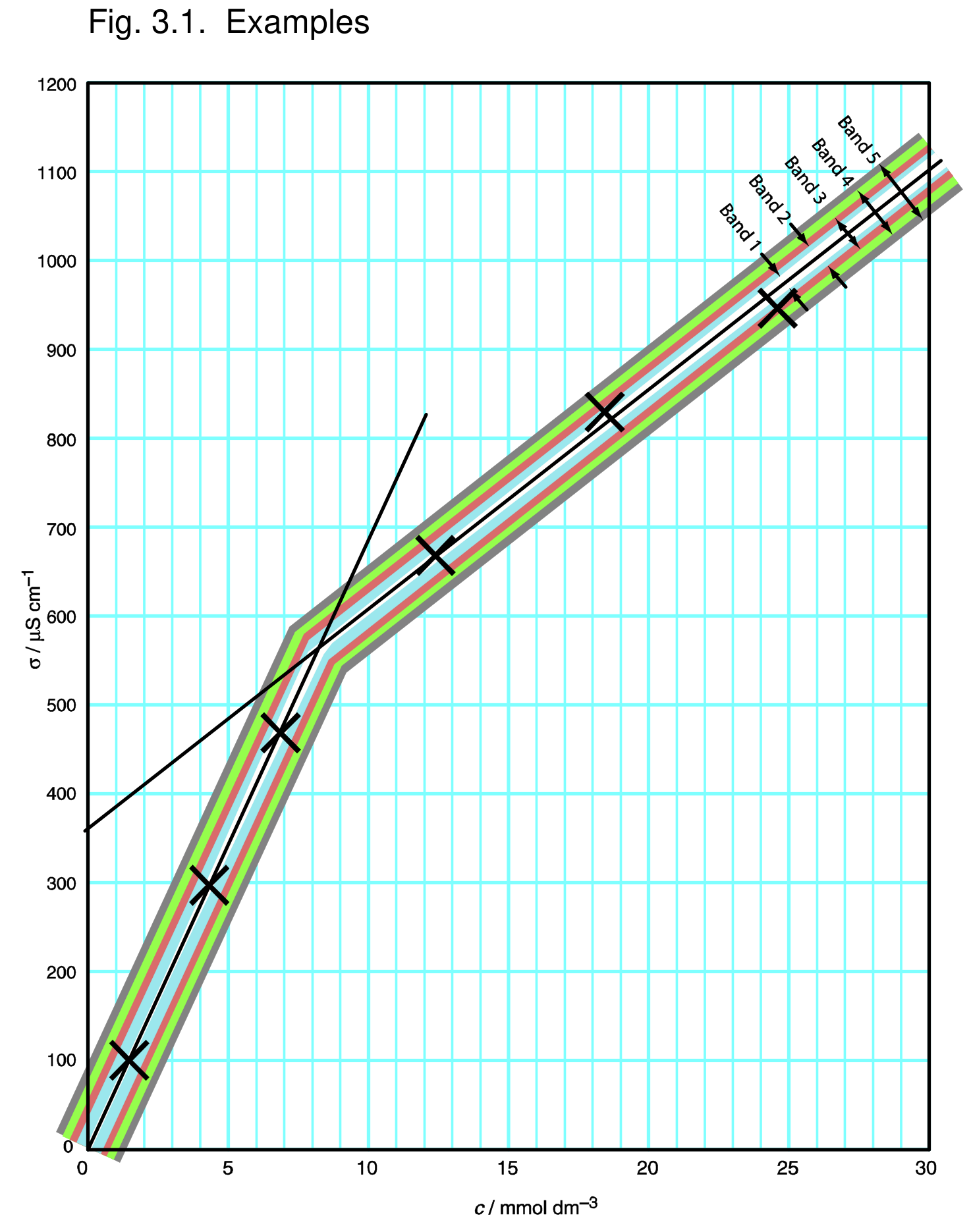
In Region1all of the datapoints lie in Band1(cross hatched)so10points scored for that Region.
In section2one of the three datapoints lies in Band1(not50%)but two lie in band2. The remaining point does not lie in Band4(m+2)so full8points are scored.
3.3 Correct concentration as read from graph with correct units is expected.
Source note: The spacing expressions with unitmmol and literature fallback8.3mmol dm⁻³ are retained as printed. This source supplies neither a completed competitor data table nor a fixed sample-dependent stock concentration or measured CMC.
Оригинал в Архива: IChO 41st-45th.pdf · решение от архива: IChO 41st-45th.pdf · допълнителни данни: IChO 41st-45th.pdf