IdPhO 2020, Теория — Задача 2. Anisotropic friction
Theory IdPhO 2020 Q2 — Anisotropic friction (10 points) · 10 т.
Условие
Force of friction is not always isotropic. Often the magnitude and direction of a friction force depend on the direction of body motion. For example, friction anisotropy can arise in the presence of "grooves" of a certain orientation on the contact surface of bodies (it is known that the coefficient of friction of oak against oak along and across the grain is equal to 0.48 and 0.34, respectively). Friction anisotropy can lead to unusual properties of motion which are studied in this problem.
What you need to know about anisotropic friction
Suppose that a surface is made of an anisotropic material. One of the most popular models of anisotropic friction suggests that there are perpendicular axes and (they are called primary) so that the friction force acting on a body will depend on the direction of the body motion as
where and are the friction force components, is a normal reaction force acting on the body, and are components of the velocity vector , and and are the friction coefficients along the primary axes.
Hereinafter, it is understood that the coordinate axes on the plane coincide with the primary axes. The friction coefficients are and unless otherwise stated.
In parts A and B a body can be considered as point-like. The plane, on which the bodies move, is horizontal in all parts of the problem.
Provide a numerical answer wherever possible.
Part A. Motion on a horizontal surface (4.0 points)
A.1 At what angle to the axis should the body velocity vector be for the absolute value of the power of the friction force be at maximum? [0,5 т.]
A.2 At what angle to the axis should the body velocity vector be for the absolute value of the power of the friction force be 1.2 times less than maximum? [0,5 т.]
A.3 Let the initial velocity have components and . After some time the velocity component along the axis equals . What is the velocity magnitude at this moment? [1 т.]
A.4 Let the velocity be . At what angle to the axis should the velocity vector be for the radius of curvature of the trajectory be minimum? What is this radius equal to? The free fall acceleration is . [1 т.]
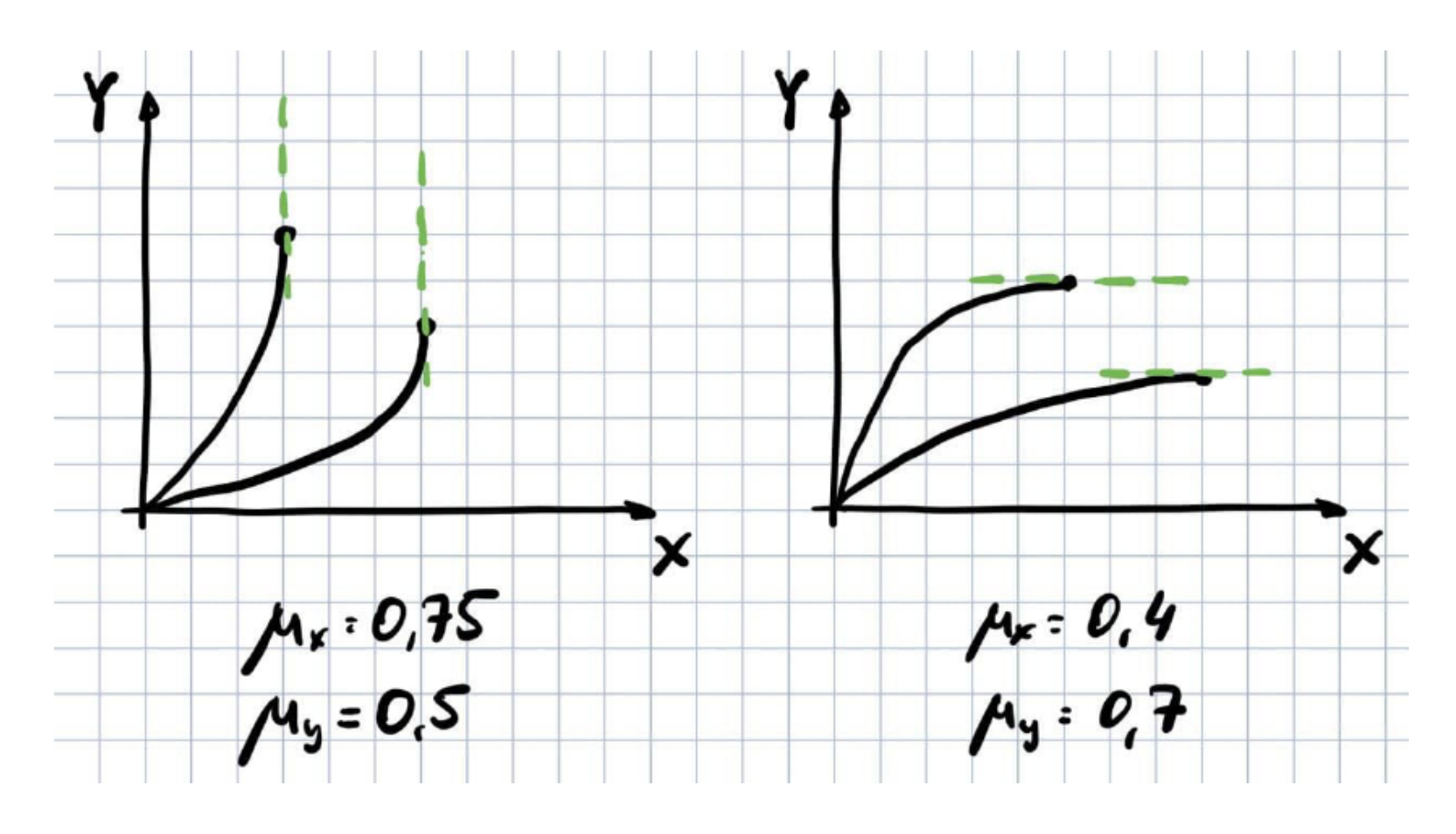
A.5 In a single diagram on the plane, sketch the trajectories of the body launched at the angles and for the friction coefficients specified above. The magnitudes of initial velocities are the same. Solve the same problem for the friction coefficients and . [1 т.]
Part B. Conditions for the beginning of body movement (2.0 points)
B.1 A body of mass is at rest at the origin. A force has been applied to it at an angle to the axis. The force magnitude linearly grows with time. Find the dependence of the moment the body starts moving on . Ignore the stagnation phenomenon. [2 т.]
Part C. Circular motion (4.0 points)
Two identical point-like masses are connected with a weightless inextensible rod of length , the system lies on a surface with anisotropic friction. The rod is aligned with the axis and does not touch the surface. One of the masses is given an initial velocity perpendicular to the rod.
C.1 For a given initial velocity find the dependence of its velocity on the angle of rotation of the rod assuming that the other body remains at rest. [1,5 т.]
C.2 Find the maximum value of the initial velocity at which the other body will remain at rest. [1,5 т.]
C.3 What distance will the body travel until it stops completely if the initial velocity is ? [1 т.]
Отговори
- A.1
- A.2
- A.3 0.28 m/s
- A.4
- A.5 Sketch: for μx > μy the trajectories bend towards the Y direction; for μx < μy they bend towards the X direction (see the solution figure).
- B.1
- C.1
- C.2 ≈ m/s
- C.3 0.34 m
Решение
A1 (0.50)
Power of the friction force is given by the equation:
since , then maximum of the power is reached when
Ответ:
A2 (0.50)
From the previous point it follows that:
From where we get:
Ответ:
A3 (1.00)
Newton's equation:
Dividing one equation by another, we get:
Integrating these equations, we obtain:
From the initial conditions we find:
So the absolute value of velocity is
Ответ:
A4 (1.00)
Projection of the friction force onto the direction perpendicular to the velocity is given by equation:
Newton's second law projected onto the direction perpendicular to the velocity has the form:
where is the radius of curvature of the trajectory. It's obvious that
The minimum radius of curvature will be when:
Ответ:
and
A5 (1.00)
If , then the accelerations along the x and y axes will be proportional to the ratio of the initial velocities and the body will move in a straight line. If , then the speed along the x-axis will decrease faster than in the previous case and the body will deviate from a linear motion as shown in the figure. The direction of deflection does not depend on how the initial velocity is directed. If , then the body will deviate in the opposite direction.
Ответ:
B1 (2.00)
Let us notice that the body will start the motion with the angle . Then projections of the forces at this moment are given by
Dividing these equations by and correspondingly and summing up squares, we get
So the answer is
Ответ:
C1 (1.50)
Newton's law projected onto the direction of motion of a point-like mass is:
Since , then:
Multiply this equation by we get
Integrating this equation, we obtain:
Ответ:
C2 (1.50)
Newton's law for a moving body in projection onto a rod has the form:
where is the angle between frictional force and direction of velocity.
Using the result from C1, we find that:
Using the result from B1, we find that:
Note that with increasing , the left hand side decreases, and the right hand side increases, so the body starts to move right at . So
Ответ:
C3 (1.00)
Substituting from the previous section in the final equation of the C1, we get the equation for the at the stopping point :
Numerically solving this equation, we get the answer for the , and so the travelled distance is equal to
Ответ:
Оригинал в Архива: IPhO_2020_Q2.pdf · официални решения: IPhO_2020_S2.pdf