IdPhO 2020, Теория — Задача 3. Laser technologies
Theory — IdPhO 2020 — Q3 — English (Official) — Laser technologies (10 points) · 10 т.
Условие
When solving the problem, use the following values of the physical constants:
the speed of light in vacuum m/s;
Planck's constant J s;
constant in Coulomb's law and electric constant ;
elementary charge C.
Part A. Classical superradiance model
A laser is a source of coherent optical radiation. Laser radiation is generated when a large number of atoms transferred to an excited state by external action (pumping) emit photons with the same phase and polarization. A consistent theory of laser radiation is based on quantum mechanics but some aspects of this phenomenon can be understood by means of classical electrodynamics.
Let us first consider emission of a photon by a single atom. According to classical electrodynamics, an atom can be regarded as dipole emitter. In this model an electric dipole is associated with an atom comprised of an immobile atomic nucleus with a positive charge and a negative charge oscillating harmonically around it (the negative charge is located at the center of the charge distribution of electron cloud).
Here the atomic dipole moment oscillates according to the law . The cyclic oscillation frequency is related to the energy of emitted photons by the Planck relation . Hereinafter the frequency of photons means cyclic frequency. The radiation power of a classical system with a variable dipole moment is given by the formula
where the angle brackets stand for the averaging over the oscillation period.
A.1 An atom emits light with a wavelength nm. Using the classical model estimate an emission time (that is, the period of time it takes the atom to emit the energy equal to that of a single photon). This time coincides with the characteristic time, during which the atom emits a photon, by the order of magnitude. All radiation is due to a single electron located at a distance about nm from the nucleus. Express your answer in terms of the physical constants, , and . [1 т.]
Suppose atoms in a certain volume are transferred to an excited state by a short-term pumping action. It is known that one atom emits a photon with a frequency for a characteristic time .
A.2 Estimate the power of electromagnetic radiation of all atoms in the spontaneous emission mode, i.e. when the direction of atomic dipole and the phase of its oscillations randomly change from atom to atom. In your answer write down the formula for the power in terms of , and . [0,25 т.]
A.3 Estimate the duration of the spontaneous emission pulse of this system of atoms. Express your answer in terms of the same quantities. [0,25 т.]
A.4 Estimate the power of electromagnetic radiation of all atoms in the superradiance mode, i.e. when the direction of atomic dipoles and the phases of their oscillations are the same for all atoms in the excited state. Express your answer in terms of , and . [0,5 т.]
A.5 Estimate the duration of the radiation pulse of the system of atoms in the superradiance mode. Express your answer in terms of the same quantities. [0,25 т.]
Part B. Nonlinear optics and pulse compression
Pulses of even shorter duration can be obtained by reducing the duration of already generated laser pulses. A pulse duration and a dispersion of frequency of pulse oscillations (spectral width) are related by the inequality . Laser pulses generated in the superradiance mode already have the shortest possible duration for the given dispersion of frequencies, . Therefore, the pulse duration can be reduced in two steps: first, increase the spectral width of the pulse (without changing the duration) and second, compress the pulse in time.
One of the most common ways to solve the first problem is pulse chirping. This method is based on the use of nonlinearity of a medium, i.e. dependence of the refractive index of the medium on the amplitude of oscillations of the electric field of the wave. The dependence is of the form , where and are some constants specific for the medium. Nonlinear effects are small, e.g. in quartz at a light intensity W/cm the refractive index increases only by . The intensity of an electromagnetic wave in a medium is determined by the formula .
Consider a pulse of duration with a small dispersion of frequencies , the average pulse frequency is . An approximate dependence of the electric field on time in such a pulse is shown in the Figure. The speed of the wave maxima is the same at the pulse edges and in the central part it decreases due to the nonlinearity effects. Because of that the total pulse duration does not change, the frequency increases at the rear part of the pulse and decreases at the front. Such a pulse is called "chirped".
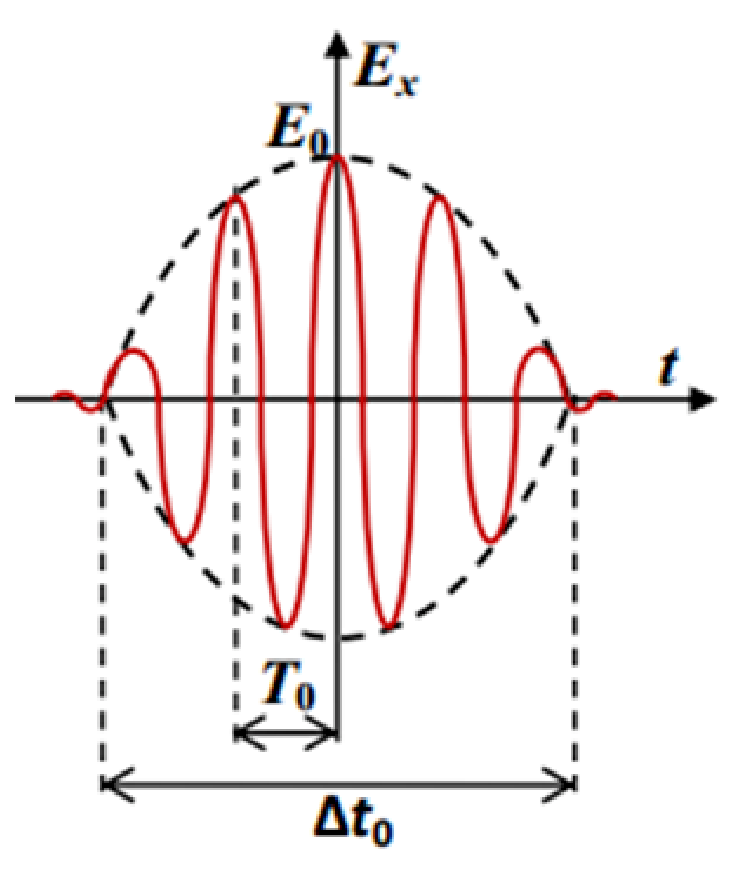
B.1 Let the amplitudes of two wave maxima be and . Find the difference in their propagation speeds . Express your answer in terms of , and . [0,5 т.]
B.2 A light pulse with a wavelength in vacuum of nm and a maximum intensity of W/cm propagates along the axis of a quartz fiber. Assume the envelope of a time dependence of the electric field squared of the wave to be a parabola. How far (find the distance ) does the pulse propagate along the fiber before its spectral width increases by the factor of ? Express your answer in terms of and calculate the numerical value (in meters, rounded to an integer). [2 т.]
To compress a chirped pulse in time one can pass it through a medium in which the group velocity of the wave depends on its frequency. For the medium under consideration, the dependence of wavenumber on frequency in the vicinity of the mean frequency can be represented as , where ns/m and fs/mm.
B.3 What sign should the constant have in order for the pulse chirped according to the scheme described above to be compressed in time in this medium? Please, indicate "+" or "-" in your answer. In what follows consider that has exactly this sign. [0,5 т.]
B.4 A pulse described in B2 has a duration ps and an initial spectral width (before chirping) and propagates in the medium described above. Find the distance the pulse should travel in order to achieve the minimum possible duration after chirping with spectrum broadening by the factor of . Express your answer in terms of physical constants, , and and calculate the numerical value in meters, rounded to an integer. [1 т.]
B.5 Nonlinearity of a medium leads to disappearance of diffraction of a light beam of sufficiently high intensity. Estimate the minimum power of a light pulse at which it does not experience diffraction, i.e. propagates inside a narrow cylindrical channel of constant radius. Express your answer for in terms of physical constants, frequency , , and . Assume the intensity distribution over the channel cross section to be approximately uniform. Find the numerical value of the power for a pulse with a wavelength in vacuum nm propagating in quartz. Coefficient . [1,5 т.]
Part C. Exoplanets
In astronomy observations of luminous objects are being made for long periods of time. This makes it possible to study variations of their emission spectra. Spectral measurements can detect planets orbiting distant stars -- "exoplanets". Exoplanets do not have their own radiation so one is bound to study radiation spectra of their stars. If the line of sight from Earth to an exoplanet lies almost in its orbital plane, such an exoplanet can be discovered by a decrease of the star brightness at a moment the exoplanet is crossing the star disk. However, if the orbital plane is tilted with respect to the direction to Earth this method does not work.
C.1 Propose a method that would allow one to detect an exoplanet with a noticeable inclination of its orbital plane with respect to the line of sight by means of studying the spectrum of its star in the optical range. As an answer name the physical phenomenon underlying your method. [1 т.]
C.2 Suppose an exoplanet of mass orbits a star of mass in a circular orbit of a radius and the period of revolution is . The orbital plane is at an angle to the direction to Earth. Estimate the accuracy of the relative frequency measurement, , required to detect such an exoplanet by your method. In your answer express in terms of the fundamental constants, , and . [1 т.]
C.3 Assume the mass of the exoplanet and its star to be equal to the mass of Earth and the Sun, respectively. Assume the radius of the circular orbit to be equal to the distance from Earth to the Sun (), the angle . The Solar mass is 330,000 times of the Earth's mass, the period of the Earth's revolution around the Sun is 1 year. Find an integer such that is the accuracy of relative frequency measurement required by your method. Usage of ultrashort (femtosecond) laser pulses makes it possible to measure frequencies in the optical range () with an accuracy of about 10 Hz. Is this accuracy enough to register the exoplanet? [0,25 т.]
Отговори
A.1
A.2
A.3
A.4
A.5
B.1
B.2
The official solution gives 7.8 m although the task asks for a value rounded to an integer.
B.3 β2 < 0 (sign "-")
B.4
B.5
C.1 Doppler effect
C.2
C.3 n = 10, exoplanet detection is possible.
Решение
A1 (1.00)
The power of radiation is
Here is the dipole moment amplitude which can be estimated as . Time of radiation is
Here we used the relation .
Ответ:
A2 (0.25)
System of the atoms' dipole moment is
The power of radiation is
We used and . All dipole moments have the same magnitude, are oriented randomly and their phases are not correlated. Therefore the second sum equals zero. The first sum consists of equal terms and te power is
For one atom we have
and thus
Ответ:
A3 (0.25)
The energy emitted by all atoms is . Hence the time of radiation is
Ответ: .
A4 (0.50)
In this case all dipole moments are oriented in the same direction and oscillate with the same phase . All terms in both sums in the expression for power in A2 are the same. The first sum has terms and the second has terms. The power is
Ответ:
A5 (0.25)
Emitted energy is the same as in A3. The time of radiation
Ответ: .
B1 (0.50)
Wave propagation speed is
So the speed difference is
Ответ:
B2 (2.00)
First approach.
The intensity is proportional to the square of electric field amplitude. Pulse envelope equation is
Here is a time when the center of the wavepacket crosses given point in space. Value of depends on the coordinate along the wave. Electric field in the wave is equal to , where the coordinate is measured along the direction of wave propagation, and the phase is
We neglect initial frequency difference because spectral width increases by hundreds of times. In this way, nonlinear effects lead to additional phase shift, proportional to the square of :
Angular frequency is the the rate of phase change with time. So quadratic phase shift leads to linear frequency shift
Spectral width of the pulse after propagating the distance in the medium is equal to the difference of frequencies at :
To obtain this formula we used . The ratio of spectral width at distance and initial spectral width is
Therefore the required distance is
To calculate the numerical value of , one should remember that the peak pulse intensity value is three times higher than the one mentioned in the problem description. Thus the value of is three times higher: .
Second approach.
Let us consider the propagation of two adjacent electric field maxima. Due to nonlinearity this maxima move with slightly different speed:
For the given pulse duration and mean frequency it consists of oscillations. The electric field maxima can be enumerated from to . Then the amplitude of electric field maximum with number is (the maximum with large number arrives at a given point later):
Consequently, the speed difference between adjacent maxima with numbers and equals
Initial frequency is equal . After propagation over distance the frequency of the maximum with number is:
Frequency linearly depends on the maximum number. The maximal frequency difference is between the first and the last maxima and equals
Hence ( and )
and the answer is the same.
Ответ:
B3 (0.50)
To squeeze the chirping pulse, the relatively high-frequency tail of the pulse should propagate faster than its low-frequency 'head'. This is called 'anomalous dispersion'. Speed of the wave propagation is the group velocity
Anomalous dispersion (larger group speed at larger frequencies) is observed for .
Ответ: .
B4 (1.00)
Since the term associated with is much less in absolute value than for the given range of frequencies, we can use approximate expression for the group velocity
The length of the chirping pulse that just has entered into the considered medium is . The difference in group velocity of the 'tail' and the 'head' is
The time in which the 'tail' will catch up with the 'head' up ( which corresponds to the minimal duration of the pulse) is
Since in this period of time the pulse will pass the distance
Ответ:
B5 (1.50)
Let be radius of the channel. Diffraction divergence angle of the beam can be estimated as
However, due to nonlinearity, the refractive index inside the channel is larger than refractive index outside of it. The beam deflecting from the channel's axis due to diffraction will not get out of it if its angle of incidence will be greater than the angle of total internal reflection . So the critical power corresponds to the condition .
Since
we have the following condition
Corresponding value of the intensity is
Finally, 'critical' power is
and does not depend on the channel diameter.
The numerical value of the power for the pulse of wavelength in a vacuum is equal to
Comment: The expression for the diffraction divergence of the circular beam is approximate. Therefore, it is possible to use alternative estimations, for instance , or .
Ответ:
C1 (1.00)
The most natural way is to detect the Doppler shift of some element (e.g. hydrogen) spectral line. The shift is caused by the star rotation with respect to the star-exoplanet system barycenter. This shift should be observed with the exoplanet rotation period.
Ответ: Doppler effect
C2 (1.00)
Planet's orbital motion velocity is . The corresponding velocity of the star is . The Doppler effect is sensitive to the velocity sightline component only (the nonrelativistic case is considered). Its maximum value is . Thus the relative frequency shift is
Ответ:
C3 (0.25)
Even for the star velocity sightline component is at most half . In order to estimate this component, one could assume the exoplanet orbit is circular. Since the same assumption is valid for the Earth's orbit, the maximal sightline projection is
The corresponding frequency shift is of order . Thus, a frequency variation in the tenth significant figure should be detected once a year. The accuracy of an optical frequency comb is of order . So, exoplanet detection is quite possible.
This method is indeed applied in practice. However a number of difficulties had to be overcome to actually use this technology. In fact, most of the stably generated femtosecond pulses have carrier frequencies outside the visible spectrum, in the microwave and infrared regions. In order to use the method in visible spectrum, a different nonlinear phenomenon should be used -- higher harmonic generation in nonlinear medium. Moreover, to increase the spectral device resolution, frequency filtering should be used which increases the narrow frequency intervals between the lines.
Ответ: , exoplanet detection is possible.
Оригинал в Архива: IPhO_2020_Q3.pdf · официални решения: IPhO_2020_S3.pdf