iGeo 2006, Писмен тест — Задача 2. The dynamics of population: migration
Questions — 6th International Geography Olympiad — Brisbane — June 2006 · 19 т.
Внимание: Бележка към темата
The Sources booklet and the worksheets (1–4) referred to in the questions and in the marking scheme are not part of this archive file.
Instructions for the students
- This test consists of five sections.
| 1 | Climate | 18 marks |
| 2 | The dynamics of population: migration | 19 marks |
| 3 | Volcano ‘Merapi’ | 15 marks |
| 4 | Economic activity and the business world | 18 marks |
| 5 | Fresh water in the Middle East | 20 marks |
The total of all marks is 90
Give only the required number of answers (reasons, examples et cetera). For instance, if the question asks for two reasons and you give more than two, only the first two reasons will be marked.
Answer all questions on your answer sheets or worksheets. Use a new answer sheet for each sections (1 - 5).
Write your name and country on each of the five answer sheets and the four worksheets.
The Sources booklet contains the maps and figures referred to in the questions.
Time available: 150 minutes. Non-native speakers of English are allowed an additional 30 minutes.
Non-native speakers of English are allowed to use dictionaries: English - native language and native language - English.
Success!
Marking scheme - overview
| 1 Climate | 2 The dynamics of population: migration | 3 Volcano Merapi | 4 Economic activity, the business world and Global Shift | 5 Fresh water in the Middle East |
|---|---|---|---|---|
| 1a (1m) | 1a (2m) | 1a (1m) | 1 (2m) | 1a (1m) |
| 1b (2m) | 1b (3m) | 1b (1m) | 2 (2m) | 1b (2m) |
| 2a (1m) | 1c (2m) | 2 (2m) | 3 (3m) | 2a (2m) |
| 2b (3m) | 1d (4m) | 3a (1m) | 4a( 3m) | 2b (2m) |
| 3a (2m) | 2a (2m) | 3b (1m) | 4b (3m) | 3a (1m) |
| 3b (1m) | 2b (2m) | 3c (1m) | 5a (3m) | 3b (1m) |
| 4 (2m) | 2c (2m) | 3d (1m | 5b (2m) | 4 (4m) |
| 5 (2m) | 3 (2m) | 4 (1m) | 5a (2m) | |
| 6 (2m) | 5 (2m) | 5b (3m) | ||
| 7 (2m) | 6a (3m) | 6 (2m) | ||
| 6b (1m) | ||||
| 18 marks | 19 marks | 15 marks | 18 marks | 20 marks |
Условие
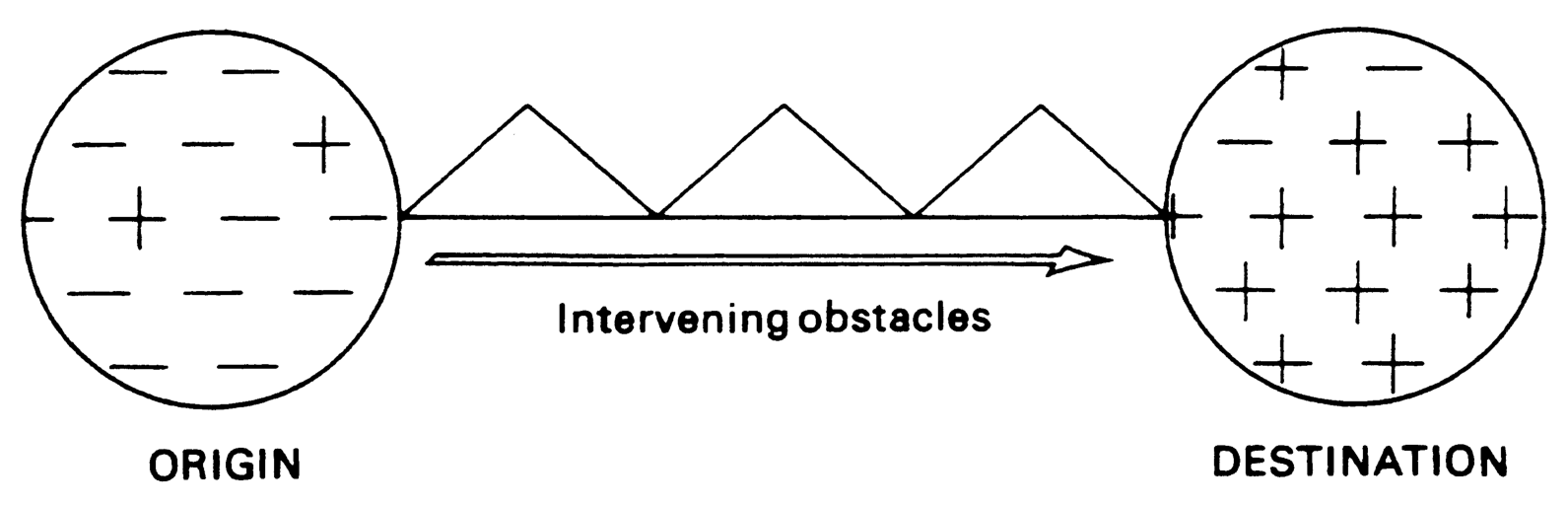
The figure above is a schematic representation of Lee’s model of The Decision to Migrate (1966).
1a What is the significance of the plus and minus signs in the circles symbolising regions of origin and destination of migrants? (2m) [2 т.]
1b Name three (3) factors that might be regarded as ‘intervening obstacles’. (3m) [3 т.]
1c With reference to the model above, describe two (2) reasons why a person would choose NOT to migrate. (2m) [2 т.]
1d Using the terms used in the model, outline the major differences between PUSH and PULL migration. (4m) [4 т.]
Refer to the source in Section 2 of the booklet.
This figure shows a population structure greatly influenced by migration. Some towns or regions within countries of the more economically developed world have this type of population structure.
2a Name two (2) factors other than age, that make migration a selective process. (2m) [2 т.]
2b Does this population structure belong to a town or region with a positive balance of migration or with a negative balance of migration?
Explain your choice. (2m) [2 т.]
2c If the population structure shown in the source resulted from a positive balance of migration, name two (2) possible economic benefits for this town or region. (2m) [2 т.]
3 Name two (2) disadvantages that migrants might experience in their new country. (2m) [2 т.]
Решение
1a (2m) + indicate factors that stimulates migration. (1m)
- indicate factors that restrict migration. (1m)
1b (3m) Three of the following:
- high costs of travel
- restrictions to enter countries legally
- physical barriers
1c (2m)
The example should indicate a negative balance between positive factors (+) on the one side and negative factors (-) and intervening obstacles on the other side.
1d (4m)
PULL: when positive factors outweigh the negative factors in the region of destination.
PUSH: when negative factors outweigh the positive factors in the region of origin.
2a (2m) Two of the following factors
- sex
- level of education
- marital status
- level of income
- ……
2b (2m) One of the following:
Choice for negative: man and woman in the reproductive age are moving out (small age group for 0 to 10)
Choice for positive: elderly people are moving in because of certain advantages of the town or region (special communities for elderly people, favourable climate, special low taxes)
2c (2m)
- Elderly migrants have more money to spend. (1m)
- Lower costs for education (1m)
3 (2m) Two of the following:
- language problems
- segregation
- lower wages
- discrimination
- …
Total = 19 marks
Оригинал в Архива: 2006IGEOQuestions.doc · официални решения: 2006IGEOMarkingscheme.doc